



Materials & Surface Integrity
Material response determines whether a shot peening route is beneficial and acceptable. These guides connect alloy and heat-treatment condition with residual stress, hardness, roughness, surface damage, corrosion behaviour, fatigue performance and the effects of later machining, cleaning, coating or temperature exposure.
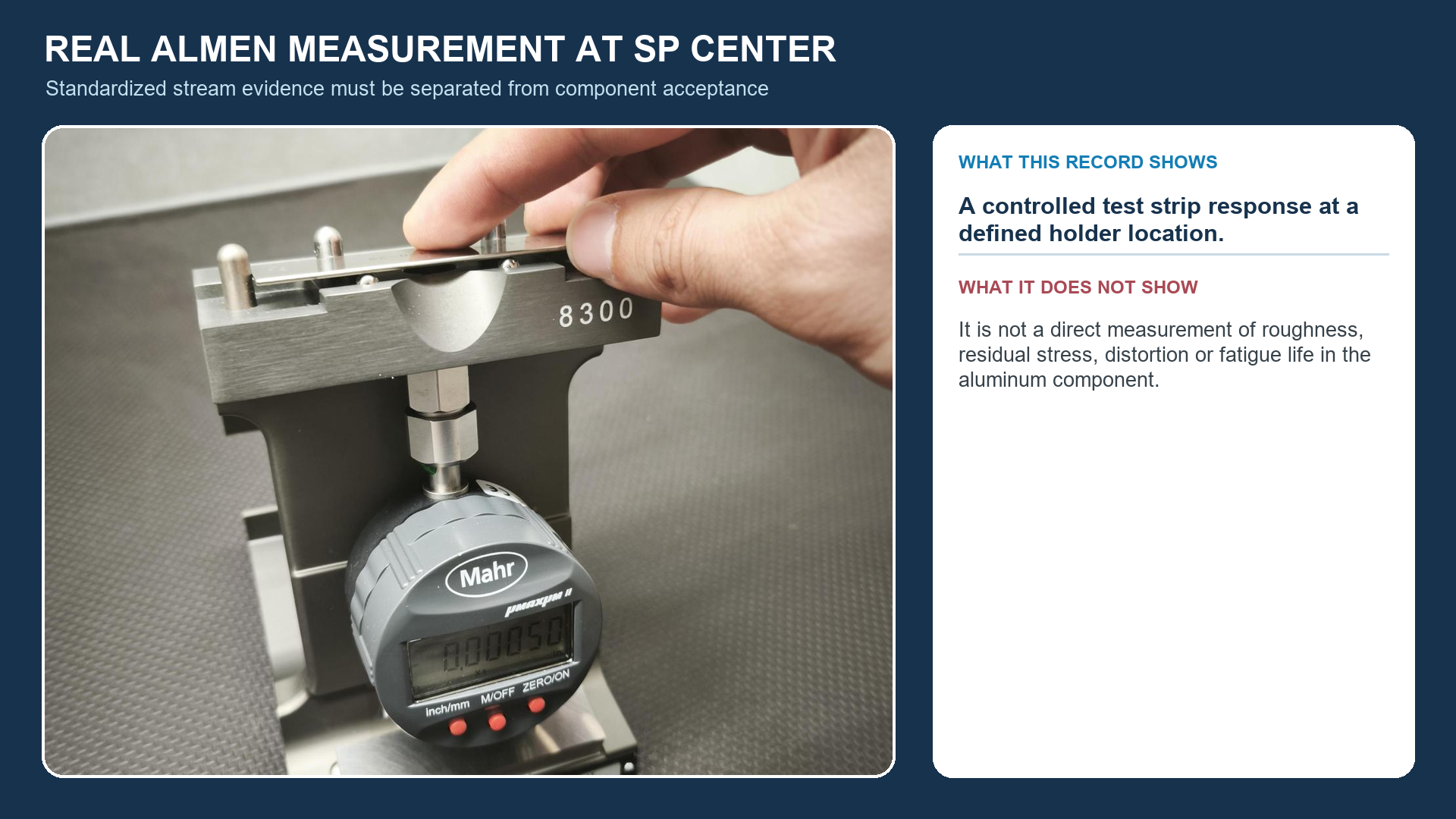
Aluminum Shot Peening: Alloy, Surface Integrity and Process Control
Learn how alloy and temper, surface integrity, geometry, media, intensity, coverage, manufacturing sequence and acceptance evidence define a qualified aluminum shot peening process.
-
Can Every Metal Be Shot Peened? Limits for Brittle Materials
Not every metal condition is suitable for shot peening. Learn how brittleness, hard layers, porosity, coatings, damage and geometry determine qualification or rejection.
-
Compressive Residual Stress After Shot Peening: Formation, Depth and Stability
Understand compressive residual stress after shot peening as a directional depth profile shaped by material, geometry, process and later thermal or mechanical exposure.
-
Hardness and Microhardness After Shot Peening: What Should Be Measured?
Choose bulk hardness or a cross-sectional microhardness profile after shot peening and control indenter, force, preparation, spacing, uncertainty and interpretation against residual stress.
How Shot Peening Improves Fatigue Life: Mechanisms, Limits and Validation
Learn how residual compression, cold work and surface topography influence fatigue, why no universal life multiplier exists and how component performance is validated.
-
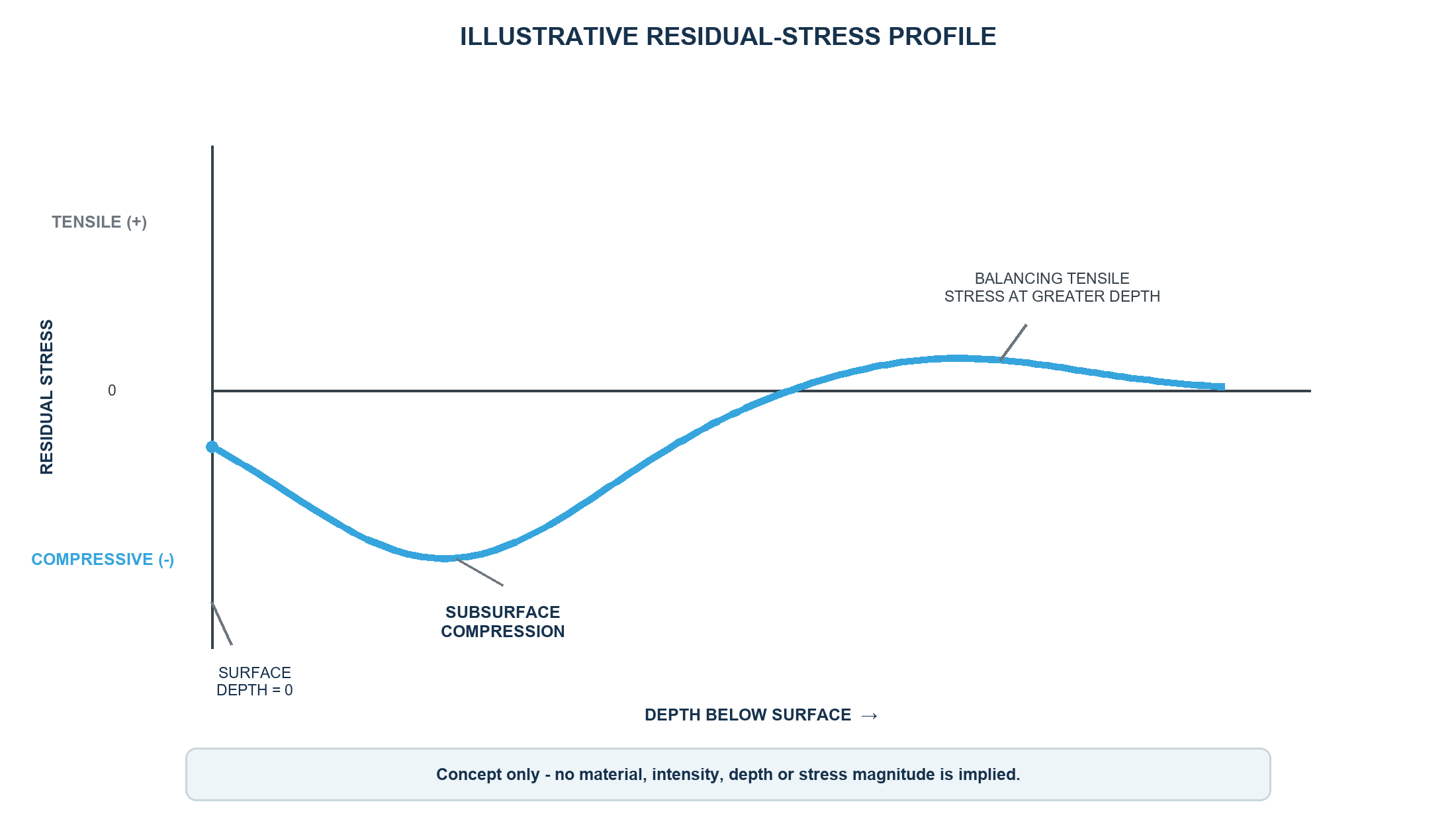
Residual-Stress Depth Profile After Shot Peening: How to Read the Curve
Read residual-stress profiles through sign, surface value, maximum compression, depth and zero crossing while controlling direction, layer removal, correction and uncertainty.
-
Shot Peening Additively Manufactured Metal Parts: Roughness, Porosity and Fatigue
Shot peening AM metal parts requires traceable build orientation, heat treatment, surface condition, defect baseline, feature access and separate roughness and fatigue evidence.
-
Shot Peening and Hydrogen Embrittlement: Limits, Plating Sequence and Evidence
Shot peening does not remove hydrogen or replace relief baking. Control material susceptibility, hydrogen sources, tensile stress, plating chronology, tests and rework authority.
-
Shot Peening and Stress Corrosion Cracking: When Compressive Stress Helps
Understand when shot peening can support SCC control, which evidence belongs to process verification, surface acceptance and component validation, and why alloy-environment susceptibility remains decisive.
-
Shot Peening Before or After Coating? How to Control the Process Sequence
Choose shot peening and coating order from the substrate, coating stack, preparation, temperature, contamination, masking and rework requirements – not a universal rule.
-
Shot Peening Carburized Steel: Case Integrity, Gear Zones and Fatigue
Qualify carburized-steel shot peening through case depth, hardness gradient, microstructure, root and flank functions, finishing sequence, surface limits and fatigue evidence.
-
Shot Peening Hardened Tool Steels: Capabilities, Damage Risks and Qualification
Qualify hardened tool-steel peening through grade, temper, hardness and toughness, carbide and EDM condition, edge protection, damage limits and service-temperature evidence.
-
Shot Peening Nickel-Base Superalloys: High-Temperature Qualification and Process Control
Qualify shot peening for nickel-base superalloys through alloy and condition, feature geometry, media, manufacturing sequence, residual-stress retention and representative thermal-mechanical evidence.
-
Shot Peening Nitrided Steel: Process Sequence, Layer Risks and Qualification
Qualify shot peening of nitrided steel by separating compound layer, diffusion zone and core, then controlling sequence, media, intensity, coverage, microdamage and case evidence.
-
Shot Peening of Stainless Steel: Surface Integrity and Contamination Control
Shot peening stainless steel requires two coordinated controls: qualify the mechanical response and preserve the specified corrosion-relevant surface condition. Manage alloy state, media, equipment history, foreign iron, handling and any authorised cleaning or passivation.
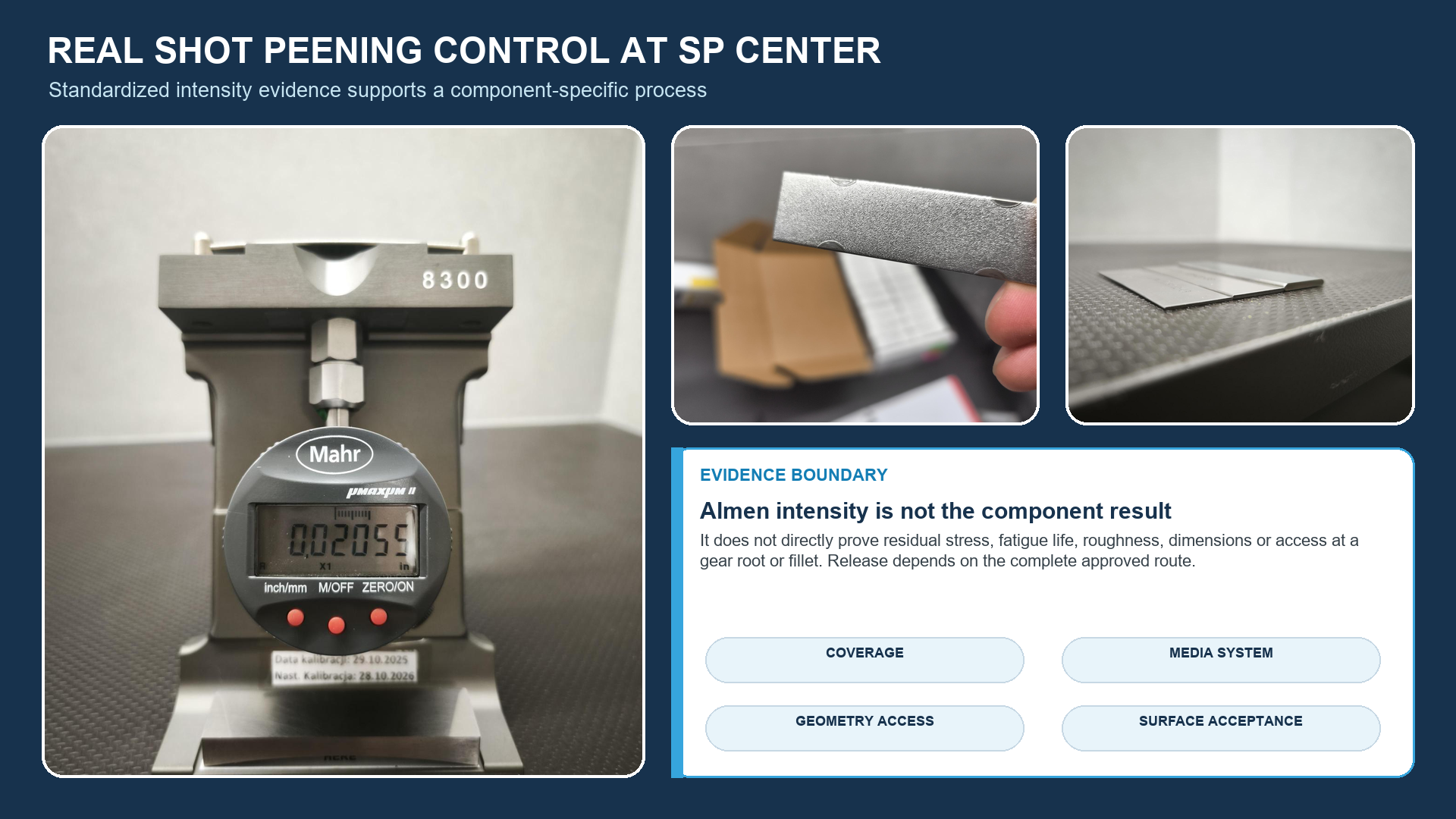
Shot Peening of Steel Components: Material, Surface and Process Control
Learn how steel grade, heat treatment, hardness, case condition, geometry, media, Almen intensity, coverage, sequence, qualification and surface acceptance define a defensible shot peening route.
-
Shot Peening Spring Steel: Parameters, Surface Integrity and Fatigue Validation
Control shot peening of spring steel through material condition, decarburization, media, intensity, coverage, stress peening, thermal sequence and representative fatigue evidence.
-
Shot Peening Welded Joints: Weld-Toe Control, Limits and Fatigue Validation
Shot peening can modify the weld-toe residual-stress state but cannot repair cracks or fusion defects. Control weld acceptance, toe coverage, surface integrity and fatigue evidence.
-
Surface Defects Before Shot Peening: Damage, Inspection and Repair Limits
Shot peening cannot repair cracks, laps, grinding burn, deep pits or unacceptable weld and heat-treatment defects. Accept or formally disposition the surface before processing.
-
Surface Roughness After Shot Peening: Predicting and Controlling Ra and Rz
Ra and Rz after shot peening depend on incoming texture, material, media, impact geometry and exposure. Build a local model and keep measurement conditions fixed.
-
Titanium Shot Peening: Alloy, Surface Integrity and Process Qualification
Titanium shot peening requires component-specific development. Control alloy and condition, thin and critical geometry, approved media, contamination, Almen intensity, coverage, exposure, surface integrity, cleaning and change control—without transferring a steel recipe by assumption.
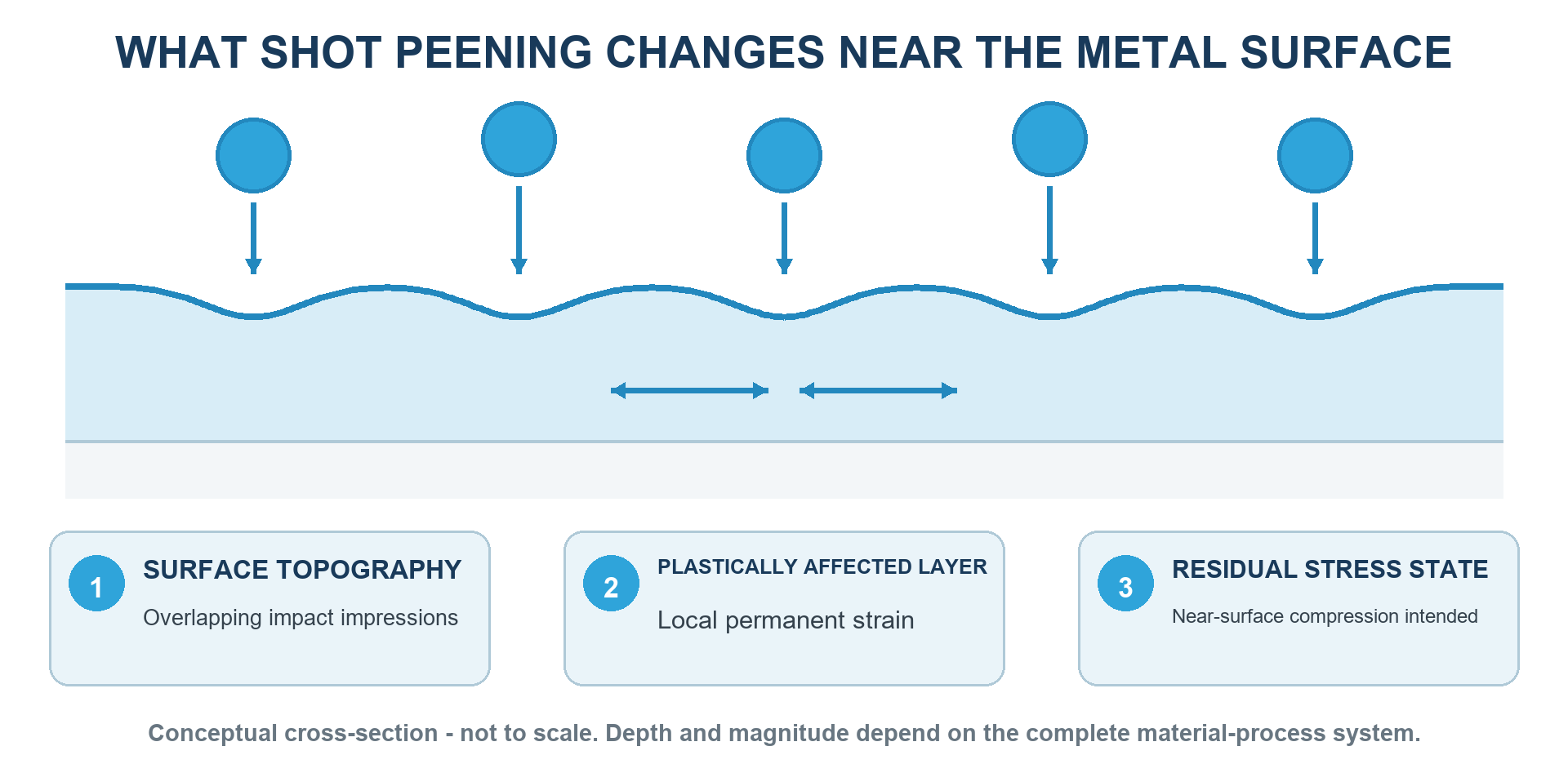
What Does Shot Peening Do to a Metal Surface?
Shot peening creates overlapping plastic impacts, a cold-worked layer and compressive residual stress while changing topography, roughness, dimensions and surface-acceptance needs.
-
When Not to Use Shot Peening: Material, Geometry and Process Limits
Do not use shot peening when authority is missing or mandatory access, inspection, surface, dimensional or final-route requirements cannot be met; qualify conditional material and geometry risks.
-
XRD Residual Stress Measurement After Shot Peening: Method, Depth Profiles and Reporting
Plan XRD residual-stress measurement after shot peening by defining material, location, direction, diffraction method, elastic constants, uncertainty and any layer-removal correction.