


Choose the sequence from substrate, coating stack, preparation, temperature, contamination and rework requirements – not from a universal rule
Shot peening is commonly placed before a final coating because it must plastically affect the substrate and later impacts can damage many coating systems. The correct sequence is nevertheless specific to the material, coating stack, surface-preparation method, temperature, contamination limits, dimensions and governing specification. Peening after coating is a special route and should not be inferred without explicit authority and qualification.
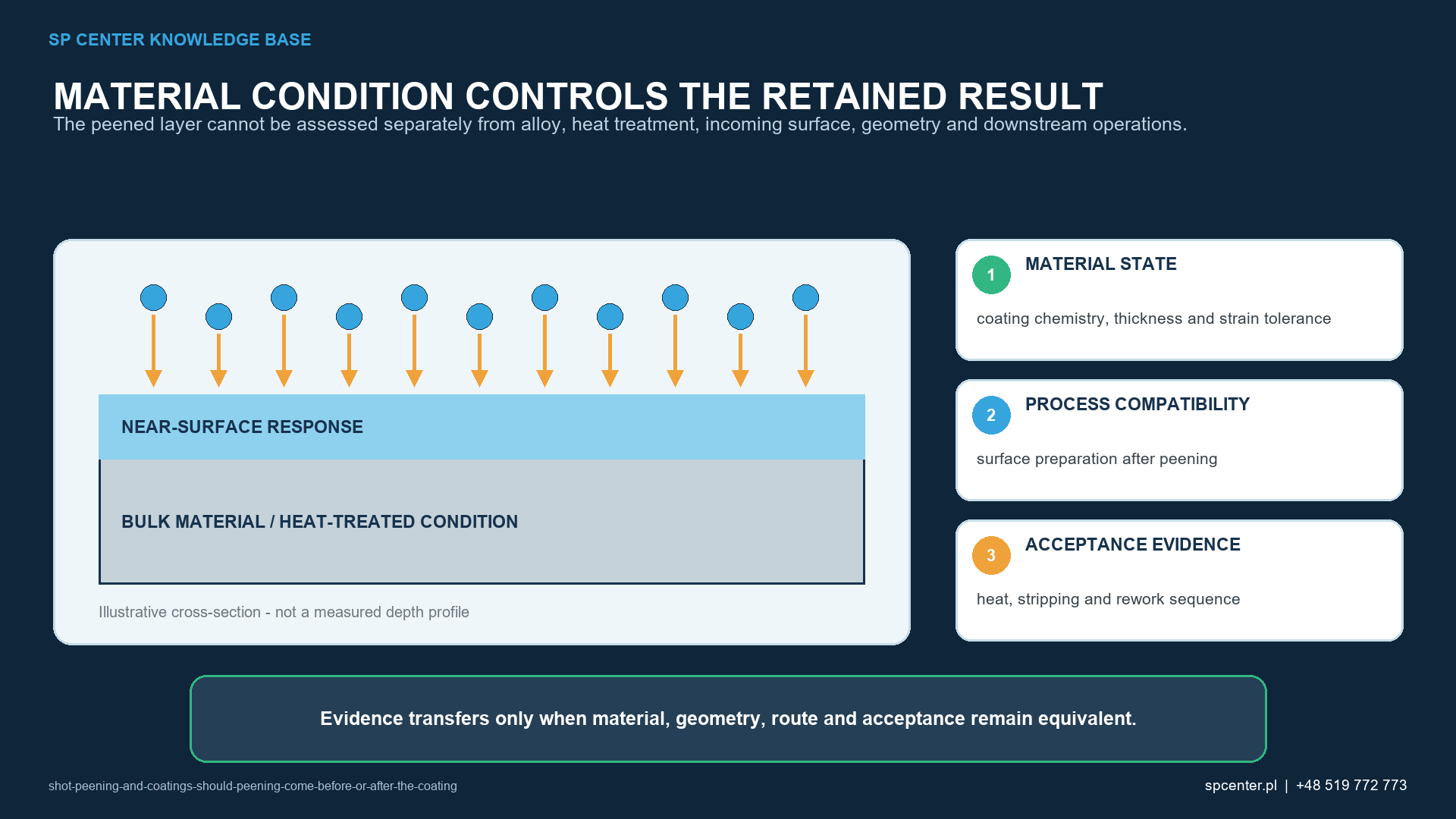
Why is there no universal before-or-after answer?
“Coating” can mean a paint, electroplate, anodic or conversion layer, thermal spray, PVD or CVD deposit, dry film, sealant or a multi-layer system. Their thickness, ductility, bond mechanism, deposition temperature and preparation needs differ. The substrate may also be steel, aluminium, titanium, nickel alloy or another material with different sensitivity to heat, chemistry and media transfer.
| Coating or route | Main sequence concern | Qualification question |
|---|---|---|
| Paint, polymer or dry-film system | Cleanliness, adhesion profile, masking and cure temperature | Does preparation and cure preserve the qualified peened substrate and meet coating acceptance? |
| Electroplated metallic coating | Chemical preparation, hydrogen risk for susceptible materials, thickness and post-treatment timing | Does the complete plating specification define peening, cleaning, bake and release sequence? |
| Anodic or conversion layer | Etching, dimensional change, sealing and corrosion requirements | Is the substrate condition after peening and pretreatment qualified for the required layer? |
| Thermal spray | Bond-coat preparation, aggressive profiling, heat input and coating build | Will surface preparation or temperature remove or relax the intended peening effect? |
| PVD, CVD or other hard coating | Deposition temperature, interface cleanliness and brittle response to later impact | Has the exact substrate and coating stack been qualified in the proposed order? |
| Coating strip and rework | Base-material removal, hydrogen or heat exposure, prior peening and cumulative reprocessing | Who authorizes restoration and what renewed inspections and qualification apply? |
Table 1. The coating family narrows the questions but does not replace its complete process specification.
The design authority and coating owner should resolve the sequence where requirements conflict. A supplier should not assume that general practice overrides a drawing, repair instruction, customer flow-down or approved coating process.
Why is peening before coating common?
Peening introduces plastic deformation and compressive residual stress into the substrate surface. Applying it before coating avoids directly impacting a brittle, thin or adhesion-sensitive deposited layer. The peened surface can then be cleaned and coated under a qualified route.
That common arrangement still needs control. Cleaning or abrasive profiling after peening may remove material or change roughness; chemical pretreatment can etch the surface; deposition or cure temperature can relax residual stress; and contamination transferred from peening media can affect adhesion, corrosion or coating chemistry.
When is peening after coating a special case?
Post-coating peening can indent, crack, chip or delaminate a coating, alter thickness, open porosity and contaminate the surface. It must therefore be treated as a distinct, explicitly approved process and qualified on the actual substrate and coating stack. A successful result on a ductile sacrificial layer does not justify transfer to a hard or brittle coating.
Do not use low visible damage as the only criterion. Adhesion, thickness, morphology, corrosion, wear and retained component performance may change even when the coating appears intact.
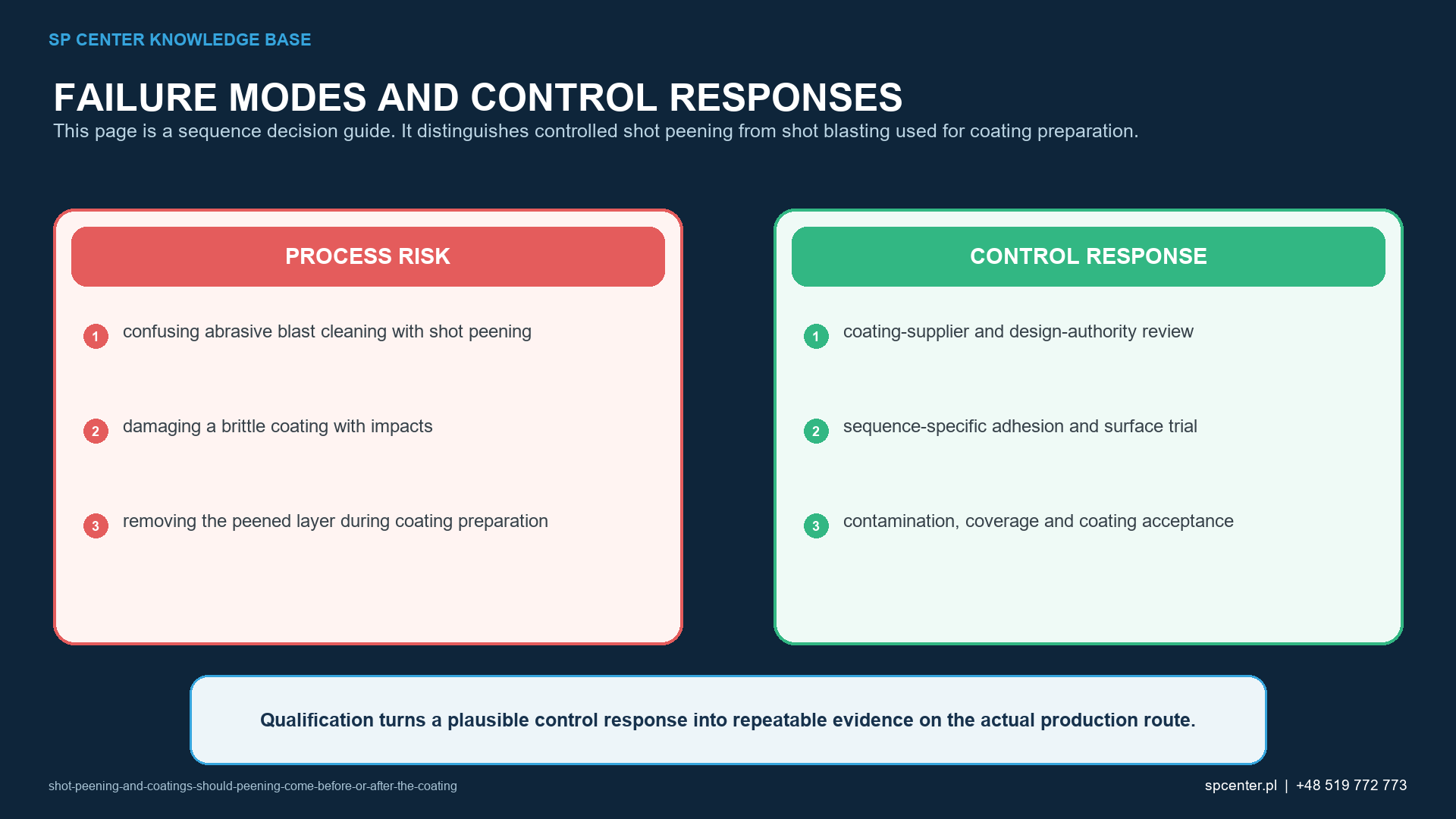
How are shot peening and abrasive blast cleaning separated?
Controlled shot peening is specified through media, intensity, coverage, exposure, equipment configuration and traceability to create a defined surface-enhancement process. Abrasive blast cleaning or profiling is specified to achieve a cleanliness and surface-profile condition for coating. One operation does not become the other because both propel particles.
If both are required, the route should state their order, media controls, contamination segregation, material-removal allowance and inspections. ASTM D4417 is limited to profile measurement of blast-cleaned steel surfaces; it is not a universal roughness method for every peened component or coating system.
Which evidence is required at each release gate?
| Evidence layer | Typical evidence | What it does not establish alone |
|---|---|---|
| Peening process | Media condition, valid saturation evidence, intensity, coverage and configuration records | Coating adhesion or retained performance after preparation and cure |
| Substrate before coating | Cleanliness, contamination, roughness or profile, dimensions and defined surface condition | Correct peening intensity or coating durability |
| Coating acceptance | Material identity, thickness, adhesion or bond test, appearance, porosity and cure as invoked | Residual-stress depth or fatigue life of the coated component |
| Component performance | Corrosion, residual stress, fatigue, wear or functional testing where required | Automatic transfer to another coating stack, geometry or service |
| Traceability and disposition | Linked lots, route revisions, process records, nonconformance and approved rework | Technical suitability without the underlying qualified evidence |
Table 2. A coating certificate cannot replace the peening record, and the peening record cannot release the coating.
Coating tests must match the coating type and invoked requirement. ASTM D3359, for example, addresses tape-test ratings for relatively ductile coating films on metallic substrates and is limited in the adhesion levels it can distinguish. It should not be named as a universal adhesion test for every hard, thick or multilayer coating.
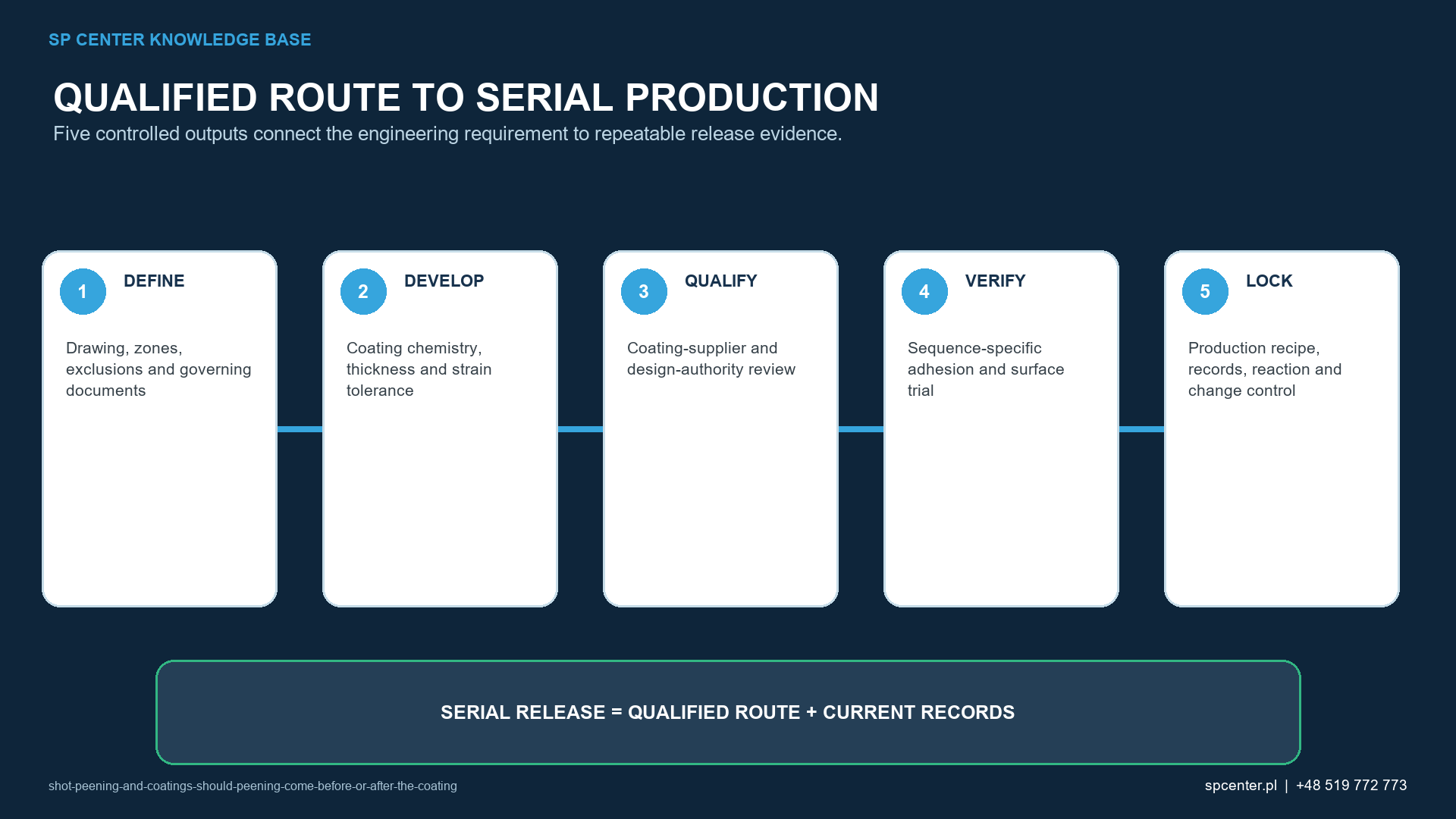
How are heat, stripping and rework controlled?
The route should record the maximum relevant temperature and time after peening and assess whether the substrate’s residual-stress state can relax. For susceptible high-strength materials and electrochemical processes, the applicable plating specification may also control stress relief, hydrogen-embrittlement precautions and bake timing. These requirements must come from the governing process, not from a generic article.
Coating removal can attack or remove base material, change surface topography and dimensions, or introduce new chemical and hydrogen exposure. It can also reveal that the component has already undergone one or more peening cycles. Stripping, repair, renewed peening and recoating need explicit technical authority and a defined inspection and requalification route.
Which failures require containment?
- Abrasive blast cleaning is recorded or accepted as shot peening, or the reverse.
- Coating preparation removes or changes the qualified peened surface without review.
- A coating is cracked, chipped, indented or delaminated by an unapproved post-coating peening step.
- Peening media transfers unacceptable contamination to the coating process.
- Cure or deposition temperature exceeds the qualified thermal route.
- Masking boundaries leave wrong or unprotected transition zones.
- Coating strip and repeat peening are performed without cumulative-history review.
Stop and contain product since the last verified acceptable state. Link the peening, cleaning, coating and thermal records, preserve evidence and obtain the required engineering or customer disposition. Additional peening, stripping or recoating is not an automatic correction.
What should an RFQ or purchase order contain?
| RFQ input | Decision enabled | Ambiguity prevented |
|---|---|---|
| Controlled drawing and complete process specifications | Establishes the contractual sequence and acceptance authority | Supplier invents an order from general practice |
| Base material, heat treatment and incoming surface | Supports peening, chemical, heat and damage review | One route is applied to unlike substrate states |
| Coating system and preparation | Defines chemistry, layers, thickness, masking, profile, cleaning and cure | Coating name is treated as a complete process |
| Treatment and exclusion maps | Coordinates peened zones, coated zones and transition boundaries | A mask protects one operation but obstructs another |
| Stripping, repair and repeat-peening authority | Controls cumulative material removal and exposure | Unapproved rework changes dimensions or surface integrity |
| Required records and release tests | Builds one traceable evidence package | Peening and coating certificates cannot be linked to the same part or lot |
Table 3. The quotation should cover one integrated surface route, even when different suppliers perform its steps.
Define logistics and preservation between operations: maximum delay where controlled, cleanliness, packaging, corrosion protection and responsibility for incoming inspection at each supplier. If the controlled sequence or acceptance authority is missing, obtain formal clarification before processing.
Frequently asked questions
Should shot peening normally be performed before coating?
Often yes, because peening acts plastically on the substrate and later impact may damage a coating. This is not a universal rule; the controlled drawing, coating specification and qualified manufacturing route decide the sequence.
Can a coated part be shot peened?
Only through an explicitly approved and qualified route. Impact can crack, chip, indent or delaminate a coating, alter thickness and contaminate the surface, although specialised systems may intentionally use a different sequence.
Is abrasive blast cleaning after shot peening acceptable?
Only when the approved route defines and qualifies it. Abrasive cleaning targets cleanliness or profile, not peening intensity, and can remove material, change roughness or affect the peened surface.
Does shot peening create the correct coating profile automatically?
No. The peened texture may or may not meet the coating supplier’s profile and cleanliness requirements. Use the specified preparation and measurement method for the actual coating system.
Can coating cure temperature relax peening residual stress?
Temperature and time can relax residual stress depending on substrate material and state. Where the retained effect is important, the complete thermal exposure requires engineering review and, if necessary, validation.
What happens when a coating must be stripped?
Stripping can remove base material, change roughness, introduce chemical or hydrogen concerns and expose prior damage. Rework requires controlled authority, dimensional and surface review, and renewed process evidence.
Does good coating adhesion prove shot peening was correct?
No. Adhesion confirms only the defined coating test result. Peening intensity, coverage, substrate condition and any retained fatigue or residual-stress requirement remain separate.
Which change can require requalification?
Examples include substrate or heat treatment, peening media or intensity, surface preparation, coating chemistry or supplier, layer thickness, cure cycle, masking, stripping route, geometry or acceptance method.
Key takeaways
- Peening before coating is common but not an automatic rule.
- Qualify the actual substrate, coating stack, preparation and thermal cycle.
- Separate controlled shot peening from abrasive blast cleaning or profiling.
- Prevent cleaning, etching, grinding or heat from unintentionally changing the peened layer.
- Release peening, pre-coat surface, coating and component performance with their own evidence.
- Control stripping and repeat peening through explicit rework authority.
Related SP Center guides
- Shot Peening Before or After Grinding?
- Shot Peening Before or After Heat Treatment?
- Surface Roughness After Shot Peening
- Shot Peening and Hydrogen Embrittlement
Technical references
1. SAE J2441_202511: Shot Peening, stabilized November 2025
2. SAE AMS2430U: Shot Peening, revised April 2018
3. SAE ARP7488: Peening Design and Process Control Guidelines, issued January 2018
4. SAE J2277_202301: Shot Peening Coverage Determination, revised January 2023
5. ASTM D4417-21, Field Measurement of Surface Profile of Blast-Cleaned Steel
6. ASTM D3359-23, Rating Adhesion by Tape Test
Standards note: Coating type, substrate and customer requirements determine which preparation and acceptance standards apply. The scope limits of each cited method must be checked before use.
Author: Paweł Kmieć
Discuss a peening and coating sequence: +48 519 772 773 | [email protected]