


Establish the specified material condition, identify every later thermal exposure and qualify the complete sequence instead of relying on a universal temperature rule
Shot peening is often placed after the heat treatment that establishes final strength, hardness and microstructure. That is a sound starting point, not an absolute rule. A later thermal cycle can relax or redistribute residual stress, change hardness or microstructure, alter dimensions or interact with a coating and hydrogen-control route. The correct order therefore comes from the controlled drawing, material specification, complete manufacturing route and application-specific qualification.
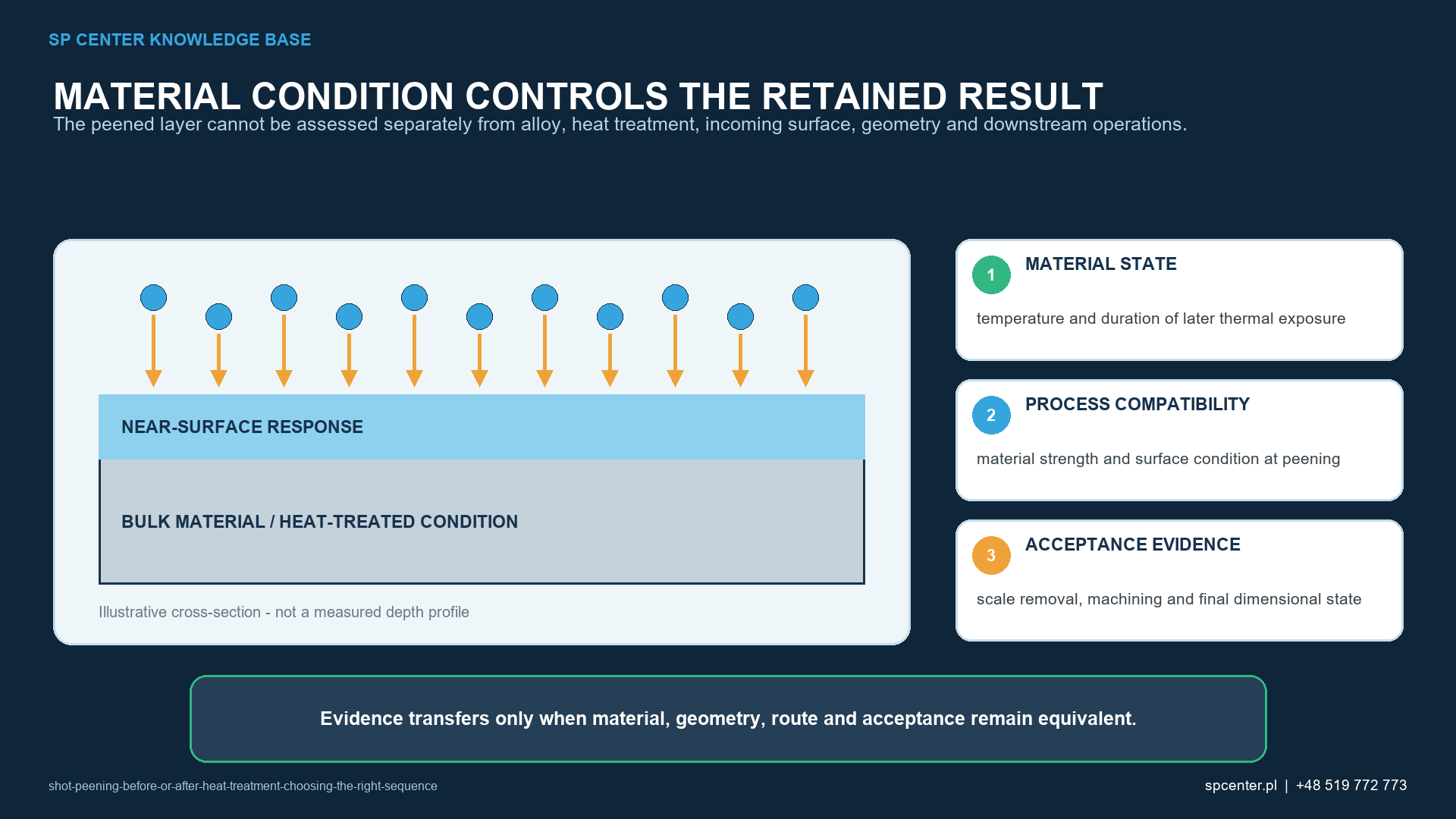
Why does final material condition usually come before peening?
The response to impacts depends on yield strength, hardness, microstructure, case condition and prior residual stress. Peening an annealed or intermediate state and then hardening it does not automatically reproduce the result obtained by peening the final condition. Heating and phase transformation can replace the earlier stress field and change the surface that was qualified.
The technical review should name the exact condition rather than only “heat treated”. Quenched-and-tempered steel, precipitation-hardened stainless steel, carburized case, nitrided layer, induction-hardened zone, titanium alloy and nickel superalloy do not share one thermal response.
| Thermal or manufacturing step | Sequence concern | Controlled decision |
|---|---|---|
| Hardening and tempering or aging | Establishes strength, hardness, microstructure and dimensional state | Normally complete the specified final heat treatment before qualifying peening |
| Carburizing, nitriding or induction hardening | Creates or transforms the functional case and may involve finishing afterward | Define case condition, grinding allowance and the point at which peening is applied |
| Stress relief after peening | May relax or redistribute introduced residual stress | Permit only under an approved material-, temperature- and time-specific route |
| Coating cure or plating bake | A later thermal cycle can affect stress, hardness, coating or hydrogen-control sequence | Use the invoked coating, bake and customer requirements; do not substitute a universal limit |
| Welding, brazing or hot forming | Can transform material and overwhelm the earlier surface state | Treat as a major sequence decision requiring engineering review |
| Warm peening or peening plus controlled anneal | Deliberately couples deformation and temperature | Use only as a separately qualified special process, not as an exception inferred from conventional peening |
Table 1. Each later thermal step needs an explicit purpose, authority and effect review.
How can heat after peening change the result?
Residual-stress relaxation is governed by more than peak temperature. Time, alloy, microstructure, initial stress magnitude and profile, prior cold work and service-relevant loading all matter. A short thermal exposure and a long hold at the same nominal temperature are not equivalent.
Heating can also temper or age the material, transform retained phases, oxidize or contaminate the surface and distort thin or asymmetrical features. Consequently, an intact-looking surface and a prior coverage record do not prove that the qualified material or stress condition remains.
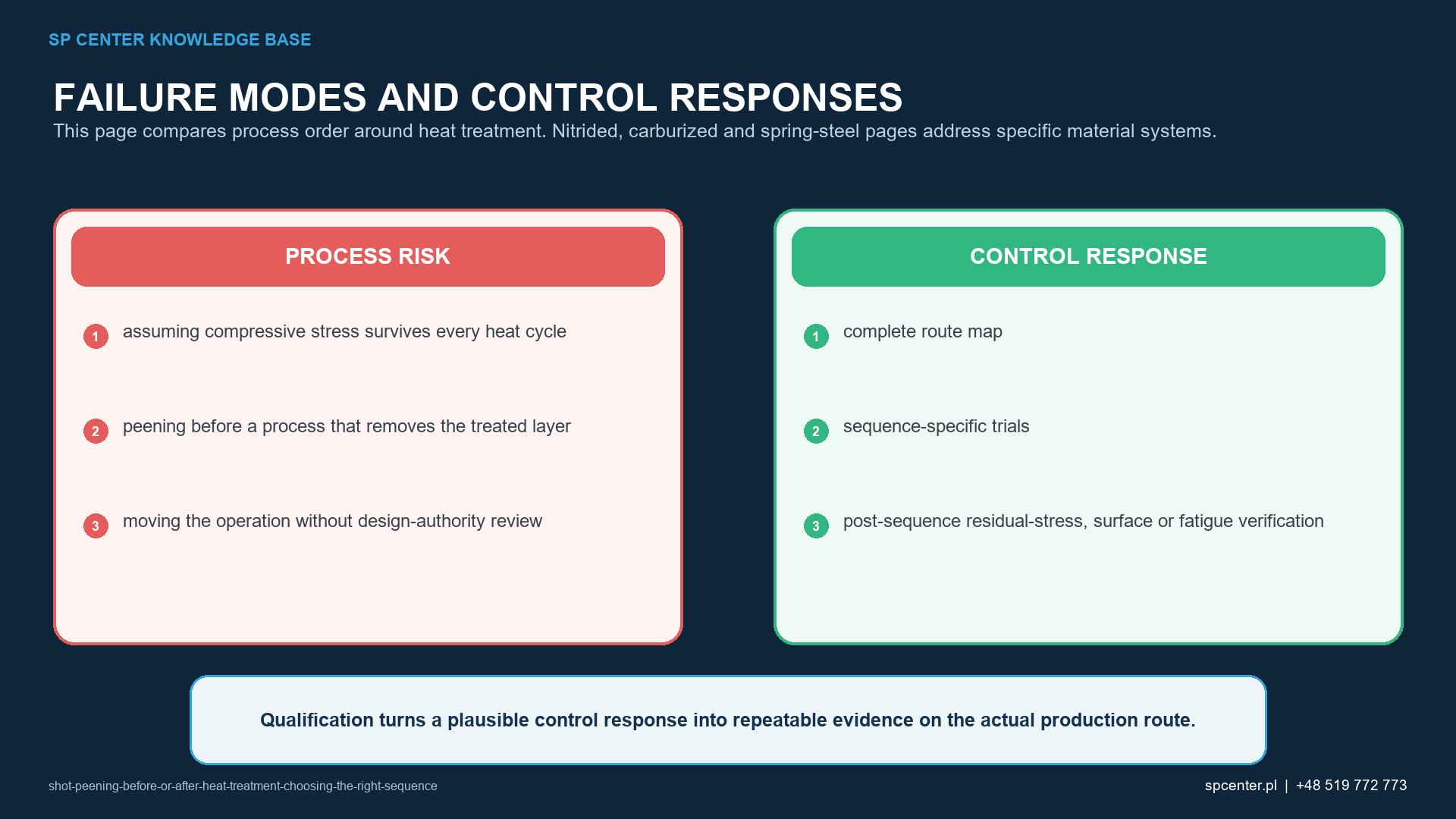
Why is a universal post-peening temperature limit unsafe?
Published research demonstrates that residual-stress stability is material- and exposure-specific. Results for one steel, temperature and duration cannot be used as a general acceptance limit for another alloy or component. The cited studies support the mechanism and the need for qualification; they do not supply SP Center with a universal production recipe.
When a later thermal exposure is unavoidable, define its actual temperature-time envelope, atmosphere, heating and cooling route and position in the process. Then determine which material, surface, residual-stress or performance checks are required by the design authority.
How do coatings, plating and hydrogen-relief baking affect the sequence?
Coating and plating routes can include cleaning, activation, deposition, curing, diffusion or baking. Some steps can change the peened surface, and some high-strength steels have mandatory hydrogen-control sequences. Peening does not remove hydrogen and cannot replace a required embrittlement-relief bake.
Do not invent a bake temperature or time from a generic shot-peening guide. Use the coating specification, material and hardness limits, customer flow-down and approved process plan. If the requirements conflict, processing should stop until the responsible authority issues a controlled clarification.
What is different about warm peening or a controlled anneal?
Warm peening and deliberately combined peening-annealing routes aim to use interactions between plastic deformation, temperature and microstructure. They are not evidence that an arbitrary heat treatment after conventional peening is harmless. Their process window includes the material, temperature, timing, strain history and final validation and must be qualified separately.
Which evidence supports qualification and production release?
| Evidence layer | Question answered | Not proved alone |
|---|---|---|
| Heat-treatment records and material tests | Is the required metallurgical state established? | Was the peening stream controlled or the component covered? |
| Almen intensity and saturation | Was the stream verified at the defined test configuration? | Did a later heat cycle preserve component residual stress? |
| Component coverage and surface inspection | Was the specified zone impacted and left in an acceptable visible condition? | Are hardness, microstructure or stress depth unchanged? |
| Hardness, case depth or microstructure | Did the material condition meet the invoked acceptance? | Does the peening process meet intensity, coverage or fatigue requirements? |
| Residual-stress measurement before and after thermal exposure | How did a stated stress component change at defined positions and depths? | Does another material, geometry or thermal history behave the same? |
| Representative fatigue or functional testing | Does the complete sequence support a defined service claim? | Can the result transfer after an unreviewed process change? |
Table 2. Heat-treatment conformity, peening control and retained application performance cannot be collapsed into one result.
SAE J442 and J443 address determination and verification of peening intensity; J2277 addresses coverage determination. AS7045 provides a framework for defining, quantifying and classifying residual stress. None of these sources alone authorizes a later thermal cycle or establishes a material-specific relaxation limit.
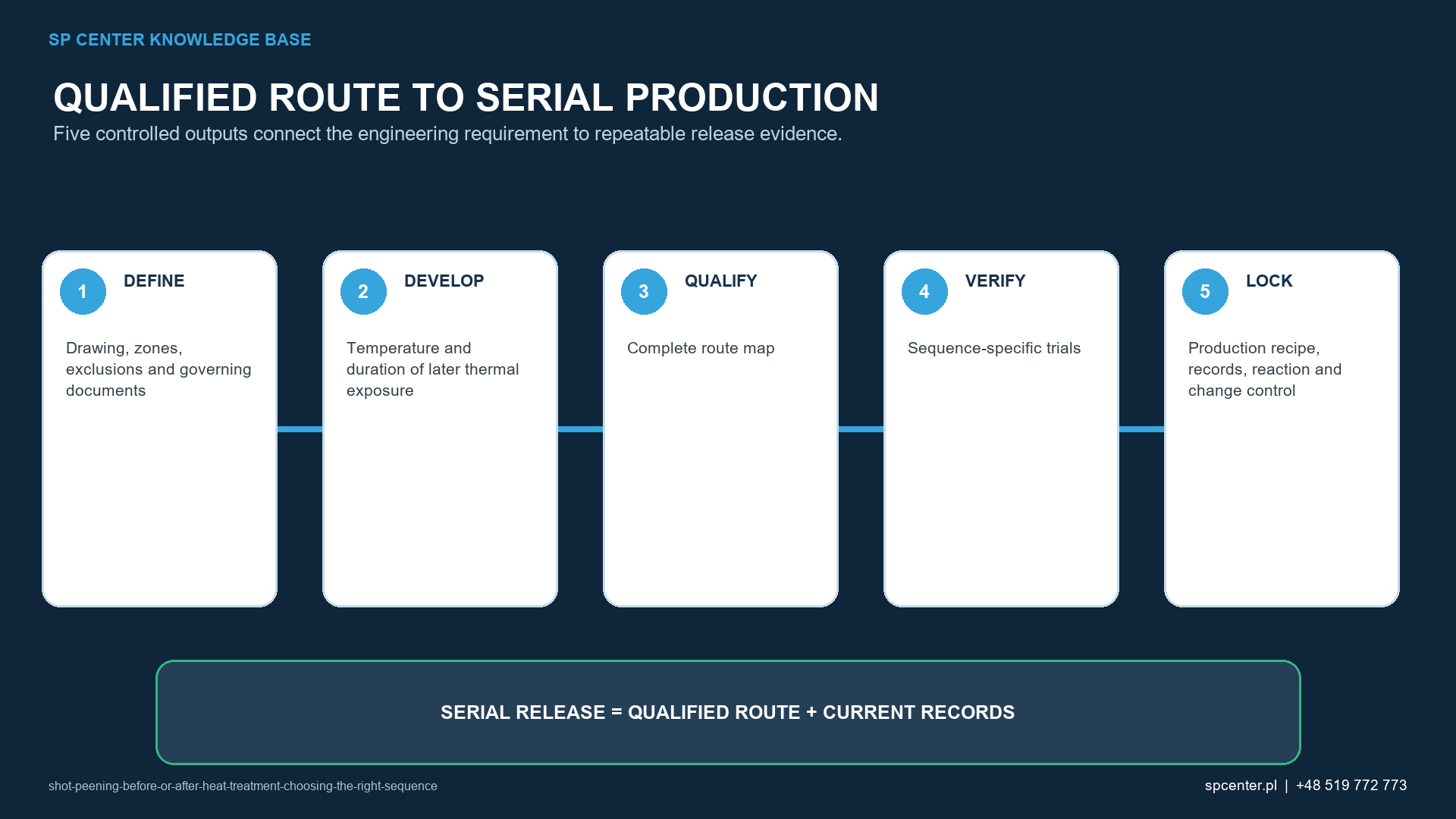
Which changes should trigger review or requalification?
- Material designation, supplier condition, heat-treatment revision, hardness range or case requirement changes.
- A stress-relief, bake, cure, hot wash, welding, brazing or thermal repair is added or moved after peening.
- Temperature, hold time, atmosphere, furnace load, heating rate or cooling route changes outside the approved baseline.
- Grinding, polishing or coating modifies the surface after peening.
- Peening media, intensity, coverage, equipment, fixture, program or treatment boundary changes.
- Residual-stress, hardness, dimensional or fatigue evidence no longer represents the final sequence.
Contain product from the last verified condition while the effect is assessed. Repeating peening after heat is not an automatic correction because cumulative exposure, roughness, dimensions and the contractual route may limit reprocessing.
What should an RFQ or process plan define?
| Required input | Why it matters | Risk prevented |
|---|---|---|
| Material specification and heat-treatment condition | Defines transformation, hardness and relaxation behaviour | A temperature limit is copied between unlike alloys |
| Complete operation order | Exposes every heating, grinding, coating and repair step after peening | A hidden bake or rework changes the qualified surface |
| Temperature-time envelope and atmosphere | Defines the actual thermal exposure rather than a label | ‘Low temperature’ is treated as harmless without evidence |
| Treatment and exclusion map | Protects heat-affected, precision and functional surfaces | The wrong material state or zone is peened |
| Final surface, hardness, dimensions and records | Provides component acceptance beyond peening settings | A conforming Almen result releases a changed component |
| Residual-stress or fatigue claim | Determines whether retained performance needs direct validation | A general benefit is promised after an unqualified heat cycle |
Table 3. A complete thermal history is essential for a technically comparable quotation and defensible qualification.
For high-strength 300M or 4340 modified steel at the scope stated by SAE ARP1631A, that document addresses manufacturing sequence. Its narrow material and strength scope must not be generalized to other steels or alloys. Use the complete revision invoked by the contract.
Frequently asked questions
Is shot peening normally performed after heat treatment?
Often yes, because peening is commonly qualified in the final strength and hardness condition and later high-temperature exposure can change residual stress. The governing route can require a different sequence.
Can a part be heat treated after shot peening?
Only when the approved route defines the material, thermal cycle and required evidence. A later cycle can relax stress, change hardness or transform the surface.
Is there one maximum temperature allowed after peening?
No. The response depends on alloy, microstructure, initial stress state, temperature, duration and application. Use the invoked requirements and representative validation.
Does a hydrogen-embrittlement relief bake always destroy the peening benefit?
No universal conclusion is valid. The required plating and bake sequence must be followed, and any retained-stress or fatigue claim must be supported for that material and cycle.
Can shot peening replace stress-relief heat treatment?
No. They are different processes with different purposes and authorities. A peening operation cannot be substituted for required heat treatment without controlled engineering approval.
Can warm peening be treated as ordinary shot peening?
No. Deliberate peening at elevated temperature or a coupled anneal changes the process concept and requires its own qualification, limits and records.
Does coverage prove that residual stress survived a later bake?
No. Coverage is impact evidence on the surface. Retained residual stress or performance after heating is a separate measurement or qualification question.
What should be sent for a sequence review?
Send the drawing, material and heat-treatment specification, full manufacturing route, all later thermal cycles, treatment map, surface and dimensional limits, quantity and required records.
Key takeaways
- Use the specified final metallurgical condition as the normal peening qualification state.
- Review every later thermal exposure by material, temperature, duration and purpose.
- Do not apply a universal safe temperature after shot peening.
- Follow coating, plating and hydrogen-relief requirements without substitution.
- Treat warm peening and coupled annealing as separately qualified processes.
- Keep heat-treatment records, intensity, coverage, residual stress and fatigue evidence distinct.
Related SP Center guides
- Shot Peening Before or After Grinding
- Shot Peening and Coatings: Process Sequence
- Shot Peening and Hydrogen Embrittlement
- XRD Residual Stress Measurement
Technical references
1. SAE J2441_202511: Shot Peening, stabilized November 2025
2. SAE AMS2430U: Shot Peening, revised April 2018
3. SAE ARP7488: Peening Design and Process Control Guidelines, issued January 2018
5. SAE ARP1631A, Manufacturing Sequence for High-Strength 300M or 4340 Modified Steel Parts
6. Diesner, The Effect of Elevated Temperature Exposure on Residual Stresses, SAE 710285
7. Menig et al., Shot Peening Plus Subsequent Short-Time Annealing, SAE 2002-01-1409
Standards note: Research results are material- and cycle-specific. Use the complete controlled standards and customer requirements for acceptance.
Author: Paweł Kmieć
Discuss a heat-treatment and shot peening sequence: +48 519 772 773 | [email protected]