


Shot peening does not remove hydrogen or replace embrittlement-relief baking; control material susceptibility, hydrogen sources, tensile stress and the complete process chronology
Shot peening can introduce compressive residual stress at a component surface, but it does not remove absorbed hydrogen and does not cure hydrogen embrittlement. Hydrogen-risk control depends on susceptible material condition, hydrogen entry or exposure, applied and residual tensile stresses, time and temperature, coating integrity and the exact sequence required by the governing specification.
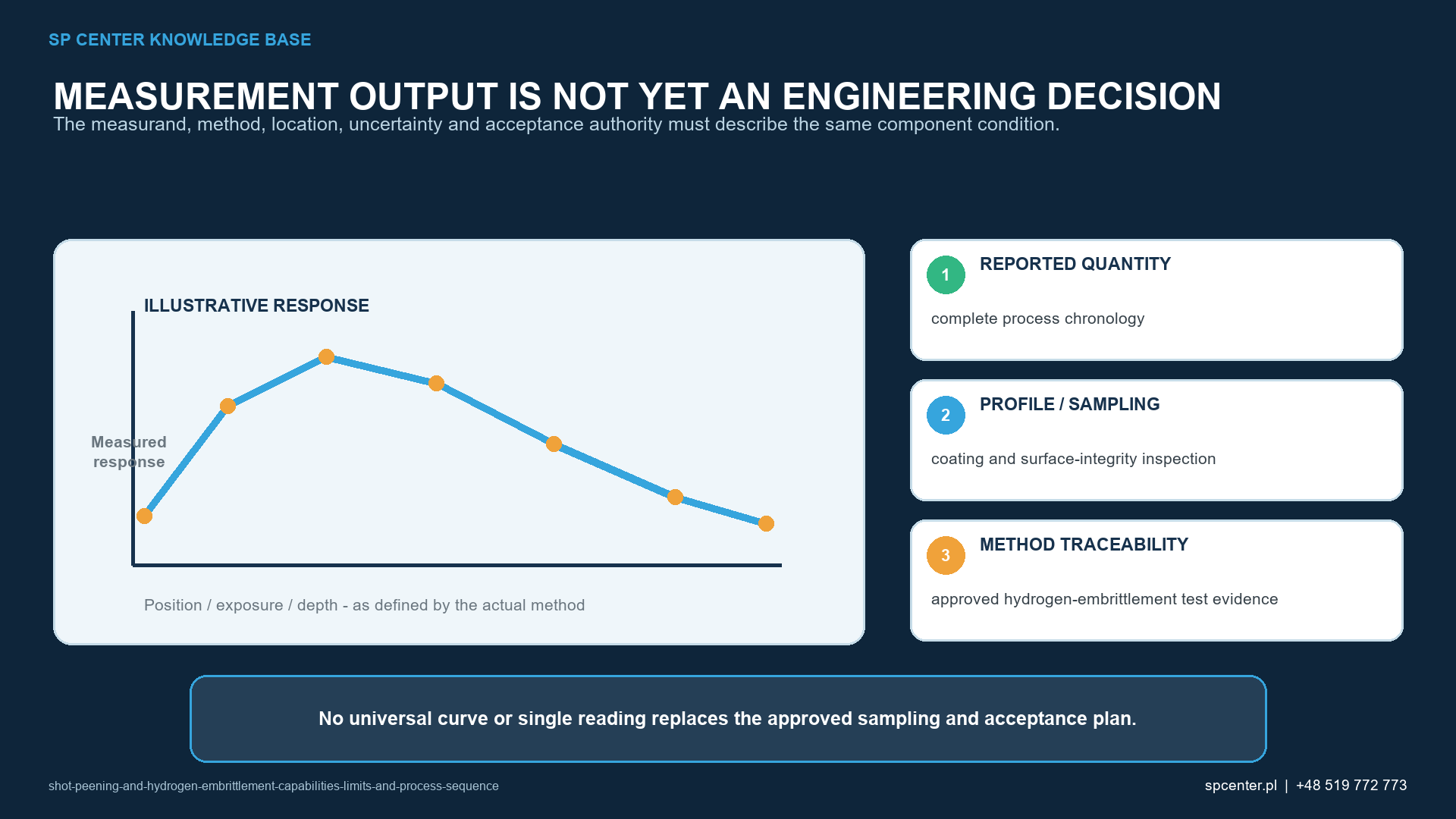
What conditions create a hydrogen-embrittlement risk?
Hydrogen-assisted cracking requires a material and microstructure capable of embrittlement, available hydrogen and a sufficient tensile driving force. Strength or hardness alone is not a complete decision, but high-strength heat-treated steels are often controlled closely in plating and chemical-processing routes. Geometry, notches, assembly load, forming, grinding and residual stress influence the local stress state.
| Risk input | Technical question | Required controlled record |
|---|---|---|
| Material and strength state | Is the alloy, hardness, heat treatment and local microstructure susceptible under the governing requirement? | Material heat, certificate, heat treatment, hardness and part revision |
| Hydrogen source | Can cleaning, pickling, etching, stripping, plating, corrosion or service exposure introduce hydrogen? | Bath or chemical identity, lot, process parameters and exposure chronology |
| Stress state | Where do applied tensile stress, assembly stress, notch stress and residual stress act? | Critical features, load state, prior forming or grinding and approved peening map |
| Diffusion and time | What delay and temperature limits control transfer to the required relief treatment? | Start and finish timestamps, queue control, furnace cycle and release |
| Coating or barrier | Does the coating trap, slow, admit or generate hydrogen, and can later impact damage it? | Coating process, thickness, integrity, stripping and repair history |
| Prior processing | Has the part already been plated, stripped, baked, repaired or peened? | Complete serial or lot route with deviations and dispositions |
Table 1. Hydrogen risk is a route-level question, not a peening-machine parameter.
Distinguish internal hydrogen introduced during manufacture from hydrogen supplied by an external service or maintenance environment. The prevention, test method and acceptance authority can differ. A delayed fracture may also have another cause, so diagnosis requires controlled failure analysis rather than the label “hydrogen” from appearance alone.
What can and cannot shot peening change?
A qualified peening process can change the near-surface residual-stress state and may reduce tensile driving force at selected surface locations. The benefit depends on material, depth profile, geometry, load, environment and stability of the residual stress. Peening does not neutralize hydrogen, guarantee that cracks cannot initiate below the compressive layer or correct an already damaged coating or component.
Plastic deformation can also change traps, roughness and local material state, so a materials-specific study cannot be converted into a universal embrittlement claim. Any claim that peening mitigates hydrogen-assisted cracking needs application-representative evidence and approval by the responsible authority.
How is the sequence around plating and baking controlled?
Potential hydrogen-entry operations include acid cleaning or pickling, etching, stripping, chemical milling, electroplating, corrosion and some service chemicals. The controlled route should identify every source rather than evaluate only the final coating. It should also establish protection, transfer limits and the required embrittlement-relief treatment.
AMS2759/9E covers baking of heat-treated steel parts to relieve hydrogen introduced during plating and certain chemical processes. The public scope does not justify reproducing project temperatures, durations or timing from memory; use the complete revision invoked by the drawing or coating process. Shot peening never substitutes for a required bake.
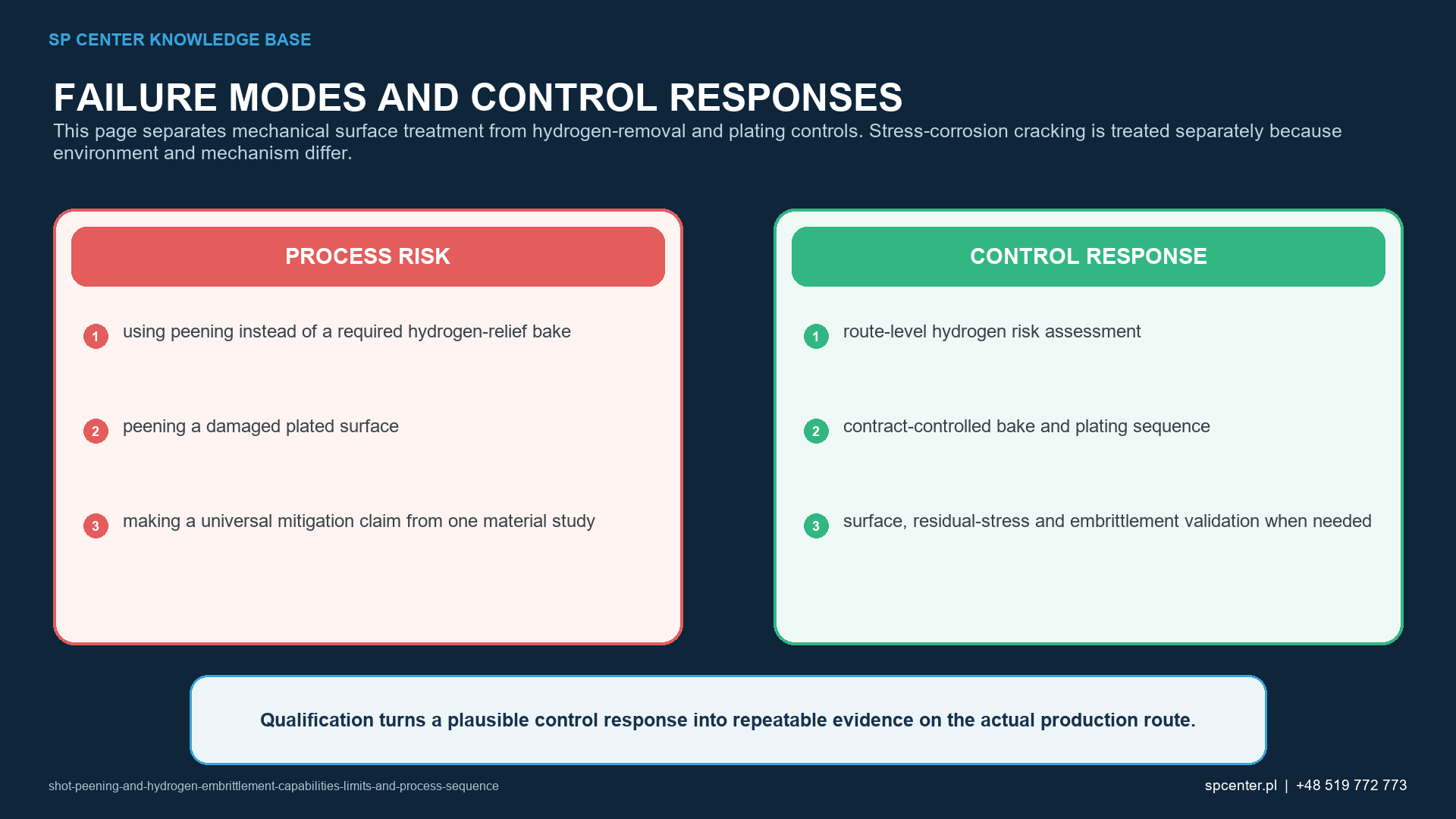
ISO 12686 covers automated controlled shot peening of metallic articles before nickel, autocatalytic nickel or chromium plating, or as a final finish. That scope supports a particular sequence context but is not permission to apply the same route to every material or coating.
Which tests and records prove control?
| Evidence | What it can demonstrate | What it cannot demonstrate alone |
|---|---|---|
| Peening intensity and coverage | The qualified peening stream and observed impact evidence on specified zones | Hydrogen content, relief-bake compliance or freedom from embrittlement |
| Process chronology | That cleaning, plating, transfer, baking and release followed the invoked sequence | Mechanical acceptability if the process or product test also fails |
| Coating and surface inspection | Specified thickness, integrity, appearance and surface condition | Absence of diffusible hydrogen or delayed cracking |
| ASTM F519 process test | Performance of the plating or coating process under its defined specimen and test conditions | Relative susceptibility of every steel or automatic acceptance of every component |
| ASTM F1624 test | A hydrogen-embrittlement threshold for steel under the selected specimen, environment and method | Universal transfer to another material, geometry or stress state |
| Component-specific validation | The application question under approved representative conditions | Unreviewed transfer after material, process or geometry change |
Table 2. Test scope and representation limits must match the release decision.
ASTM F519 is intended to evaluate plating or coating processes and specified service environments with defined steel specimens. Its public scope explicitly states that it is not the method for comparing relative susceptibility of different steels. ASTM F1624 addresses hydrogen-embrittlement threshold measurement in steel under its defined conditions. ASTM F1940 is specifically limited to process-control verification for plated or coated ferrous fasteners and must not be presented as a universal component test.
Production records should link part or lot identity to material and heat treatment, incoming surface, every chemical bath or exposure, plating or coating lot, timestamps, relief furnace and cycle, peening machine, media, intensity, coverage, inspection, deviations and release. If a maximum transfer interval is invoked, actual timestamps and queue control are essential evidence.
Which failures require immediate containment?
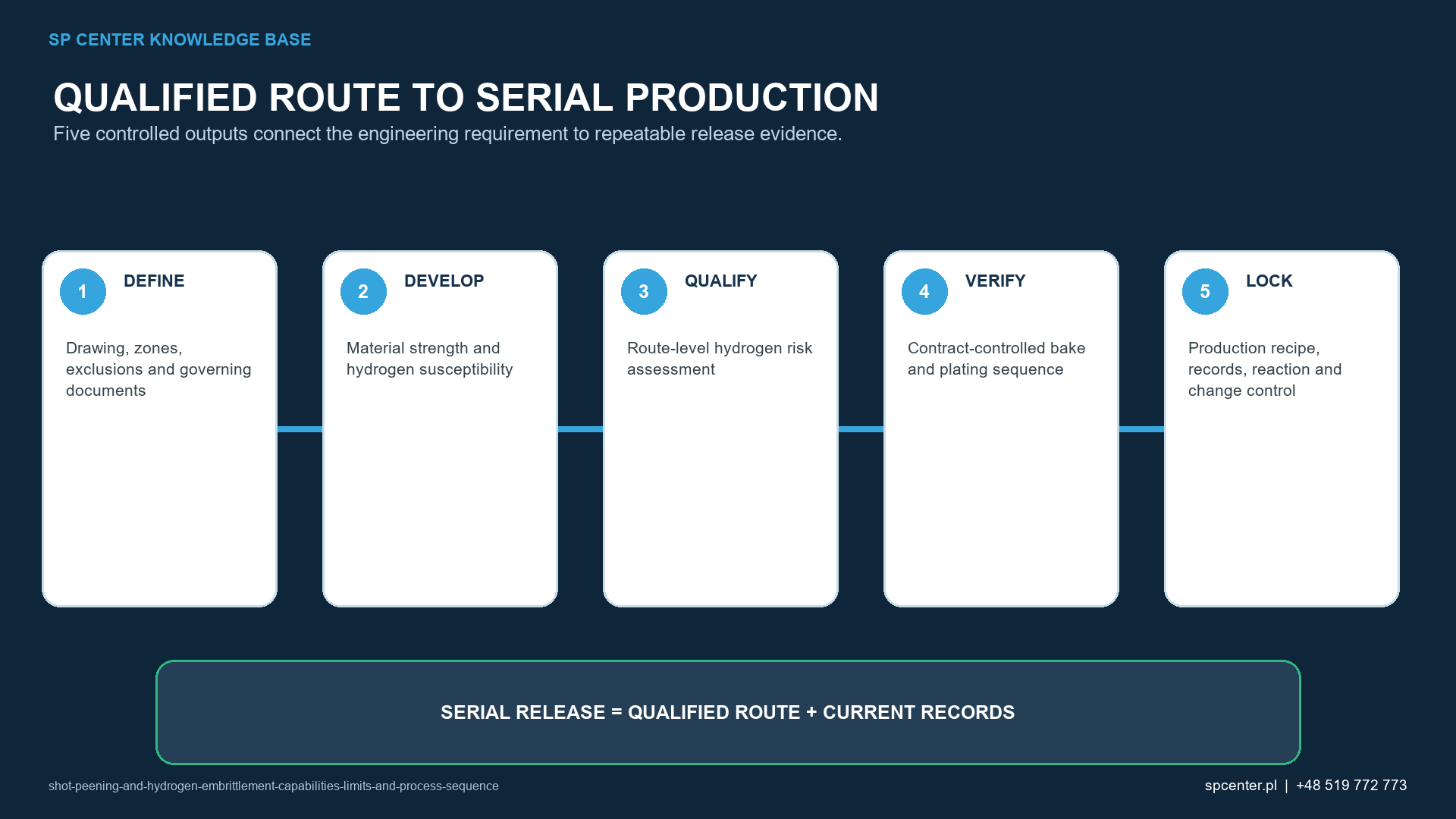
- Shot peening is used or proposed instead of a required embrittlement-relief bake.
- Required transfer time, furnace chart, part load identity or bake completion cannot be proven.
- Pickling, stripping or another hydrogen-entry operation is absent from the route review.
- A plated surface is damaged by an unapproved peening step.
- Material, hardness or heat-treatment condition differs from the qualified hydrogen-control class.
- A process witness is treated as automatic acceptance of a non-equivalent part.
- Repeat stripping, plating or peening occurs without cumulative-history review.
Stop the process and contain product from the last verified acceptable state. Preserve chemistry, bath, timing, furnace, coating, peening and inspection records. Do not attempt recovery through extra peening or an improvised bake; obtain the required technical and customer disposition under the governing process.
What should an RFQ or purchase order define?
| RFQ or order input | Why it matters | Unsafe shortcut prevented |
|---|---|---|
| Complete material and strength requirement | Defines susceptibility review and governing process class | Using only a generic steel name |
| All hydrogen-generating or exposing operations | Builds the real risk chronology | Reviewing plating while ignoring pickling or stripping |
| Peening position and requirement | Separates the mechanical surface treatment from hydrogen controls | Treating peening as a replacement for baking |
| Relief treatment specification and timing | Defines the required oven route without inventing values | Applying a generic temperature or delay |
| Required process and product tests | Identifies qualification, periodic control and lot-release evidence | Assuming one witness test answers every question |
| Stripping, repair and repeat-processing authority | Controls accumulated hydrogen exposure, material removal and peening | Unapproved recovery of a nonconforming route |
Table 3. A safe quotation needs the complete chemical, coating, thermal and mechanical route.
Also define responsibility at supplier interfaces, packaging and corrosion protection, permitted waiting conditions, test-specimen relationship, record retention and notification rules. When the controlled bake requirement, sequence or material class is missing, processing should wait for formal clarification.
Frequently asked questions
Does shot peening remove hydrogen from steel?
No. Shot peening is a mechanical surface treatment and is not a hydrogen-removal or embrittlement-relief bake. Any required relief treatment follows the governing material, plating or process specification.
Can compressive residual stress reduce hydrogen-assisted cracking risk?
It may reduce the surface tensile driving force in a qualified system, but it does not eliminate hydrogen, material susceptibility, applied stress, subsurface stress or service exposure. No universal mitigation factor should be claimed.
Can shot peening replace a required post-plating bake?
No. If a controlled specification requires embrittlement-relief baking, peening cannot replace it. Missing timing or furnace evidence is a process nonconformance requiring containment and disposition.
Should shot peening occur before electroplating?
It is commonly positioned before certain plating routes, and ISO 12686 specifically addresses automated controlled peening before nickel, autocatalytic nickel or chromium plating or as a final finish. The actual drawing and plating specification remain controlling.
Does an ASTM F519 pass prove every part is free from hydrogen embrittlement?
No. F519 evaluates defined plating or coating processes and service environments with specified test configurations. Its scope and representation limits must be applied by the responsible engineering authority.
Is hydrogen embrittlement the same as stress-corrosion cracking?
No. Mechanisms and environments can overlap or interact, but they are not interchangeable diagnoses. The failure analysis and governing requirements must identify the applicable mechanism.
Can a plated part be peened after coating?
Only through an explicitly approved and qualified route. Impact can damage or contaminate the coating and does not remove hydrogen already absorbed by the substrate.
What changes can require requalification or renewed hydrogen review?
Material or hardness, cleaning or pickling chemistry, plating bath, transfer time, bake equipment or cycle, coating, stripping, repair, peening configuration, geometry and test method are typical examples.
Key takeaways
- Shot peening neither removes hydrogen nor replaces relief baking.
- Review susceptible material, hydrogen sources, tensile stresses, time and environment together.
- Record the complete chronology across cleaning, pickling, stripping, plating, baking and peening.
- Use only the bake and timing requirements invoked by the controlled process.
- Apply F519, F1624 and F1940 within their stated scopes.
- Contain missing chronology or bake evidence; do not improvise recovery.
Related SP Center guides
- Shot Peening and Stress Corrosion Cracking
- Shot Peening Before or After Coating?
- Shot Peening Before or After Heat Treatment?
- Surface Defects and Shot Peening
Technical references
1. SAE AMS2759/9E, Hydrogen Embrittlement Relief (Baking) of Steel Parts
3. ASTM F1624-12(2024), Measurement of Hydrogen Embrittlement Threshold in Steel
4. ASTM F1940, Process-Control Verification for Hydrogen Embrittlement in Plated or Coated Fasteners
6. SAE J2441_202511: Shot Peening, stabilized November 2025
7. SAE ARP7488: Peening Design and Process Control Guidelines, issued January 2018
Standards note: Do not infer bake values, material thresholds or test acceptance from titles or summaries. Apply the complete controlled specifications invoked by the product and process.
Author: Paweł Kmieć
Discuss a peening and hydrogen-control sequence: +48 519 772 773 | [email protected]