



Components & Applications
Component geometry, material and service loading determine how shot peening must be applied and verified. This section covers part-specific routes for gears, springs, shafts, crankshafts, blades, welded details and other fatigue-critical features, including access, masking, coverage and qualification evidence.
-
Compressor Blade Shot Peening: Edges, Radii and Coverage Control
Qualify compressor blade shot peening for roots, fillets, airfoil surfaces, thin edges, fixture presentation, Almen intensity, coverage, dimensions, repairs and aerospace traceability.
-
Connecting Rod Shot Peening: Critical Areas, Masking and Control
Qualify connecting rod shot peening for beam and fillet zones, precision bores, split faces, threads, masking, Almen intensity, coverage, dimensions, cleanliness and traceability.
-
Crankshaft Shot Peening: Critical Areas and Process Control
Crankshaft shot peening targets drawing-defined fillets, oil-hole exits and transitions through a qualified route that controls access, intensity, coverage, masking and component-specific acceptance.
-
Gear Shot Peening: Tooth-Root Access, Surface Integrity and Qualification
Gear shot peening must follow the governing failure mode, prove access and coverage at every specified tooth root, protect functional flanks and control material, case and finishing sequence.
-
Landing Gear Shot Peening: Process Control, Repair Sequence and Traceability
Landing-gear shot peening requires drawing-defined zones, controlled incoming condition and coating sequence, qualified feature access, customer approvals and serial traceability.
-
Shot Peening Bearing Components: Raceways, Non-Contact Features and Limits
Shot peening bearing components requires surface-specific authorization, protected raceways, controlled grinding sequence, texture and form checks, cleanliness and separate contact-fatigue evidence.
-
Shot Peening Bolts and Fasteners: Threads, Fatigue and Process Control
Control fastener shot peening through thread-root and under-head access, manufacturing sequence, geometry, coating and hydrogen requirements, and separate fatigue evidence.
-
Shot Peening Bores and Internal Surfaces: Access, Nozzles and Control
Qualify bore peening through exact nozzle or lance, centring, full-depth motion, representative intensity, approved coverage inspection, dimensions and complete media removal.
-
Shot Peening Shafts and Axles: Critical Features, Access and Fatigue Evidence
Shot peening shafts and axles requires controlled fillets, splines, keyways and holes, qualified rotational access, protected precision seats and separate fatigue evidence.
-
Shot Peening Transmission Components: Gears, Shafts, Splines and Notch Areas
Control shot peening of transmission components by feature: gear roots and flanks, splines, shaft fillets, keyways, holes and journals require different access and evidence.
-
Spring Shot Peening: Fatigue, Stress Peening, Relaxation and Cracking
Spring shot peening can delay surface fatigue cracking, but fatigue, spring load relaxation and residual-stress relaxation need separate evidence. Control geometry, access and sequence.
-
Turbine Blade Shot Peening: Roots, Thin Edges, Cooling Holes and Coatings
Turbine-blade shot peening needs a feature map for roots, platforms, airfoils, thin edges, cooling holes and coatings, plus service-relevant residual-stress and fatigue evidence.
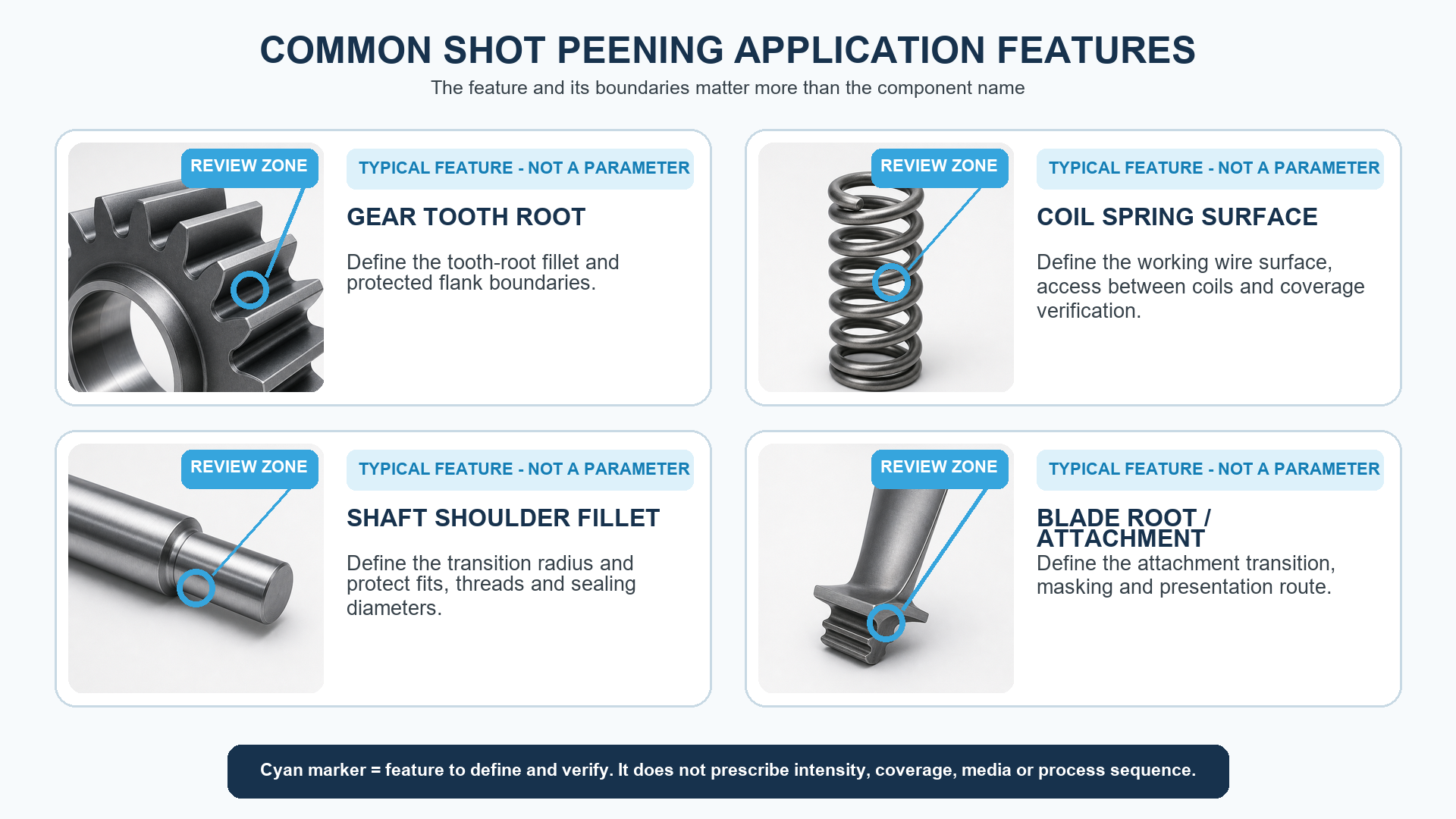
What Is Shot Peening Used For? Components, Materials and Engineering Objectives
See where shot peening is used, which components and materials are typical, what engineering objectives it supports and how each application is qualified.