


Control thread-root access, runout and under-head fillets without damaging form, fit, bearing surfaces, coating sequence or hydrogen-control requirements
Shot peening bolts and fasteners is not a matter of applying one setting to the complete part. Loaded thread roots, thread runout and under-head fillets can be fatigue-critical, yet they are difficult to reach and inspect. Flanks, bearing faces, drive features, shanks and precision fits can have different functions and may require treatment, exclusion or protection. The drawing and qualified route must decide each surface explicitly.
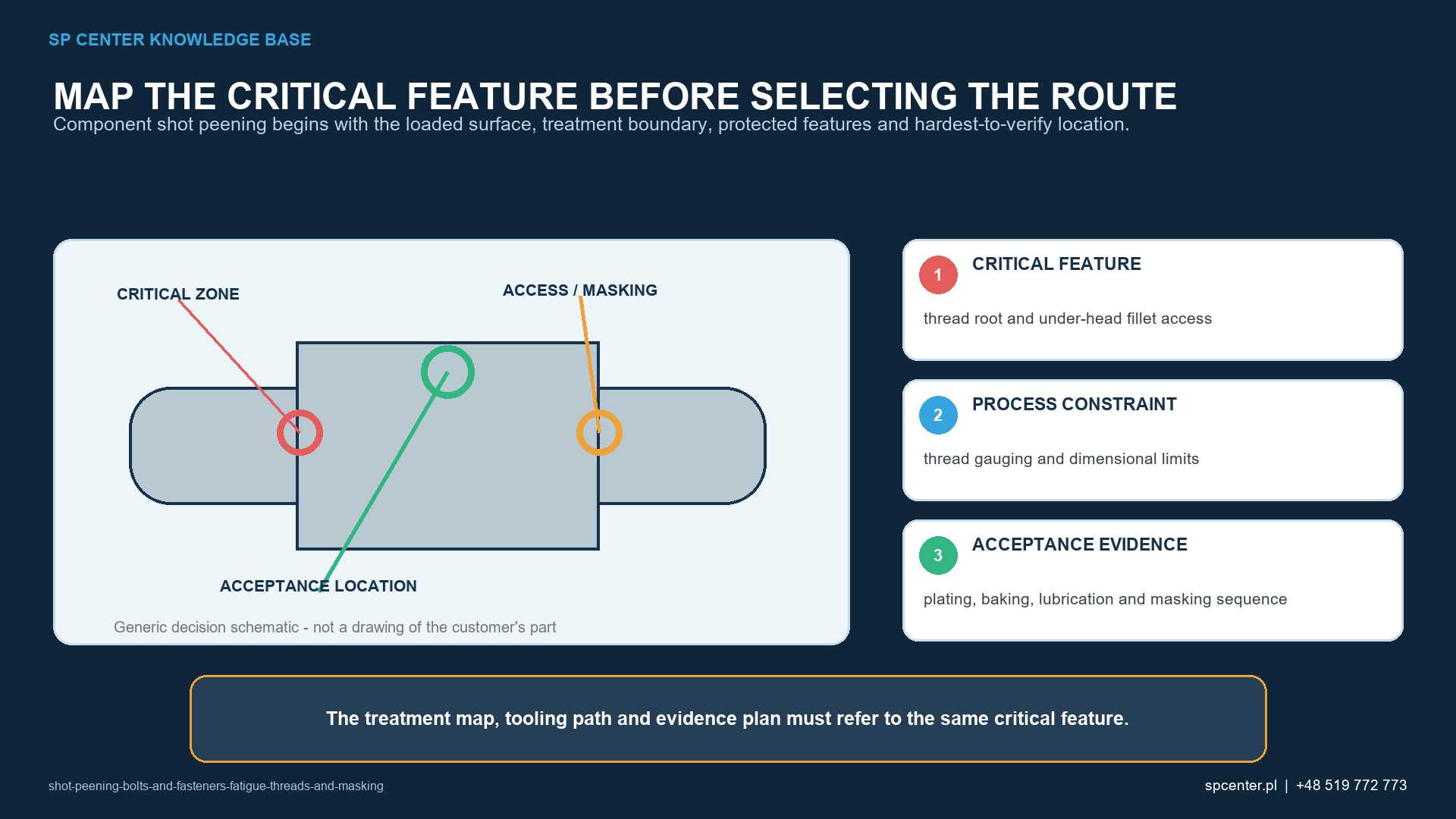
Which fastener features require separate decisions?
A threaded fastener combines geometric notches, preload, mean stress, cyclic load, contact and friction. Failure location depends on the particular design and manufacturing history. It cannot be inferred solely from the generic name “bolt” or from tensile strength.
| Fastener feature | Main technical concern | Controlled decision |
|---|---|---|
| Loaded thread roots | High local stress but difficult line-of-sight and variable impact angle | Explicitly authorize treatment and qualify access, coverage method and thread acceptance |
| Thread runout | Combined notch, section and manufacturing transition | Define start and stop boundaries, motion and inspection |
| Under-head fillet | Fatigue-critical transition with shadowing by the head | Qualify nozzle or wheel access, fixture orientation and overlap |
| Shank or reduced section | Dimensional, surface and bending requirements can differ | State the exact treatment length and dimensional limits |
| Bearing face, drive feature or precision fit | Friction, seating, torque transfer and assembly can be affected | Treat, exclude or mask according to controlled design data |
| Blind hole or internally threaded feature | Access and retained media are difficult to verify | Use a separately qualified route with effective cleaning and inspection |
Table 1. Surface function, access and acceptance method determine whether and how each feature is peened.
ISO 898-1 specifies mechanical and physical properties for certain carbon- and alloy-steel bolts, screws and studs within its stated scope. Its own scope does not specify fatigue resistance or torque/clamp-force performance. Conformity to a property class therefore does not by itself qualify a shot-peening route or fatigue claim.
Why are thread roots and runout difficult to process?
The root is narrow, curved and partly shadowed by adjacent flanks. Impact angle and line-of-sight change around the circumference and along the helix. A nominal nozzle direction or wheel setting can produce an acceptable Almen result while leaving inconsistent root exposure.
Qualification should use the actual diameter, pitch, thread form, runout and fixture. It should demonstrate rotation or other motion, stream overlap and the hardest-to-reach location without unacceptable flank rounding, dents, burrs or media embedment. A flat coupon cannot prove root coverage.
How does thread manufacture affect the route?
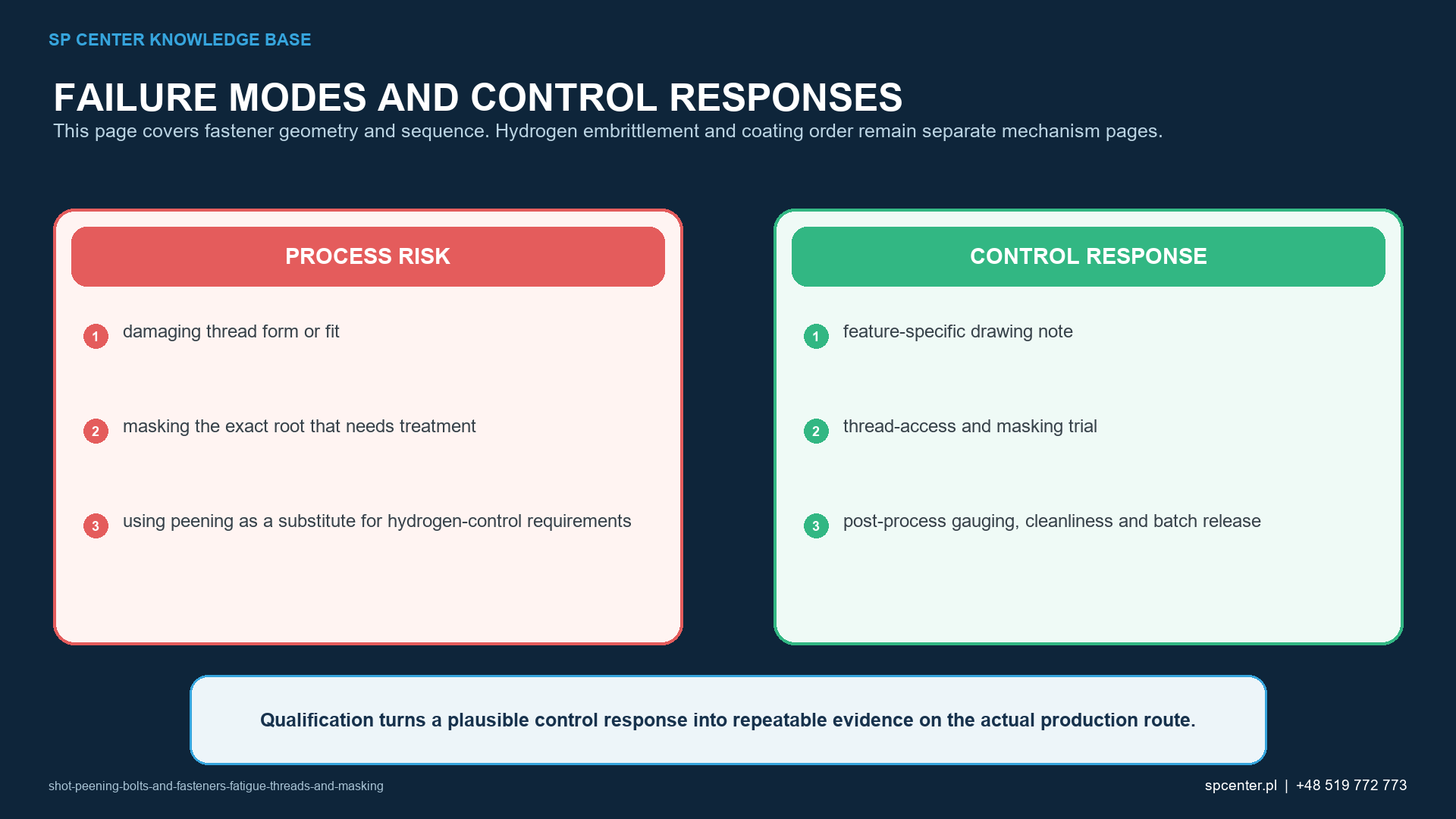
Rolled, cut and ground threads can differ in root geometry, surface finish, laps, grinding damage and incoming residual stress. The order of thread manufacture, heat treatment, peening, cleaning and coating is part of the qualified configuration. A result for a rolled thread after heat treatment cannot be transferred to a cut thread or to a different order without review.
Shot peening does not repair cracks, laps, decarburization, grinding burn or an unacceptable thread form. Incoming inspection and product-standard requirements remain in force before peening.
What must be protected beyond the thread root?
Bearing faces and under-head geometry influence seating and load transfer. Flanks and pitch diameter control fit. Drive recesses, splines, cross-holes and locking features can trap media or be damaged. Masking and fixtures must be repeatable, clean and traceable and must not scratch high-stress transitions.
Thread gauges and dimensional checks should be selected by the controlling product or drawing requirement. A passing gauge is important but does not by itself prove coverage, residual stress, preload behaviour or fatigue performance.
How do coating, lubrication and hydrogen control interact?
Cleaning, activation, electroplating, conversion coating, lubrication and baking can change the final surface and friction condition. High-strength steels can also be susceptible to hydrogen embrittlement. Shot peening introduces compressive residual stress but does not extract hydrogen and cannot replace a required embrittlement-relief bake or process-control test.
ISO 12686 addresses automated controlled shot peening of certain steel articles before nickel, autocatalytic nickel or chromium plating, including applications intended to reduce susceptibility to hydrogen embrittlement. Its scope is not a universal fastener instruction. ASTM F519, F1940 and F606/F606M also have defined scopes; use them only when invoked by the product, coating or customer authority.
Which evidence supports qualification and release?
| Evidence layer | What it establishes | What it cannot establish alone |
|---|---|---|
| Material, heat treatment and thread-manufacture records | The fastener entered peening in the qualified metallurgical and geometric state | That roots were reached or fatigue improved |
| Almen intensity and saturation | The peening stream is verified at defined test locations | Coverage at a thread root or an acceptable thread form |
| Component coverage | The authorized zone shows the required impact evidence by the approved method | Pitch diameter, flank damage, fit or preload behaviour |
| Thread and dimensional inspection | Form, pitch diameter, runout, length and fit meet invoked limits | Residual-stress depth or fatigue performance |
| Coating and hydrogen-control records | The specified plating, cleaning and bake route was followed | That peening removed hydrogen or replaced embrittlement testing |
| Representative fastener fatigue test | The complete material-thread-peening-coating configuration addresses a defined load case | Transfer to another diameter, thread process, coating or preload |
Table 2. Fastener release may require process, geometry, finishing and performance evidence; no single result substitutes for the others.
Which nonconformities require containment?
- The thread root or under-head fillet is outside the qualified stream footprint.
- Mask leakage exposes a bearing face, precision shank or drive feature.
- Thread flanks are rounded, dented, burred or contaminated by media.
- Thread gauges, pitch diameter, runout, length or straightness fail.
- Media remains in an internal thread, recess, cross-hole or locking feature.
- The coating, lubrication or baking route differs from the qualified sequence.
- A fatigue claim is transferred to another diameter, thread process, property class or preload without evidence.
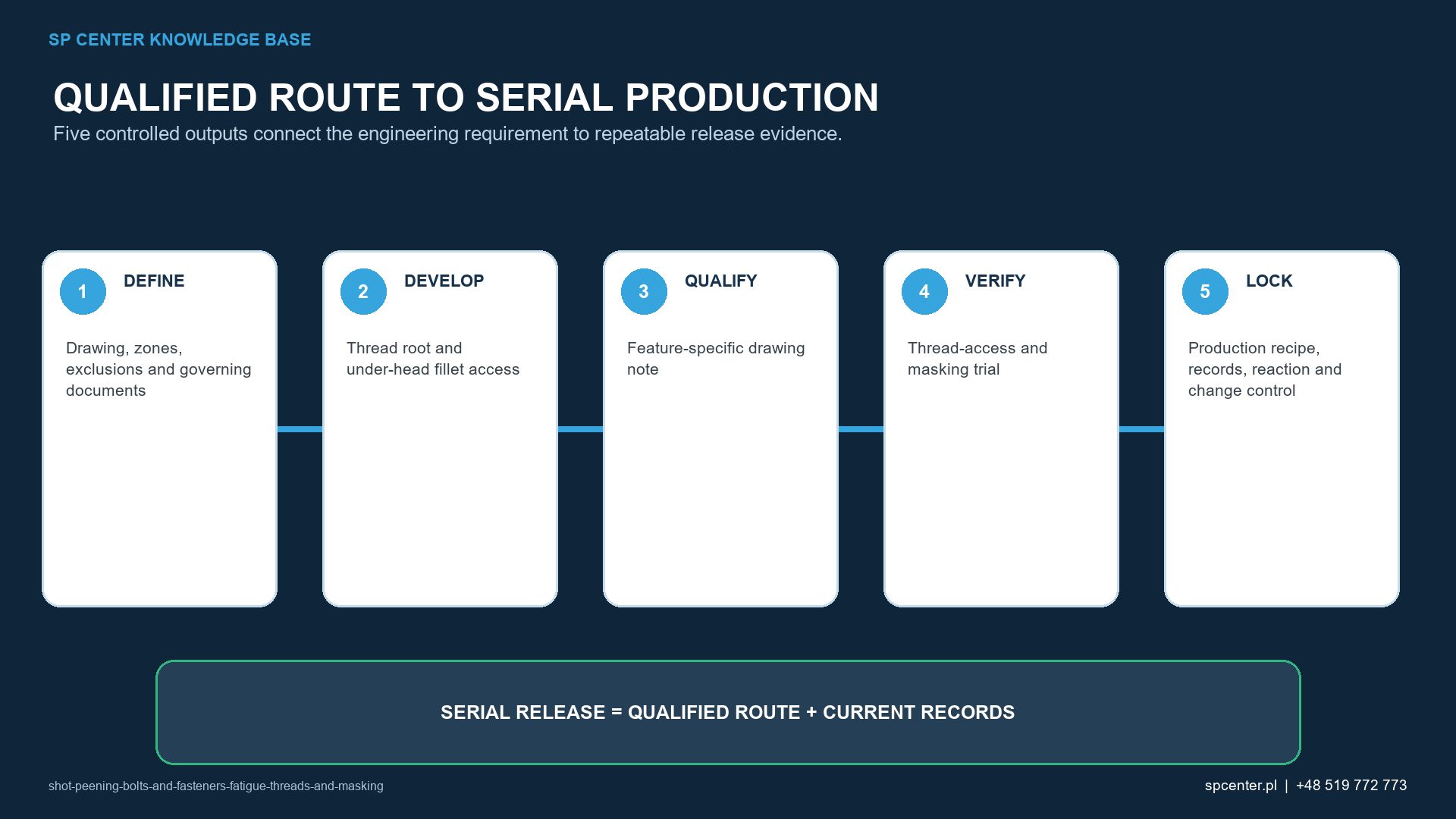
Stop processing and contain the affected lot from the last verified acceptable condition. Preserve machine, media, fixture, program, inspection and finishing records and obtain the required disposition. Repeat peening is not an automatic correction because cumulative exposure and thread damage can increase.
What should an RFQ or purchase order define?
| RFQ input | Why it matters | Risk prevented |
|---|---|---|
| Fastener standard, part number and revision | Defines identity, geometry, property class and controlling authority | A generic bolt process overrides product requirements |
| Material, hardness and heat treatment | Controls plastic response and hydrogen susceptibility | A route is copied between unlike strength levels |
| Rolled, cut or ground thread and manufacturing order | Defines root geometry and incoming residual-stress condition | Thread manufacture and peening sequence are assumed equivalent |
| Treatment, exclusion and masking map | Separates roots, runout, under-head fillet, shank and fits | Critical roots are missed or functional faces are damaged |
| Coating, lubrication, bake and assembly requirements | Links corrosion protection, friction and hydrogen controls | Peening is treated as a substitute for the specified finishing route |
| Inspection, fatigue claim and traceability | Defines release evidence and lot linkage | Settings alone are used to promise fastener life |
Table 3. A technically complete request separates fastener identity, manufacturing state, treatment map and final acceptance.
Also state lot size, packaging, cleanliness, required certificates, source approval and deviation authority. If thread treatment or a coating-bake interaction is unclear, processing should wait for controlled clarification rather than an assumed shop practice.
Frequently asked questions
Can bolt threads be shot peened?
Only when the drawing or approved specification authorizes it and the actual thread root, flank and runout can be processed and accepted by a qualified method.
Should every high-strength fastener be shot peened?
No. Material strength alone does not authorize peening. Geometry, thread manufacture, coating, preload, service loading and customer requirements determine the route.
Are rolled and cut threads equivalent for peening?
No. They can differ in root geometry, surface integrity and residual-stress state. Qualification must represent the actual manufacturing method and sequence.
Does Almen intensity prove coverage in a thread root?
No. Intensity verifies the stream at the test fixture. Root access and coverage require a component-specific approved method.
Can shot peening repair a cracked or damaged thread?
No. Cracks, laps, grinding damage and unacceptable thread form require detection and disposition before peening.
Can peening replace a hydrogen-embrittlement relief bake?
No. Peening does not remove hydrogen. The invoked cleaning, plating, baking and verification requirements remain mandatory.
Can an external-thread process be used for internal threads?
Not without separate qualification. Internal threads have different access, shadowing, media-retention and inspection problems.
What information is needed to quote fastener peening?
Provide the controlled drawing, fastener and material specification, thread method, heat treatment, treatment map, coating and bake route, dimensions, quantities and records.
Key takeaways
- Treat roots, runout, under-head fillets, shanks and bearing faces as different functions.
- Qualify access and coverage on the actual thread geometry and fixture.
- Keep rolled, cut and ground threads and their operation order distinct.
- Protect form, fit, friction and assembly functions with controlled boundaries.
- Do not use peening to repair defects or replace hydrogen-control processing.
- Separate intensity, coverage, dimensional acceptance, coating records and fatigue evidence.
Related SP Center guides
- Shot Peening and Hydrogen Embrittlement
- Shot Peening Before or After Heat Treatment
- Shot Peening of Steel Components
- Shot Peening and Fatigue Life
Technical references
1. SAE J2441_202511: Shot Peening, stabilized November 2025
2. SAE AMS2430U: Shot Peening, revised April 2018
3. SAE ARP7488: Peening Design and Process Control Guidelines, issued January 2018
5. ISO 898-1:2013, Mechanical Properties of Carbon- and Alloy-Steel Bolts, Screws and Studs
6. ASTM F606/F606M, Mechanical Test Methods for Threaded Fasteners and Related Products
8. ASTM F1940, Process-Control Verification for Hydrogen Embrittlement in Plated or Coated Fasteners
Standards note: Confirm the current complete revision invoked by the product standard, drawing, coating specification and customer flow-down. These sources do not authorize a universal thread-peening recipe.
Author: Paweł Kmieć
Discuss shot peening for bolts or fasteners: +48 519 772 773 | [email protected]