


Separate rolling-contact surfaces from non-contact features and protect texture, form, cleanliness and lubrication functions through surface-specific authorization
Shot peening can be appropriate for selected bearing-component features, but a bearing is not one uniform surface. A route that benefits a non-contact fillet may be unacceptable on a finished raceway or rolling element because texture, waviness, form, cleanliness and lubrication can dominate rolling-contact behaviour. Every surface therefore needs an explicit treatment, exclusion or protection decision.
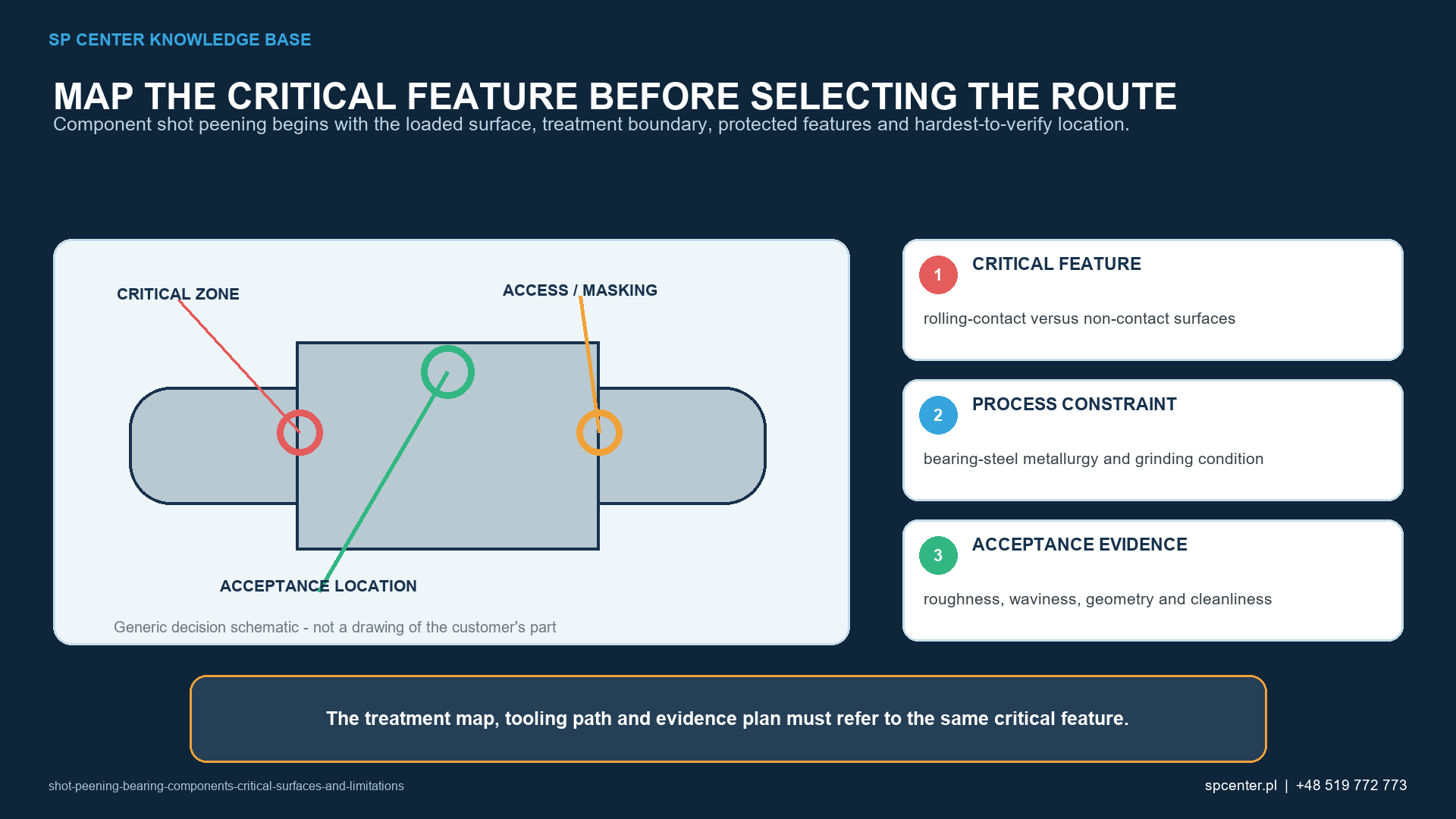
Which bearing surfaces have different functions?
Bearing rings, balls, rollers, cages, shoulders, fillets, mounting seats, seal tracks and lubrication paths do not share one stress state or acceptance method. Raceway and rolling-element surfaces carry repeated Hertzian contact, while a shoulder or transition may be governed by bending, assembly or local notch stress. These failure mechanisms must not be treated as interchangeable.
| Bearing feature | Main concern | Controlled decision |
|---|---|---|
| Finished raceway | Roughness, waviness, form, dents and contamination can govern rolling contact | Treat only when the drawing and qualified route explicitly authorize it |
| Rolling element | Surface integrity, size, roundness and contact finish are critical | Do not infer a ring process is transferable to balls or rollers |
| Non-contact fillet or shoulder | Bending fatigue or stress concentration may be relevant | Define treatment boundary, access, masking and component checks |
| Cage, pocket or lubrication path | Thin sections, retained media and altered flow are possible | Define treatment need, distortion limit, cleaning and media-release verification |
| Mounting, seal or fit surface | Diameter, roughness and assembly function can change | Treat, exclude or protect according to controlled design data |
| Ground or superfinished transition | Grinding burn, cracks or later stock removal can dominate | Control incoming inspection and the exact finishing-peening sequence |
Table 1. The functional surface determines the process boundary and release evidence.
ISO 15243 classifies visible damage and failure modes of rolling bearings made from standard bearing steels. It can support consistent failure terminology, but it does not qualify a peening process or prove the root cause from appearance when further investigation is needed.
Why are finished raceways particularly sensitive?
Peening impacts can change profile and areal texture, waviness, form, diameter and local topography. They can also create dents, transfer media or retain debris. In rolling contact, these changes interact with contact pressure, lubricant film, sliding, contamination, material cleanliness and subsurface defects. A more compressive stress value cannot be considered in isolation from those trade-offs.
A specialised process may intentionally treat a raceway or rolling element, but it needs explicit design authority and qualification on the actual material, hardness, geometry, initial finish and service-relevant contact condition. Evidence from a free flat coupon or a non-contact fillet is not sufficient.
How do material and grinding condition affect qualification?
Through-hardened, carburized, nitrided and other bearing materials can differ in hardness gradient, case depth, retained austenite, carbide or inclusion state and damage tolerance. Use the controlled material and heat-treatment condition rather than the generic term “bearing steel”.
Incoming grinding or superfinishing must be acceptable before peening. Shot peening does not repair grinding burn, cracks, laps or other rejectable defects. If grinding or superfinishing follows peening, the qualified route must control material removal because it can remove or change the treated layer.
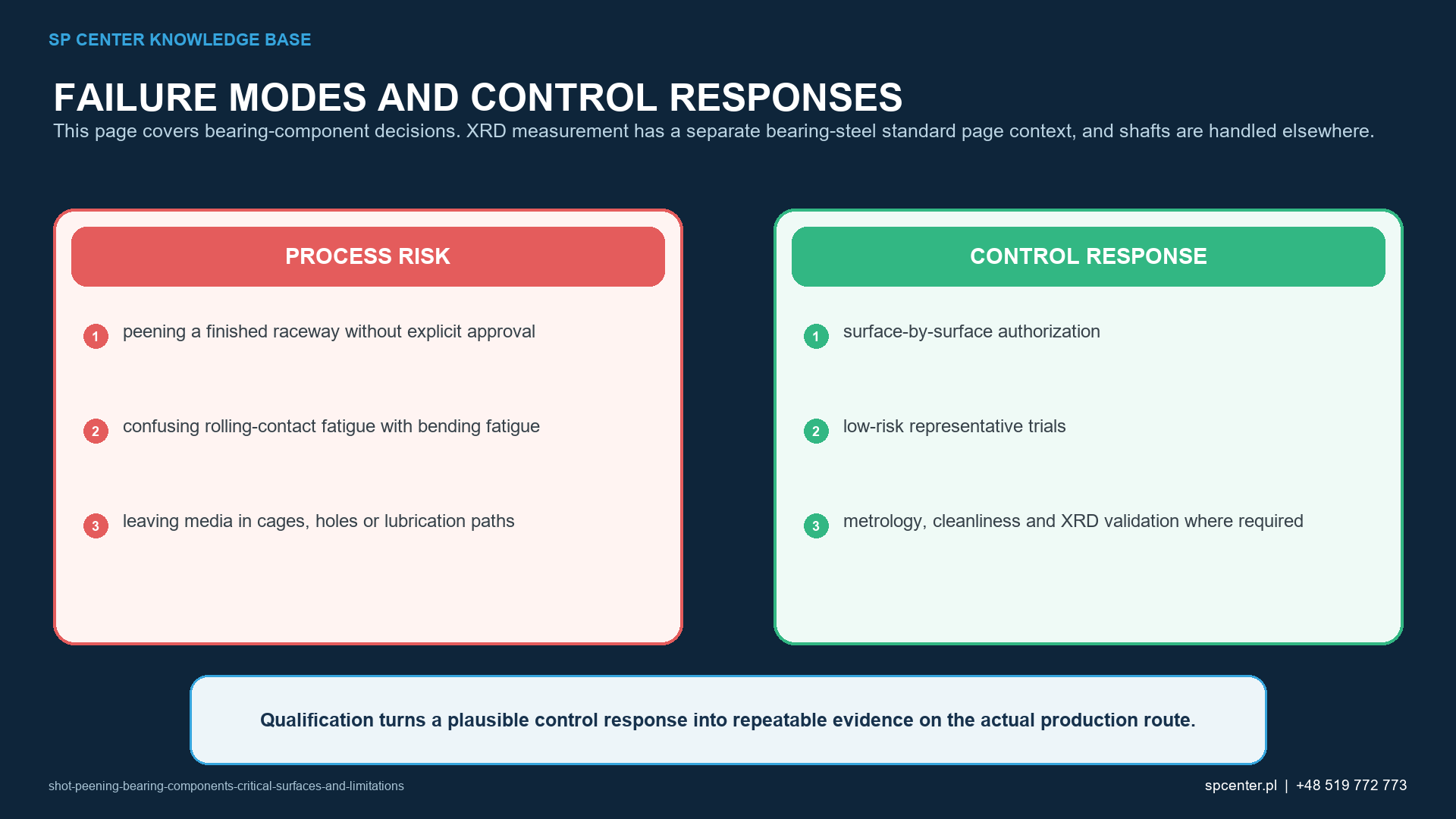
How are treatment, exclusion and masking zones controlled?
The drawing or approved process map should identify rolling-contact zones, non-contact features, mounting and seal surfaces, oil paths and transition boundaries. Masking must be repeatable without scratching precision surfaces or shedding debris. Where a treatment boundary lies near a raceway, the transition and overspray risk require representative verification.
Fixtures should locate the correct component revision, preserve roundness and expose the most difficult feature. Rotation, nozzle or wheel direction, stand-off, angle and footprint overlap must be qualified without uncontrolled dwell. Cages and thin sections need distortion limits and confirmed media removal.
Which evidence supports qualification and release?
| Evidence layer | What it answers | What it does not answer alone |
|---|---|---|
| Almen intensity and saturation | Is the peening stream controlled at defined verification locations? | Was every bearing surface reached and preserved? |
| Component coverage | Does the authorized treatment zone show the required impact evidence? | Are raceway texture, form, cleanliness or fatigue acceptable? |
| Texture and geometry | Do roughness, waviness, roundness, diameter, runout and profile meet invoked limits? | Is the residual-stress field or rolling-contact life proven? |
| Cleanliness and damage inspection | Is media absent from cages, holes and oil paths and is the surface undamaged? | Did the process create the required stress depth? |
| Residual-stress measurement | What defined stress component exists at the stated location and direction? | Does another surface, depth, direction or material share that result? |
| Representative performance test | Does the qualified configuration meet the defined rolling-contact or bending-fatigue question? | Can the result be transferred without equivalence review? |
Table 2. No single surrogate releases all bearing functions.
The measurement plan should state surface, position, direction, instrument, filter or evaluation length where applicable, calibration or verification, sampling and acceptance authority. When XRD is invoked, record material, diffraction method, stress direction, location, depth method and uncertainty. ASTM E2860 has a bearing-steel-specific scope and is not a universal residual-stress method for every alloy.
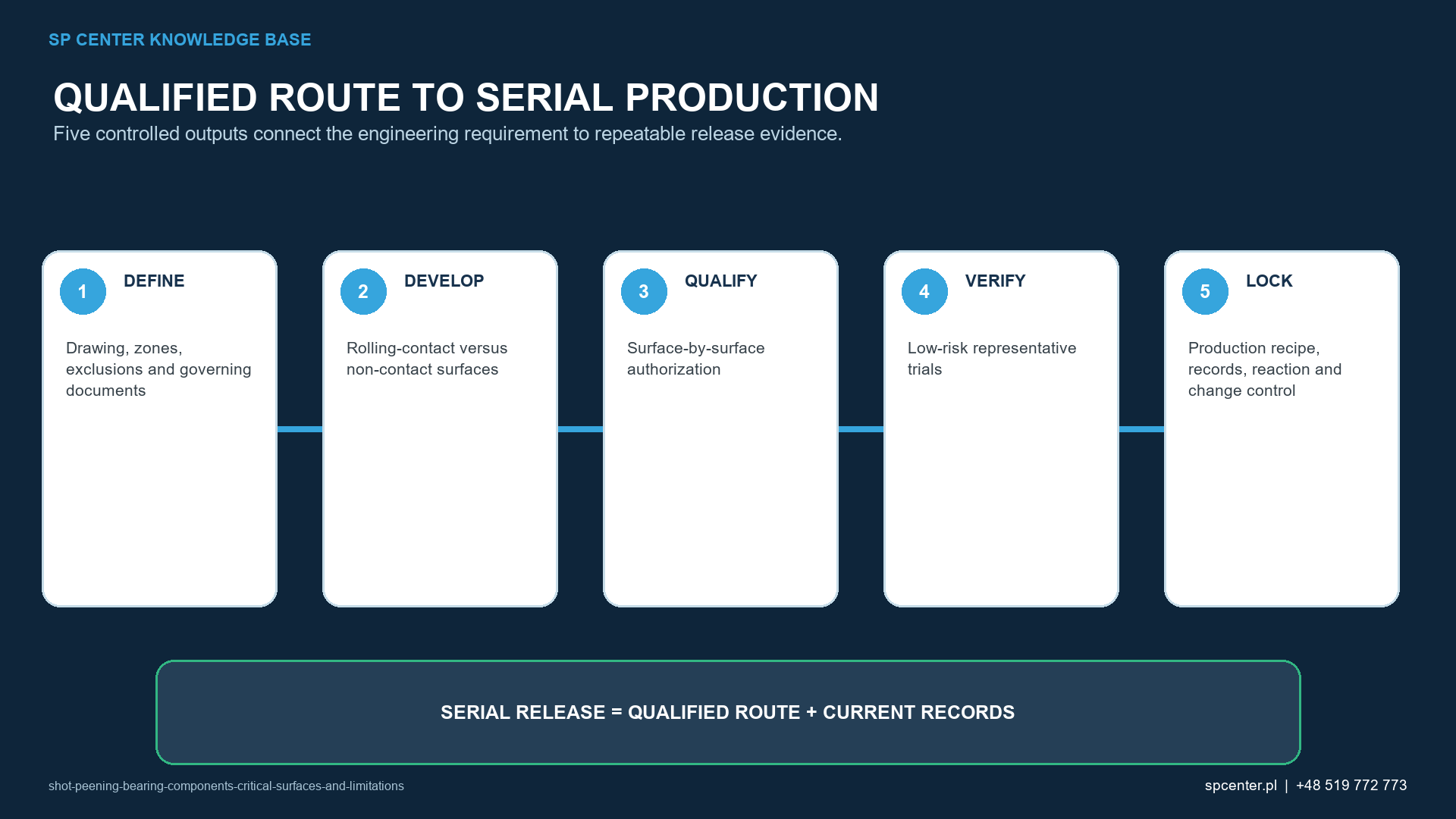
Which failures require containment?
- A finished raceway or rolling element is peened without explicit authorization.
- Mask leakage or fixture error exposes a fit, seal or contact surface.
- Media remains in a cage pocket, cross-hole or lubrication path.
- Surface texture, waviness, roundness, runout or diameter moves outside its limit.
- Grinding burn or a crack is hidden or treated as though peening repaired it.
- Media contamination or embedment is unacceptable for the bearing material or lubricant system.
- A ring process is transferred to rollers, balls or another size without equivalence review.
Stop and contain product from the last verified acceptable condition. Preserve part, media, fixture, program, cleaning and inspection evidence, determine the affected scope and obtain the required engineering or customer disposition. Repeat peening or additional finishing is not an automatic correction.
What should an RFQ or purchase order define?
| RFQ input | Why it matters | Risk prevented |
|---|---|---|
| Bearing component type and function | Separates ring, raceway, rolling element, cage and non-contact feature | A generic bearing recipe is assumed |
| Material, heat treatment and case condition | Controls hardness, retained austenite, case depth and damage sensitivity where applicable | Different metallurgical states are treated as equivalent |
| Treatment, exclusion and transition map | Protects contact, fit, seal and lubrication functions | A finished raceway is peened by omission |
| Grinding and superfinishing route | Defines incoming surface and any stock removal after peening | The peened layer is damaged or removed |
| Surface, form, cleanliness and customer-specified inspections outside SP Center's service scope limits | Builds component acceptance beyond intensity and coverage | A visually peened part is released despite functional damage |
| Performance claim and records | Defines whether residual stress, rolling-contact fatigue or other validation is required | A life promise is inferred from process settings |
Table 3. A technically comparable quotation needs surface function and acceptance limits, not only a bearing name.
Also state component size and mass, datums, handling restrictions, lubricant-cleanliness requirements, packaging, lot logic and required customer approvals. If the treatment status of a raceway or precision surface is unclear, processing should wait for controlled clarification.
Frequently asked questions
Can bearing raceways be shot peened?
Only when the controlled design and qualified route explicitly permit it. Finished raceways have demanding texture, form, cleanliness and contact-fatigue requirements, so peening them cannot be assumed acceptable.
Can a non-contact bearing fillet be peened?
Potentially, when the drawing identifies the feature and qualification demonstrates access, coverage, surface condition and dimensional acceptance. A fillet result does not authorize the raceway.
Does compressive residual stress always improve rolling-contact fatigue?
No universal conclusion applies. Texture, defects, material state, stress depth, contact pressure, lubrication and cleanliness interact. A claim needs representative validation.
Can Almen intensity prove a raceway is acceptable?
No. Intensity characterizes the stream at standardized verification locations. Raceway texture, waviness, form, coverage, cleanliness and any performance requirement remain separate.
Should a raceway always be masked?
There is no universal rule. It should be treated, excluded or protected exactly as the controlled drawing, specification or approved technical decision requires.
Can shot peening repair grinding burn or a raceway crack?
No. Grinding damage, cracks, laps or other rejectable defects require detection and disposition before peening under the applicable manufacturing route.
Can superfinishing be performed after peening?
Only through a qualified sequence. Material removal can change roughness and remove part of the compressed layer, so stock allowance, final geometry and retained performance require control.
Does ASTM E2860 apply to every bearing alloy?
No. Its scope is X-ray diffraction residual-stress measurement for specified bearing steels. Material, geometry, measurement direction and the governing acceptance method must be checked.
Key takeaways
- Separate raceways and rolling elements from non-contact fillets, shoulders and cages.
- Do not peen a finished raceway without explicit authorization and representative qualification.
- Control metallurgy, grinding condition, sequence, texture, form and cleanliness together.
- Keep Almen intensity, component coverage, surface acceptance, residual stress and performance distinct.
- Do not use peening to repair grinding damage or cracks.
- Verify complete media removal from cages, holes and lubrication paths.
Related SP Center guides
- Shot Peening Transmission Components
- Shot Peening Shafts and Axles
- Surface Roughness Measurement After Shot Peening
- XRD Residual Stress Measurement
Technical references
1. SAE J2441_202511: Shot Peening, stabilized November 2025
2. SAE AMS2430U: Shot Peening, revised April 2018
3. SAE ARP7488: Peening Design and Process Control Guidelines, issued January 2018
6. ISO 15243:2017, Rolling Bearings – Damage and Failures
7. SAE J2277_202301: Shot Peening Coverage Determination, revised January 2023
Standards note: Bearing design and customer requirements determine the permitted surfaces and acceptance methods. A failure-classification or XRD standard does not itself authorize peening.
Author: Paweł Kmieć
Discuss shot peening for a bearing component: +48 519 772 773 | [email protected]