


When compressive residual stress can support SCC control – and which component evidence is still required
Shot peening can support the control of stress-corrosion cracking (SCC) by reducing a harmful tensile-stress contribution at or near the surface. That benefit is conditional. SCC requires the interaction of a susceptible material, a specific environment and a damaging stress state; shot peening changes only part of that system. It does not make a susceptible alloy corrosion-proof and does not replace material selection, environmental control, coatings, inspection or representative SCC validation.
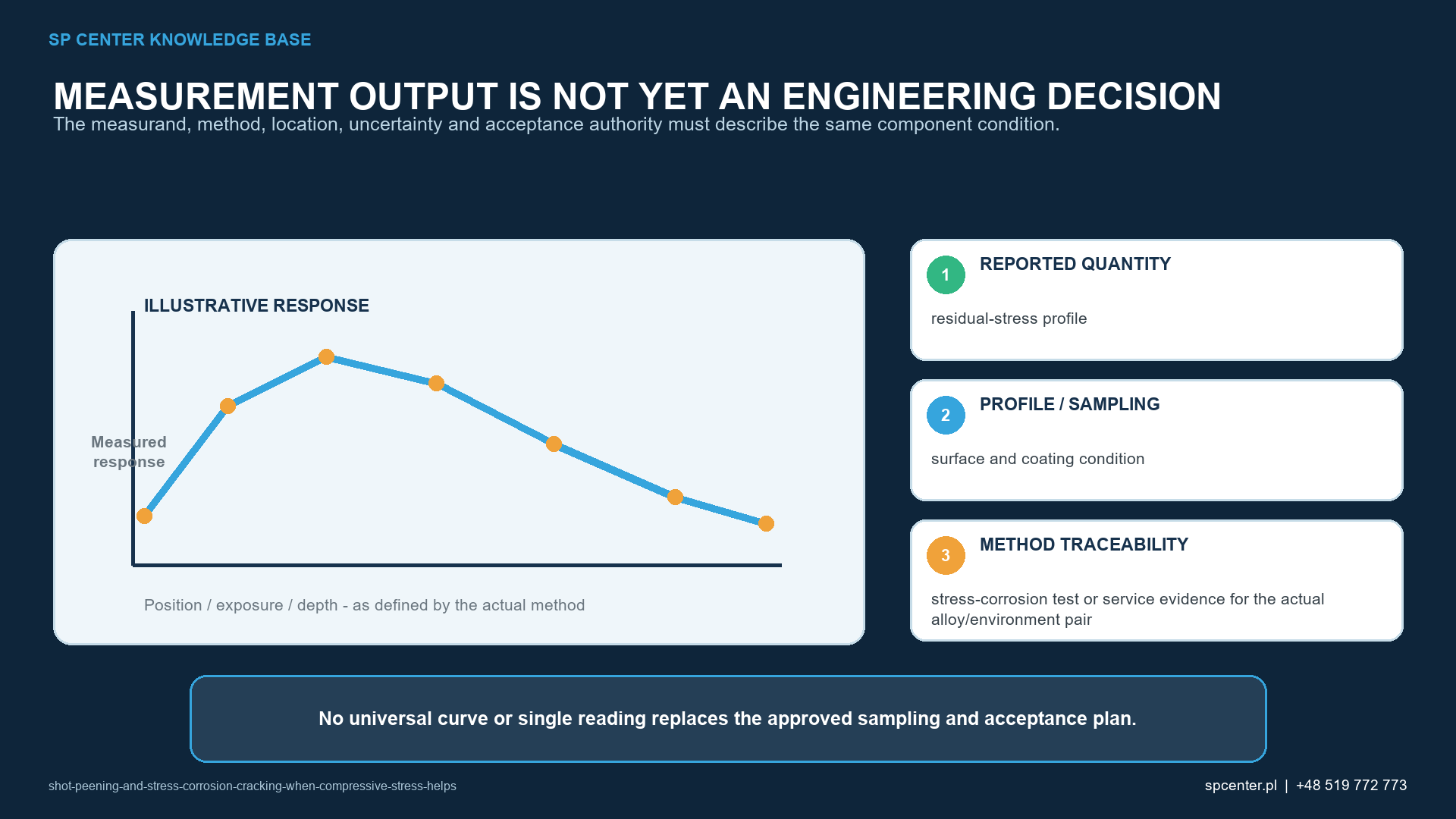
What must be true before shot peening can help with SCC?
The engineering review must consider the actual alloy and heat-treatment condition, the chemical and thermal environment, the source and direction of tensile stresses, the drawing-defined critical surface and the retained residual-stress field after all subsequent manufacturing and service exposures. A generic statement that compressive stress is beneficial is not enough to approve a component.
Residual stress is not permanent under every condition. Elevated temperature, cyclic loading, plastic deformation, machining, grinding, straightening or an incompatible downstream process can relax, redistribute or remove the treated layer. Qualification should therefore represent the production sequence and the service conditions relevant to the claim.
Which four decision dimensions must be reviewed together?
| Decision dimension | Question to resolve | Evidence needed |
|---|---|---|
| Material-environment susceptibility | Is the actual alloy and heat-treatment condition susceptible in the specified environment? | Applicable material data, customer requirement and representative SCC evidence |
| Stress state | Are damaging tensile stresses present, and are beneficial compressive residual stresses retained in the critical zone? | Manufacturing history, load and temperature review, and component-specific residual-stress evidence where required |
| Surface and coating condition | Can roughness, contamination, embedded media, damage or coating discontinuity change local corrosion behaviour? | Incoming and final surface acceptance, media-compatibility controls and coating verification |
| Geometry and access | Can the qualified stream reach the complete drawing-defined zone without damaging adjacent features? | Access study, masking plan, coverage evidence and feature-specific inspection |
Table 1. No single row establishes SCC control on its own. The qualification case is defensible only when all applicable dimensions refer to the same part condition and service environment.
How can shot peening change the near-surface stress state?
Repeated controlled impacts plastically deform a shallow surface layer. Elastic constraint from the surrounding material can leave that layer in compression after impact. If tensile stress is required for crack initiation or growth in the relevant SCC mechanism, a retained compressive residual-stress field may reduce the effective tensile driving force at the surface.
The magnitude and depth of the component residual-stress field cannot be read directly from Almen intensity. They depend on material properties, hardness, prior manufacturing, media, intensity, coverage, geometry, impact angle and exposure. Component-specific residual-stress measurement is a validation tool when required; it is not a routine substitute for Almen verification, coverage inspection or configuration control.
Why can the surface and coating condition reverse the expected benefit?
Shot peening changes surface topography. Excessive roughness, folds, edge damage, embedded particles, foreign-metal contamination or an unsuitable cleaning route can create local corrosion sites or interfere with a coating system. Media selection and cleanliness must therefore be compatible with the component, environment and downstream finish. The correct control route depends on the invoked specification and the approved process plan.
Masking and access also matter. A nominally correct process can leave an untreated band, over-treat an excluded surface or damage a coating boundary. Coverage must be evaluated on the required component area by the approved method; a satisfactory Almen result does not demonstrate access or coverage on a fillet, bore, edge or shielded feature.
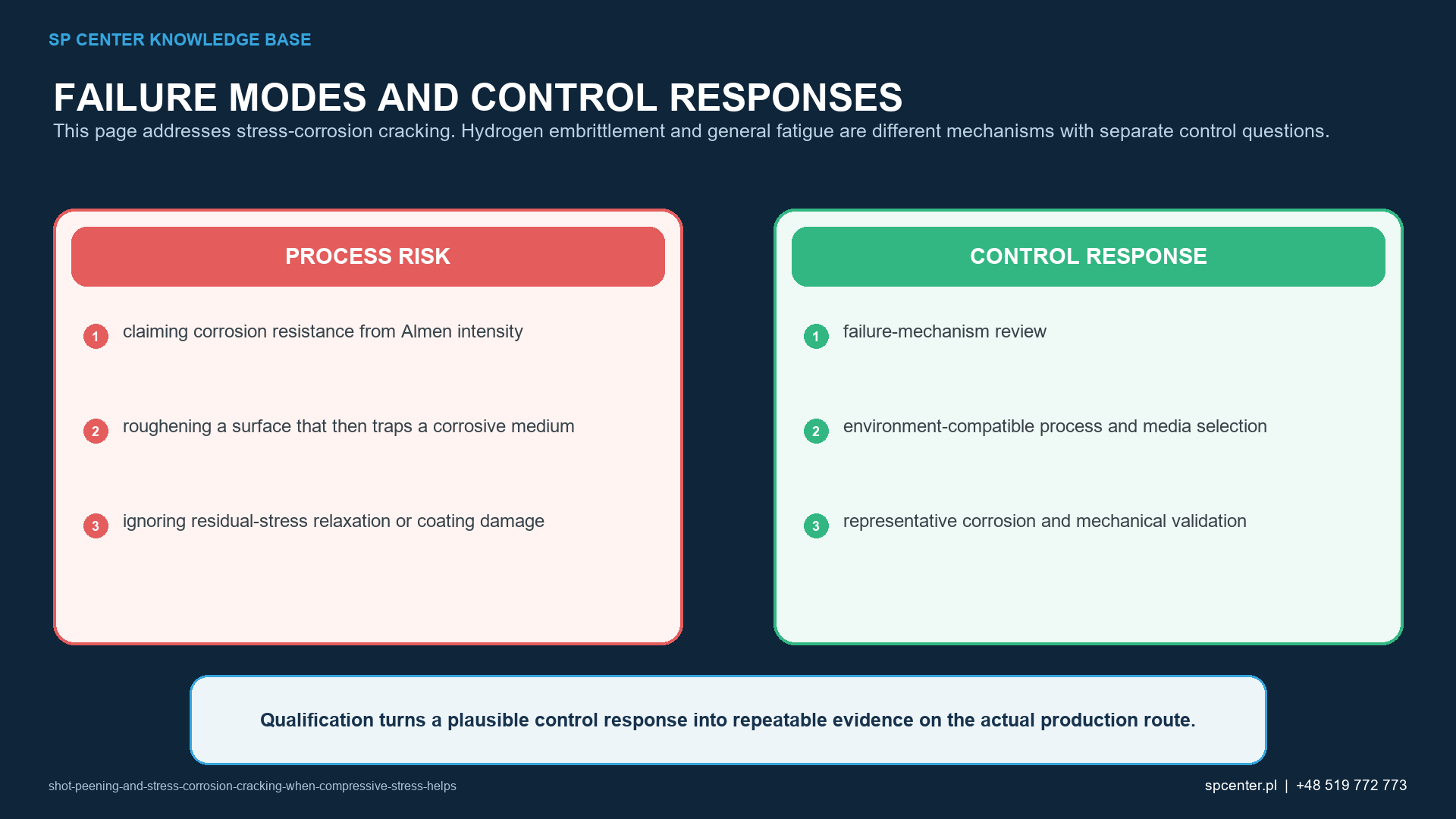
Which evidence belongs to process verification, surface acceptance and component validation?
| Evidence layer | Representative controls or results | What it does not prove by itself |
|---|---|---|
| Process verification | Almen system, intensity determination or verification, media condition, equipment, fixture, motion and monitored parameters | SCC resistance of the component in its service environment |
| Component surface acceptance | Coverage on the specified area, masking boundaries, cleanliness, coating condition, roughness or dimensions when invoked | Retained residual-stress depth profile or long-term SCC performance |
| Component validation | Residual-stress profile, representative SCC test, combined loading or environmental evidence required by the qualification plan | Automatic release of every production lot without the specified production controls |
Table 2. The three evidence layers are complementary, not interchangeable. A complete qualification or release package contains only the evidence required by the governing documents, but each item must answer the question to which it is assigned.
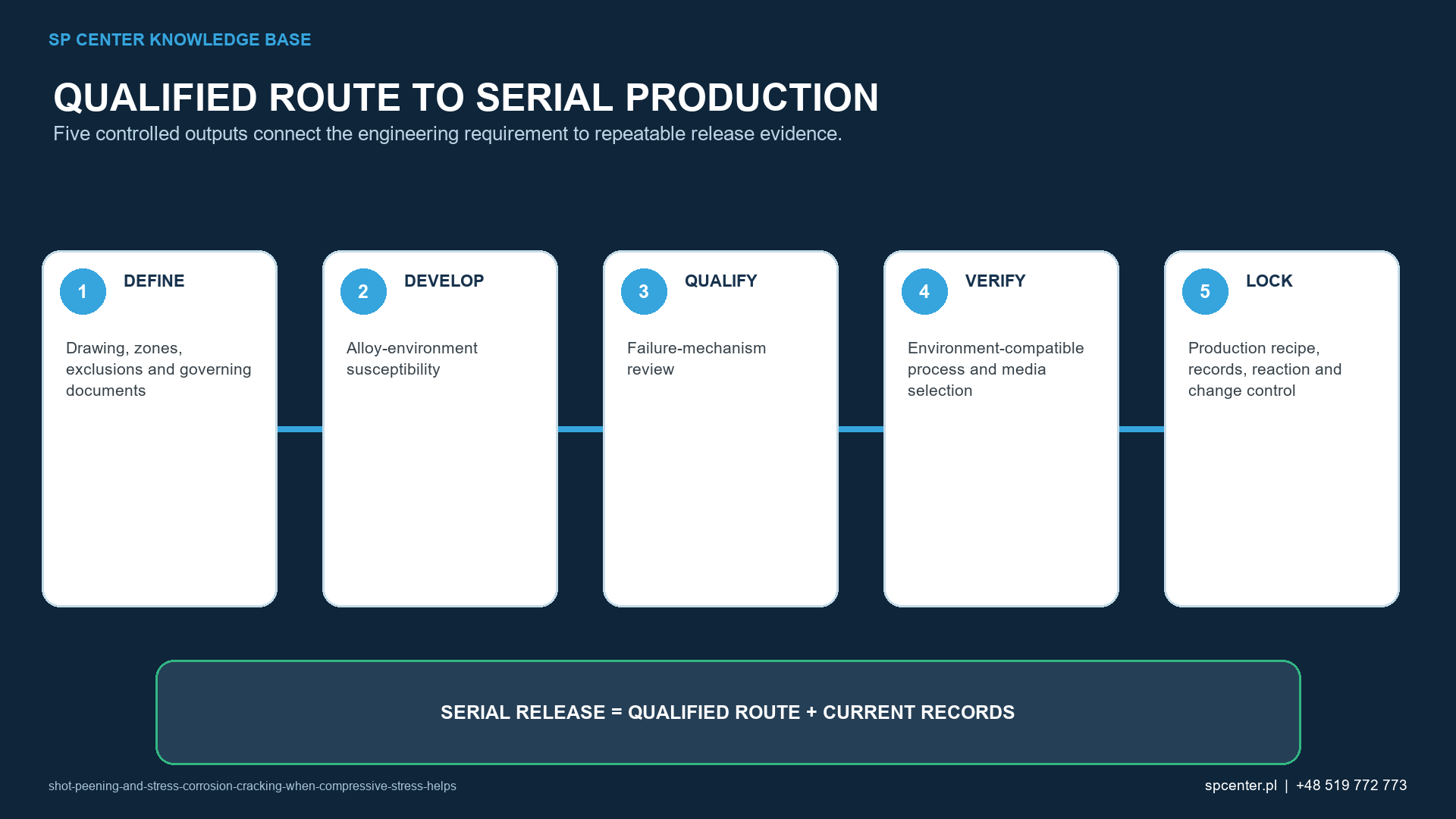
How should an SCC-related shot peening route be qualified?
- Confirm the controlled drawing, specification hierarchy, material condition, critical surfaces, service environment and SCC claim.
- Define the actual machine, media, nozzle or wheel configuration, fixture, masking, movement, treatment sequence and monitoring route.
- Determine or verify Almen intensity using the invoked method and qualified configuration.
- Establish the exposure needed to achieve the specified coverage on representative geometry without unacceptable surface or dimensional effects.
- Validate the component response required by the qualification plan, such as retained residual stress, coating compatibility or representative SCC performance.
- Approve operating limits, reaction plans, records, change control and requalification triggers before serial production.
If a customer supplement, test method or acceptance criterion is missing, production should be held while a controlled technical clarification is obtained. Internal experience cannot silently replace a contractual requirement.
Which changes can invalidate the existing qualification?
Material or heat-treatment changes, a different environment, geometry or access change, another media family, machine or nozzle configuration, altered masking, a different sequence, surface finish, cleaning or coating route, and higher service temperature can affect representativeness. The governing procedure should define the approval and requalification path. Not every change requires the same action, but no material change should be accepted by assumption.
What conditions require containment or engineering review?
| Observed condition | Immediate disposition | Engineering question |
|---|---|---|
| Intensity or monitored parameter outside the approved limit | Contain affected production and follow the approved reaction plan | Was the qualified stream maintained for the affected interval? |
| Incomplete or uncertain coverage | Do not infer acceptance from Almen results; evaluate by the approved coverage method | Was the entire required surface impacted without unacceptable boundary error? |
| Surface damage, contamination or coating defect | Hold the part for controlled review | Can the condition increase local corrosion susceptibility or invalidate the qualified state? |
| Unapproved change to material, heat treatment, sequence or service environment | Stop transfer of the previous qualification | Does existing component validation remain representative? |
Table 3. Re-peening is not an automatic correction. Cumulative exposure, roughness, dimensions, coating condition and material response must be reviewed before another cycle is authorised.
What should a drawing, RFQ or purchase order state?
- Part number, drawing and revision, material and heat-treatment condition.
- Drawing-defined treatment and exclusion zones, masking boundaries and sensitive features.
- Governing process specifications, customer supplements and approved-source requirements.
- Almen intensity range and strip designation, coverage requirement and evaluation method.
- Incoming and final surface, cleanliness, coating, roughness and dimensional limits when applicable.
- Service environment or SCC performance requirement needed to select representative validation.
- Required process, inspection, traceability, deviation and release records.
Frequently asked questions
Can shot peening prevent stress-corrosion cracking?
Not universally. It can reduce the tensile surface-stress contribution to SCC when the material, environment, surface condition and retained compressive residual stress support that mechanism. It does not remove material-environment susceptibility.
Does correct Almen intensity prove SCC resistance?
No. Almen intensity characterizes the peening stream under defined standardized conditions. SCC resistance is a component- and environment-specific performance question that requires separate validation when it is claimed or specified.
Is X-ray diffraction required for every production lot?
No universal rule applies. XRD may be required for process development or component validation, but routine production controls are those invoked by the drawing, process specification, approved plan and customer requirements.
Can a coating be applied after shot peening?
Potentially, but the sequence, surface preparation, allowable material removal, temperature and coating process must be qualified. A later operation can alter the surface or relax or remove part of the beneficial residual-stress field.
Can a qualified SCC-related process be transferred to another alloy or environment?
Not on machine settings alone. The transfer review must address alloy condition, environment, geometry, surface and coating system, service temperature, loading and the representativeness of the existing validation.
What should an RFQ include?
Provide the controlled drawing and revision, alloy and heat treatment, service environment, treatment and exclusion zones, governing specifications, intensity and coverage requirements, surface or coating limits, quantities and required validation and release records.
Key takeaways
- Shot peening can reduce a tensile-stress contribution to SCC, but it does not remove alloy-environment susceptibility.
- Material and environment, retained stress, surface and coating condition, and geometry must be reviewed together.
- Almen intensity, coverage and component SCC validation are separate evidence layers.
- Surface damage, contamination, unsuitable sequence or residual-stress relaxation can invalidate the expected benefit.
- Performance claims require component- and environment-representative evidence under the governing customer requirements.
Related SP Center guides
Technical references
1. SAE AMS2430U: Shot Peening, revised April 2018
2. SAE ARP7488: Peening Design and Process Control Guidelines, issued January 2018
3. SAE J442_202602: Tools for Peening Intensity Determination and Verification, revised February 2026
4. SAE J443_202512: Procedures for Determining and Verifying Peening Intensity, revised December 2025
5. SAE J2277_202301: Shot Peening Coverage Determination, revised January 2023
Standards note: The drawing, contract, customer requirements and revisions invoked for the programme remain authoritative.
Author: Paweł Kmieć
Discuss your shot peening requirement: +48 519 772 773 | [email protected]