


Recognize true no-go conditions, separate them from risks that need qualification, and protect the component from an unauthorized or technically unsuitable process route
Shot peening should not be used when the controlled requirements prohibit it, a rejectable defect is being treated as though peening were a repair, the specified surface cannot be reached or inspected, mandatory finish or dimensional limits cannot be met, or the final manufacturing route removes or invalidates the intended effect. Other conditions—such as high hardness, thin walls, coatings or complex geometry—are not automatic prohibitions, but they require a defensible qualification.
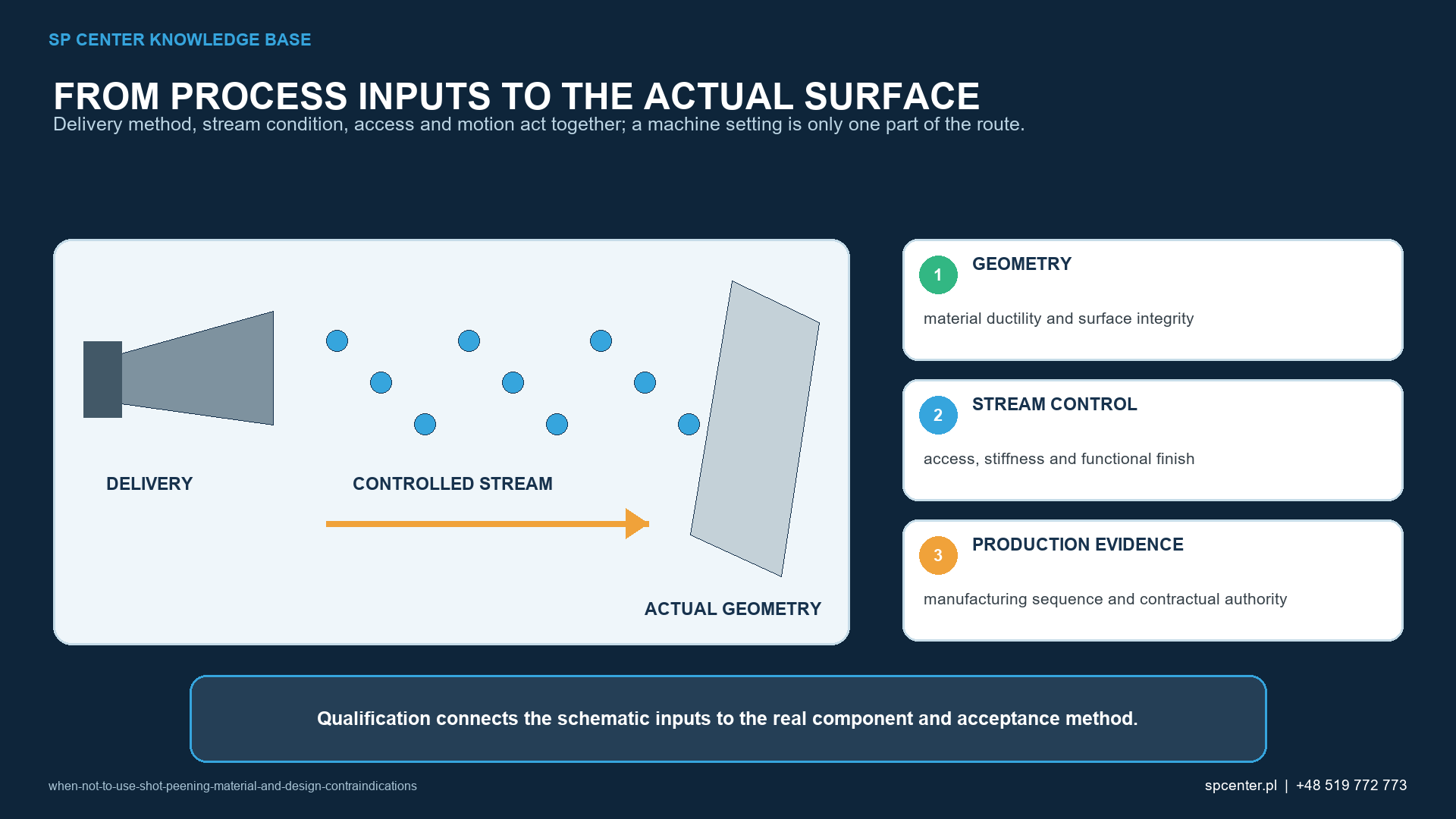
What is an actual no-go condition?
A true no-go exists when one or more mandatory requirements cannot be satisfied or when the required design, engineering, quality or customer authority is absent. Stop when the drawing prohibits peening, the process would conceal an incoming reject, the required area is physically unreachable, coverage cannot be assessed by the invoked method or a functional surface cannot tolerate the qualified impact condition.
Uncertainty is not permission. If the drawing, purchase order and process specification conflict or omit a necessary decision, place the work on hold and obtain a controlled clarification. An internal recipe cannot replace missing contractual authority.
| Screening condition | Engineering question | Typical decision route |
|---|---|---|
| Drawing or contract prohibits or does not authorize peening | Is there controlled authority for the exact part, area and process sequence? | Stop and obtain formal clarification or design/customer approval before processing |
| Crack, fold, lap, severe corrosion, loss of section or other rejectable defect | Is the incoming condition acceptable and is peening being mistaken for a repair? | Stop; use the authorized inspection, repair or rejection route |
| Brittle, very hard, porous or damage-sensitive material state | Can the required plastic deformation be introduced without cracking, particle pull-out or unacceptable roughness? | Representative material and geometry qualification or no-go |
| Thin, compliant or dimensionally critical feature | Can intensity, sequence and fixturing meet free-state shape and dimensional limits? | Distortion qualification with explicit stop criteria or alternative route |
| Recess, blind feature or inaccessible surface | Can the qualified stream reach the full required area and can coverage be assessed? | Demonstrate access and inspection; otherwise revise the design or route |
| Functional finish, sealing, bearing, thread or aerodynamic surface | Can impact texture, edge change and material transfer remain within the invoked limits? | Protect or exclude the area, qualify a narrow window or do not peen it |
| Existing or planned coating, plating or diffusion treatment | Is impact permitted at that stage and will later operations preserve the required layer? | Define and qualify the complete sequence; do not assume compatibility |
| High-temperature or material-removal operation after peening | Will heat relax residual stress or finishing remove the affected layer? | Validate the final-route result or move/replace the operation with design authority |
| Contamination or cleanliness constraint | Are media material, equipment segregation, cleaning and verification adequate? | Establish qualified controls or select a compatible route |
Table 1. Suitability depends on the exact component state, feature and manufacturing route; few material or geometry labels create a universal answer.
Which material conditions require caution rather than a blanket ban?
Brittle, very hard, porous, additively manufactured, cast, plated or damage-sensitive conditions can respond differently to repeated impact. Relevant risks include cracking, edge chipping, particle pull-out, fold formation, excessive roughness, contamination and dimensional change. Hardness alone is not a universal suitability limit.
Use representative material, heat treatment, surface condition and geometry. A flat coupon can screen material response but may not represent a thin edge, pore population, notch, case depth or complex stress concentration. Define stop criteria before the trial and examine the most damage-sensitive location.
When do geometry and access make the route unsuitable?
A stream must reach every required area at a controlled angle and energy while masks, fixtures and adjacent features remain protected. Deep bores, undercuts, close-spaced teeth, back faces and narrow passages can create shadowing or media retention. More exposure on an accessible surface does not correct a blind region.
If the critical area cannot be reached with qualified equipment, or its coverage cannot be demonstrated using the approved direct or correlated indirect method, do not release the route. A design change, local treatment strategy or another process may need to be evaluated by the design authority.
What about thin sections, edges and dimensional tolerance?
Shot peening introduces local plastic deformation. Thin walls, unsupported spans, sharp edges and asymmetric treatment can bend, twist, oil-can, erode or round the component. Fixtures can hide deformation while the part is restrained, so free-state measurement may be necessary.
The process is unsuitable when the required intensity and coverage cannot coexist with the drawing-defined dimensions, edge condition and form. A lower-risk window, balanced sequence, revised support or limited treatment zone must be qualified rather than assumed.
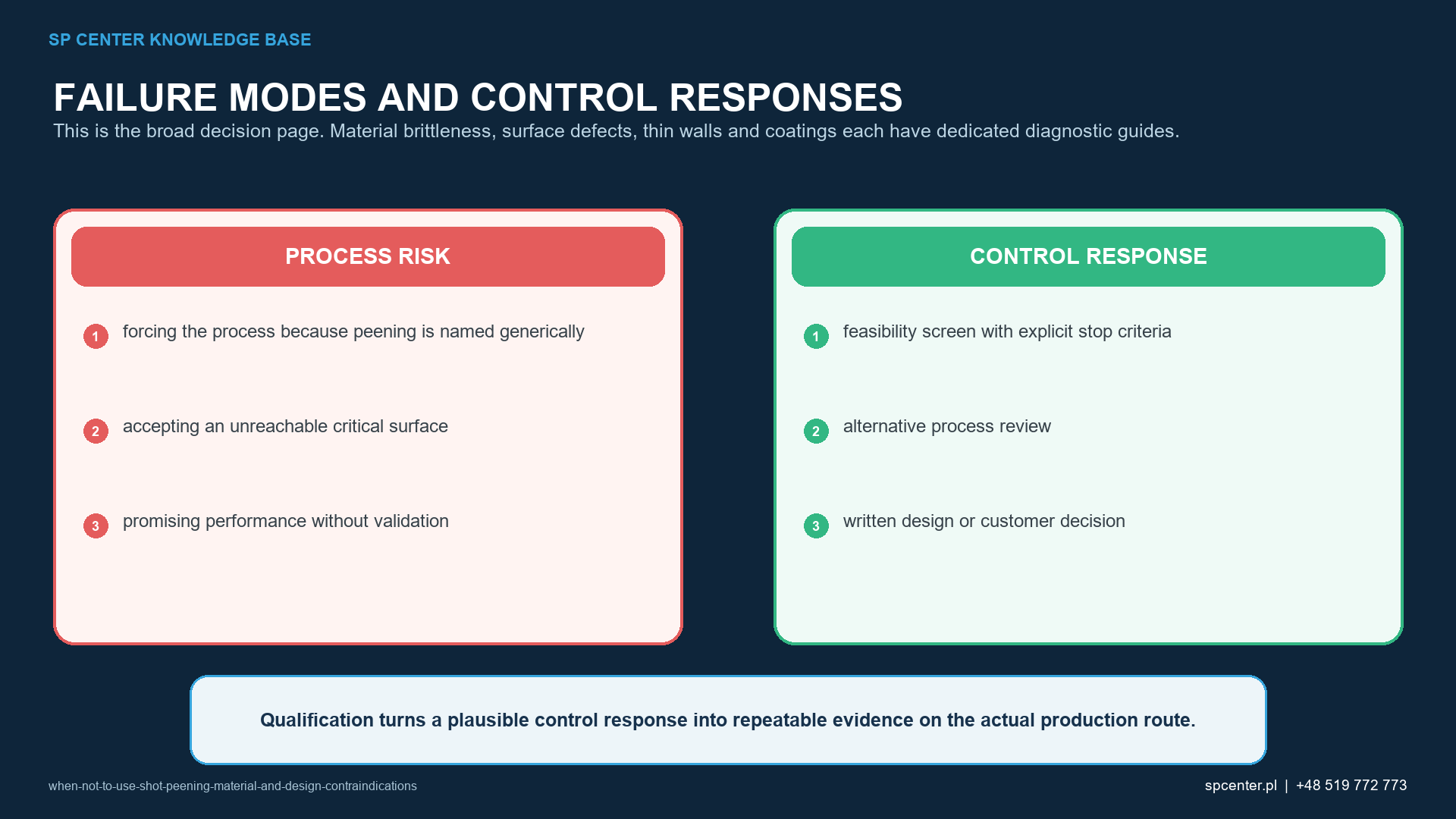
How are evidence and approval matched to the decision?
| Decision class | Minimum evidence | What is not enough |
|---|---|---|
| Immediate no-go | A clear prohibition, rejectable incoming defect, missing authority or inability to meet a mandatory requirement | A supplier preference, a visually uniform surface or a nominal machine recipe |
| Conditional feasibility | Production-representative part/material, controlled process window, worst-feature access, surface and dimensional stop criteria | Almen intensity alone or a coupon that omits the critical geometry |
| Component surface acceptance | Coverage where required, mask boundaries, damage, cleanliness, roughness and dimensions under approved methods | A saturation curve or machine log without component results |
| Application validation | Invoked residual-stress, fatigue, SCC, distortion, coating or functional testing for the final manufacturing state | A generic benefit claim transferred from another alloy or service condition |
| Alternative-route approval | Design/customer decision, updated requirements, qualification and traceability for the selected alternative | Replacing shot peening with shot blasting or another process by informal agreement |
Table 2. A technically correct measurement is still insufficient when it answers a different question from the suitability decision.
Process verification, component surface acceptance and component validation remain separate. A valid Almen result does not accept a sealing face, a coverage result does not prove residual-stress depth, and an XRD profile does not replace routine production controls.
When do surface function and contamination rule out peening?
Sealing lands, bearing fits, threads, aerodynamic contours, fatigue-critical edges and specified low-roughness surfaces may be sensitive to impressions, raised lips, material transfer or dimensional change. Protecting or excluding a surface can be valid only when the drawing and qualified route define the boundary and transition.
Media composition and equipment history matter where free iron, embedded particles, cross-alloy transfer or cleanliness limits are critical. If segregation, media control, cleaning and verification cannot meet the governing requirement, that equipment or route is unsuitable.
How can coatings and later operations invalidate the route?
Peening before plating or coating may be required in one system and prohibited or restricted in another. Peening an existing coating can cause cracking, spallation, thickness change or contamination. Grinding, polishing or machining after peening can remove part of the affected layer; thermal exposure can relax residual stress.
Approve the complete sequence—not only the peening cycle. The final state after machining, cleaning, heat treatment, coating and finishing must support the intended surface and performance claim. If it does not, move, redesign or replace the operation through the authorized engineering route.
What gates should a feasibility review close?
| Gate | Question that must be closed | Recorded output |
|---|---|---|
| Authority | Which drawing, specification, purchase-order and customer requirements govern the exact feature and revision? | Controlled requirement set and resolved conflicts |
| Incoming condition | Are material, heat treatment, surface, defects and prior processing suitable for a trial? | Accepted baseline or formal rejection/repair route |
| Feasibility | Can stream access, media, fixture, masking and motion achieve requirements without crossing stop criteria? | Qualified process window or documented no-go |
| Final-route compatibility | Do machining, heat, cleaning, plating, coating and finishing preserve the intended result? | Approved manufacturing sequence and change triggers |
| Acceptance and validation | Which process, surface, dimensional and application results are actually required? | Methods, locations, limits, sampling and approval authority |
| Production release | Does the actual lot follow the current qualified route with complete evidence? | Traceable release or controlled nonconformance |
Table 3. The outcome may be a qualified route, a limited treatment map, a request for clarification or a documented no-go.
How should alternatives be evaluated?
Do not select an alternative only because shot peening is difficult. The design authority must first define the required function: cleaning, roughness, compressive residual stress, deeper affected layer, forming, dimensional correction or coating preparation. Shot blasting, deep rolling, laser shock peening, ultrasonic peening, machining or design modification address different mechanisms and constraints.
The selected route needs its own material compatibility, access, process-control, surface, dimensional and performance evidence. Avoid claiming equivalence unless a controlled specification and representative validation establish it.
What belongs in the decision record?
- Part identity, drawing revision, material, heat treatment, incoming surface and defect status.
- Required and excluded treatment areas, functional surfaces and critical dimensions.
- Governing specifications, customer flow-down and authority for the decision.
- Feasibility risks, representative test geometry and predeclared stop criteria.
- Qualified intensity, media, equipment, fixture, masking, path and coverage method when a route proceeds.
- Surface, dimensional, contamination and final-sequence results.
- Application validation where performance credit is invoked.
- Documented no-go, design change, alternative process or approved production release.
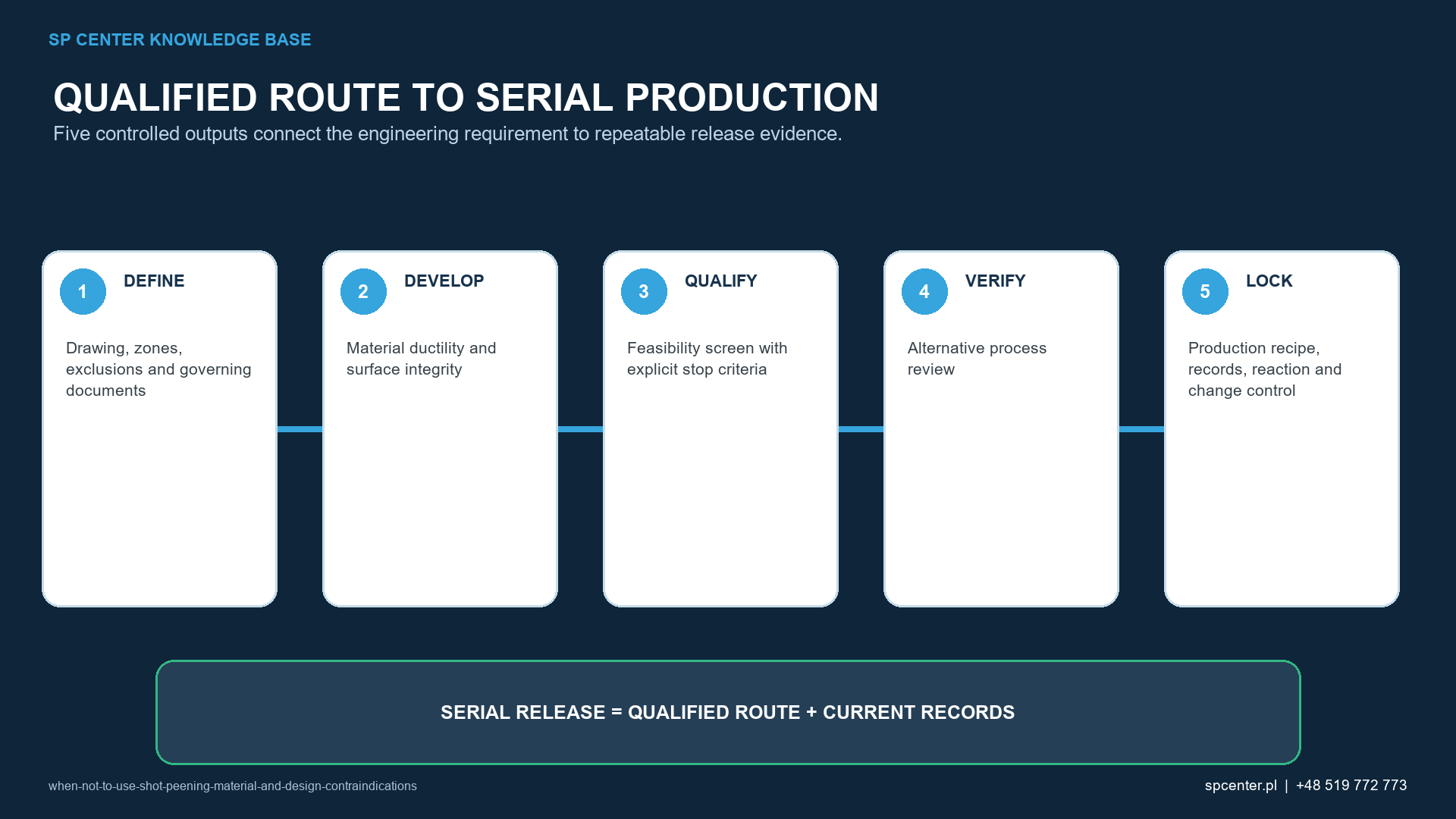
When should shot peening not be used?
Do not use it when the governing documents prohibit it, a rejectable defect is being treated as a repair, the required area cannot be reached or inspected, mandatory surface or dimensional limits cannot be met, or the route lacks the required authority and qualification.
Are brittle or very hard materials always unsuitable?
No universal hardness or ductility threshold applies to every alloy and geometry. These conditions narrow the process window and may require representative testing. If cracking, pull-out or unacceptable surface damage cannot be prevented, the route is unsuitable.
Can shot peening repair an existing crack?
No. Peening may alter appearance or local stress but must not be used to conceal or accept a crack, fold, lap, corrosion loss or other rejectable defect. Follow the authorized inspection and disposition route.
Should thin parts never be shot peened?
Not automatically. Thin or compliant parts may be feasible with qualified intensity, balanced sequence, suitable support and free-state dimensional acceptance. If distortion cannot be controlled within the governing limits, do not use that route.
Can an inaccessible feature be accepted from an accessible witness area?
Only when the governing method explicitly permits a qualified, representative correlation. A convenient surface does not by itself prove stream access or coverage in a blind bore, underside or deep fillet.
Can shot peening be applied over a coating?
Only when the coating type, condition and process sequence are explicitly permitted and qualified. Impact can crack, detach, contaminate or change some coatings, while later coating or finishing steps can alter the peened layer.
Does a successful Almen result prove that the route is suitable?
No. It verifies a standardized stream response. Material damage, coverage, dimensions, finish, contamination, coating compatibility and application performance remain separate decisions.
Is shot blasting a suitable alternative when shot peening is rejected?
Not as a direct substitute. Shot blasting is normally selected for cleaning or surface preparation. Any alternative surface-enhancement route needs its own design authority, requirements, qualification and acceptance evidence.
Key takeaways
- Do not peen without controlled authority for the exact part, area and sequence.
- Shot peening is not a repair for cracks or other rejectable defects.
- Brittleness, hardness, thin walls and coatings are conditional risks, not universal bans.
- Unreachable or uninspectable required areas create a no-go until the route is changed and qualified.
- Almen intensity cannot accept finish, dimensions, contamination or performance by itself.
- Qualify the final manufacturing state and document either the approved route or the no-go decision.
Related SP Center guides
- Can Every Metal Be Shot Peened?
- Shot Peening Thin-Walled Parts
- Surface Defects and Shot Peening
- Shot Peening and Coatings
Technical sources
1. SAE J2441_202511: Shot Peening, stabilized November 2025
2. SAE AMS2430U: Shot Peening, revised April 2018
3. SAE ARP7488: Peening Design and Process Control Guidelines, issued January 2018
4. SAE J2277_202301: Shot Peening Coverage Determination, revised January 2023
Standards note: Apply the complete drawing, contract, customer requirements and invoked specification revisions. These sources do not create one universal suitability threshold for all materials and geometries.
Author: Paweł Kmieć
Discuss shot-peening feasibility for a component: +48 519 772 773 | [email protected]