


Develop the process for the exact titanium alloy, condition and component geometry while controlling media, contamination, Almen response, coverage and surface integrity
Titanium shot peening requires component-specific development. A steel recipe or a nominally gentler generic cycle cannot be transferred by assumption. Alloy and product form, heat treatment, section thickness, critical geometry, incoming surface, contamination restrictions, media, Almen intensity, coverage, exposure and acceptance evidence must be developed as one controlled route.
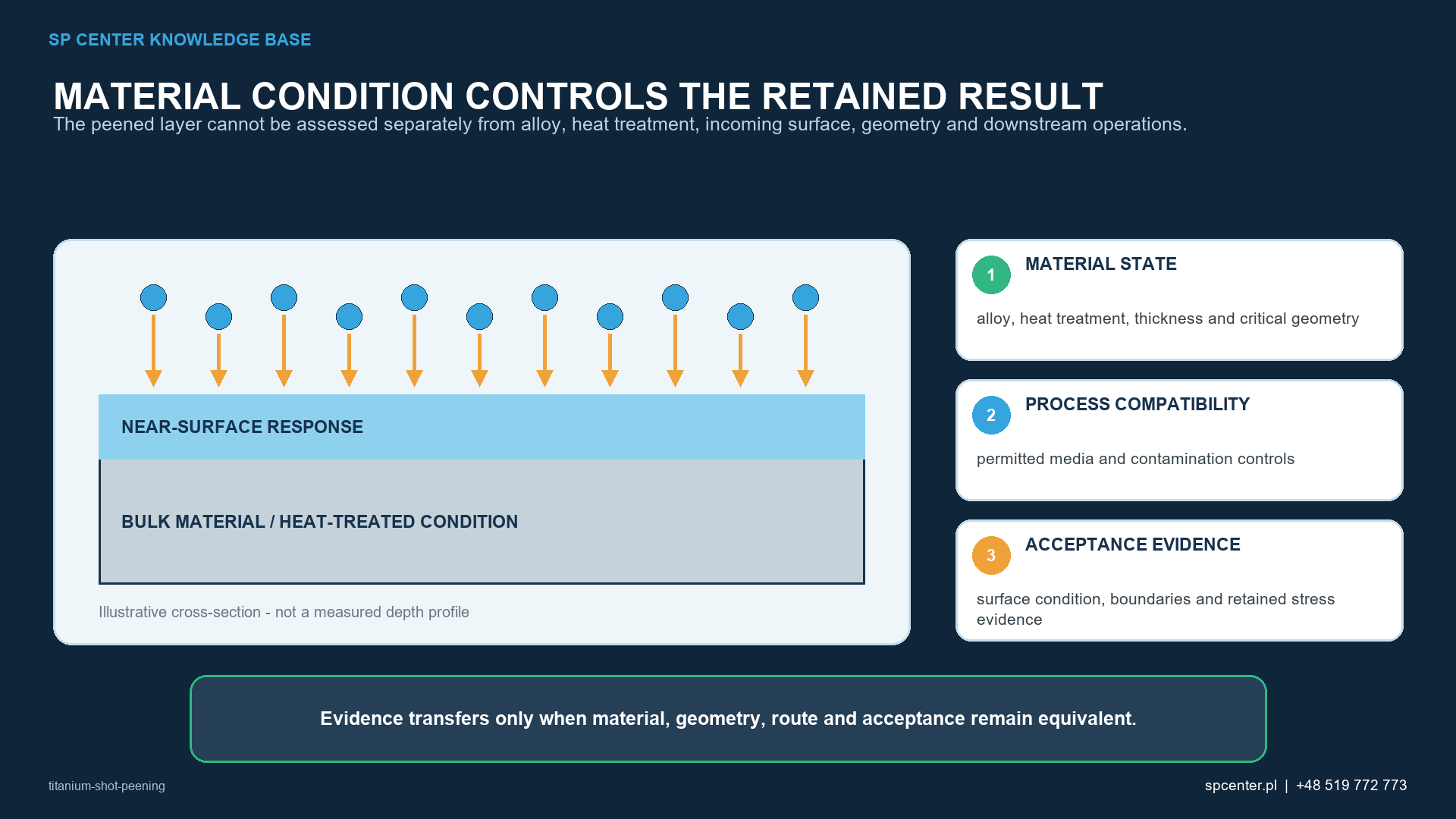
Why is “titanium” insufficient to select a process?
| Titanium material case | Why the distinction matters | Qualification focus |
|---|---|---|
| Commercially pure titanium | Strength, formability and surface response differ by grade and prior work | Grade, product form, hardness/strength condition, thin features and surface limits |
| Alpha or near-alpha alloy | Elevated-temperature and creep/fatigue applications can impose specific surface requirements | Exact heat treatment, service temperature basis, geometry and validated surface response |
| Alpha-beta alloy, including Ti-6Al-4V | Properties vary with product form, heat treatment and microstructure | Do not transfer one Ti-6Al-4V route between forgings, bar, plate or repair conditions without review |
| Beta or metastable-beta alloy | High strength and heat-treatment sensitivity can change indentation, distortion and fatigue response | Actual condition, hardness, section geometry and component-specific evidence |
| Coated, repaired or previously processed surface | Prior operations can change access, contamination, adhesion, dimensions and acceptance | Authorised manufacturing sequence and explicit disposition of existing layers or repairs |
Table 1. Alloy family alone does not define the peening response; the actual material condition and manufacturing history matter.
Titanium alloys differ from steels in elastic modulus, plastic response, work hardening, tribological behaviour and sensitivity to surface condition. Even two components with the same nominal alloy can need different routes because product form, heat treatment, machining, geometry, loading and customer requirements differ.
What can controlled shot peening achieve on titanium?
Controlled impacts can plastically modify the near-surface region and introduce a compressive residual-stress field. This may support fatigue performance for the qualified material, geometry and loading case. The magnitude and depth of the field, fatigue-life change and service benefit are not proven by the alloy name, Almen intensity or coverage alone.
Shot peening is used only when the drawing, approved design intent or repair/manufacturing route calls for it. It must not hide machining damage, pre-existing folds, cracks, burns or other unresolved surface defects.
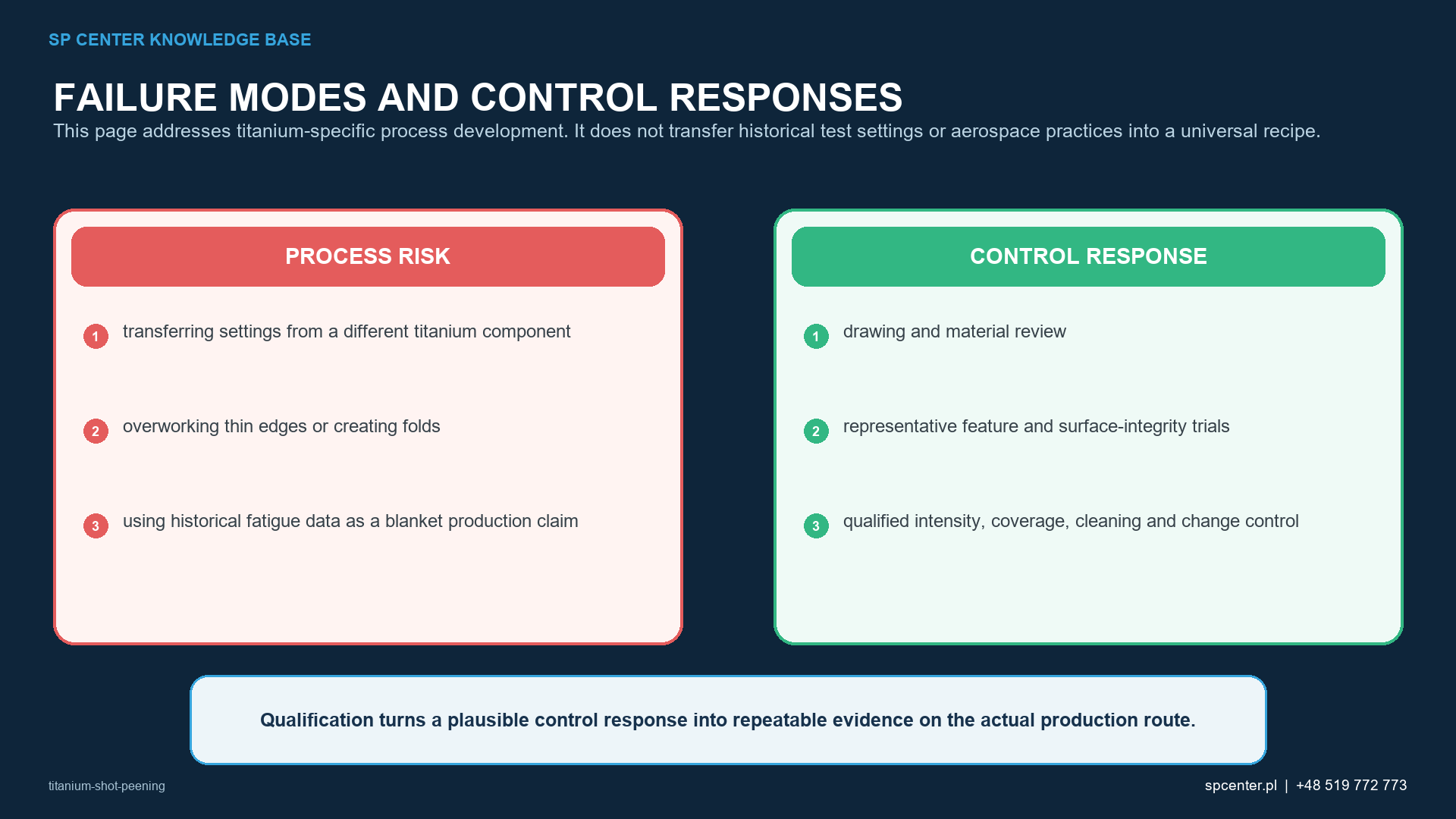
How are media and contamination controlled?
| Control area | Titanium-specific question | Evidence |
|---|---|---|
| Media approval | Is material, size, hardness, shape and operating condition permitted for this customer and alloy route? | Invoked process/media documents, certificates and operating-mix records |
| Cross-contamination | Can previous media, dust, equipment, tooling or handling transfer prohibited foreign material? | Dedicated or validated changeover route and required cleanliness verification |
| Stream severity | Does the current setup provide the specified standardised response without leaving the approved window? | Saturation curve and Almen-intensity verification under the invoked procedure |
| Geometry and access | Can the stream reach fillets, holes, edges and masked boundaries at the qualified angle and stand-off? | Fixture/path definition and coverage at worst-access prescribed locations |
| Surface and dimensions | Are roughness, indentation, folds/laps, edge condition, distortion and dimensions acceptable? | Invoked visual, dimensional, surface or other component inspection |
| Cleaning and downstream route | Can media and residues be removed without chemical or mechanical damage to the treated layer? | Authorised cleaning/drying method, compatibility and downstream status |
Table 2. Media selection includes mechanical capability, surface integrity and the complete contamination route.
Steel, conditioned cut wire, ceramic, glass or another spherical medium is not automatically permitted or prohibited solely because the substrate is titanium. The invoked specifications and customer restrictions determine the allowed system. Media history, cabinet and recovery circuit, tooling, masks, handling and containers can all transfer foreign material.
A media change is not automatically a qualified equipment changeover. Dedicated equipment or a validated cleanout and release route may be required. The selected process must also remove retained particles and residues from the complete geometry without introducing an unapproved chemical or abrasive post-treatment.
How is Almen intensity selected and interpreted?
Production must reproduce the range specified by the drawing and governing process documents. Where design or process-development authority exists, the authorised selection must consider material condition, section thickness, geometry, media and component surface limits. The engineering objective is a demonstrated window—not the highest attainable intensity.
Longer exposure does not repair an intensity result outside the authorised range. Equal Almen intensity obtained with different media populations does not prove equal roughness, cold work, residual-stress profile or fatigue behaviour on titanium.
Why are coverage, exposure and component acceptance separate?
| Evidence layer | What it establishes | What it does not establish alone |
|---|---|---|
| Almen intensity | Standardised response of the defined peening stream/setup | Residual-stress profile, fatigue life, coverage or acceptable titanium surface |
| Coverage | Extent of impact evidence over the specified component surface | Correct intensity, acceptable exposure multiple or freedom from damage/contamination |
| Qualified exposure | Authorised time, passes, rotation or motion relative to the 100% coverage baseline when required | A visually countable percentage above 100% or guaranteed fatigue benefit |
| Surface/dimensional inspection | Conformance to invoked roughness, damage, boundary, edge, distortion and dimensional criteria | Specified subsurface stress state unless separately measured |
| Residual-stress or fatigue validation | Measured response for the stated material, method, location and condition | Universal transfer to other titanium grades, geometries or process configurations |
Table 3. Each evidence layer answers a different acceptance question.
Coverage is assessed on required areas and at difficult boundaries or shadowed features using the approved method. When an exposure above 100% is specified, it is normally implemented as an authorised multiple of the time required to establish complete coverage—not by visually counting impact marks beyond 100%.
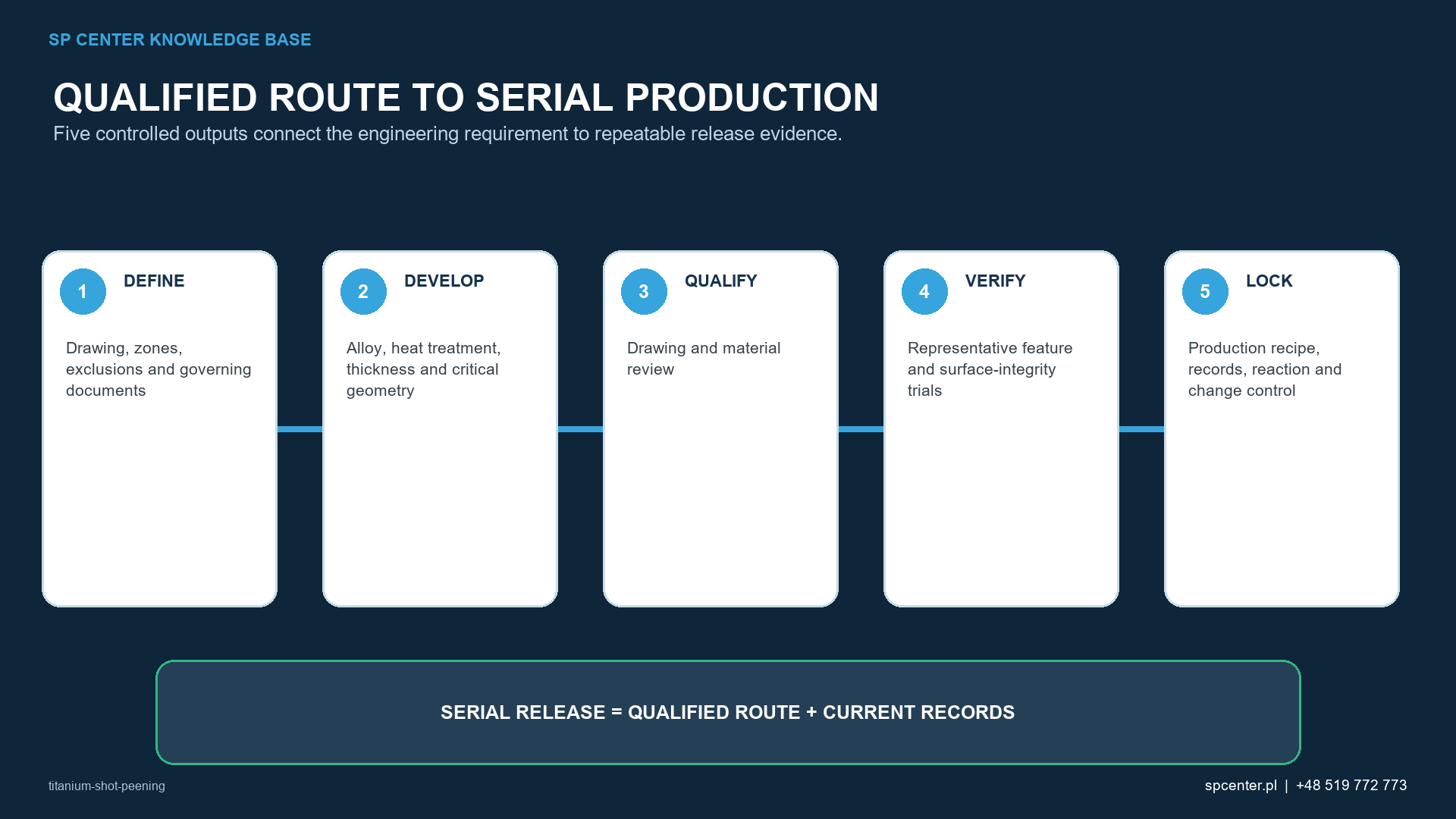
How is the actual component represented in qualification?
| Stage | Required output | Change sensitivity |
|---|---|---|
| Requirements and material review | Drawing hierarchy, alloy/product form, heat treatment, service objective, zones and exclusions | New revision, material source/condition, repair state or design intent |
| Risk and geometry review | Critical radii, holes, edges, thin walls, masks, access, media retention and distortion controls | Changed feature, fixture, mask, loading or part orientation |
| Media and equipment selection | Permitted media, stable delivery configuration and contamination-control route | Media family/size/hardness, separator, nozzle/wheel or equipment-location change |
| Stream qualification | Valid saturation curve and Almen-intensity verification locations | Changed stream settings, tooling or condition outside authorised limits |
| Component qualification | Coverage/exposure baseline, surface integrity, dimensions and any specified validation | Changed geometry, path, sequence, surface preparation or acceptance method |
| Production control | Released recipe, serial/lot records, media control, maintenance, alarms and reaction plan | Software, maintenance, cleaning or downstream-sequence change |
Table 4. Qualification ties the standardised stream response to representative titanium features and controlled serial production.
Thin walls, free edges, small radii, holes, splines and masked transitions can respond differently from an open flat coupon. The trial and inspection plan should represent the highest-risk geometry, incoming surface, fixture support, path, impact angle and downstream route. Surface and dimensional evidence remains required even when intensity and coverage conform.
How should cleaning and downstream operations be controlled?
Cleaning, etching, pickling, coating removal, polishing or other chemical/mechanical operations can alter the titanium surface or the mechanically affected layer. They must follow an authorised, material-compatible sequence with controlled contamination, possible hydrogen-related risk where relevant, material removal, rinsing, drying and acceptance. Do not insert a generic post-peening treatment by habit.
What is titanium shot peening?
It is controlled shot peening applied to a specified titanium alloy and condition to modify the near-surface mechanical state. It requires defined media, Almen intensity, coverage, exposure, geometry, surface acceptance and contamination controls.
Can Ti-6Al-4V components be shot peened?
Yes, when the drawing and qualified route authorise it. Product form, heat treatment, geometry, initial surface, media, intensity, coverage, contamination and acceptance criteria must match the component.
Can a steel shot peening recipe be used for titanium?
Not by assumption. Titanium alloy response, modulus, section sensitivity, surface integrity and contamination restrictions differ. Transfer requires authorised technical evidence tied to the actual component and process.
Which media are best for titanium shot peening?
No medium is universally best. The governing requirements must permit it, and qualification must address achievable intensity, access, roughness, embedded or transferred material, breakdown, operating mix and equipment cleanliness.
Does correct Almen intensity prove titanium residual stress?
No. Almen intensity is a standardised stream response. The component residual-stress profile requires a specified measurement or validation method when it is an acceptance or design requirement.
Are 100% coverage and qualified exposure the same?
No. Coverage evaluates impact evidence over the required surface. Qualified exposure defines the authorised duration or motion history; values above 100% are normally based on an exposure multiple after the 100% baseline is established.
What surface risks must be checked on titanium?
Depending on the component: roughness, excessive indentation, folds/laps, edge damage, distortion, masking boundaries, embedded foreign material, retained media and compatibility with cleaning, coating or assembly.
What should an RFQ for titanium parts include?
Provide drawing/revision, alloy and product form, heat treatment/condition, incoming surface and prior processes, zones, media/contamination restrictions, intensity, coverage/exposure, geometry, quantities, surface/dimensional limits and records.
Key takeaways
- Develop the process for the exact titanium alloy, product form, condition and component.
- Do not transfer a steel or another titanium recipe without authorised evidence.
- Keep Almen intensity, coverage, exposure and residual-stress evidence distinct.
- Control media capability and the complete contamination route together.
- Verify roughness, folds/laps, edges, dimensions and retained media where required.
- Represent thin and difficult geometry in qualification and coverage inspection.
- Control cleaning, maintenance and other changes through the approved route.
Related SP Center guides
Technical sources
1. SAE AMS2430U: Shot Peening, revised April 2018
2. SAE J2441_202511: Shot Peening, stabilized November 2025
3. SAE J443_202512: Procedures for Determining and Verifying Peening Intensity, revised December 2025
4. SAE J2277_202301: Shot Peening Coverage Determination, revised January 2023
5. SAE AMS2431E: Peening Media, General Requirements, revised April 2023
6. SAE ARP7488: Peening Design and Process Control Guidelines, issued January 2018
Standards note: The drawing, contract and customer flow-down determine applicability and revision. This guide does not prescribe a universal titanium intensity, media or post-treatment and does not replace component-specific validation.
Author: Paweł Kmieć
Discuss titanium shot peening feasibility and qualification: +48 519 772 773 | [email protected]