


How foreign material enters the operating mix, why intensity cannot prove cleanliness and how to validate prevention, changeover and disposition
Media contamination in shot peening is the presence of foreign material or an unintended media population in the operating mix. It can change the peening stream, transfer incompatible material to the component, compromise coating or corrosion performance and break traceability to the qualified process. Correct Almen intensity and complete coverage remain essential controls, but neither demonstrates that the media are clean or chemically compatible with the component.
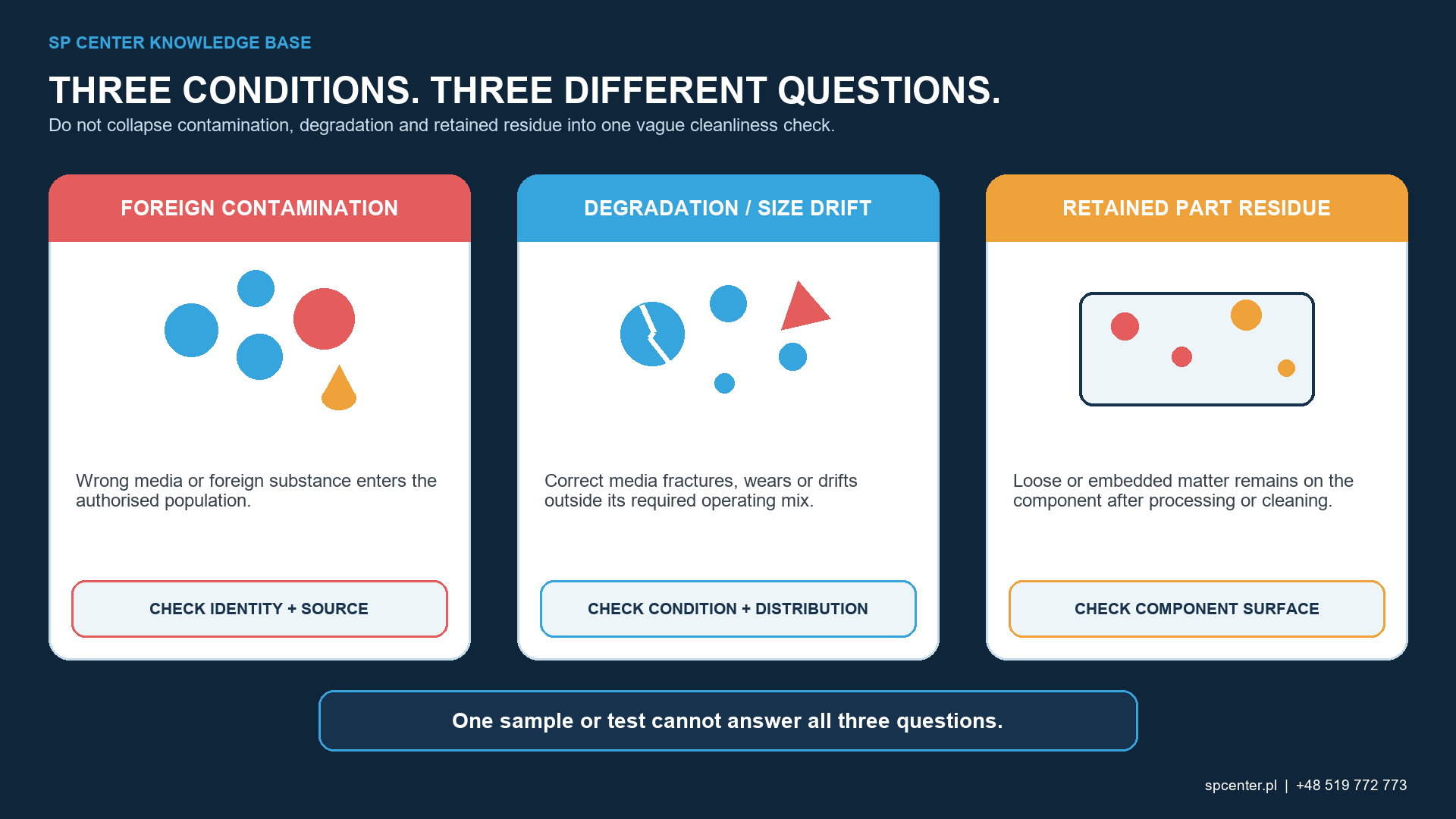
How is contamination different from degradation or residue?
| Condition | Definition | Why the distinction matters |
|---|---|---|
| Media contamination | Foreign material or an unintended media population in the operating mix | May change stream behaviour, embed incompatible material or compromise downstream operations |
| Media degradation | Breakage, wear, shape change or size-distribution drift of the intended media | Can affect intensity, surface finish and process stability without an external contaminant |
| Surface residue | Material left on the component after peening or cleaning | May come from the intended media, contaminant, process fluid or cleaning route and requires component-specific evaluation |
| Equipment debris | Wear products from hoses, nozzles, wheels, liners, seals, fixtures or maintenance activity | Can be both a contamination source and evidence of equipment deterioration |
Table 1. Investigation and disposition depend on identifying which condition exists. A worn intended particle, a steel particle carried into a ceramic route and a loose residue on the finished component are not the same problem.
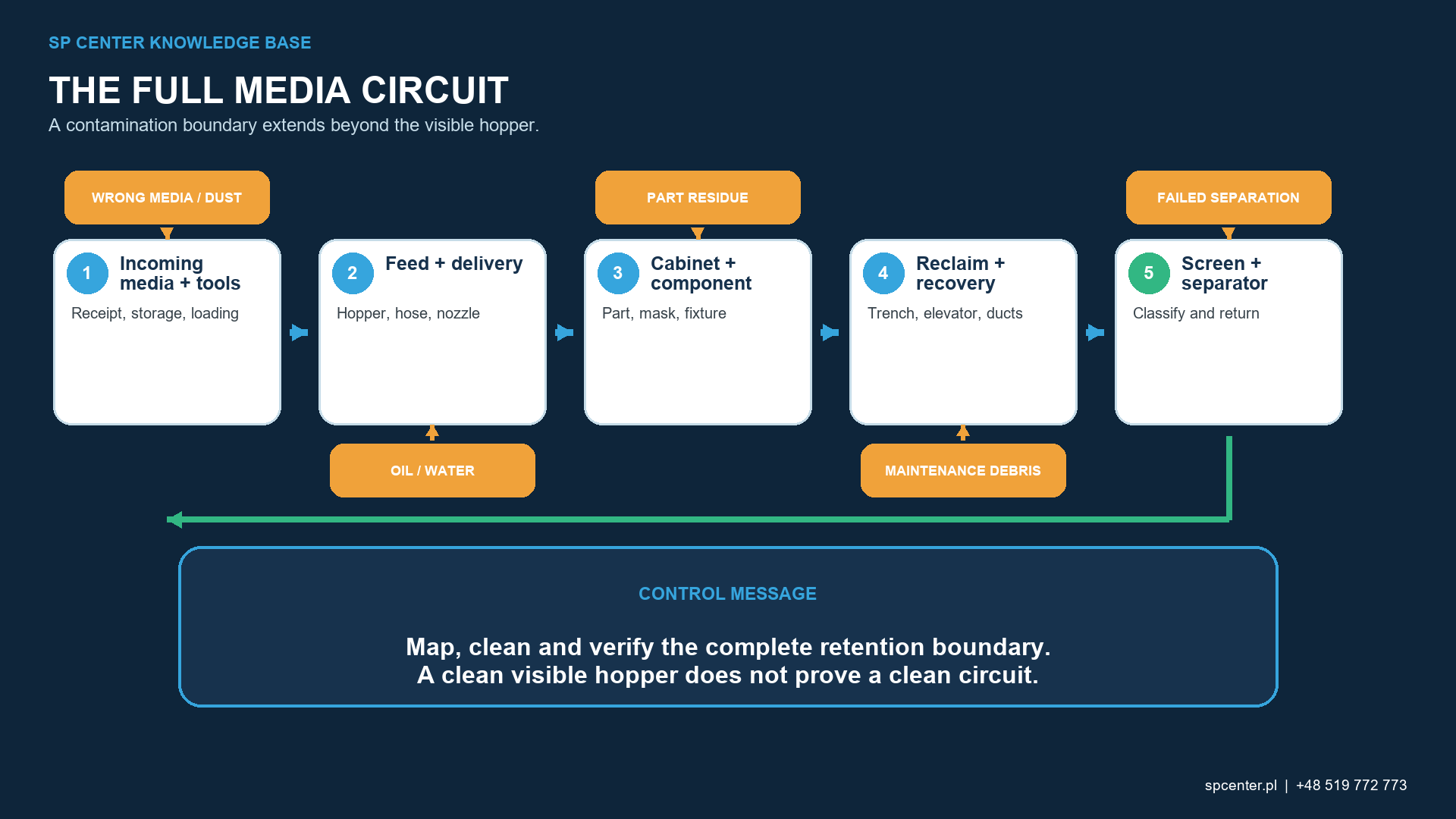
Where can contamination enter the process?
| Entry route | Representative contaminant | Preventive control |
|---|---|---|
| Previous process or media family | Steel shot in a glass, ceramic or nonferrous-media route | Dedicated equipment or a qualified changeover with acceptance sampling |
| Incoming component | Scale, chips, coating fragments, grinding debris, oil or cleaning residue | Defined incoming condition, cleaning and segregation |
| Recirculation and classification | Broken particles, dust, oversize material or separator carry-over | Maintained screens, separators, dust extraction and operating-mix checks |
| Maintenance and tooling | Grinding swarf, fasteners, wire fragments, lubricants or shop debris | Controlled maintenance, line clearance and post-maintenance verification |
| Storage and handling | Mixed lots, moisture, packaging debris or incorrect container | Closed identified containers, lot traceability and controlled dispensing |
Table 2. An effective control plan follows the complete media and component path, including recovery equipment and maintenance interventions, rather than checking only the fresh-media container.
Why do intensity and coverage not prove cleanliness?
Almen intensity verifies the effect of the peening stream under a defined standardized configuration. Coverage evaluates whether the required component surface has been impacted. Neither method identifies foreign-particle chemistry, a small incompatible population, embedded transfer or maintenance debris. A mixed operating population can therefore satisfy intensity and coverage while remaining unacceptable for the material, downstream finish or contractual cleanliness requirement.
How can contamination affect the component?
| Potential effect | Mechanism | Evidence needed for disposition |
|---|---|---|
| Changed peening stream | Different size, density, hardness or shape changes acceleration and impact response | Operating-mix analysis, intensity history and equipment review |
| Embedded foreign material | Particles or transfer films remain in the treated surface | Surface examination and material-specific analysis by an approved method |
| Corrosion or staining risk | Ferrous or chemically incompatible carry-over changes local electrochemical behaviour | Material, environment and downstream-finish assessment plus applicable cleanliness criteria |
| Coating or bonding problem | Residue interferes with cleaning, conversion, plating, coating or adhesion | Approved surface-preparation and downstream-process acceptance evidence |
| Traceability failure | Unknown operating mix prevents reconstruction of the qualified condition | Containment, lot genealogy and documented technical disposition |
Table 3. Not every foreign particle produces the same consequence. Severity depends on contaminant identity and amount, component alloy and heat treatment, surface requirement, service environment, subsequent cleaning or coating and the customer acceptance criteria.
Why does ferrous carry-over require particular attention?
Ferrous carry-over onto aluminium, titanium, nickel alloys or corrosion-resistant steels can create staining, local corrosion concerns or incompatibility with later surface processing. The presence of a magnetic or iron-rich particle is not evaluated by Almen intensity. At the same time, no universal rejection rule should be invented: the required limit, analytical method and component disposition must come from the governing specification and material-specific risk.
Ceramic, glass, stainless or nonferrous media can reduce one source of ferrous transfer, but they do not eliminate contamination. Previous media, machine wear, incoming components, maintenance activity and handling remain possible sources.
When is dedicated equipment preferable?
An exclusively assigned system is often the strongest control where cross-contamination has high consequence, cleaning access is poor, media families are incompatible or the customer requires segregation. A shared system may still be technically acceptable if the equipment is designed for cleanability and the complete changeover has a qualified, repeatable and documented acceptance route. A commercial preference is not a substitute for the contractual requirement.
How should a media changeover be validated?
| Changeover stage | Required question | Representative evidence |
|---|---|---|
| Removal | Were the old media and accessible deposits removed from reservoirs, hoses, separators, cabinet and recovery path? | Controlled cleaning checklist and inspection |
| Dead-zone review | Can retained particles remain in corners, ducting, valves, fixtures or return paths? | Equipment-specific risk map and access verification |
| Recharge and purge | Is the new operating mix stable after controlled charging and circulation? | Defined charge, purge quantity or cycle and operating record |
| Sampling and analysis | Do samples represent the operating stream and critical carry-over locations? | Approved sampling plan, analytical method and results |
| Release | Are acceptance criteria met and configuration and lot identity recorded? | Reviewed release decision and requalification status |
Table 4. Purging with new media alone may dilute carry-over without removing deposits trapped in the recovery system. Validation must challenge the real equipment, including locations most likely to retain the previous media or debris.
How can contamination be detected and monitored?
The analytical route should match the suspected contaminant and required decision. Options may include visual or microscopic classification, sieving, magnetic separation, gravimetric checks, particle identification or chemical and surface analysis. Each method has detection and sampling limits. A result is defensible only when the sampling location, sample size, preparation, equipment, acceptance criteria and review are controlled.
Routine monitoring can combine supplier lot controls, operating-mix checks, separator performance, housekeeping inspection and periodic analytical verification. Frequency should follow the governing requirement, process risk, change history and demonstrated stability rather than an invented universal interval.
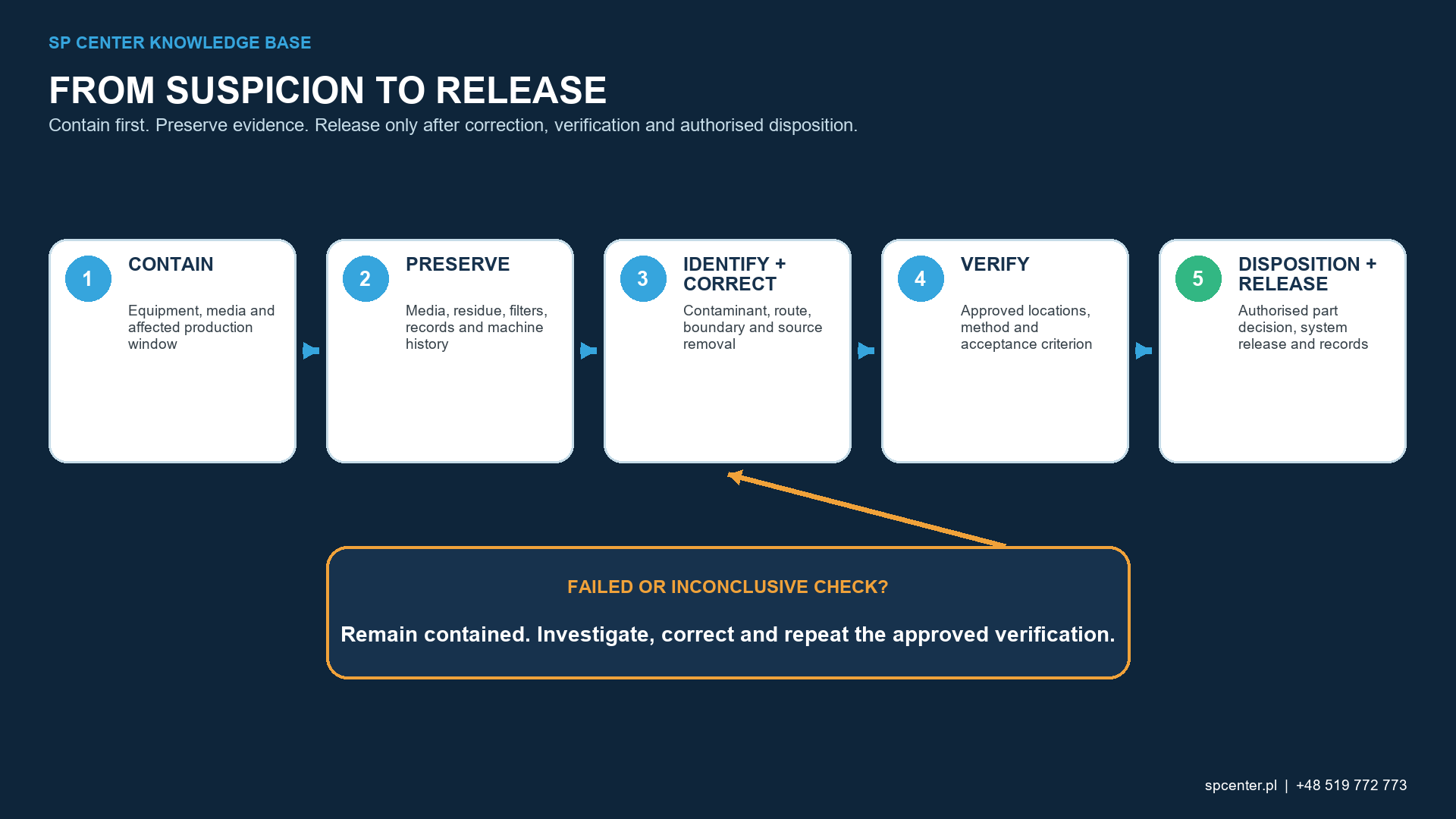
What should happen when contamination is suspected?
| Finding | Immediate action | Do not assume |
|---|---|---|
| Unexpected particles in operating media | Stop use, identify and contain the affected equipment and media lots | That classification will remove every contaminant |
| Suspected affected components | Hold the time-window population and preserve genealogy | That final cleaning automatically restores the qualified surface |
| Intensity remains within limits | Continue the contamination investigation independently | That intensity proves chemical or material cleanliness |
| No visible surface defect | Apply the required material-specific inspection and acceptance criteria | That invisible transfer or embedded material is absent |
| Source cannot be reconstructed | Escalate through the approved nonconformance and customer route | That an undocumented purge is sufficient evidence for release |
Table 5. Containment must consider both media and product. The affected time window begins with the last acceptable evidence and ends only after the system has been restored and the approved release criteria are met.
What should an RFQ or process specification state?
- Component material, heat treatment, service environment and sensitive downstream finishes.
- Permitted media family and any segregation, dedicated-equipment or changeover requirement.
- Operating-mix and cleanliness criteria plus the approved sampling and analytical method.
- Incoming component condition, precleaning, masking and prohibited materials.
- Traceability, lot-control, maintenance and change-notification requirements.
- Containment, deviation, customer notification and component-disposition route.
Frequently asked questions
What is media contamination in shot peening?
It is foreign material or an unintended media population in the operating mix. It is distinct from normal wear of the intended media and from residue found later on the component.
Can correct Almen intensity prove that the media are clean?
No. Intensity characterizes the peening stream under defined reference conditions. A contaminated mix can still produce an in-range result while creating an unacceptable surface or traceability condition.
Does 100% coverage prove absence of contamination?
No. Coverage confirms impact coverage of the required surface by the approved method. It does not identify the chemistry, origin or compatibility of the impacting particles.
Is dedicated equipment always required?
Not universally. Dedicated equipment can reduce cross-contamination risk, while a controlled changeover may be acceptable when the governing requirements permit it and the cleaning, sampling, analysis and release route is qualified.
Can an affected component simply be cleaned?
Not by assumption. Cleaning may remove loose residue but may not remove embedded material, surface damage or a chemically altered condition. Disposition must use the component material, environment, downstream process and customer criteria.
Is there one universal acceptable contamination limit?
No universal value should be assumed. The limit and detection method must come from the applicable specification, customer requirement, qualified process and material-specific risk assessment.
Key takeaways
- Contamination, intended-media degradation, component residue and equipment debris require different controls.
- Correct intensity and coverage do not prove media cleanliness or chemical compatibility.
- Dedicated equipment can reduce risk; shared equipment requires a qualified and documented changeover when permitted.
- Sampling and analysis must represent the operating stream and the suspected contaminant.
- An affected component cannot be released on cleaning or visual appearance alone without the required technical disposition.
Related SP Center guides
Technical references
1. SAE AMS2431E: Peening Media, General Requirements, revised April 2023
2. SAE AMS2430U: Shot Peening, revised April 2018
3. SAE ARP7488: Peening Design and Process Control Guidelines, issued January 2018
Standards note: The applicable AMS2431 detail specification, drawing, contract, customer requirements and invoked revisions remain authoritative.
Author: Paweł Kmieć
Discuss your shot peening requirement: +48 519 772 773 | [email protected]