


How to select a media family and qualify material, size, shape, hardness and operating condition for the actual component route
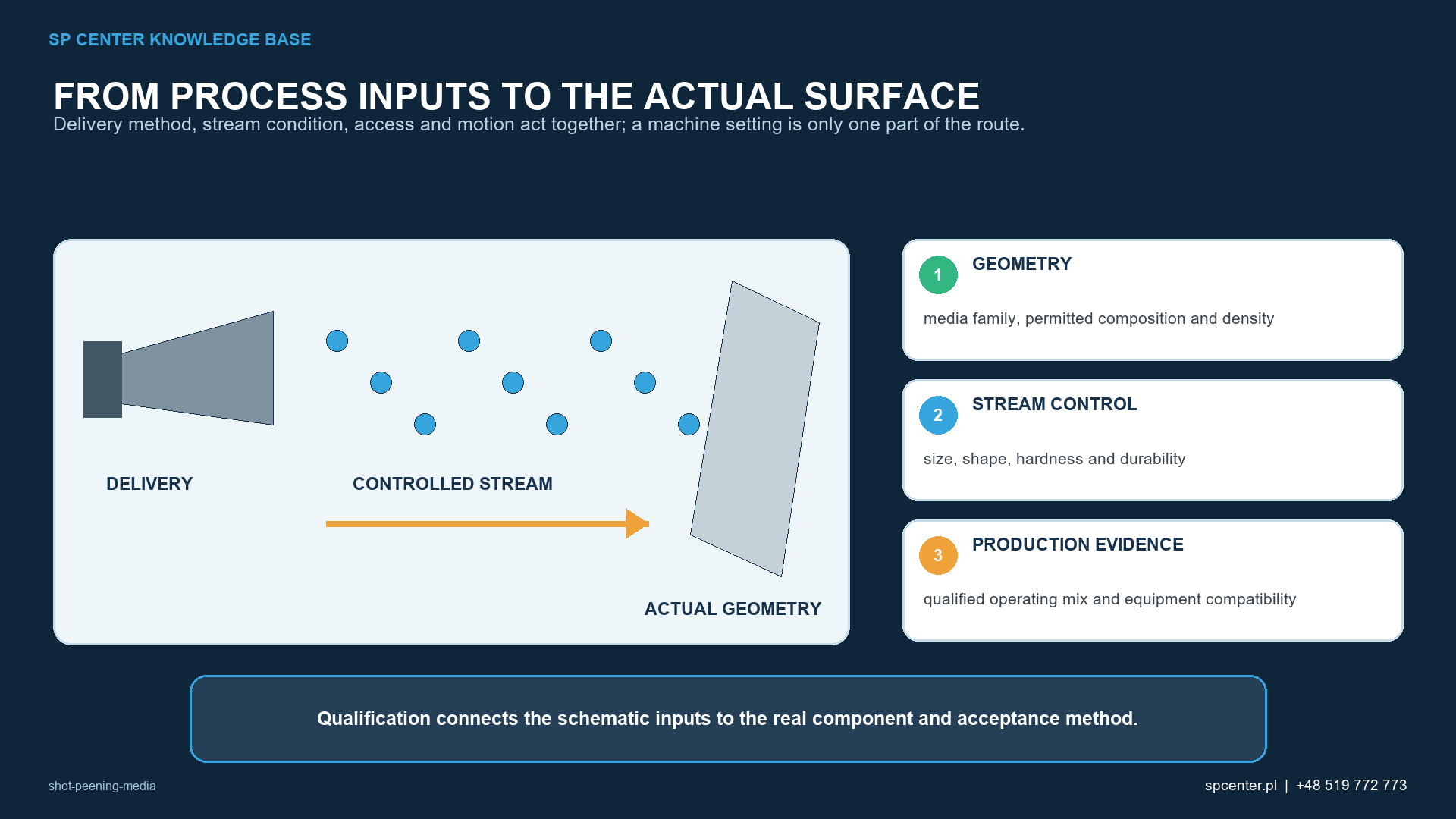
Shot peening media are the controlled particles that transfer repeated impact to the component surface. Selection is not a choice between catalogue names alone. Media family, material, density, size distribution, shape, hardness, durability and cleanliness interact with the equipment, geometry, component material, required surface and downstream process. The correct route is the one authorized by the governing requirements and supported by qualified process and component evidence.
Which media families are used?
| Media family | Typical selection reason | Key qualification question |
|---|---|---|
| Conditioned cut wire | Controlled material and manufactured particle route with defined conditioning | Do material, conditioning, size, hardness and operating-mix limits match the invoked detail specification? |
| Cast steel shot | High density, established recirculating use and broad equipment compatibility | Are size distribution, hardness, shape, breakage and ferrous-transfer risks acceptable? |
| Stainless or other metallic media | Material compatibility or contamination strategy for selected components | Does the exact alloy, hardness, density and transfer behaviour support the component and downstream route? |
| Glass bead | Nonferrous media route and selected surface-response requirements | Are fracture, sharp fragments, size loss, embedment and durability controlled? |
| Ceramic shot | High hardness, nonferrous composition and selected durability or surface response | Are composition, density, shape, breakdown and compatibility qualified for the actual equipment and component? |
Table 1. These family descriptions support selection logic but do not replace the applicable SAE AMS2431 detail specification or customer requirement. Material names such as “steel”, “stainless”, “glass” or “ceramic” are not complete procurement descriptions.
How should a media family be selected?
| Selection dimension | Question | Evidence |
|---|---|---|
| Governing specification | Which general and detail media requirements and revisions are invoked? | Drawing, process specification, customer supplement and approved media source |
| Component material | Can transfer, embedment or contamination create corrosion, fatigue, coating or cleaning risk? | Material-specific compatibility and surface-acceptance criteria |
| Geometry and access | Can the media population reach all treatment zones without unacceptable local effects? | Representative access and coverage evidence |
| Required surface and response | Can the route meet intensity, coverage, roughness, damage and component-validation requirements? | Qualified process window and component evidence |
| Equipment and recovery | Can the machine accelerate, meter, recover and classify this family reproducibly? | Equipment capability, operating-mix control and wear or separator verification |
Table 2. The selection begins with controlled requirements. If a media designation is already invoked, a substitution is a technical change rather than a purchasing convenience.
Why does component compatibility matter?
Media can transfer particles, films or wear debris to the surface. Ferrous carry-over, glass or ceramic fragments, alloy-specific contamination and embedded material can affect corrosion behaviour, cleaning, plating, coating, bonding or inspection. Compatibility depends on the actual component alloy, heat treatment, service environment and downstream route; it cannot be inferred from a generic claim that a media family is “clean” or “nonferrous”.
The starting surface also matters. Scale, coating, machining residue or previous blasting can contaminate the operating mix or obscure component acceptance. Incoming condition, precleaning and prohibited materials should be defined in the process plan.
Which media characteristics must remain controlled?
| Media characteristic | Why it matters | Where it is controlled |
|---|---|---|
| Material and density | Influence acceleration, impact response, contamination compatibility and identification | Approved designation, certificate, receiving and change control |
| Size distribution | Influences particle population, access, intensity response and surface texture | Receiving and operating-mix measurement |
| Shape | Influences impact contact, roughness, damage risk and durability | Microscopic or approved shape classification |
| Hardness | Influences deformation, breakage, durability and component response | Specified hardness method and qualified preparation |
| Cleanliness and operating condition | Influence traceability, chemical compatibility and process stability | Segregation, classification, sampling, contamination and trend controls |
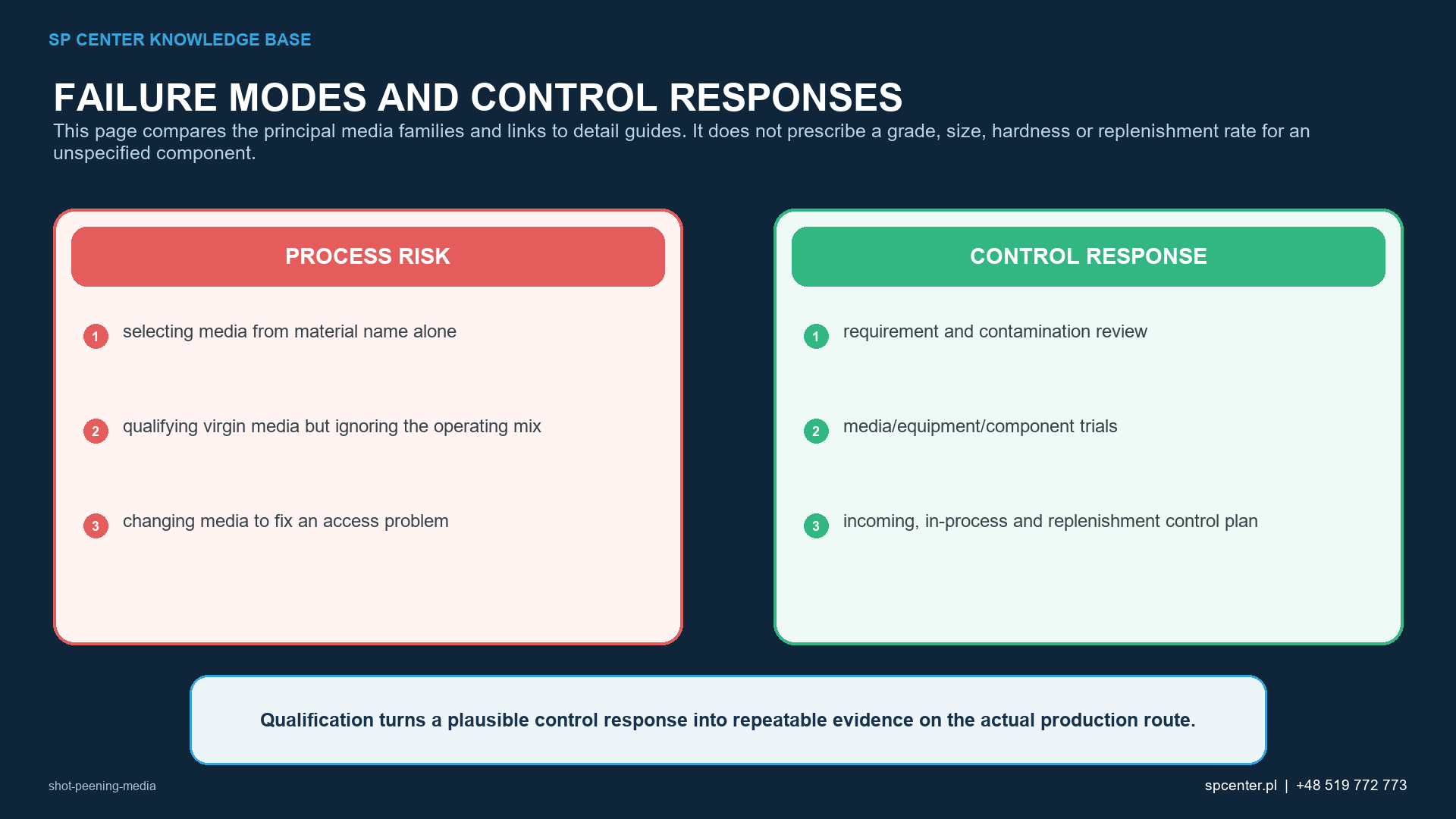
Table 3. A conforming nominal size does not prove material identity, acceptable shape, hardness or cleanliness. Each invoked characteristic requires its own controlled method.
How does equipment architecture affect media selection?
Air-blast and wheel systems accelerate and meter media differently. Density, size, flowability, breakdown, nozzle or wheel wear, recovery and classification influence the stable operating range. A media family suitable for one architecture or component is not automatically suitable for another. Equipment trials must use the actual machine, metering route, fixture, motion and recovery system.
Reusable media develop an operating mix rather than remaining identical to the supplier lot. Replenishment and classification should maintain the approved population. Single-use or non-recirculating routes still require identity, flow, cleanliness and traceability controls appropriate to the invoked process.
Which evidence layers must remain separate?
| Evidence layer | What it establishes | What it does not establish alone |
|---|---|---|
| Supplier-lot and receiving acceptance | Identity and delivered conformance under the invoked media requirements | Condition after recirculation in the machine |
| Operating-mix control | Whether the active media population remains within the approved state | Required Almen intensity or component coverage |
| Peening-stream verification | Standardized effect and monitored process configuration | Media cleanliness, every surface feature or component performance |
| Component surface acceptance | Coverage, boundaries, surface condition and invoked dimensions | Supplier-lot conformance without media evidence |
| Component validation | Material-, geometry- and route-specific engineering response | Automatic release of serial production without specified controls |
Table 4. Media evidence supports process control, but it cannot be substituted for the Almen system, component coverage or engineering validation.
How should a media route be qualified?
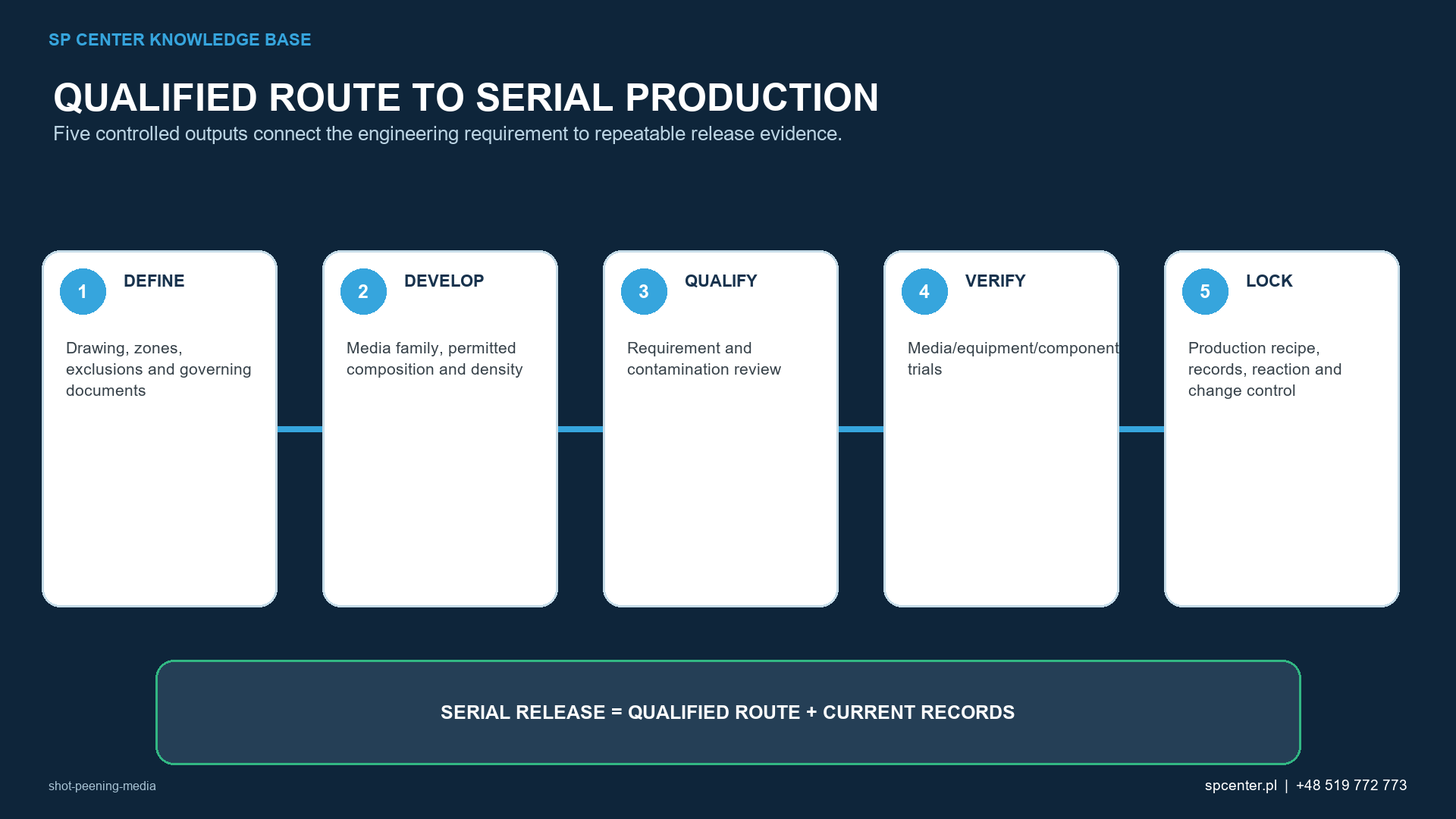
- Confirm the contractual hierarchy, approved media family, material and detail specification.
- Review component alloy, heat treatment, geometry, access, surface limits and downstream operations.
- Confirm machine compatibility, delivery, recovery, classification, segregation and contamination controls.
- Accept and identify the supplier lot and establish the operating-mix control route.
- Determine or verify intensity and establish coverage and surface acceptance on representative geometry.
- Validate the component response when required, then approve operating limits, records, maintenance and change control.
Why does a media substitution require review?
| Proposed change | Why settings cannot simply be copied | Minimum technical review |
|---|---|---|
| Another media family | Density, hardness, contact, flow, durability and contamination behaviour change | Specification approval, equipment compatibility, intensity, coverage, surface and validation |
| Another size or hardness grade | Particle population, acceleration, access, roughness and component response may change | Media acceptance, process window and component evidence |
| Another supplier or manufacturing route | Distribution, conditioning, alloy, durability and lot controls may differ | Source approval, receiving qualification and equivalence review |
| Fresh-media ratio or classifier setting | The operating population and stream stability may move | Operating-mix trend, intensity and surface review |
| Shared-equipment changeover | Retained prior media can contaminate the new route | Qualified cleaning, purge, sampling, analysis and release |
Table 5. A successful numerical machine setting belongs to a defined media and equipment configuration. Matching pressure, wheel speed or nominal size does not establish technical equivalence.
What should be specified and recorded?
- Media family, material, designation, applicable general and detail specifications and revisions.
- Approved source, supplier lot, certificate, receiving status and storage identity.
- Permitted size, shape, hardness, cleanliness and operating-mix criteria.
- Machine charge, replenishment, classification, sampling and disposal.
- Segregation, dedicated-equipment or qualified-changeover requirements.
- Intensity, coverage, surface acceptance, validation, deviations and release records.
Frequently asked questions
Which shot peening media is best?
There is no universal best family. The correct choice depends on the invoked specification, component material, geometry, required intensity and coverage, surface limits, equipment, downstream route and qualification evidence.
Are glass beads, ceramic shot and steel shot interchangeable?
No. They differ in material, density, hardness, durability, fracture behaviour, contamination compatibility and equipment response. Substitution requires the prescribed technical approval and qualification.
Does a media certificate qualify the process?
No. It supports receiving acceptance. The machine operating mix, peening stream, component surface and any required engineering response need their own controlled evidence.
Can the same machine settings be used after changing media?
Not by assumption. Even a similar designation can change mass flow, acceleration, intensity, coverage exposure and surface condition. The qualified process must be reviewed and re-established as required.
Why must the operating mix be monitored?
Recirculation, wear, breakage, replenishment, classification and contamination change the active population after receiving acceptance.
What should an RFQ state about media?
State the invoked process and media specifications, component material, treatment zones, intensity and coverage, surface and contamination limits, approved-source or segregation requirements, validation and required records.
Key takeaways
- No media family is universally best; selection belongs to the component, equipment and governing requirements.
- Material, density, size, shape, hardness, durability and cleanliness form one controlled system.
- Supplier-lot acceptance and operating-mix control are separate decisions.
- Media conformance, intensity, coverage and component validation are complementary evidence layers.
- Media substitution requires controlled approval and qualification rather than copied machine settings.
Related SP Center guides
- Shot Peening Media Quality Control
- Media Contamination in Shot Peening
- Air-Blast vs Wheel Shot Peening
Technical references
1. SAE AMS2431E: Peening Media, General Requirements, revised April 2023
2. SAE AMS2430U: Shot Peening, revised April 2018
3. SAE J444_202306, Cast Shot and Grit Size Specifications for Cleaning and Peening
4. SAE ARP7488: Peening Design and Process Control Guidelines, issued January 2018
Standards note: The applicable media detail specification, drawing, contract, customer requirements and invoked revisions remain authoritative.
Author: Paweł Kmieć
Discuss your shot peening requirement: +48 519 772 773 | [email protected]