


How particle geometry affects contact, surface condition and process stability—and how to inspect incoming lots and the operating mix
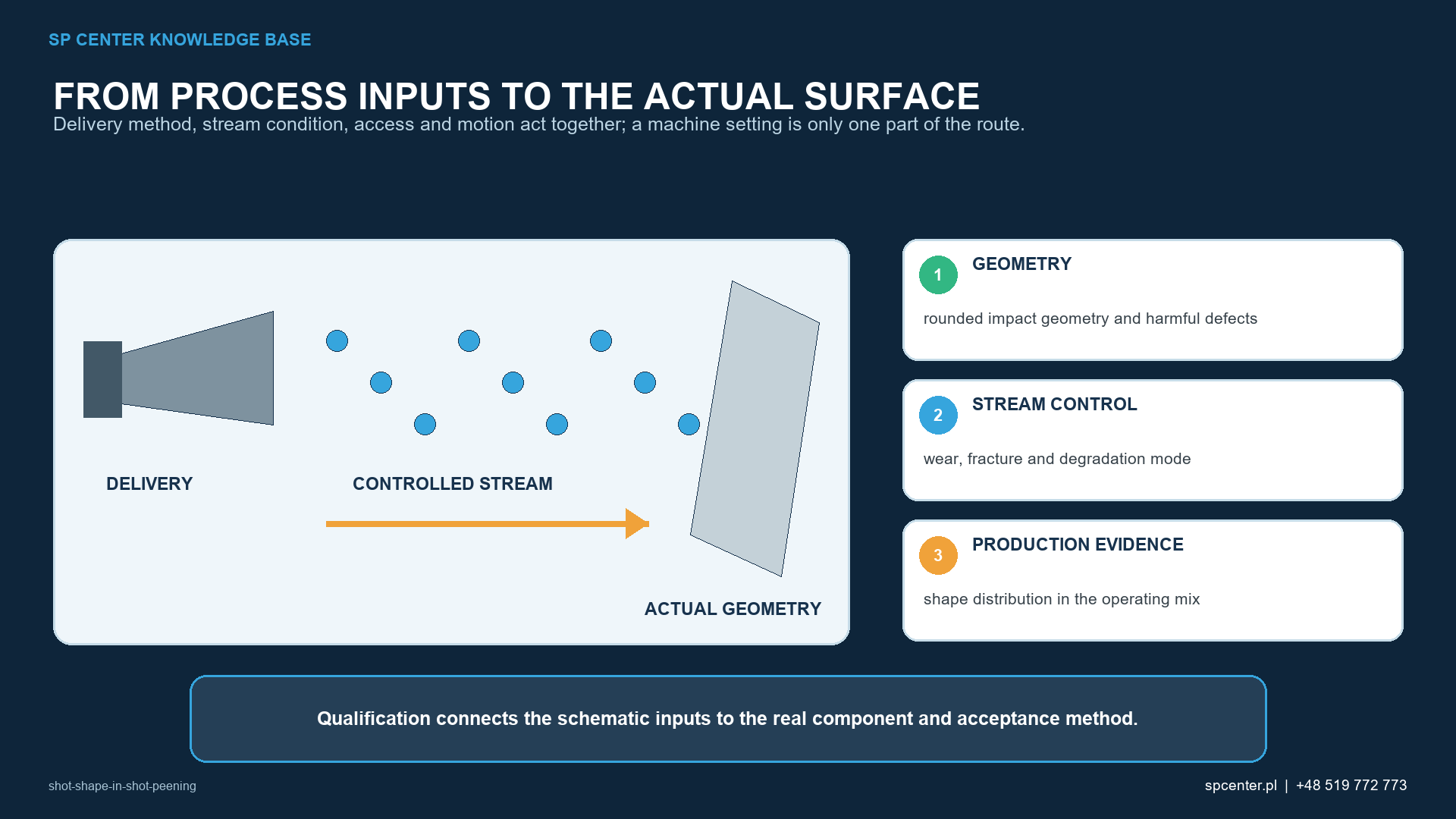
Shot shape is a controlled media characteristic in shot peening because particle geometry changes the local contact condition. Rounded or correctly conditioned particles, angular fragments, elongated particles and fused or heavily worn shapes do not strike the component in the same way. Shape control must therefore address both the delivered media lot and the recirculating operating mix. It supports a qualified process but does not replace Almen intensity, coverage or component-surface inspection.
Which particle shapes matter?
| Observed shape | Possible origin | Technical concern |
|---|---|---|
| Rounded or correctly conditioned particle | Conforming production and conditioning route | Expected contact condition for the qualified media family |
| Angular or sharp fragment | Breakage, poor conditioning or foreign abrasive | Local cutting, folding, roughness or surface-damage risk |
| Elongated particle | Insufficiently conditioned cut wire or mixed media | Directional contact, inconsistent impact response and possible specification nonconformance |
| Fused, clustered or double particle | Manufacturing defect or agglomeration | Oversize local impact and unstable classification |
| Flattened or heavily worn particle | Plastic deformation, unsuitable hardness or extended recycle | Changed contact area, reduced durability and operating-mix drift |
Table 1. The acceptable categories and limits depend on the invoked media specification and detail specification. Descriptive terms in this guide are not universal acceptance criteria.
Where do adverse shapes come from?
| Source | Mechanism | Control |
|---|---|---|
| Supplier lot | Incorrect conditioning or excessive shape defects | Approved media designation, lot traceability and required receiving inspection |
| Normal recirculation | Fatigue breakage and wear accumulate defective particles | Operating-mix sampling, classifier performance and replenishment control |
| Equipment condition | Wheel, nozzle, hose or separator damage generates fragments or changes breakage rate | Maintenance, wear inspection and process trending |
| Cross-contamination | A different media or abrasive enters the system | Segregation, qualified changeover and contamination investigation |
| Sampling or preparation | Bias, overlapping particles or poor imaging produces a false classification | Representative sampling, validated preparation and controlled viewing conditions |
Table 2. A poor shape result can indicate supplier-lot nonconformance, normal operating-mix degradation, equipment deterioration, cross-contamination or a biased inspection. The investigation must distinguish these causes.
How can shape change the component surface?
A rounded contact tends to displace material differently from a sharp edge or elongated particle. Angular fragments can increase local cutting, folding or roughness risk, while oversized fused particles may create isolated severe impressions. The actual result also depends on particle material, size, hardness, velocity, impact angle, component material and prior surface condition. Shape should never be evaluated as an isolated performance guarantee.
Shape also affects media durability and flow. Broken or flattened particles can change the size distribution, classifier load, mass flow and intensity response. The operating-mix trend may therefore provide early evidence of media or equipment instability even before a formal limit is exceeded.
Which evidence layers must remain separate?
| Evidence layer | What it answers | What remains separate |
|---|---|---|
| Incoming-lot shape acceptance | Whether the delivered sample meets the invoked shape criteria | Condition of the media after service in the machine |
| Operating-mix shape control | Whether the recirculating population remains within the approved condition | Correct Almen intensity and complete component coverage |
| Almen intensity verification | Whether the peening stream has the required standardized effect | Particle-shape distribution and surface damage |
| Component surface acceptance | Coverage, boundary condition and invoked surface limits | Conformance of every media lot without media records |
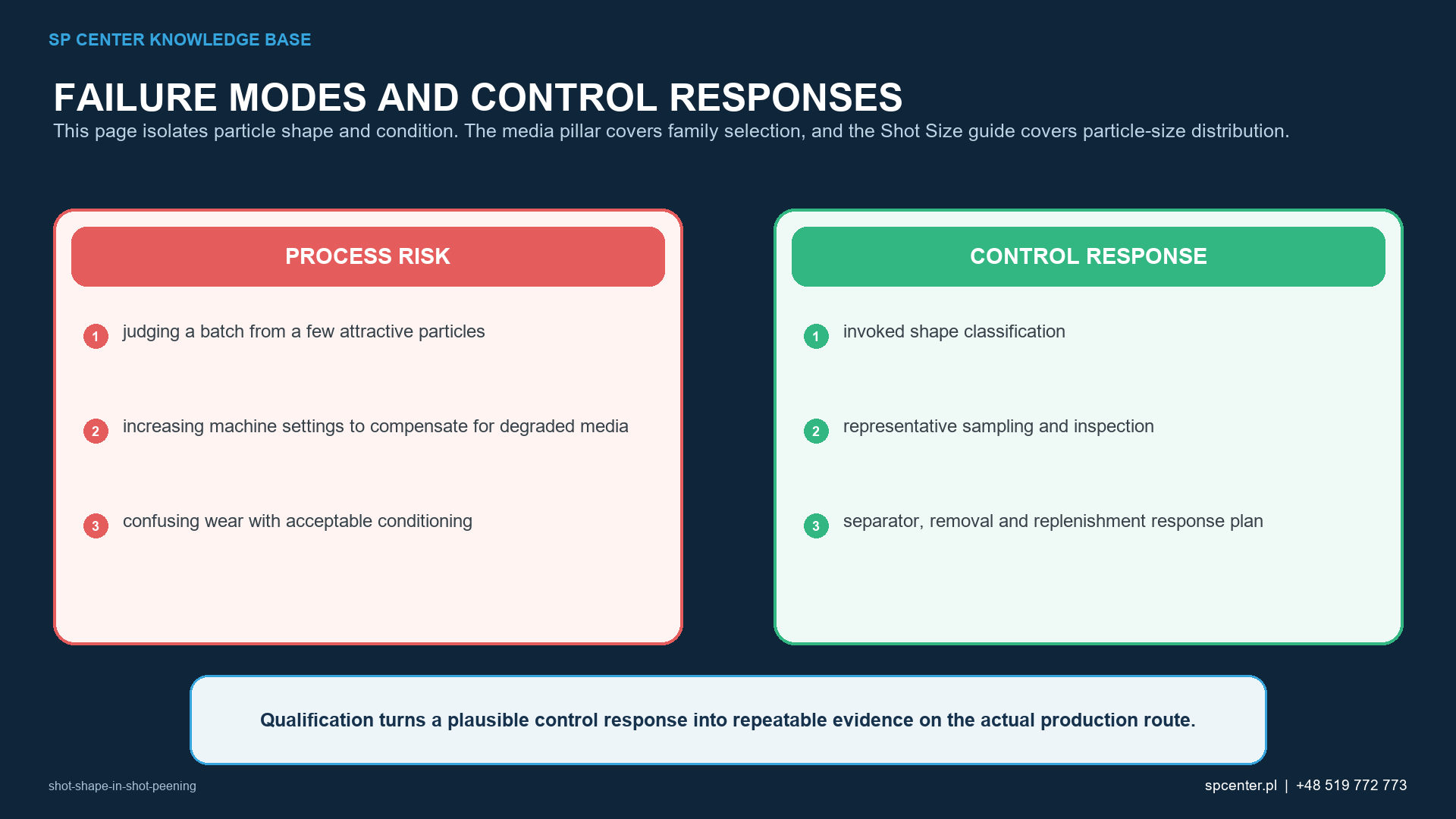
Table 3. Media-shape acceptance answers a media question. It cannot release a component surface, and a satisfactory component or Almen result cannot reconstruct missing media conformance evidence.
How should a shape sample be inspected?
| Inspection element | Control question | Common bias |
|---|---|---|
| Sampling location and time | Does the sample represent the supplier lot or active operating stream? | Taking only an accessible surface scoop after segregation |
| Sample reduction | Does division preserve broken, small, large and irregular particles? | Preferential loss of fine or light fragments |
| Preparation | Are particles separated and presented without overlap or orientation bias? | Hiding defects under other particles or selecting favourable fields |
| Imaging and classification | Are magnification, illumination, categories and decision rules approved? | Changing thresholds or categories after seeing the result |
| Counting and reporting | Are all examined particles, exclusions and calculations traceable? | Reporting only selected images instead of the complete result |
Table 4. Representative sampling and controlled preparation are as important as microscopy. A high-resolution image of a biased sample is not defensible evidence.
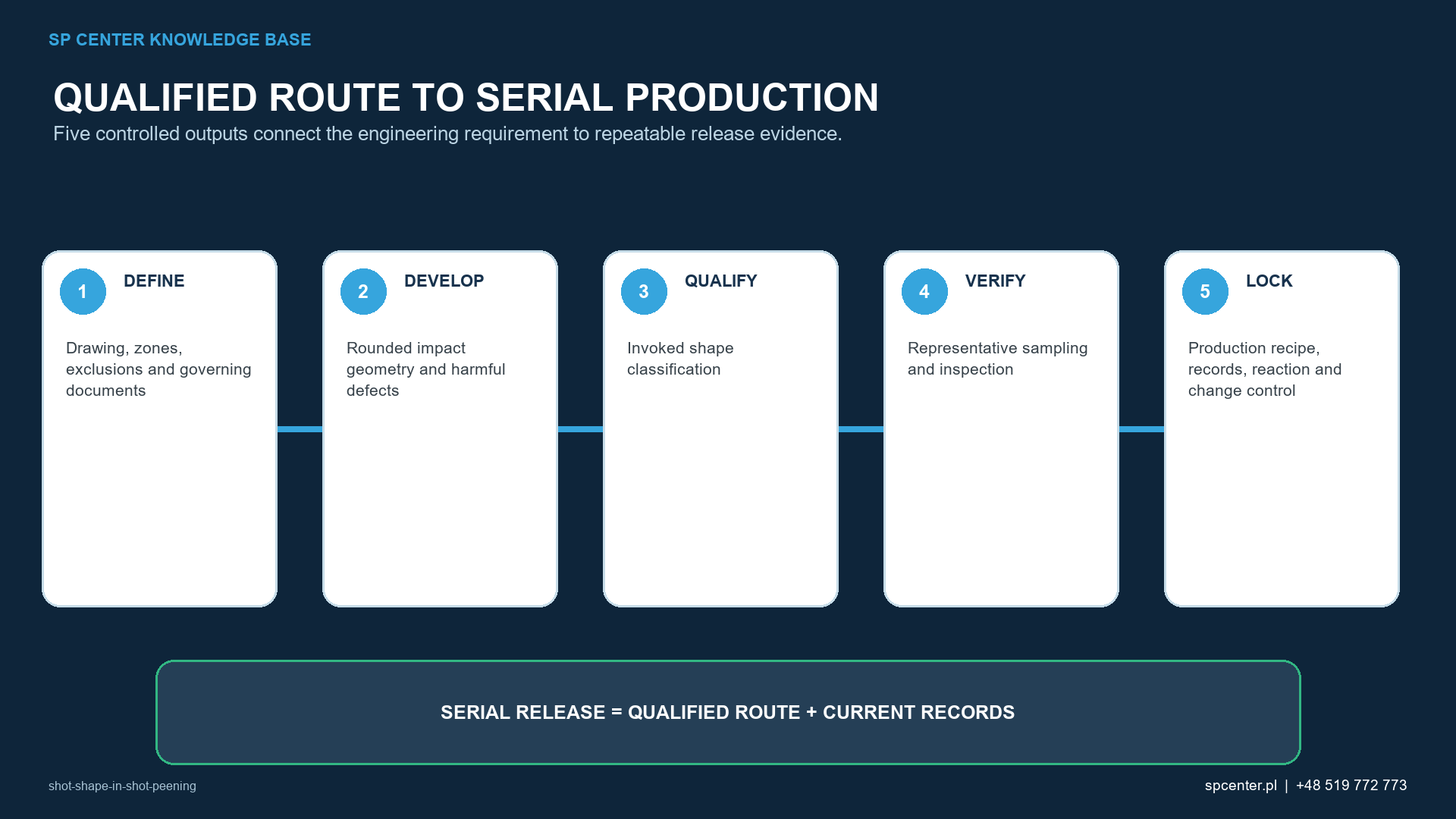
The approved method should define the media state being sampled, location and timing, sample reduction, preparation, magnification or imaging conditions, classification categories, count or calculation, acceptance criteria and record. Automated image analysis may support repeatability when its segmentation and classification logic are qualified for the media family and expected defects.
How should incoming and in-process frequency be set?
Receiving and operating-mix frequencies must follow the governing specification, customer requirement and approved control plan. Additional checks may be justified after a new lot, machine maintenance, classifier change, unusual media consumption, intensity drift, surface anomaly or suspected contamination. A universal frequency should not be invented from another process.
Which findings require containment or investigation?
| Finding | Immediate response | Product question |
|---|---|---|
| Shape result outside the applicable limit | Stop or contain use of the affected operating mix and confirm the measurement | Which components were processed since the last acceptable shape evidence? |
| Rapid adverse trend within limits | Investigate media durability, classifier and equipment condition | Can the trend affect intensity, roughness or surface condition before the next planned check? |
| Foreign angular particles | Open a contamination investigation and segregate affected media | Is the foreign material compatible with the component and downstream route? |
| Correct intensity with unacceptable shape | Continue containment; do not release on intensity alone | Could local surface damage or embedded material remain undetected? |
| Unclear classification | Repeat using the approved method or escalate to technical review | Is the evidence sufficient for a contractual acceptance decision? |
Table 5. Replenishing with fresh media can dilute a defective population but does not by itself establish the cause, restore traceability or dispose of affected product.
What records demonstrate shape control?
- Applicable media specification, detail specification and customer revision.
- Supplier, media designation, lot, certificate and receiving status.
- Machine, operating mix, replenishment and classifier or separator condition.
- Sampling point, time, method, sample reduction and preparation.
- Images, categories, raw counts, calculation, equipment or software identity and result.
- Trends, nonconformances, containment, restoration, product disposition and release.
Frequently asked questions
Why does shot shape matter in shot peening?
Particle shape determines the local contact condition. Rounded or correctly conditioned media and angular, broken or elongated particles can produce different roughness, material displacement, durability and surface-damage risks.
Does a spherical commercial designation prove acceptable shape?
No. The delivered lot and operating mix must meet the shape criteria and inspection method invoked for the applicable media family and customer requirement.
Can correct Almen intensity prove acceptable particle shape?
No. An operating mix with shape defects may still produce an in-range Almen result. Shape, intensity and component surface acceptance require separate evidence.
Should every irregular particle be rejected?
Do not invent a zero-defect rule. Shape categories, sample size, permissible population and disposition must come from the governing specification and approved process.
Why can the operating mix differ from the supplier lot?
Recirculation introduces wear and breakage, while replenishment and classification change the population. Equipment wear and cross-contamination can add further shape defects.
What happens after an adverse shape result?
The process and affected product window should be contained as required, the result confirmed, the cause investigated, the media system restored and product disposition completed under the approved procedure.
Key takeaways
- Particle shape changes the local impact contact and can affect roughness, damage risk and media durability.
- Supplier-lot shape and operating-mix shape are separate control decisions.
- Sampling, preparation and classification rules determine whether the result is representative.
- Correct intensity does not prove acceptable shape; acceptable shape does not prove component coverage.
- Adverse results require cause investigation, media restoration and product-window disposition.
Related SP Center guides
Technical references
1. SAE AMS2431E: Peening Media, General Requirements, revised April 2023
2. SAE J444_202306, Cast Shot and Grit Size Specifications for Cleaning and Peening
3. SAE AMS2430U: Shot Peening, revised April 2018
4. SAE ARP7488: Peening Design and Process Control Guidelines, issued January 2018
Standards note: The applicable media detail specification, drawing, contract, customer requirements and invoked revisions remain authoritative.
Author: Paweł Kmieć
Discuss your shot peening requirement: +48 519 772 773 | [email protected]