


Qualify the mechanical peening response and the corrosion-relevant surface condition as two coordinated but separate acceptance objectives
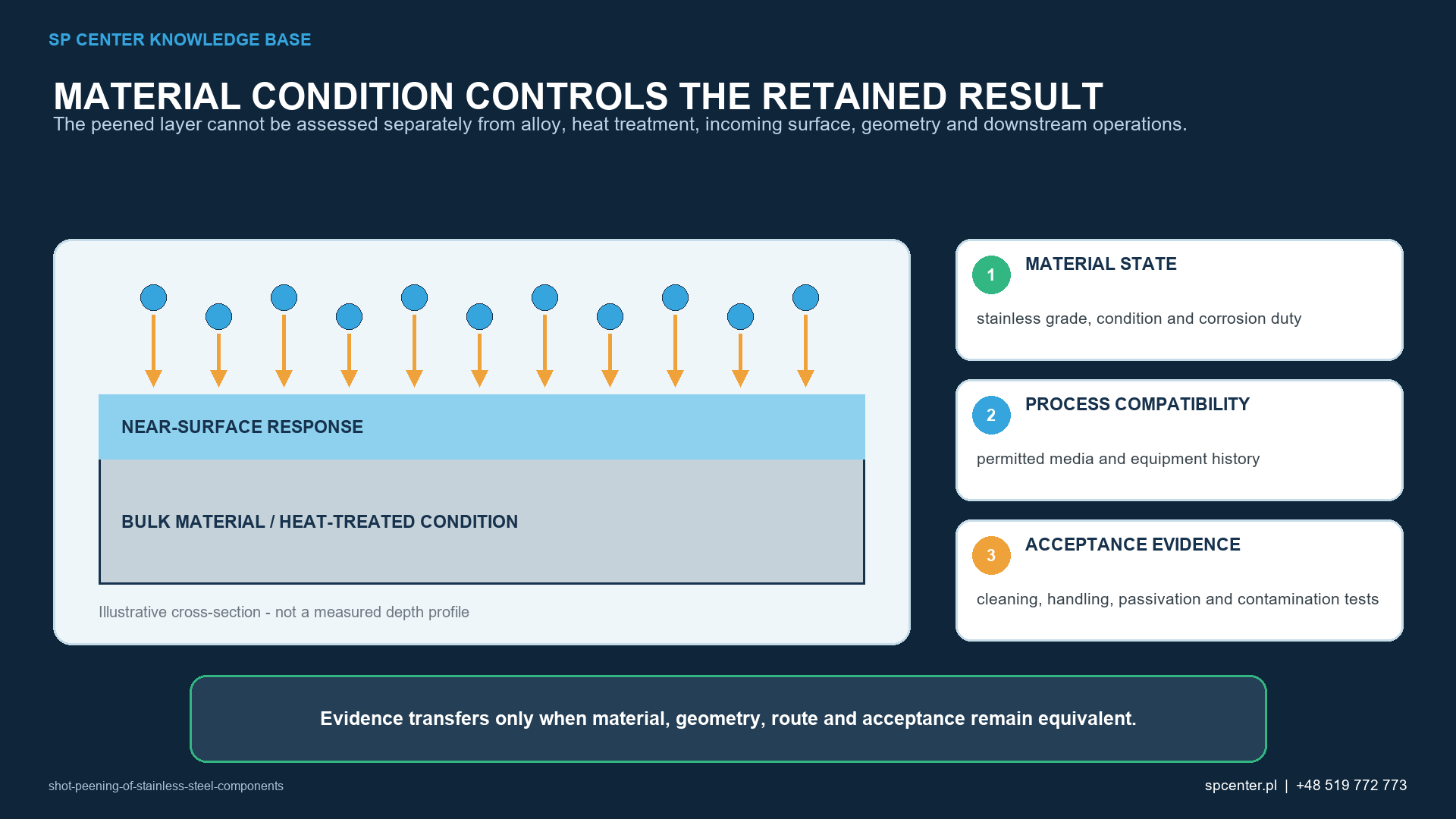
Shot peening can introduce a beneficial near-surface compressive residual-stress field in stainless steel, but the route must also preserve the surface condition required for corrosion, sealing, hygiene, appearance or downstream processing. Qualification therefore starts with the exact alloy, heat treatment and service duty, then controls media, equipment history, process severity, contamination, handling and any authorised cleaning or passivation.
Why is stainless steel not one process material?
| Stainless family | Material-specific concern | Qualification focus |
|---|---|---|
| Austenitic | Strong work-hardening response; grade and condition can affect magnetic, deformation and corrosion behaviour | Actual grade, prior cold work, hardness, roughness, distortion and service environment |
| Martensitic | Higher strength/hardness and corrosion behaviour depend strongly on heat treatment and temper | Heat-treatment identity, hardness, damage sensitivity, dimensions and invoked aerospace/customer requirements |
| Precipitation-hardening | Mechanical and corrosion properties depend on solution/age condition and alloy | Do not transfer peening parameters between conditions without authorised engineering review |
| Duplex | Two-phase microstructure and corrosion performance are condition- and environment-sensitive | Grade, product condition, thermal history, surface integrity and application-specific evidence |
| Ferritic or specialised stainless | Strength, formability, sensitisation and corrosion response differ from other families | Treat the exact grade and condition as a separate material case |
Table 1. The alloy family is a starting point; the actual grade, product condition and heat-treatment state govern qualification.
Do not transfer parameters solely because two materials are called stainless steel. Drawing and material records should identify designation, product form, heat treatment, hardness and relevant prior cold work. Service environment and the actual fatigue, corrosion or stress-corrosion mechanism define which outcomes need validation.
What does shot peening change at the surface?
Controlled impacts plastically deform the near-surface region. Constraint from the underlying material can leave a compressive residual-stress field, while roughness, cold work, topography, dimensions and local surface chemistry may also change. The affected depth and magnitude are not universal and cannot be calculated from Almen intensity alone.
Shot peening is not automatically a corrosion-resistance treatment. A result demonstrated for one alloy, environment and surface route does not establish performance for another. Where corrosion, stress-corrosion cracking or fatigue performance is claimed, use the component- or application-specific validation required by the governing engineering basis.
Where can foreign iron and cross-contamination enter?
| Potential contact source | Possible contamination route | Control question |
|---|---|---|
| Peening media and operating mix | Foreign iron, previous-alloy carry-over, fractured particles or dust | Is media type approved, segregated, conforming and protected through storage, feed and recovery? |
| Cabinet, separator, hopper, hoses and nozzle | Retained media or ferrous debris remains after a nominal media change | Is equipment dedicated, or is a validated changeover and release method defined? |
| Fixtures, masks and tooling | Carbon-steel contact, worn hardware, embedded particles or rebound | Are materials, cleanliness, wear limits and treatment boundaries controlled? |
| Benches, gloves, brushes and containers | Recontamination after peening or cleaning | Are handling items clean, compatible, identified and segregated as required? |
| Internal features | Particles and cleaner remain in holes, passages, threads or cavities | Does the route define removal, drying and verification for the complete geometry? |
Table 2. Contamination control follows every surface and particle that can contact the component or media circuit.
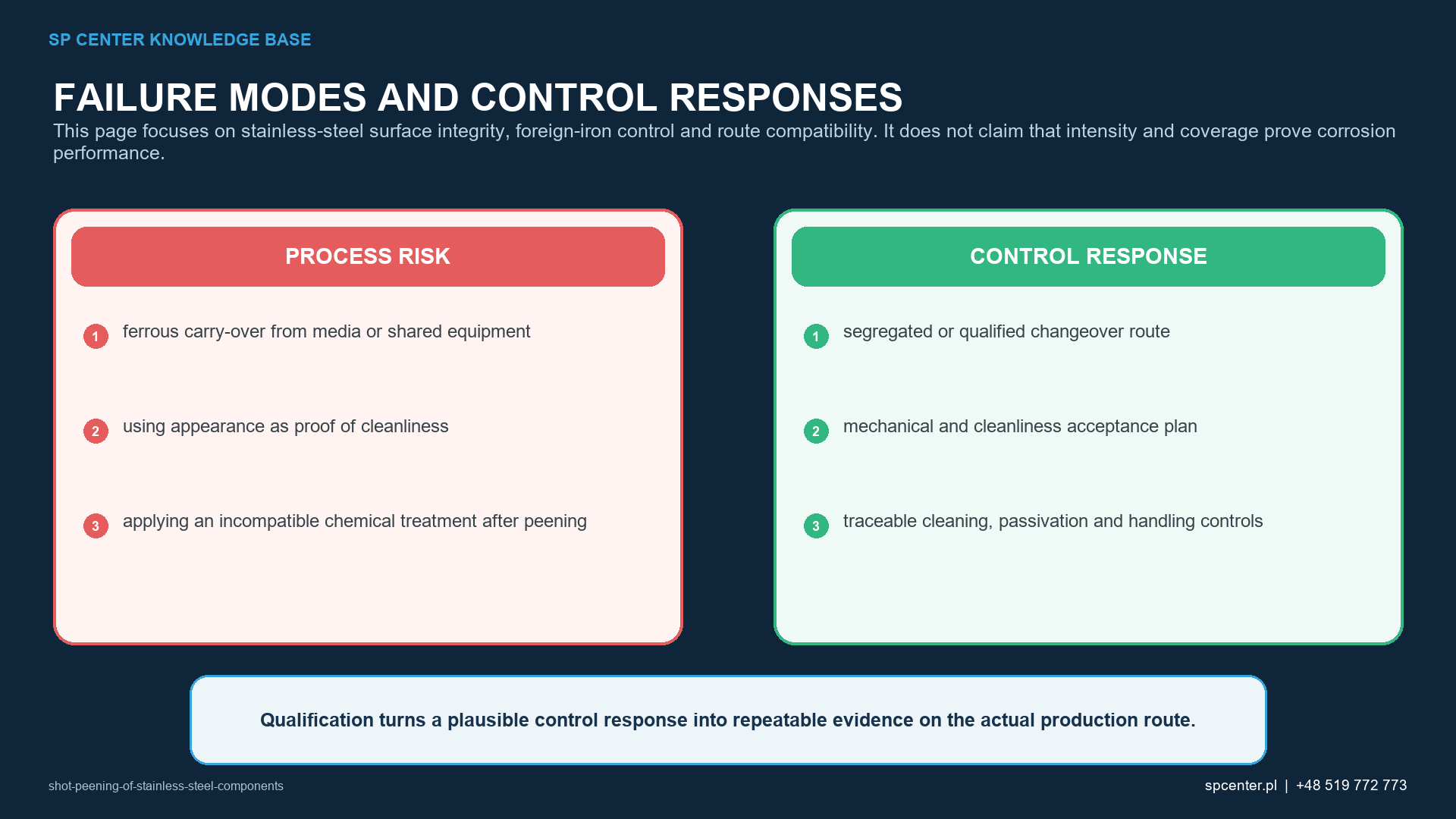
Exogenous iron can rust locally or disturb the intended passive surface condition; the stainless alloy itself has not been converted to carbon steel. Immediate visual cleanliness is not proof that a thin residue or embedded foreign material is absent. Likewise, changing the media container does not by itself validate equipment changeover.
How is peening media selected for stainless steel?
The drawing, process specification and customer flow-down determine which media are permitted. Stainless steel shot or conditioned cut wire, ceramic shot, glass shot or another approved medium may be feasible depending on mechanical capability and contamination compatibility. “Non-ferrous” or “stainless” does not mean universally suitable.
Qualification covers media material, size, hardness, shape, density and operating condition together with the equipment. The media must achieve the specified intensity and coverage without unacceptable roughness, embedded particles, contamination, distortion or surface damage. Blast cleaning or glass-bead blasting must not be called shot peening unless the controlled route meets the invoked peening requirements.
Which evidence is needed for release?
| Evidence | Question answered | Question not answered by itself |
|---|---|---|
| Almen intensity | Did the defined stream/setup provide the required standardised response? | Is the stainless component clean, corrosion-resistant or at the required residual-stress depth? |
| Coverage | Does the required surface show the invoked extent of impact evidence? | Are intensity, foreign-iron condition, roughness or corrosion behaviour acceptable? |
| Roughness/topography | Does the measured surface meet the specified method and limits? | Is the surface free of foreign iron or embedded media? |
| Free-iron or passivation-effectiveness test | Does the approved qualitative test meet its invoked acceptance criterion? | Has shot peening intensity, coverage or fatigue performance been demonstrated? |
| Residual-stress or fatigue validation | What response was measured for the stated material, location, method and condition? | Is the result transferable to another alloy, environment, geometry or process route? |
Table 3. Mechanical verification, component coverage, surface condition and cleanliness evidence answer different questions.
When are cleaning and passivation required?
Post-peening cleaning or chemical passivation is not added by default. It is used only when the drawing, specification or authorised manufacturing plan requires and qualifies it. Compatibility with alloy, heat treatment, dimensions, surface texture, later processes and service must be reviewed, and trapped solution must be prevented or removed from the complete geometry.
ASTM A380/A380M-25 provides practices for cleaning, descaling, pickling and passivation; ASTM A967/A967M-25 specifies alternative chemical passivation treatments and qualitative effectiveness tests. Neither document selects one universal treatment or acceptance criterion for every application. ISO 8074:2025 and ISO 8075:2025 address aerospace surface treatment for defined stainless families; applicability still depends on the invoked contract and complete standard.
How is the complete production route qualified?
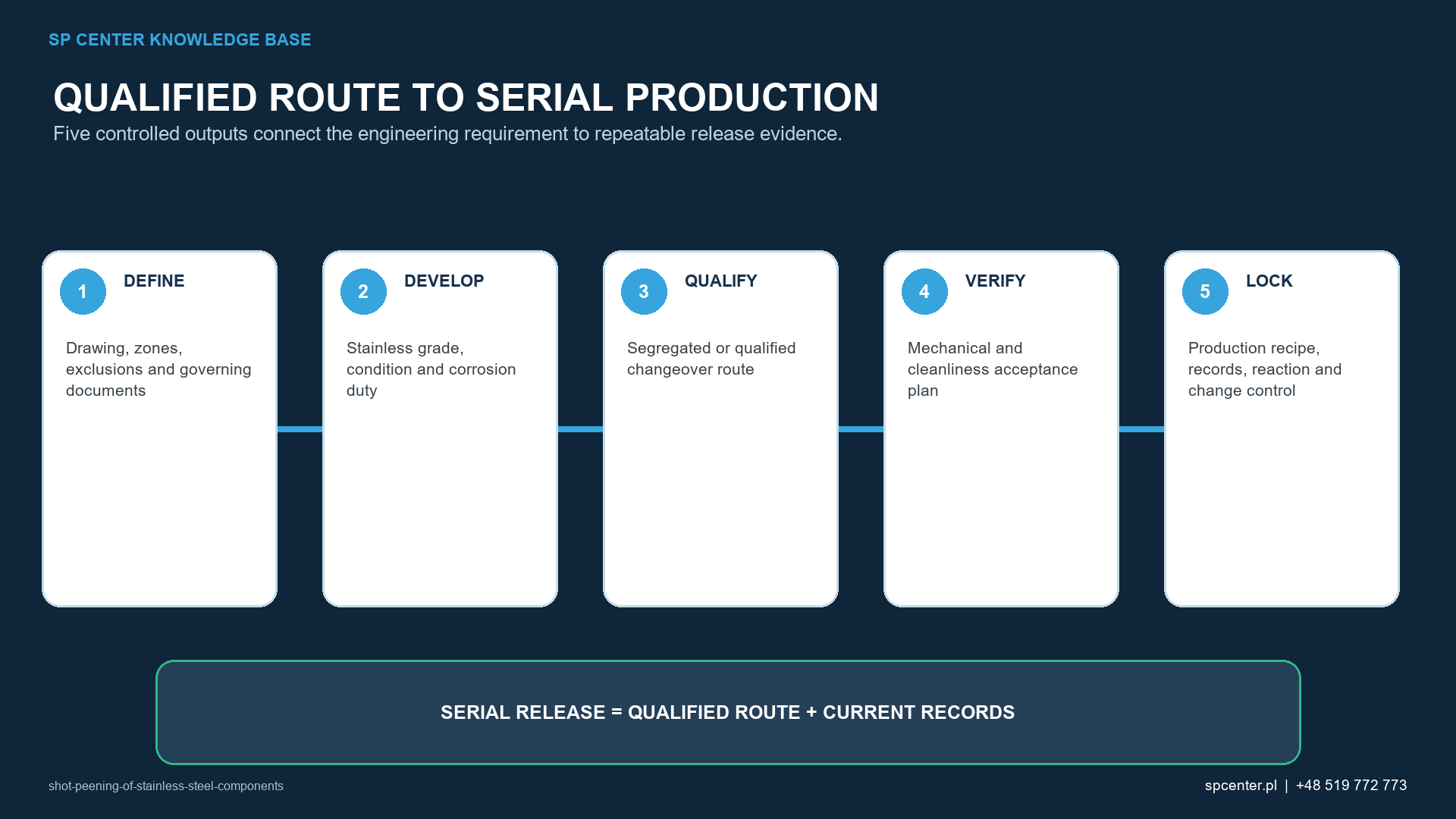
| Process stage | Required decision | Controlled output |
|---|---|---|
| Requirements review | Identify exact alloy/condition, service duty, treatment zones, media, specifications and surface acceptance | Resolved requirement matrix and authorised route |
| Equipment and media approval | Choose dedicated equipment or a validated changeover; control media identity, operating mix and recovery | Released configuration and contamination-control plan |
| Mechanical qualification | Establish intensity, coverage, exposure, geometry, roughness, dimensions and damage limits | Representative evidence tied to the production setup |
| Post-process sequence | Determine whether cleaning, passivation or other surface treatment is required and compatible | Authorised chemicals, parameters, rinsing/drying and acceptance method |
| Production release | Verify media/process records, component coverage, surface condition, cleanliness and required tests | Traceable serial/lot release and disposition of exceptions |
| Change control | Assess media, equipment, tooling, program, location, cleaner, passivation or test-method changes | Approved verification or requalification before use |
Table 4. Qualification integrates mechanical performance, contamination prevention, post-process compatibility and traceable release.
Shared equipment may be technically feasible only after the contamination route is understood and accepted. Depending on risk, the route can require dedicated circuits, validated cleanout, controlled first-off material, dedicated tooling, cleanliness testing and defined reaction limits. “The machine is clean” is not objective evidence without an approved method and result.
Why does stainless steel need special shot peening controls?
The process must achieve the required mechanical effect while preserving the specified surface condition. Alloy grade, heat treatment, media, equipment history, foreign-iron risk, handling and any cleaning or passivation route all matter.
Can carbon-steel shot be used on stainless steel?
Only when the governing requirements and qualified route explicitly permit it. Mechanical capability and foreign-iron/cross-contamination risk must be assessed together; a successful intensity result alone is insufficient.
Is stainless-steel media automatically safe for stainless parts?
No. It still requires approval for grade, size, hardness, shape, condition and contamination history. Equipment, recovery, tooling and handling can transfer foreign material even with dedicated media.
Does correct Almen intensity prove stainless-steel cleanliness?
No. Almen intensity verifies standardised stream response. Foreign iron, embedded particles, cleaning, passivation effectiveness and corrosion-relevant surface condition require separate invoked evidence.
Does shot peening always improve stainless-steel corrosion resistance?
No. Corrosion response depends on alloy, condition, environment, surface topography, contamination, process severity and post-process route. Shot peening is not a universal corrosion-protection treatment.
Is passivation always required after shot peening?
No. It is used only when the drawing, specification or authorised manufacturing plan requires and qualifies it. The selected treatment, material compatibility, rinsing, drying and acceptance test must be controlled.
Can a shared peening machine process stainless steel?
Potentially, but only through an accepted contamination-risk assessment and dedicated or validated changeover controls covering the complete delivery/recovery circuit, tooling, handling and release evidence.
What should an RFQ for stainless components include?
Provide drawing/revision, exact alloy and product form, heat treatment/hardness, service duty, prior and later processes, zones, media and equipment restrictions, intensity, coverage, roughness, cleanliness/passivation, quantities and record requirements.
Key takeaways
- Treat mechanical response and corrosion-relevant surface condition as separate acceptance objectives.
- Qualify the exact stainless grade, heat treatment, hardness and service environment.
- Control the full contamination chain: media, machine, recovery, tooling, handling and internal geometry.
- Do not use intensity, coverage or visual appearance as substitutes for cleanliness evidence.
- Select cleaning, passivation and testing only from the authorised route.
- Verify roughness, dimensions, embedded particles and other surface limits where required.
- Reassess relevant media, equipment, tooling and post-process changes before production.
Related SP Center guides
Technical sources
1. SAE AMS2430U: Shot Peening, revised April 2018
2. SAE ARP7488: Peening Design and Process Control Guidelines, issued January 2018
3. SAE J2277_202301: Shot Peening Coverage Determination, revised January 2023
5. ASTM A967/A967M-25, Chemical Passivation Treatments for Stainless Steel Parts
6. ISO 8074:2025, Aerospace — Surface treatment of austenitic stainless steel parts
7. ISO 8075:2025, Aerospace — Surface treatment of hardenable stainless steel parts
8. SAE J2441_202511: Shot Peening, stabilized November 2025
Standards note: The drawing, contract and customer flow-down determine applicability and revision. This guide does not prescribe universal media, cleanliness criteria, passivation or a corrosion-performance claim.
Author: Paweł Kmieć
Discuss stainless-steel shot peening and contamination controls: +48 519 772 773 | [email protected]