


How material, cut dimensions, conditioning, hardness and operating-mix control determine whether conditioned cut wire suits the component route
Conditioned cut wire (CCW) is peening media manufactured from wire, cut to controlled dimensions and mechanically conditioned until the particle geometry meets the invoked requirements. Its potential advantages are controlled material, repeatable geometry and useful durability. It is not automatically superior to cast shot and must be selected with the component, equipment, intensity, coverage, surface limits and governing media specification.
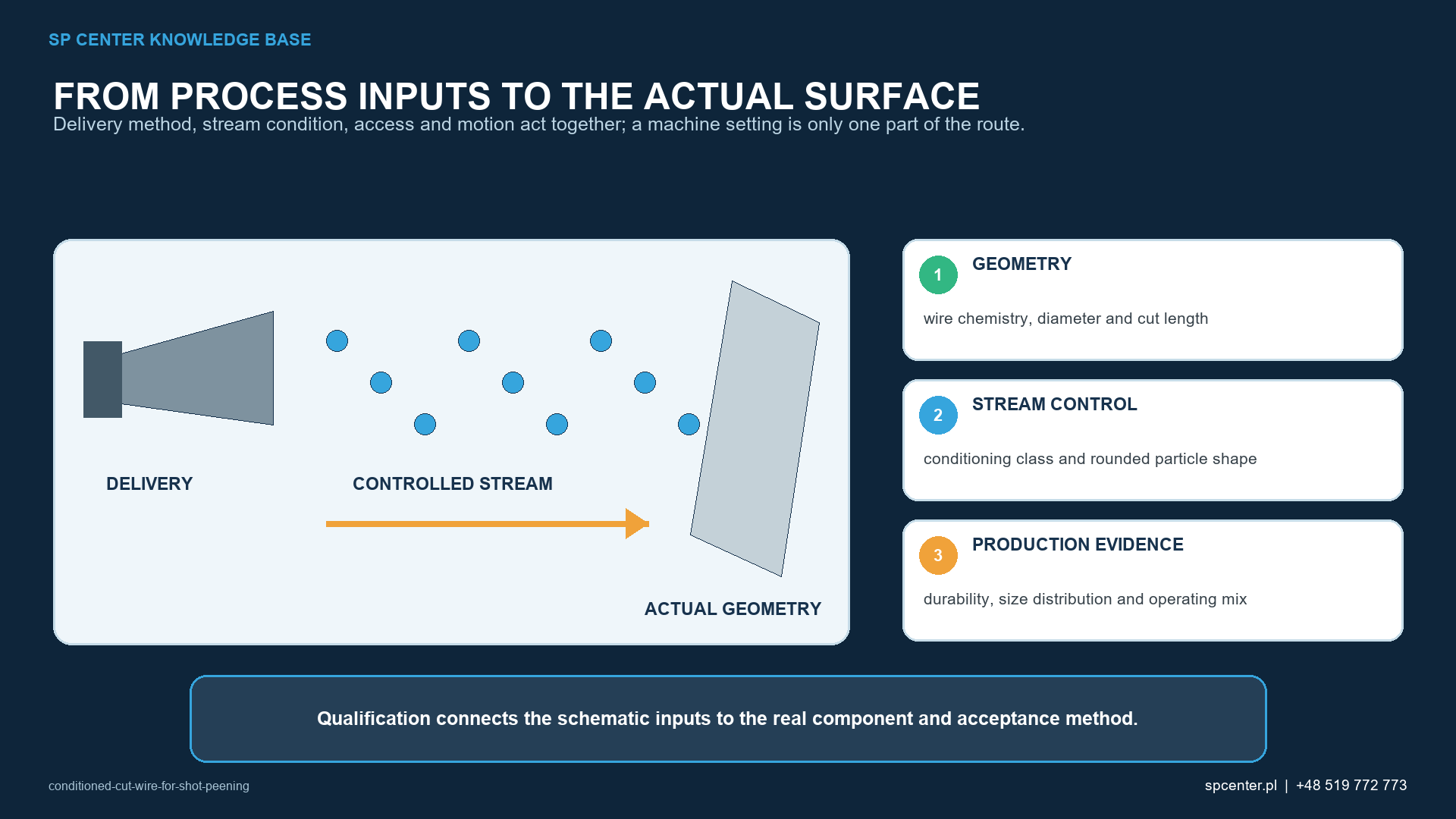
How is conditioned cut wire manufactured?
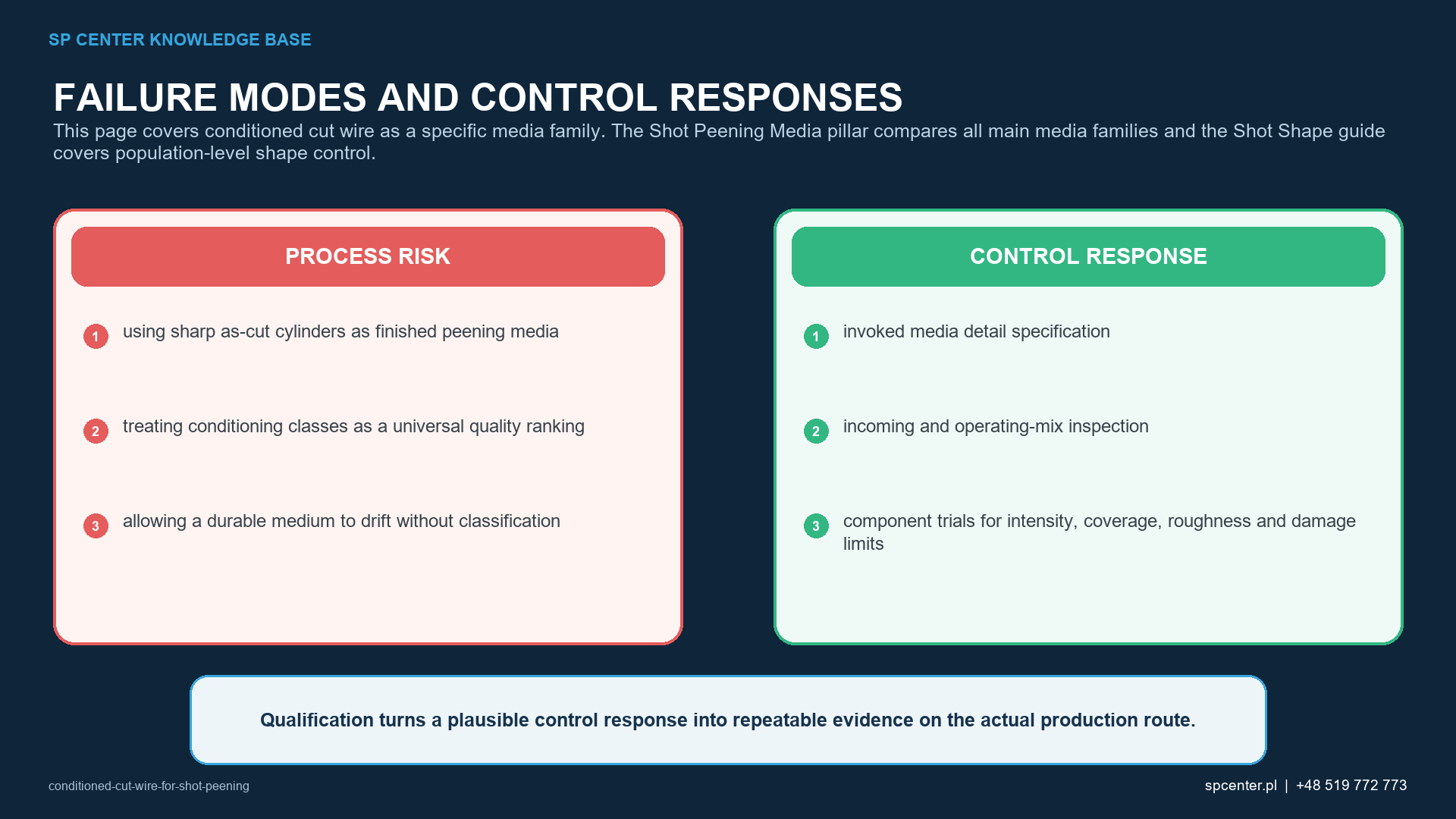
The starting wire establishes material composition and diameter. Cut length influences the initial aspect ratio. Mechanical conditioning then rounds the cut edges and changes the particle toward the required shape condition. An as-cut cylinder or an angular fragment is not automatically acceptable as finished shot peening media.
Material family, size, hardness, conditioning and acceptance criteria must come from the controlled specification. Commercial labels such as conditioned, double conditioned or special conditioned should not be treated as one universal quality ladder without a defined standard and inspection method.
Why does particle shape matter?
Rounded and angular contacts load the surface differently. Sharp edges, elongated particles and fracture fragments can change local indentation, roughness, damage risk and coverage development. Shape is therefore a process-control characteristic, not a cosmetic attribute.
Shape inspection does not replace size measurement, and sieving does not fully identify elongated or angular particles. Representative sampling, approved classification, acceptance limits and a reaction plan must be defined for both the supplier lot and the operating mix.
What does durability contribute?
Wire-derived media can show useful resistance to fracture under suitable conditions. Slower change in size and shape can support a stable operating mix and reduce replenishment demand. Durability does not make the media permanent: repeated impact can still cause wear, deformation, fracture, carry-out and contamination.
Durability is valuable only while the active population remains within its approved size, shape, hardness and cleanliness limits. Purchase price and expected life should therefore be evaluated as cost per accepted part within the qualified process window.
How does CCW compare with cast steel shot?
The families differ in manufacturing route, initial particle geometry, material classes, breakdown behaviour, available sizes and hardness ranges. Cast steel shot is widely available and can be economical. Conditioned cut wire may be attractive where controlled geometry and long-term operating-mix stability have high value. Neither family is inherently compliant, mandatory for an industry or interchangeable by nominal size alone.
Which specifications apply?
| Controlled choice | Primary authority or evidence | What remains to be qualified |
|---|---|---|
| Carbon-steel CCW, regular hardness | AMS2431/3F when contractually invoked | Size, conditioning, equipment, intensity and component response |
| Carbon-steel CCW, high hardness | AMS2431/8D when contractually invoked | Hardness-class approval, breakdown and component response |
| Stainless-steel CCW | AMS2431/4E when contractually invoked | Alloy, transfer risk, segregation and downstream compatibility |
| Selection and use guidance | SAE J441_202206 | Contractual media and component acceptance |
| Production route | Drawing, process specification and approved process plan | Actual machine, operating mix, intensity, coverage and surface limits |
Table 1. Media identity and conditioning remain traceable to the invoked requirements; the media specification does not replace process qualification.
How should size and hardness be selected?
Size affects particle mass, access, impact population, coverage development and surface texture. Hardness affects deformation, shape retention, fracture and interaction with the component. The largest or hardest permitted grade is not a default choice. Selection must provide the required peening-stream response while respecting worst-access geometry and component surface limits.
Why does the operating mix still matter?
Recirculating CCW changes through use and replenishment. Control the active size distribution, particle condition, unacceptable shapes, contamination and classifier performance. A supplier certificate supports receiving acceptance but does not prove that the in-machine population remains within the qualified state.
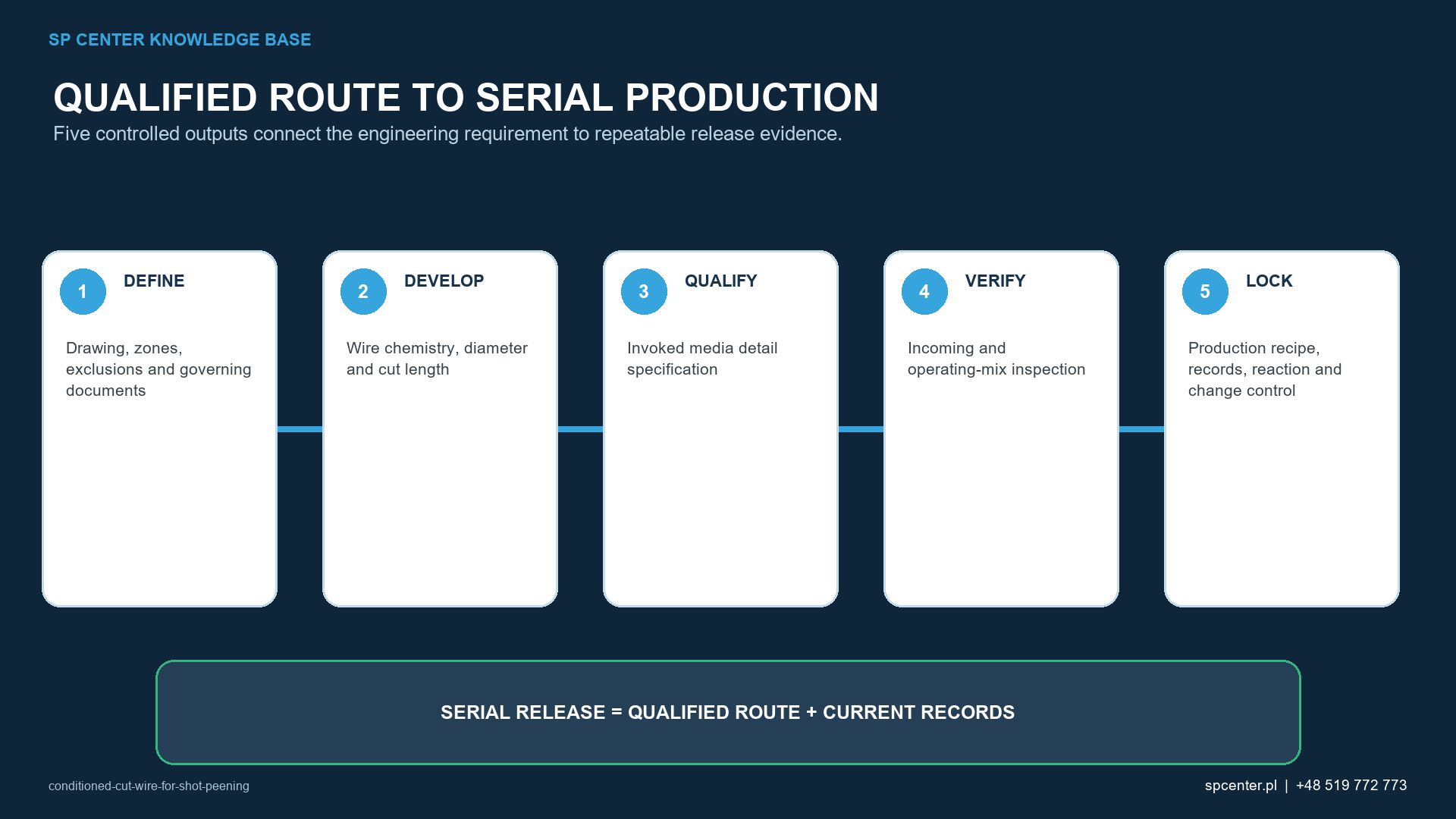
How is a CCW route qualified?
| Qualification stage | Required decision |
|---|---|
| Requirements review | Confirm media family, material, hardness, size, conditioning and revision hierarchy |
| Component review | Assess material, heat treatment, geometry, access, contamination and surface limits |
| Equipment review | Confirm metering, acceleration, recovery, classification and segregation capability |
| Process development | Establish saturation curve, Almen intensity, coverage and qualified exposure |
| Serial media control | Define supplier-lot acceptance, operating-mix sampling, replenishment and reaction limits |
| Component acceptance | Verify boundaries, coverage, surface condition and invoked dimensions or roughness |
| Change control | Review another family, grade, supplier, conditioning state or equipment configuration before use |
Table 2. Excellent media cannot compensate for an unqualified machine configuration or inadequate component acceptance.
Frequently asked questions
What is conditioned cut wire for shot peening?
It is wire-derived peening media cut to controlled dimensions and mechanically conditioned so the particle geometry meets the invoked requirements. Raw as-cut cylinders are not automatically acceptable finished peening media.
Is conditioned cut wire always better than cast steel shot?
No. Both families can support qualified shot peening. Selection depends on the governing specification, component, equipment, geometry, contamination strategy, surface limits and total process evidence.
Does conditioned cut wire eliminate media wear?
No. It can provide useful durability in a suitable system, but particles still wear, deform, break or leave the recovery system. The operating mix remains subject to control.
Does more conditioning always improve fatigue performance?
No. The required particle condition is defined by the applicable specification and qualified route. Component performance depends on the complete process and resulting surface state.
Does correct Almen intensity prove CCW condition?
No. Intensity verifies a standardized stream response. Media size, shape, hardness, operating-mix condition, component coverage and surface acceptance require complementary evidence.
When should conditioned cut wire be considered?
Consider it when the governing requirements permit it and controlled particle geometry, durability, operating-mix stability, contamination compatibility or lifecycle cost support the component route.
Key takeaways
- CCW is a defined wire-derived media family, not a generic name for cut cylinders.
- Material, cut dimensions, conditioning, size and hardness form one procurement definition.
- Durability supports stability only while the operating mix remains conforming.
- CCW and cast steel shot are not universally ranked or interchangeable.
- Media conformance, Almen intensity, coverage and component acceptance remain separate.
Related SP Center guides
Technical references
1. SAE J441_202206, Cut Wire Shot
2. SAE AMS2431E: Peening Media, General Requirements, revised April 2023
4. SAE AMS2431/8D, Peening Media Conditioned Carbon Steel Cut Wire Shot, High Hardness (55 to 62 HRC)
5. SAE AMS2431/4E, Peening Media Conditioned Stainless Steel Cut Wire Shot (AWS)
Standards note: Use the complete specifications and revisions invoked by the drawing, contract and customer requirements.
Author: Paweł Kmieć
Discuss your shot peening requirement: +48 519 772 773 | [email protected]