


How media hardness, toughness and the actual treated-surface condition influence particle behaviour, process stability and component acceptance
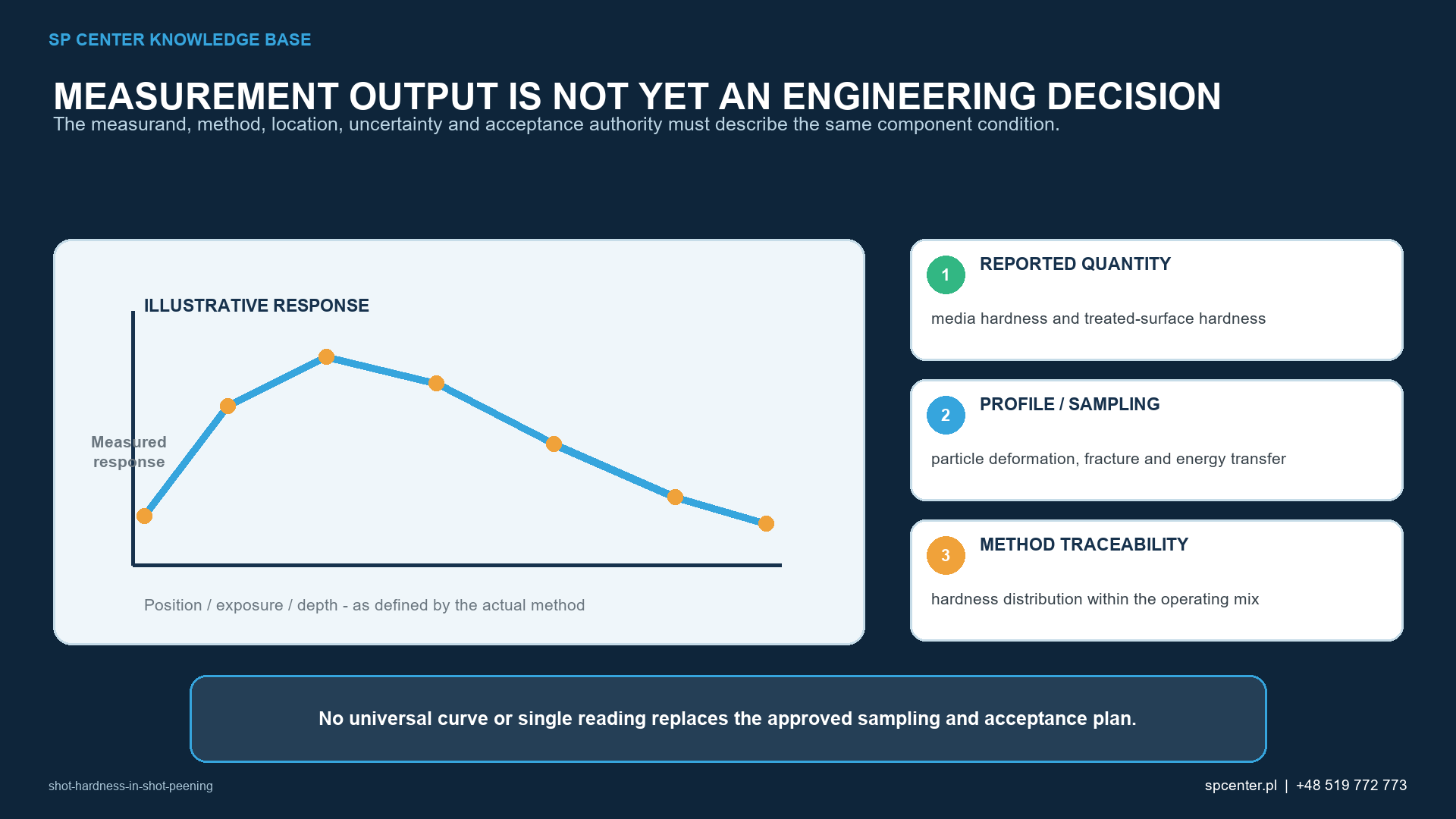
Shot peening media hardness affects whether a particle retains its shape, plastically deforms or fractures during repeated impact. It is not an independent machine setting and does not determine Almen intensity, residual-stress depth, coverage or fatigue performance by itself. Selection must follow the governing specification and account for media material, toughness, size, shape and density, the delivery system and the actual surface being peened.
Why is hardness only one part of the impact system?
Every impact mechanically loads both the particle and the component surface. Their elastic and plastic response also depends on particle mass and velocity, contact geometry, prior surface condition and repeated-impact history. The useful engineering question is whether the specified media remain conforming while the qualified process produces the required result on the actual surface.
| Variable | What it influences | What it cannot establish alone |
|---|---|---|
| Media hardness | Resistance to plastic deformation and contribution to shape retention | Required intensity, coverage, surface condition or fatigue performance |
| Media toughness | Resistance to cracking and fracture under repeated impact | Media hardness or component suitability |
| Media size and density | Particle mass, acceleration response, access and impact population | Actual velocity or qualified exposure |
| Particle shape | Contact geometry, indentation and breakdown behaviour | Conformance to the complete media specification |
| Treated surface condition | Local resistance to indentation and sensitivity to damage | Permitted media family or process window |
Table 1. Hardness must be evaluated with the other media, stream and component variables.
Which component hardness is relevant?
The bulk alloy designation may not describe the surface exposed to peening. Carburizing, nitriding, induction hardening, coatings, prior cold work and local heat treatment can alter the near-surface response. Two components made from the same nominal alloy can therefore require different process development.
- Confirm the final heat-treatment condition and controlled drawing revision.
- Use applicable surface or case hardness, not only core hardness or raw-material data.
- Identify hardness gradients, coatings and locally hardened regions.
- Confirm the condition before peening and the effect of subsequent operations.
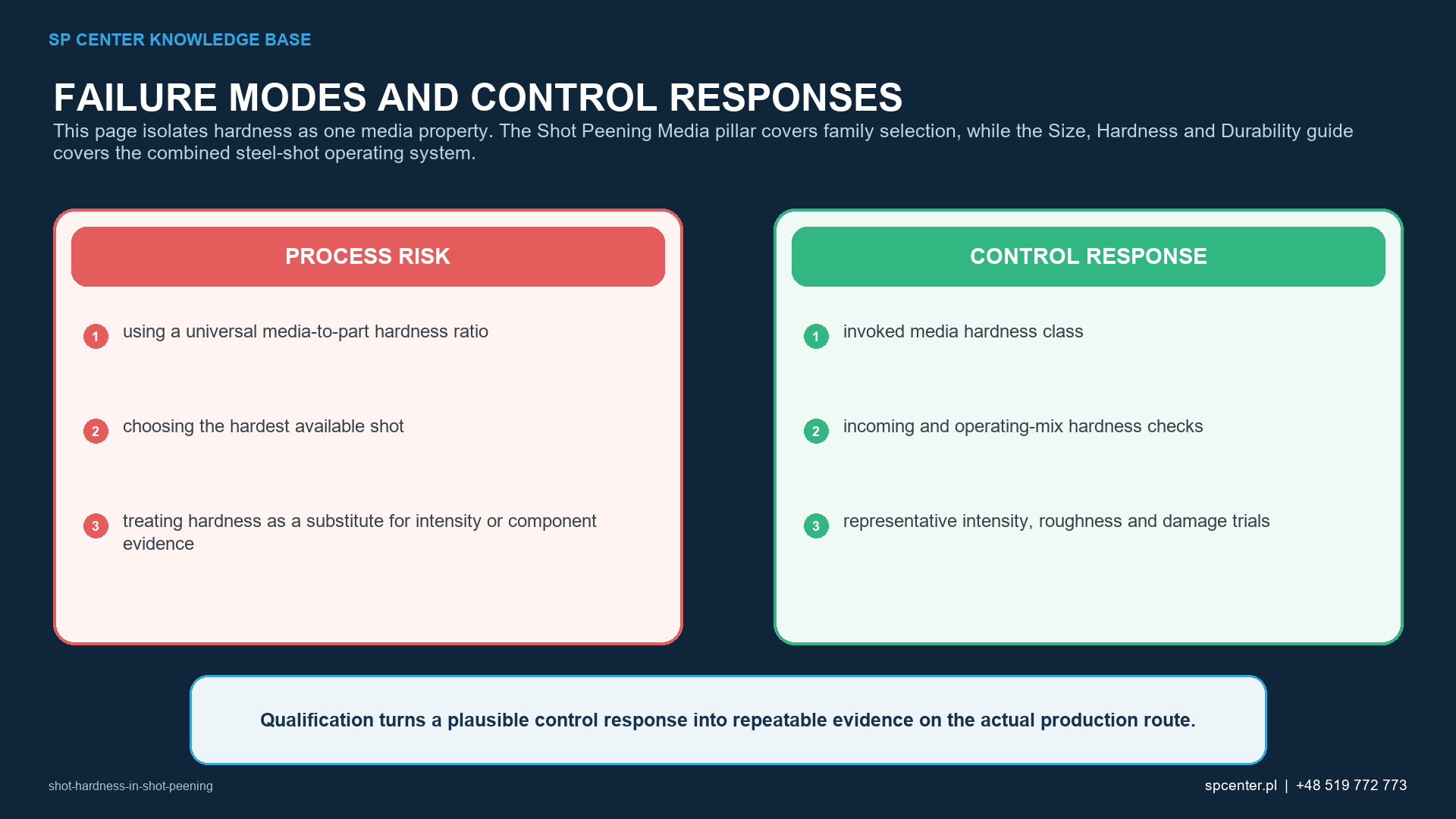
What can happen when metallic media are too soft for the duty?
Rapid particle deformation can increase flattened, elongated or otherwise nonconforming particles in the operating mix. Contact geometry, separation behaviour, coverage development and stream stability can then move away from the qualified condition. Reduced energy transfer may occur, but the primary concern is loss of the controlled media state.
| Observed condition | Possible consequence | Controlled response |
|---|---|---|
| Increasing flattened or elongated particles | Contact geometry and operating-mix behaviour change | Inspect against invoked shape criteria and follow the reaction plan |
| Accelerated wear or size loss | Size distribution and replenishment demand shift | Review classification, additions and media-consumption trend |
| Unstable intensity | The process inputs or operating mix may not reproduce the qualified stream | Contain affected product and investigate media, machine and delivery together |
| Variable surface response | Coverage development, roughness or damage may change | Verify media, equipment and component condition before adjustment |
Table 2. Media deterioration is evidence for investigation, not proof of one root cause.
Why are harder media not automatically better?
High-hardness metallic media may be appropriate for selected hard surfaces, but greater hardness can also change wear, fracture, indentation and surface topography. A hard but insufficiently tough particle may fracture rather than remain stable. Maximum available hardness is therefore not a default selection rule.
Evaluate indentation, laps or folds, roughness, distortion and dimensional risk when those conditions are relevant to the component. Confirm durability in the actual operating mix, not only from new-media documentation. A change of hardness class is a controlled process change.
Which SAE hardness classes illustrate the distinction?
| Current SAE detail specification | Media class identified by SAE | Engineering limitation |
|---|---|---|
| AMS2431/1G | Cast steel shot, regular hardness, 45–52 HRC | The class does not establish component suitability |
| AMS2431/2G | Cast steel shot, high hardness, 55–62 HRC | High hardness does not replace process qualification |
| AMS2431/3F | Conditioned carbon-steel cut wire shot, regular hardness, 45–52 HRC | Conditioning, size and shape requirements remain applicable |
| AMS2431/8D | Conditioned carbon-steel cut wire shot, high hardness, 55–62 HRC | It is not interchangeable with cast shot or another hardness class |
Table 3. The current official SAE designations identify separate media families and hardness classes. The complete invoked slash specification remains necessary.
How do media hardness and Almen intensity differ?
Media hardness is a property of the sampled particles. Almen intensity is the standardized arc-height response determined or verified through the applicable saturation procedure for a defined stream configuration. Hardness may influence the stream, but it does not replace the Almen system.
| Evidence | What it establishes | What remains separate |
|---|---|---|
| Media hardness result | Conformance of the sampled media to the invoked hardness requirement | Production intensity and condition of the entire operating mix |
| Saturation curve and intensity verification | Standardized response of the qualified peening-stream configuration | Coverage and component residual-stress profile |
| Coverage evaluation | Impacted extent of the specified component area under the approved method | Media hardness and Almen intensity |
| Component surface acceptance | Specified roughness, damage, boundaries or dimensions | Engineering performance unless validated separately |
| Component validation | Application-specific residual stress, fatigue, SCC or other invoked response | Routine process release unless required by the control plan |
Table 4. Media, peening-stream verification, component surface acceptance and component validation are complementary evidence layers.
Does hardness predict surface roughness?
No single hardness-to-roughness rule is technically defensible. Surface topography also depends on particle size and shape, velocity, angle, coverage, exposure, component hardness, prior finish and the evolving operating mix. Evaluate the specified surface condition on representative or actual components under the qualified setup.
How should media hardness be qualified and controlled?
| Qualification stage | Decision |
|---|---|
| Requirements review | Confirm permitted media family, hardness class, acceptance and revision hierarchy |
| Surface-condition review | Identify final heat treatment, surface or case hardness, coatings and sensitive features |
| Candidate-media review | Evaluate hardness with toughness, size, shape, density and contamination controls |
| Process development | Establish equipment setup, saturation curve, Almen intensity and exposure |
| Component evaluation | Confirm coverage, surface integrity and invoked dimensions or roughness |
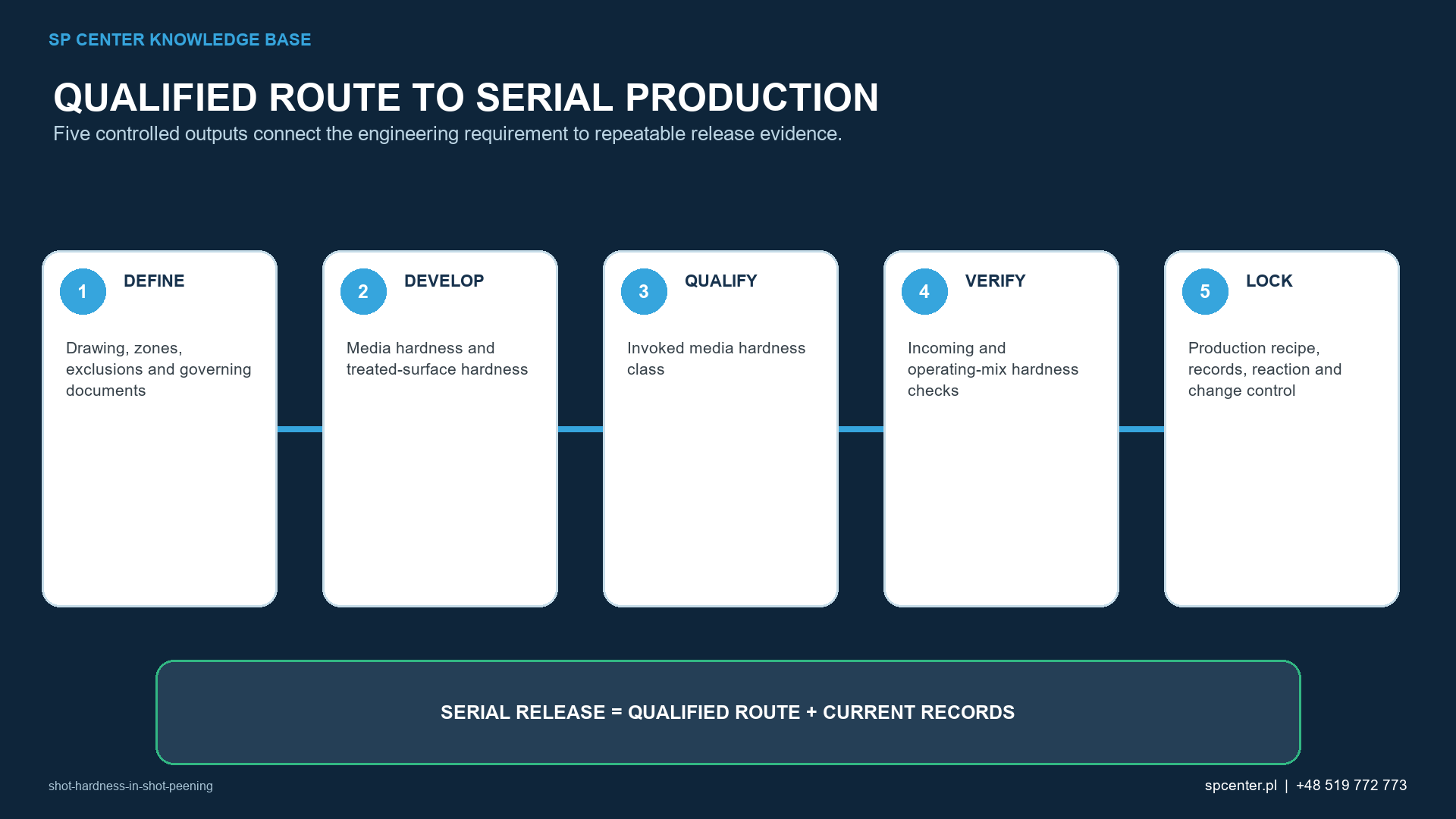
| Serial control | Define receiving and operating-mix checks, additions, classification and reaction plan |
| Change control | Obtain the prescribed approval before changing family, class, supplier or qualified setup |
Table 5. Qualify the complete system rather than one hardness value in isolation.
Frequently asked questions
Must shot peening media always be harder than the component?
No universal media-to-component hardness ratio applies to every process. Follow the permitted media class and qualify the complete process against the actual treated surface and governing requirements.
Does harder media create higher Almen intensity?
Not by itself. Hardness can change particle deformation, but intensity also depends on material, size, density, velocity, mass flow, angle, equipment and the complete operating mix.
Does harder media always make the surface rougher?
No. Surface texture also depends on size, shape, velocity, angle, coverage, exposure, component hardness, prior finish and operating-mix condition.
Which component hardness should be considered?
Use the surface condition that is actually peened. Case hardening, nitriding, induction hardening, coatings, cold work and local heat treatment can make core or raw-material data unrepresentative.
Does a supplier hardness certificate qualify the operating mix?
No. It supports supplier-lot acceptance. Recirculating media can wear, deform, fracture or mix with older particles and therefore requires the prescribed in-use controls.
What should an RFQ state about media hardness?
State the controlled drawing, component material and final heat treatment, treated-surface condition, invoked media specification and class, intensity, coverage, surface limits, quantities and records.
Key takeaways
- Base selection on the treated surface condition, not only the alloy designation.
- Evaluate hardness with toughness, material, size, shape and density.
- Use only the media family and hardness class permitted by controlled requirements.
- Keep media hardness, Almen intensity, coverage and component validation separate.
- Control both the supplier lot and the production operating mix.
Related SP Center guides
Technical references
1. SAE AMS2431E: Peening Media, General Requirements, revised April 2023
2. SAE AMS2431/1G, Peening Media (ASR) Cast Steel Shot, Regular Hardness (45 to 52 HRC)
3. SAE AMS2431/2G, Peening Media (ASH) Cast Steel Shot, High Hardness (55 to 62 HRC)
5. SAE AMS2431/8D, Peening Media Conditioned Carbon Steel Cut Wire Shot, High Hardness (55 to 62 HRC)
Standards note: Use the complete specifications and revisions invoked by the drawing, contract and customer requirements. A media procurement specification is not a component process instruction.
Author: Paweł Kmieć
Discuss your shot peening requirement: +48 519 772 773 | [email protected]