


Select the permitted ceramic family and grade, qualify the complete media–machine–component system and control the circulating operating mix
Ceramic shot is an engineered rounded medium for controlled shot peening, not a universal upgrade from steel shot and not angular ceramic grit for abrasive blasting. It can be useful when the governing requirement permits it and a defined need—such as control of ferrous carryover, a fine feature or a particular process window—is demonstrated. Composition, grade, size, density, hardness, shape, operating mix, equipment compatibility and component acceptance must be treated as one qualified system.
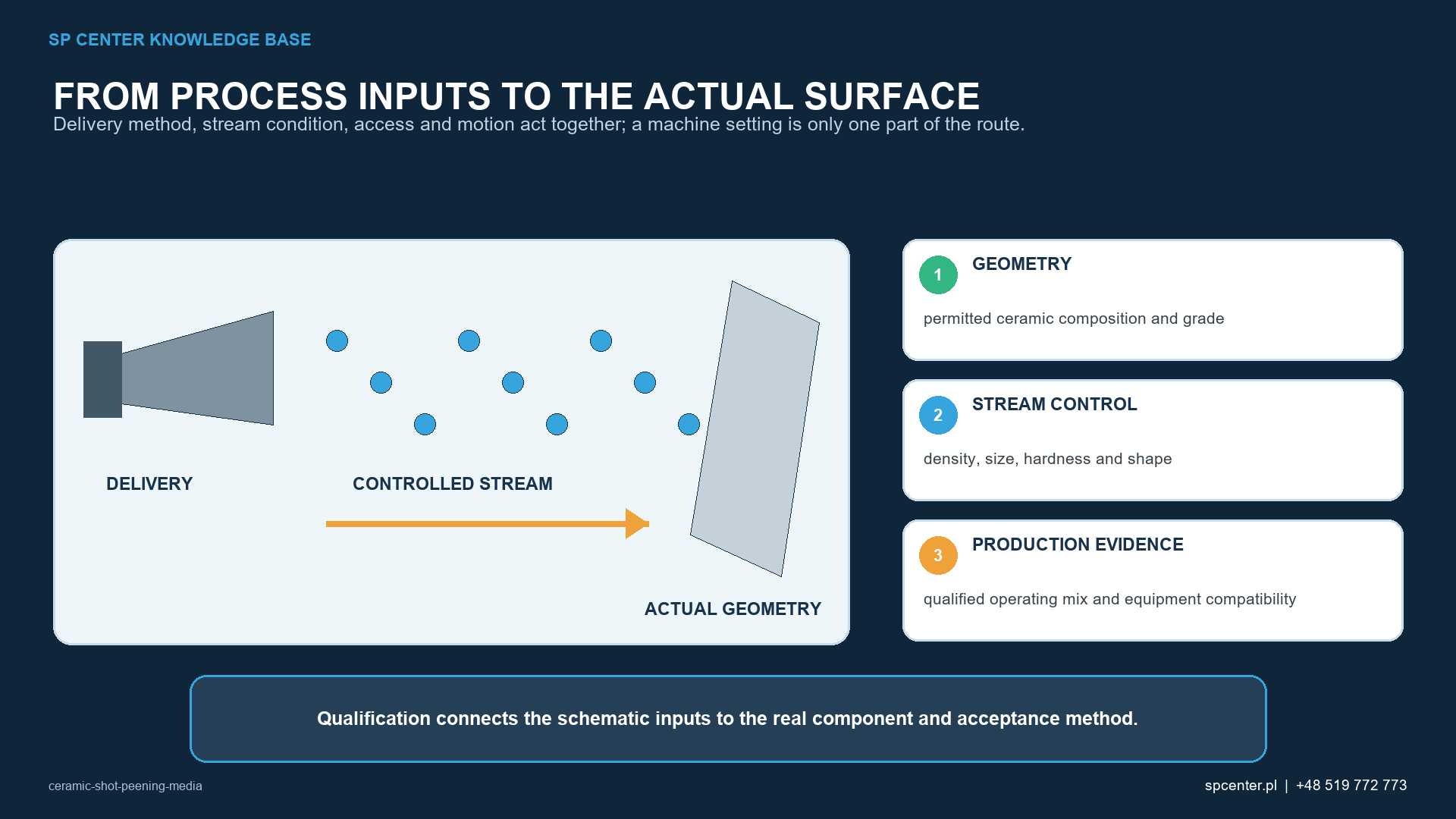
What is ceramic shot—and what is it not?
SAE J1830_202310 covers characteristics including chemistry, microstructure, density, hardness, size, shape and appearance for zirconium-oxide-based ceramic shot. AMS2431 provides general procurement requirements, while ceramic detail specifications identify particular media families. The publisher scopes show that ceria-zirconia and yttria-zirconia are separate procurement categories.
The generic words ceramic media do not establish a composition, density class, size or acceptance criterion. Ceramic shot is also not interchangeable with glass beads, steel shot or angular ceramic blasting grit. Each substitution changes coupled process variables.
| Selection question | Why it matters | Required evidence |
|---|---|---|
| Which ceramic composition and grade are permitted? | Ceria-zirconia, yttria-zirconia and other ceramic-shot specifications are not interchangeable labels | Drawing, process specification, customer flow-down and applicable procurement specification |
| Which size and size distribution are required? | Size influences mass, access, impression population, classification and achievable intensity | Approved nominal size, incoming inspection and operating-mix limits |
| Which density and hardness apply? | They influence impact response and media/component wear but do not define performance alone | Supplier certification and verification required by the invoked specification |
| Which shape and appearance criteria apply? | Fractured, angular, fused or otherwise nonconforming particles can change surface response | Approved sampling, preparation, magnification, classification and acceptance criteria |
| What contamination limits govern? | Ceramic media can reduce one ferrous-transfer source but can still carry foreign material | Dedicated/changeover controls, equipment history, cleanliness and component acceptance |
Table 1. Media identity must be explicit and connected to controlled requirements and evidence.
When can ceramic shot be technically useful?
A ceramic grade may be evaluated for titanium or other contamination-sensitive alloys when transfer from steel media is a defined risk. Fine controlled sizes may support work on small or intricate features. A particular density, hardness or durability class may also support a process window that cannot be achieved robustly with another permitted medium.
These are evaluation reasons, not guaranteed outcomes. Ceramic particles still deform, wear or fracture; they can change roughness, embed foreign material or damage a sensitive surface. Component material, heat treatment, geometry, incoming finish and downstream operations remain part of the decision.
How does ceramic shot compare with steel shot?
| Decision factor | Ceramic shot | Steel shot | Engineering boundary |
|---|---|---|---|
| Composition | Engineered ceramic family and grade | Specified steel composition and manufacture | Use only a media family expressly permitted by the governing requirement |
| Density and particle mass | Grade-dependent; commonly different from steel | Commonly higher for equal particle volume, subject to the actual grades | Re-establish process response; do not convert pressure or wheel speed by a universal factor |
| Fine sizes and feature access | Fine controlled grades may be available | Industrial ranges are widely available | Particle size does not overcome blocked line of sight or prove coverage |
| Ferrous carryover | Can remove steel shot as one direct source | May be prohibited for contamination-sensitive parts | Machine history, recovery, handling and changeover remain part of contamination control |
| Breakdown and separation | Wear/fracture behaviour is grade- and machine-dependent | Wear and shape degradation also require control | Operating mix, classifier and discard limits must suit the selected media |
| Commercial decision | Purchase price and lifecycle may differ | Often broadly available | Compare qualified total process cost, not price per kilogram alone |
Table 2. Neither media family is universally superior; the governing requirement and qualified component result decide.
For equal nominal diameter and velocity, particle mass varies with material density. Momentum and kinetic energy therefore cannot be assumed equal. Real response also depends on size distribution, particle velocity, hardness, shape, impact angle, local flux and component motion. There is no universal pressure, mass-flow or wheel-speed conversion from steel to ceramic media.
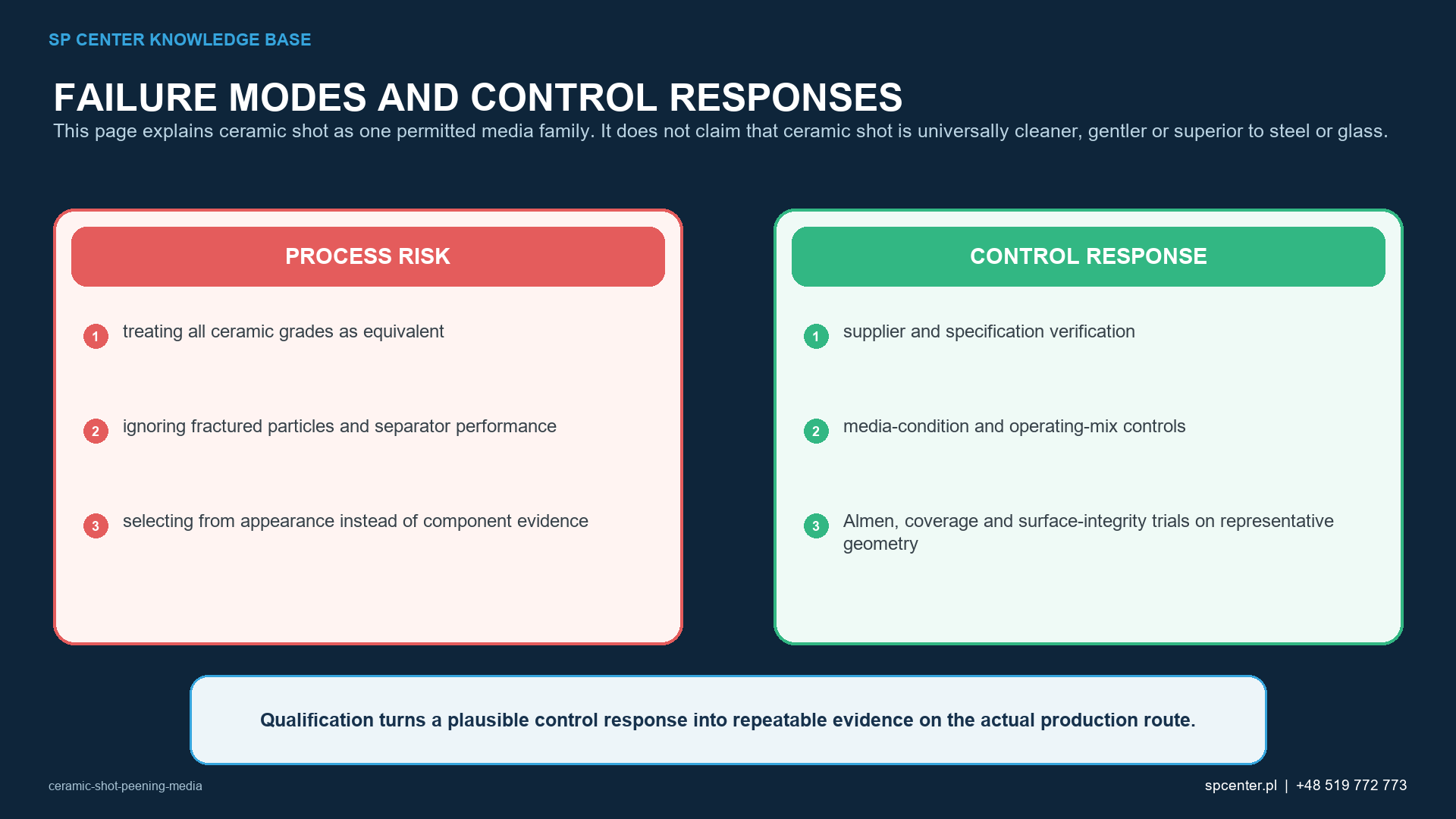
Why is the operating mix a production control?
A conforming incoming lot is only the starting population. During circulation, media is replenished, worn, fractured, classified and removed. The resulting operating mix can differ in size distribution, shape population and foreign material. Its limits, sampling method, inspection frequency and reaction plan must follow the invoked specification and qualified process.
| Control layer | What to monitor | Typical reaction trigger |
|---|---|---|
| Incoming lot | Identity, certification, size, shape/appearance and other invoked characteristics | Wrong grade, damaged packaging, failed sample or incomplete traceability |
| Storage and transfer | Segregation, cleanliness, containers, labels and equipment route | Mixed identity, open contamination path or unapproved changeover |
| Operating mix | Size distribution, unacceptable shapes, fractured particles, foreign material and replenishment | Limit exceeded, trend shift or unexplained intensity/surface change |
| Classifier and recovery | Separation efficiency, screens, air wash, magnets where applicable and retained foreign material | Bypass, wear, blocked screen, unstable return or failed challenge |
| Delivery | Mass flow, pressure/velocity control, nozzle or wheel condition and alarms | Unstable flow, calibration failure, worn delivery hardware or alarm |
| Component output | Intensity, feature coverage, surface condition, cleanliness and dimensions as invoked | Nonconformance or loss of established correlation |
Table 3. Incoming-lot control, equipment condition and operating-mix control close different risks.
What can go wrong with fractured or off-size ceramic media?
Unacceptable angular fragments or an altered size distribution can change local impact, coverage development, surface marking and recovery behaviour. Excess undersize may signal breakdown or ineffective classification; retained oversize or fused particles can create a different damage risk. Do not invent visual limits: use the sampling, preparation, magnification, classification and acceptance criteria of the governing document.
Where contamination matters, define what is prohibited, how equipment history is controlled and how cleanliness is verified. A dedicated route may reduce changeover risk, but dedication alone does not prove media or component conformity.
Are all peening machines compatible with ceramic shot?
No. Delivery stability, media-flow measurement, nozzle or wheel wear, recovery, separator performance, containment and cleaning can differ by grade and size. Air-blast and wheel equipment use different delivery systems; neither can be assumed suitable without a documented equipment and process assessment.
High rebound may assist redistribution in some geometries, but it does not establish coverage in a root, bore or cavity. The complete specified surface must be assessed by the approved direct or qualified indirect method on actual or authorised representative geometry.
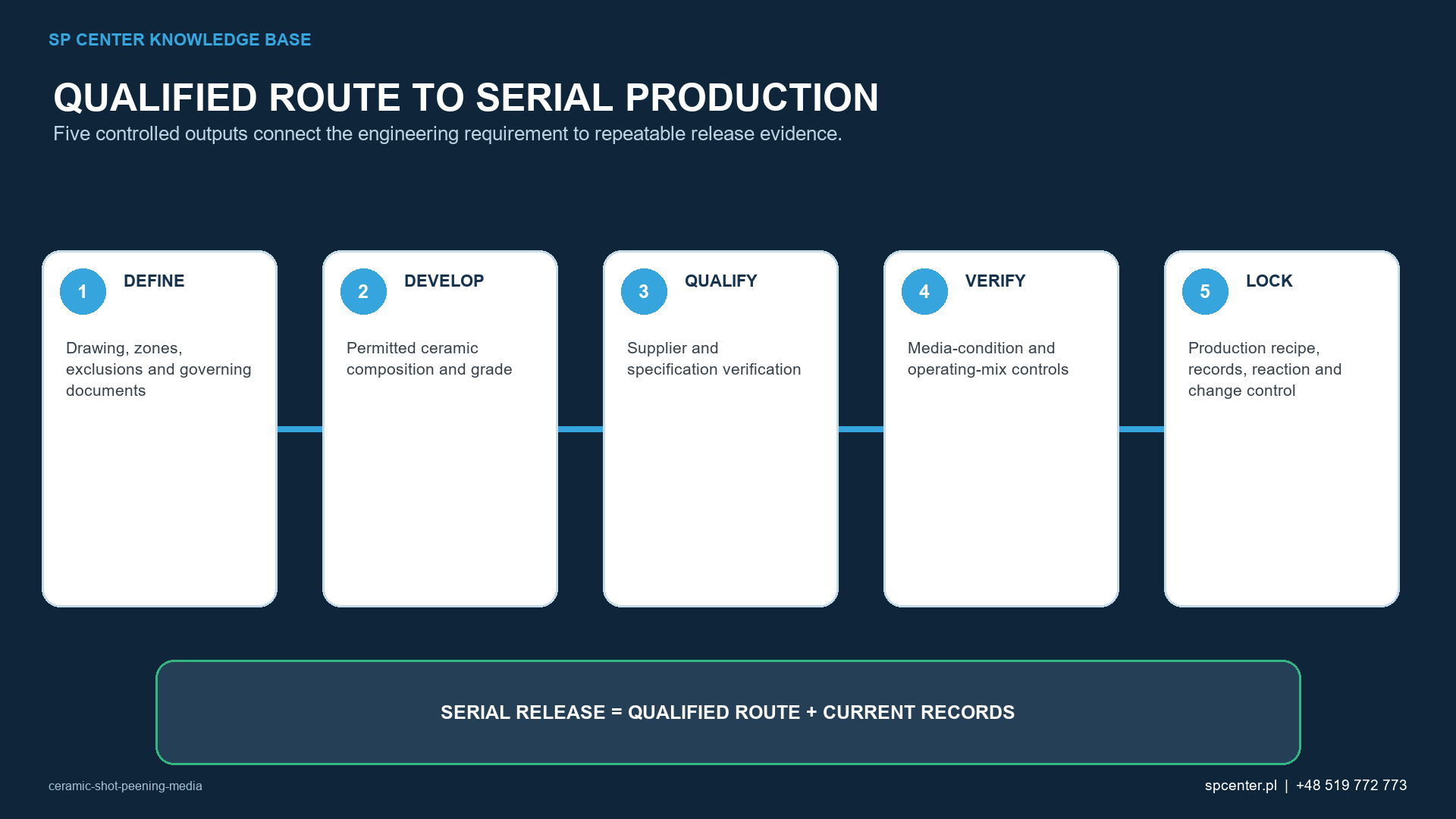
How should ceramic shot be qualified?
| Qualification stage | Required output | What it prevents |
|---|---|---|
| Requirement review | Permitted media specification, grade, size, component material, treatment map and acceptance requirements | Selection by generic ‘ceramic’ label or supplier marketing |
| Equipment assessment | Compatible delivery, flow measurement, recovery, classification, containment, cleaning and changeover route | Assuming every air-blast or wheel machine handles every ceramic grade |
| Process development | Valid saturation/intensity basis, controlled media flow, geometry, motion, exposure and operating-mix limits | Reusing a steel-shot program without qualification |
| Component acceptance | Approved coverage, surface, roughness, contamination, damage, cleanliness and dimensional evidence | Treating Almen intensity as complete part acceptance |
| Serial control | Lot traceability, sampling frequency, replenishment, classifier checks, alarms and reaction plan | Undetected drift from fresh media to an unsuitable operating mix |
| Change control | Assessment and requalification trigger for supplier, formulation, grade, size, machine or acceptance changes | Silent transfer of evidence to a different process system |
Table 4. A ceramic-media change is qualified as a complete process-system change.
What belongs in the production record?
- Part identity, drawing revision, material, heat treatment, incoming surface and treatment/exclusion map.
- Permitted ceramic specification, family, grade, nominal size, supplier, lot and certification.
- Incoming inspection, storage, transfer, equipment route and changeover or dedication controls.
- Operating-mix results, replenishment, classifier/recovery checks, foreign-media findings and reaction records.
- Equipment, nozzle/wheel configuration, fixture, motion, media mass flow, valid saturation/intensity and monitored variables.
- Component coverage, surface, roughness, damage, contamination, cleanliness and dimensional acceptance as invoked.
- Changes, nonconformances, authorised reprocessing, customer approvals and final release traceability.
What is ceramic shot peening media?
It is an engineered rounded peening medium. Zirconium-oxide-based families are covered by several SAE documents, but the exact composition, grade and size must be identified rather than described only as ceramic.
Is ceramic shot always better than steel shot?
No. Suitability depends on the permitted media, component material, contamination controls, required intensity, geometry, surface limits, equipment capability, lifecycle and qualified result.
Does ceramic shot eliminate metallic contamination?
It can remove steel shot as one source of ferrous carryover, but equipment history, mixed media, recovery systems, storage, handling and other foreign material still require control.
Can the same machine settings be used after changing from steel to ceramic shot?
Not without an authorised qualification basis. Density, mass, flow, breakdown and delivery behaviour can change, so intensity, exposure, coverage, surface acceptance and equipment controls must be re-established as applicable.
Does high rebound guarantee coverage in a cavity?
No. Rebound may redistribute particles, but it does not prove that the complete specified surface receives acceptable impact-impression coverage. Access must be demonstrated on the actual or authorised representative geometry.
What is the ceramic-shot operating mix?
It is the circulating media population in production after replenishment, wear, fracture, classification and removal. It can differ from a new incoming lot and therefore needs its own inspection and limits.
Does correct Almen intensity prove ceramic media is acceptable?
No. It verifies the standardised stream response for the defined configuration. Media conformity, component coverage, surface condition, contamination, cleanliness and dimensions remain separate acceptance questions.
Which ceramic-shot standards should be specified?
The answer depends on the contract. SAE J1830 addresses zirconium-oxide-based ceramic-shot characteristics; AMS2431 provides general media requirements and its slash sheets address specific ceramic families. Use only the documents and revisions invoked by the governing requirement.
Key takeaways
- Ceramic shot is engineered rounded peening media, not angular blasting grit.
- Identify the permitted composition, grade and size; do not specify only “ceramic”.
- Treat incoming-lot conformity and circulating operating-mix condition separately.
- Do not infer contamination control, coverage or surface performance from supplier data alone.
- Re-establish intensity, exposure, coverage, surface acceptance and equipment controls after an applicable media change.
- Use the complete invoked specifications and customer requirements for acceptance.
Related SP Center guides
- Shot Peening Media
- Steel Shot for Shot Peening
- Shot Size in Shot Peening
- Shot Hardness in Shot Peening
Technical sources
1. SAE J1830_202310, Size Classification and Characteristics of Ceramic Shot for Peening
2. SAE AMS2431E: Peening Media, General Requirements, revised April 2023
3. SAE AMS2431/7C, Peening Media Ceramic Shot
4. SAE AMS2431/9A, Peening Media Ceramic Shot, Ceria-Zirconia (ACZ)
5. SAE AMS2431/10, Peening Media, Ceramic Shot, Yttria-Zirconia (AYZ)
6. SAE AMS2430U: Shot Peening, revised April 2018
7. SAE J443_202512: Procedures for Determining and Verifying Peening Intensity, revised December 2025
8. SAE J2277_202301: Shot Peening Coverage Determination, revised January 2023
Standards note: The scope and editions listed above correspond to the cited publisher catalogue records. Procurement and process acceptance must use the complete documents and revisions invoked by the drawing, contract and customer flow-down.
Author: Paweł Kmieć
Discuss ceramic-media feasibility and qualification: +48 519 772 773 | [email protected]