


Separate surface enhancement from intentional shape control before choosing parameters, fixtures, measurements and approval criteria
Shot peening and peen forming use the same basic mechanism—repeated particle impacts create near-surface plastic strain—but they are not interchangeable processes. Shot peening is normally specified to obtain a controlled surface state while keeping the component inside drawing tolerances. Peen forming deliberately varies that strain across a panel or section to create or correct a target curvature. The difference changes the engineering plan, qualification and release evidence.
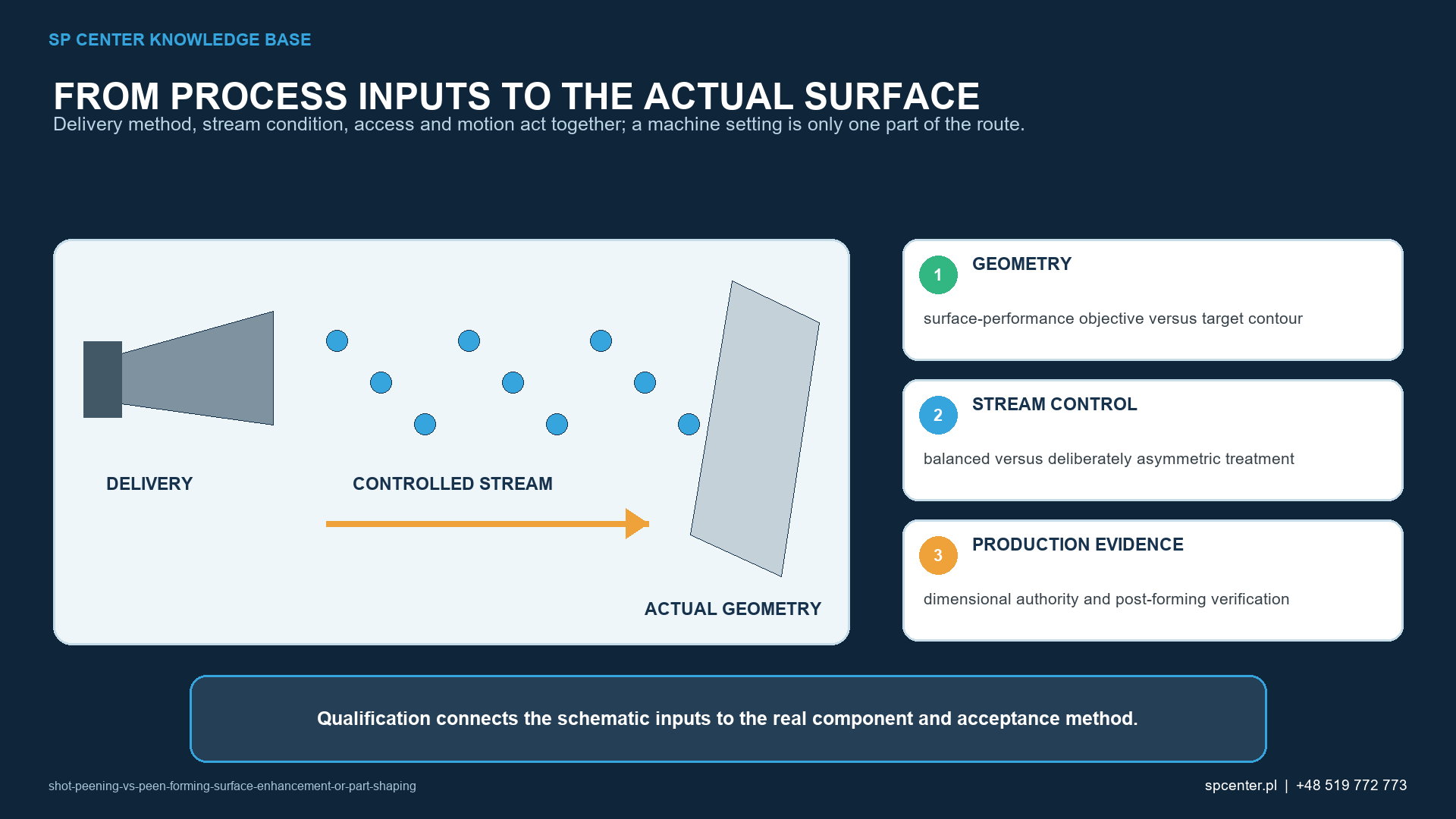
What is the decisive difference?
The decisive difference is intended output. For shot peening, macroscopic shape change is a risk or limit. For peen forming, shape change is a required result. A process does not become peen forming merely because a thin part bends, and it does not remain ordinary shot peening when extra exposure is intentionally used to achieve contour.
Drawings, procedures and reports should name the correct route. Ambiguous terms such as “straighten by peening” require controlled clarification of target geometry, treatment surfaces, surface requirements and approval authority.
| Dimension | Shot peening | Peen forming |
|---|---|---|
| Primary purpose | Modify near-surface residual stress and cold work for fatigue or other approved surface benefit | Create or correct a specified component contour through controlled differential plastic strain |
| Shape change | Unintended and limited by drawing tolerances | Intentional output measured against a target contour |
| Treatment map | Required, protected and transition surfaces | Spatial intensity, media, pass count, direction and optional pre-stress zones that generate curvature |
| Main process evidence | Intensity, media, coverage, surface integrity and part acceptance | Controlled impact inputs plus contour, springback, repeatability and forming-model or trial evidence |
| Typical risk | Underpeening, overpeening, missed coverage, surface damage or distortion | Over- or under-forming, twist, local waviness, edge effect and shape drift from incoming stress |
| Rework | Additional peening only through an approved process or disposition | Iterative passes only within the qualified forming and surface-integrity plan |
Table 1. Shared impact physics does not make the engineering routes equivalent.
How does peen forming create curvature?
A plastically stretched surface layer is restrained by the underlying material. If the in-plane strain field is unbalanced through the thickness or across the panel, the part bends. Changing media, intensity, exposure, pass direction or treated area changes the strain distribution and therefore the curvature.
The response also depends on thickness, stiffness, alloy, temper, rolling direction, incoming residual stress, prior machining and panel geometry. Identical machine settings can produce different shapes from different blanks.
What does a peen-forming plan contain?
| Peen-forming input | Effect | Control question |
|---|---|---|
| Intensity and media | Change the magnitude and depth of inelastic strain | Are the impact conditions within the calibrated and surface-safe forming domain? |
| Spatial exposure | Creates the strain gradient that drives local curvature | Are zone boundaries, overlap, pass direction and dwell repeatable? |
| One- or two-sided treatment | Controls curvature direction and stress balance | Is the sequence qualified and are functional surfaces allowed to be treated? |
| Pre-stress or elastic loading | Changes the residual shape after unloading | Are load magnitude, direction, fixture stiffness and release sequence controlled? |
| Incoming plate state | Thickness, rolling direction, residual stress and prior forming affect response | Is each blank inside the qualified material and shape family? |
| Measurement and iteration | Feeds correction of the next pass or zone | Are datum, free-state support, temperature, stabilization and data reduction consistent? |
Table 2. The forming plan adds spatial and shape-feedback controls to the core peening controls.
Define target contour, allowable twist and waviness, forming zones, protected areas, intensity and media ranges, pass direction, overlap, sequence, optional pre-stress, fixture state and stop criteria. The plan also defines measurement after release and the authorized rule for iterative correction.
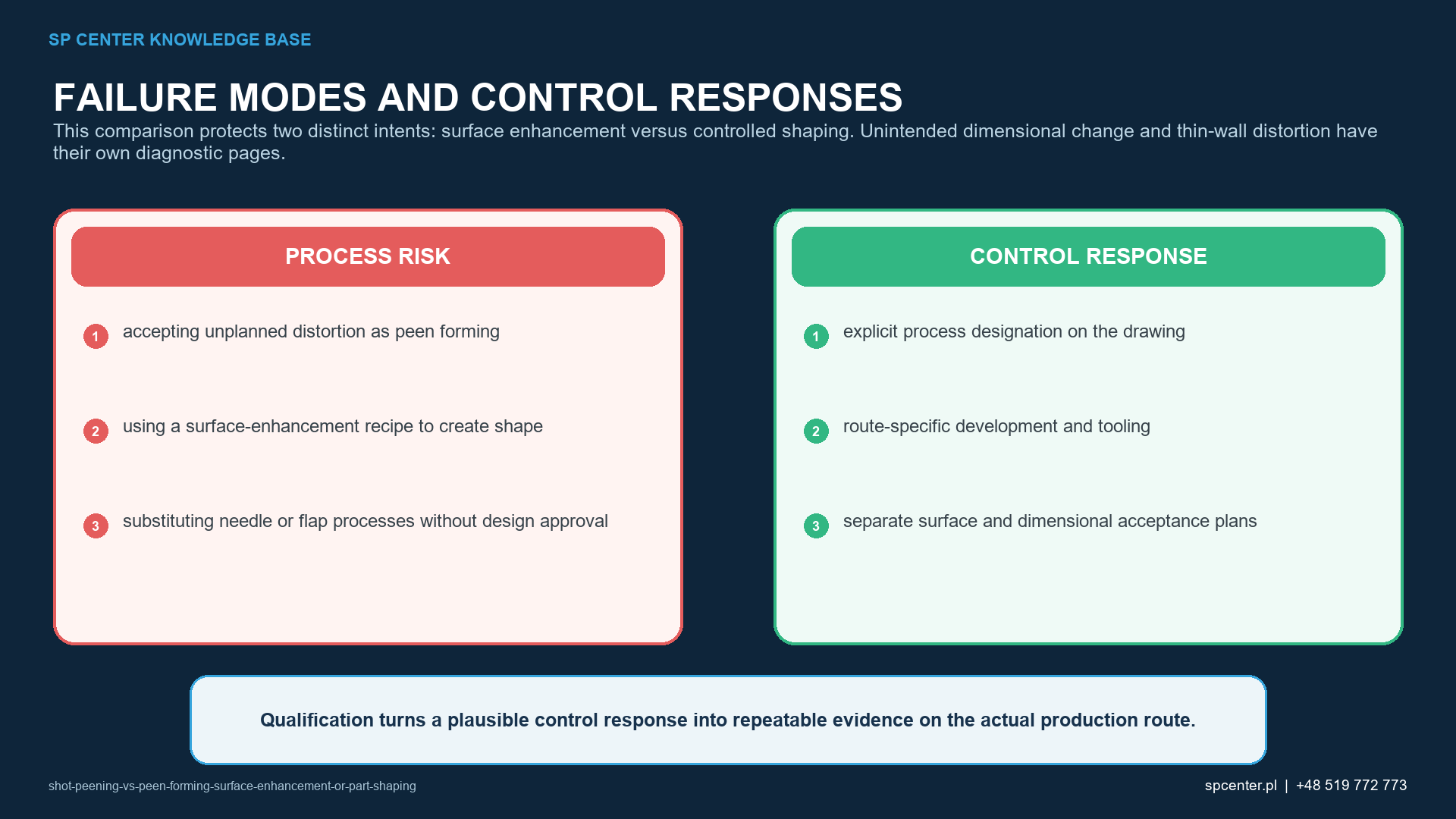
How are intensity and coverage used?
Almen intensity remains a standardized process response derived from a valid saturation curve. It is not curvature and cannot be converted universally into panel radius. Coverage remains an observed surface condition; it is not a measure of forming strain.
Peen forming may use repeated passes or graded zones after full coverage has already been achieved. Those passes are controlled forming exposure, not a redefinition of 100% or 200% coverage.
What is pre-stress peen forming?
In pre-stress forming, a fixture elastically loads the component during peening. After release, the combination of applied elastic strain and impact-induced plastic strain produces the final shape. The fixture is part of the qualified process, not only a support.
Control applied load or deflection, direction, support locations, stiffness, sequence and release. Inspect fixture contacts and confirm that no local buckling, fretting or shadowing invalidates the surface.
How is shape measured and corrected?
Use a controlled free-state datum scheme, temperature, support and stabilization period. Compare measured contour, twist and local waviness to the target. Retain raw scan data and the calculation or fit method.
A closed-loop route can compare the current shape with the target and adjust later passes. The adjustment rule, maximum cumulative exposure, allowed zones and approval must be qualified; uncontrolled “peen until it fits” is not acceptable.
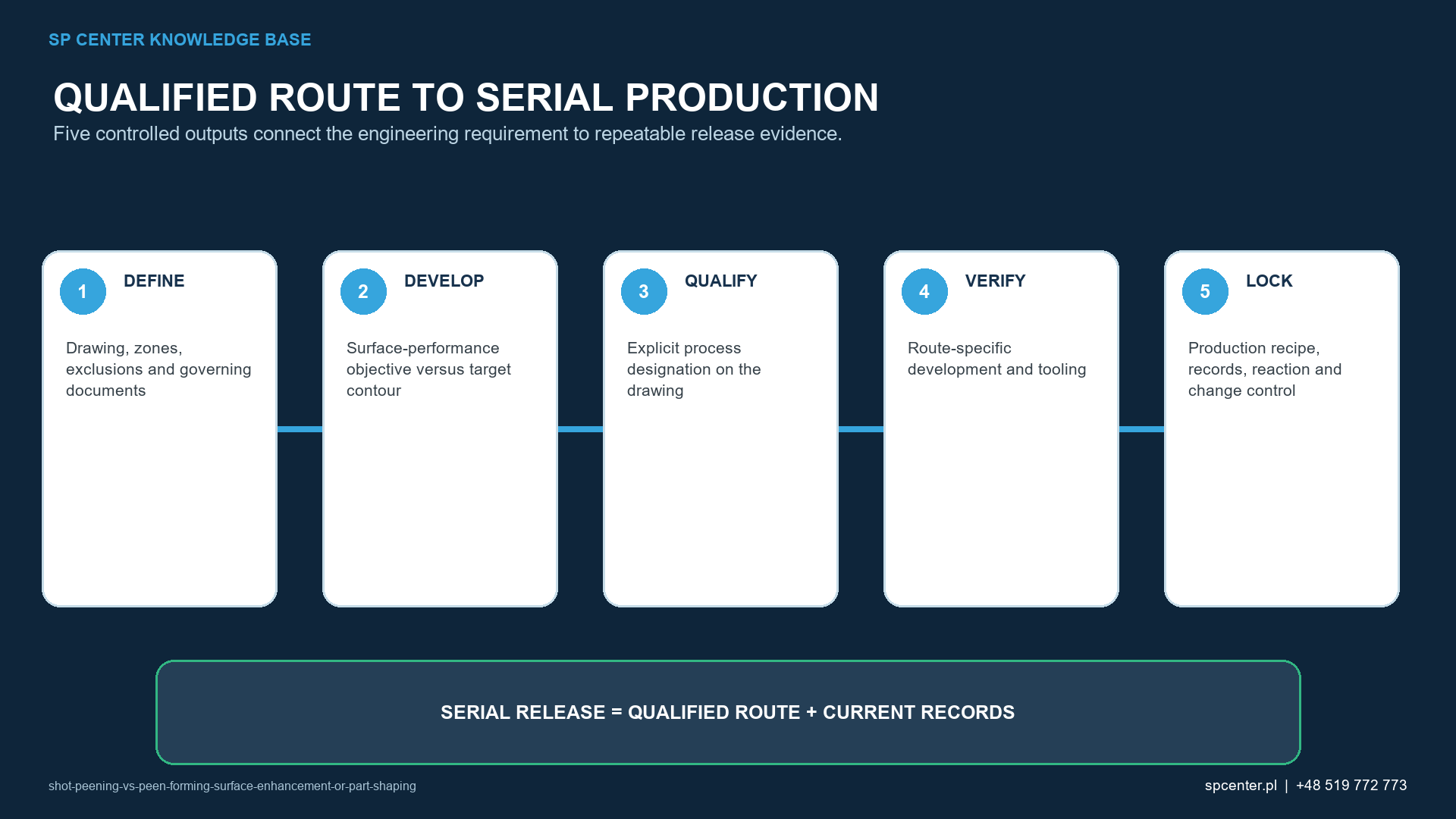
How do qualification and release differ?
| Release question | Shot peening evidence | Peen-forming evidence |
|---|---|---|
| Was the impact process controlled? | Valid saturation curve, intensity verification, media and equipment records | Same core evidence plus forming-map and pass-revision traceability |
| Were required surfaces treated? | Coverage acceptance on specified surfaces | Exposure-map completion and any specified coverage or surface acceptance |
| Is the surface acceptable? | Damage, roughness, contamination and transition inspection | Same checks at high-exposure, boundary, fixture and pre-stress zones |
| Is the geometry acceptable? | Part remains within drawing tolerances after release | Contour, twist, waviness and trim references meet the target after stabilization |
| Is performance retained? | Application evidence for the surface-enhancement claim | Structural, fatigue and residual-stress evidence for the formed and peened state where required |
Table 3. Peen forming retains peening controls and adds intentional shape-control evidence.
Where surface enhancement is also credited, verify that the forming route provides the required residual-stress, fatigue or surface evidence. A part can meet contour and still fail surface-integrity or performance requirements.
Can distortion be repaired by extra peening?
Additional exposure changes cold work, residual stress, roughness and damage risk. Opposite-side peening can recover shape while creating an unqualified stress state. Treat every correction as an approved forming or rework operation with defined limits and reinspection.
If distortion arose from an abnormal event, preserve the original condition, contain the affected product and determine root cause before correction. Shape recovery does not erase the process nonconformance.
What records are required?
- Correct process designation and approval authority.
- Material, temper, thickness, rolling direction and incoming shape.
- Qualified equipment, media, intensity and saturation evidence.
- Forming-zone map, protected areas, passes, overlap and sequence.
- Fixture or pre-stress load, support and release condition.
- Intermediate and final free-state contour data.
- Surface-integrity, coverage and functional-performance evidence.
- Deviations, iterative corrections, approvals and final release.
Frequently asked questions
Is peen forming just high-intensity shot peening?
No. Peen forming is defined by intentional shape control through a spatial strain plan. High intensity without a forming plan is not a qualified forming process and can simply damage or distort a part.
Can ordinary shot peening straighten a distorted part?
Not as an informal repair. Shape correction by peening needs an approved forming or rework plan with surface-integrity, residual-stress, dimensional and performance evidence.
Does peen forming still require Almen intensity control?
Controlled peening response is normally part of the process basis, but the complete invoked forming plan is decisive. Almen intensity alone does not define component curvature.
Is coverage the same as forming amount?
No. Coverage describes impact impressions on the surface under the approved method. Forming amount is the resulting contour change and depends on strain distribution through and across the component.
What is pre-stress peen forming?
The component is elastically loaded during peening and takes a different shape after release. Loading, fixture, safety, sequence and springback require qualification.
Can a peen-forming model replace shape measurements?
No. Models can plan zones and passes, but incoming residual stress and material variation require measured contour feedback and independent validation.
Can the same machine perform both processes?
Possibly, if its capability, configuration and controls are qualified for each route. Shared equipment does not make the procedures, approvals or acceptance criteria interchangeable.
Does peen forming automatically improve fatigue life?
No. It changes shape and near-surface state, but fatigue also depends on roughness, residual-stress distribution, loading, edges and subsequent operations. The performance claim needs its own evidence.
Key takeaways
- Define whether shape change is a limit or the required output.
- Do not use unplanned distortion as evidence of peen forming.
- Keep Almen intensity, coverage and component curvature as different quantities.
- Qualify forming zones, pass sequence, fixture and free-state measurement.
- Control iterative correction and cumulative exposure.
- Verify surface integrity and performance even when target shape is achieved.
Related SP Center guides
- Shot Peening Thin-Walled Parts
- Dimensional Change After Shot Peening
- Shot Peening Simulation
- What Is Shot Peening?
Technical references
1. SAE J2441_202511: Shot Peening, stabilized November 2025
2. SAE ARP7488: Peening Design and Process Control Guidelines, issued January 2018
3. SAE J442_202602: Tools for Peening Intensity Determination and Verification, revised February 2026
4. Finite element analysis of peening-induced deformation of flexible panels, 1998
5. Simulation from peening parameters to residual-stress and deformation fields, 2016
6. Closed-loop shot peen forming with in-process measurement and optimization, 2022
Standards note: Process designation, forming limits, surface requirements, rework and approval follow the complete controlled drawing, specification and customer authority.
Author: Paweł Kmieć
Discuss shot peening, peen forming or distortion control: +48 519 772 773 | [email protected]