


A practical engineering guide to controlled impact, compressive residual stress, Almen intensity, coverage and process selection
Shot peening is a controlled cold-working process in which selected media repeatedly impact a specified surface. Each impact plastically deforms a small region; constraint from the underlying material can leave beneficial compressive residual stress near the treated surface. A conforming process is defined by the drawing and governing specification and is controlled through intensity, coverage, media, equipment, motion and documented acceptance—not by appearance alone.
For component requirements and quotations, see our controlled shot peening services.
Why do engineers specify shot peening?
Engineers specify shot peening when a controlled surface condition supports the design intent. The usual application is a fatigue-critical feature exposed to repeated tensile loading or a significant stress range, where crack initiation is expected at or near the surface. Gears, springs, shafts, crankshafts, connecting rods, turbine components, fasteners and structural features are common examples, but suitability must be established for the actual material, geometry and load case.
Shot peening does not guarantee service life. It cannot correct an unsuitable design, improper heat treatment, an unacceptable crack or severe corrosion. The benefit depends on the material condition, manufacturing sequence, surface state, loading spectrum, environment and stability of the qualified process.
How does shot peening work?
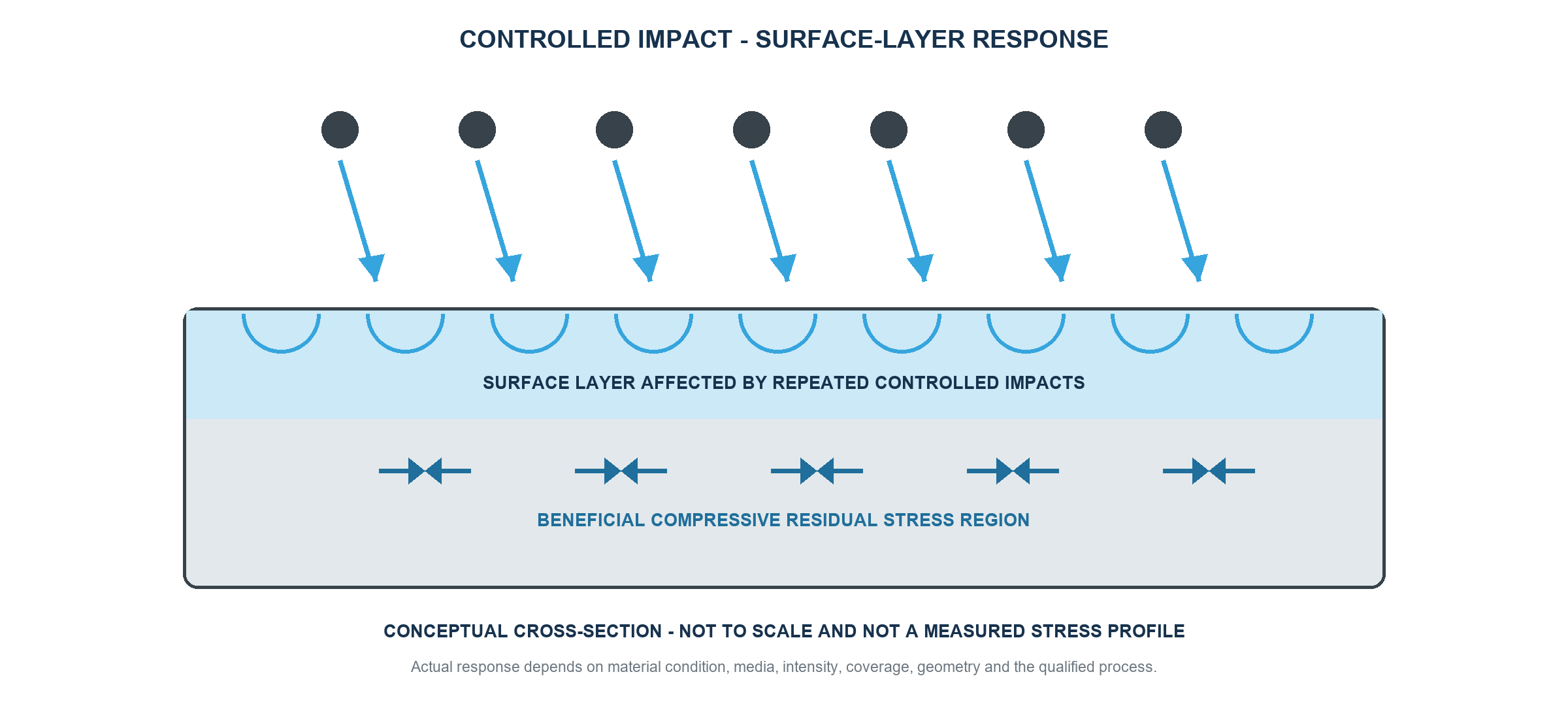
Metallic, glass or ceramic peening media are accelerated toward the component by compressed air, a centrifugal wheel or another qualified delivery method. Repeated impacts create small plastic indentations. The elastically responding material below the surface constrains the plastically expanded layer, which can generate a compressive residual-stress field after the external impact has ended.
The magnitude and depth of the affected region are not universal. They depend on material properties and heat treatment, media, peening intensity, coverage, impact angle, geometry and other process conditions. Roughness, near-surface hardness and dimensions can also change; these effects must be assessed against the component requirements.
Which variables control the process?
| Control area | What the process plan must address | Evidence produced |
|---|---|---|
| Media | Family, size, shape, hardness, cleanliness and operating condition | Media certification, inspection and operating-mix records as required |
| Delivery system | Pressure or wheel speed, media flow, nozzle or wheel condition and stream stability | Monitored settings and reaction plan |
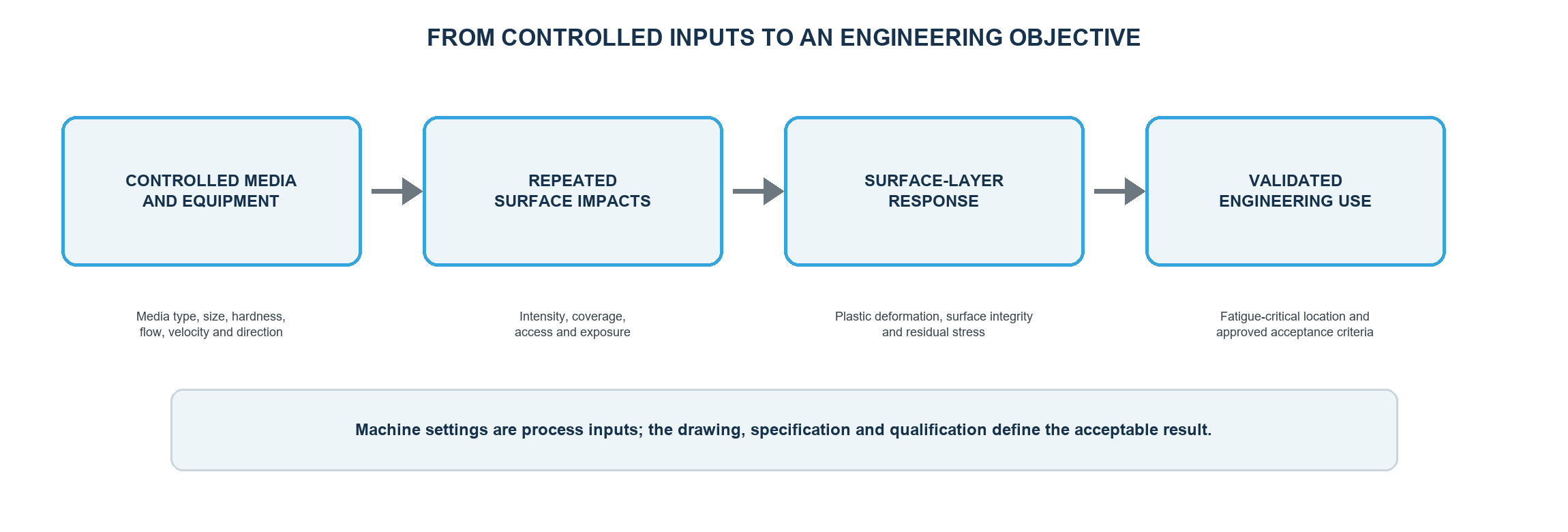
| Component presentation | Fixture, motion, access, impact angle, stand-off, masking and protected features | Approved recipe, tooling and setup identity |
| Process verification | Almen strip, holder, gage, saturation method and required verification locations | Traceable intensity result |
| Surface acceptance | Treatment boundaries, coverage, surface condition and any invoked dimensions or roughness | Recorded component acceptance |
Table 1. Process verification and component surface acceptance answer different questions and both must follow the invoked requirements.
How do Almen intensity and coverage differ?
Almen intensity characterizes the standardized response of the peening stream under a defined strip, holder, gage and saturation procedure. Coverage evaluates the extent to which the specified component surface shows evidence of peening impacts under the approved inspection method. Correct intensity does not prove complete coverage, and complete coverage does not prove correct intensity.
Neither control is a direct measurement of the component residual-stress profile. X-ray diffraction or other component validation may be required by the customer or qualification plan, but it does not automatically replace routine intensity, coverage or configuration controls.
What is the difference between shot peening and shot blasting?
Shot peening and shot blasting can use similar media-delivery equipment, but their primary purposes and acceptance systems differ. Shot peening creates a qualified surface-enhancement condition. Shot blasting is generally used to clean, descale or prepare a surface to a specified cleanliness or profile. The drawing, process specification and intended output—not the cabinet or nozzle alone—determine which process is being performed.
| Criterion | Shot peening | Shot blasting |
|---|---|---|
| Primary purpose | Controlled surface enhancement | Cleaning, descaling or surface preparation |
| Engineered output | Qualified peened condition on specified areas | Specified cleanliness, profile or preparation result |
| Core controls | Intensity, coverage, media condition, delivery, access, motion and masking | Media, delivery settings, dwell and completion of the preparation objective |
| Acceptance focus | Drawing, process specification, intensity, coverage and other invoked criteria | Cleanliness, profile, contaminant removal or coating-preparation requirement |
| Typical use | Fatigue-critical gears, springs, shafts, turbine and structural features | Rust, scale or coating removal and preparation before a later operation |
Table 2. Shot peening and shot blasting require separate process intent, controls and acceptance evidence.
A component may require both operations at different manufacturing stages. When it does, the sequence, allowed material removal, intermediate surface state, masking, treatment areas and inspection requirements must be controlled separately.
When should shot peening be considered?
- The drawing, customer specification or approved repair instruction invokes the process.
- A defined surface feature is fatigue-critical and subject to cyclic tensile stress.
- The expected crack-initiation location is at or near an accessible surface.
- Media, intensity, coverage, motion, masking and distortion can be controlled.
- The process can be qualified on representative hardware or approved test pieces.
When is shot peening not the right solution?
- The actual objective is cleaning, rust or scale removal, coating removal or surface preparation.
- The component contains a defect or incorrect material condition that first requires disposition.
- The required feature cannot be accessed, protected or inspected by a qualified method.
- Parameters are being copied from a different material or geometry without engineering review.
- The proposed justification is simply that more intensity or exposure must be better.
How is a shot peening route qualified and released?
Qualification connects the component requirement to the approved equipment, media, tooling, motion, masking, intensity, coverage, inspection and records. Production release then shows that the authorized configuration and required checks were used for the specific job. Process accreditation or a quality-system certificate supports organizational control, but it does not replace the drawing, contract, customer approval or job-level specification.
- Confirm drawing and specification revisions, material condition, treatment areas and acceptance criteria.
- Develop equipment, tooling, motion, access and masking.
- Establish and verify intensity for the required locations.
- Demonstrate coverage and other component surface acceptance requirements.
- Perform residual-stress, fatigue or other component validation only where required.
- Approve monitoring, traceability, reaction plans and production records.
What information is needed for a feasibility review?
Provide the controlled drawing and revision, material and heat treatment, required and excluded areas, governing specifications, intensity and coverage requirements, dimensions and quantity, manufacturing sequence, distortion and surface limits, qualification evidence, customer approvals and required records.
Frequently asked questions
What does shot peening do?
Shot peening plastically deforms a thin surface region and can create beneficial compressive residual stress near the treated surface. The engineering benefit depends on material, geometry, loading and a qualified process.
Does shot peening increase hardness?
It can change near-surface hardness, but the response depends on the material and process. Hardness should not be assumed to increase or used for acceptance unless the governing requirement defines it.
How is shot peening intensity measured?
Peening intensity is determined or verified with the specified Almen strip, holder and gage under the invoked saturation and verification procedure. It is not a direct residual-stress measurement on the component.
Is coverage the same as exposure time?
No. Coverage describes how completely the specified surface shows peening impressions under the approved method. Exposure time or motion history is a process input used to achieve the required coverage.
Can shot blasting and shot peening be used on the same component?
Yes, when each operation has a defined purpose, sequence, treated area and acceptance requirement. Cleaning or preparation must not be substituted for a qualified peening operation.
How can I assess whether a component is suitable for shot peening?
Review the drawing, material and heat treatment, fatigue-critical location, access, masking, distortion sensitivity, surface requirements and invoked specification. Qualification must then demonstrate the selected route.
Key takeaways
- Shot peening is controlled cold working for surface enhancement, not a cleaning process.
- The direct mechanical effect is concentrated near the treated surface.
- Almen intensity and coverage are separate controls.
- Shot blasting and shot peening may both be used, but each needs its own purpose and acceptance route.
- The drawing, governing specification and qualified production process remain authoritative.
Related SP Center guides
Technical references
1. SAE AMS2430U: Shot Peening, revised April 2018
2. SAE J2441_202511: Shot Peening, stabilized November 2025
3. SAE ARP7488: Peening Design and Process Control Guidelines, issued January 2018
4. SAE J442_202602: Tools for Peening Intensity Determination and Verification, revised February 2026
5. SAE J443_202512: Procedures for Determining and Verifying Peening Intensity, revised December 2025
6. SAE J2277_202301: Shot Peening Coverage Determination, revised January 2023
Standards note: Use the complete revision invoked by the drawing, contract and customer requirements.
Author: Paweł Kmieć
Discuss your shot peening requirement: +48 519 772 773 | [email protected]