


How glass shot differs from cosmetic glass-bead blasting and how density, fracture, equipment and operating-mix control affect qualification
Properly specified glass shot can be used for controlled shot peening. Its lower density, nonferrous composition and availability in fine sizes can support selected low-intensity or access-limited process routes. These properties do not make glass universally gentle or interchangeable with steel or ceramic media. The process must control grade, size, brittle breakdown, equipment compatibility, operating mix and component acceptance.
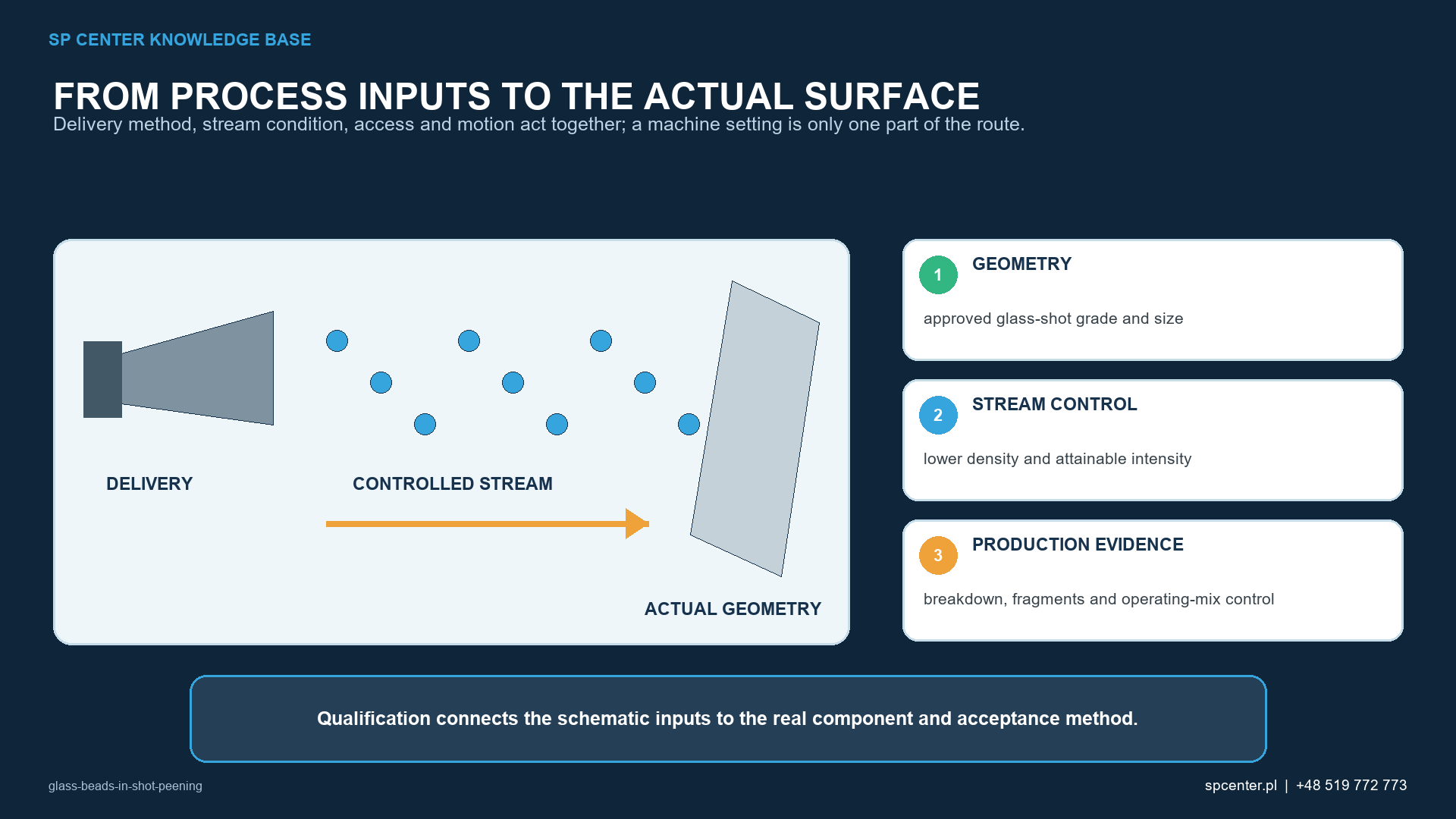
How does glass-shot peening differ from glass-bead blasting?
The media may look similar, but process purpose and evidence are different. Glass-bead blasting may be specified for cleaning, appearance, texture or surface preparation. Glass-shot peening is a controlled mechanical surface-enhancement process with defined media, Almen intensity, coverage or qualified exposure, production variables and records.
| Question | Glass-bead blasting | Controlled glass-shot peening |
|---|---|---|
| Primary purpose | Cleaning, texture, appearance or surface preparation | Specified mechanical surface enhancement |
| Media requirement | A commercial blasting grade may be permitted by the finishing specification | Media must conform to the invoked peening-media requirements |
| Process evidence | Defined by the finishing requirement | Intensity, coverage or exposure, media control and production records as invoked |
| Acceptance | Cleanliness, appearance, texture or finish | Drawing and process-specification requirements with controlled evidence |
Table 1. The media name alone does not determine whether an operation is blasting or controlled shot peening.
Which SAE documents apply to glass shot?
| Document | What it addresses | What it does not establish alone |
|---|---|---|
| AMS2431E | General procurement requirements for peening media | A component-specific process instruction |
| AMS2431/6D | Glass shot for peening metal parts in conjunction with AMS2431 | Suitability for every alloy, geometry or machine |
| SAE J1173_201905 | Glass-bead characteristics and standard size numbers for peening | A complete shot peening process specification |
| SAE J443_202512 | Determination and verification of peening intensity | Residual-stress depth, coverage or fatigue life |
| SAE J2277_202301 | Coverage determination and its relationship to exposure | One universal inspection rule for every contract |
Table 2. Each document addresses a different evidence layer; the drawing, contract and invoked revisions remain authoritative.
Why can glass shot be selected?
For equal nominal diameter and velocity, glass and steel do not create the same impact condition because density, hardness and mechanical response differ. Lower density may support development of a lower-intensity route. Fine sizes may improve access to small features. A nonferrous composition can avoid the specific mechanism of transferring steel-shot particles to selected components.
These are process-development options, not universal benefits. Glass shot may also be considered as an authorized second stage of a dual-peening sequence, but the complete sequence and resulting component condition require qualification.
| Application condition | Why it matters | Required decision |
|---|---|---|
| Aluminum or titanium component | Ferrous carry-over may be restricted while surface damage and dimensional change remain possible | Confirm permitted media, cleanliness and downstream requirements |
| Thin section or small feature | Lower particle density may be useful, but distortion and edge damage can still occur | Qualify intensity, exposure and component acceptance |
| Hard or case-hardened surface | The required mechanical response may exceed a practical glass-media window | Compare only the media families permitted by the governing requirements |
| Critical finish or profile | Peening changes surface topography | Define protected surfaces, roughness and damage criteria |
Table 3. Material name alone does not determine the correct media family.
What is the principal limitation of glass shot?
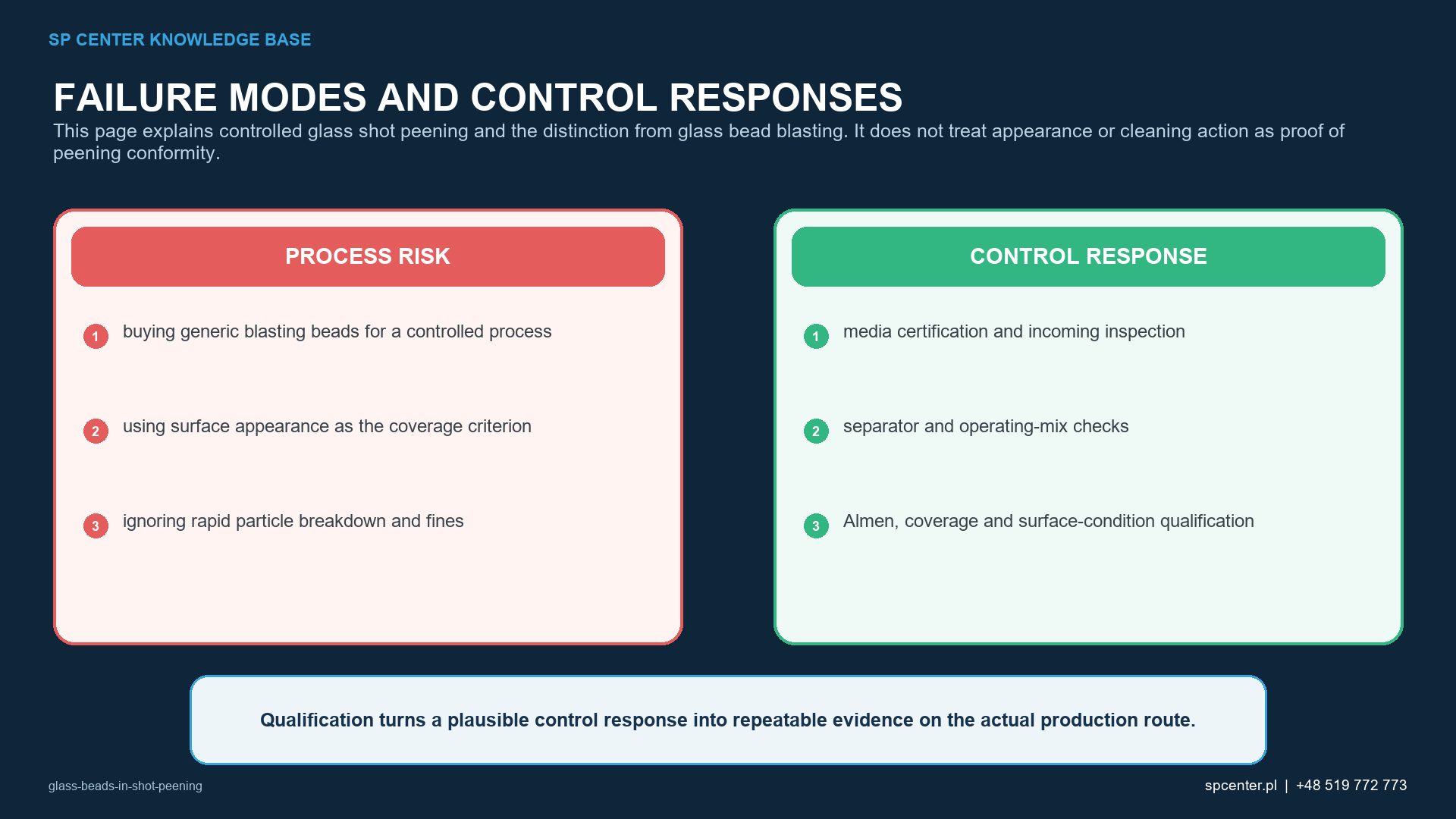
Glass is brittle. Repeated impact can create fractured beads, angular fragments and undersize material. Broken particles are not equivalent to conforming spherical shot and can change surface interaction, intensity stability, coverage development, contamination and consumption.
- Apply the invoked size, shape, integrity and contamination requirements.
- Control replenishment, classification and removal of undersize or fractured media.
- Define representative sampling, inspection frequency and reaction limits.
- Prevent unintended mixing with other media families or component materials.
- Treat a change in family, grade or size as a controlled process change.
How must equipment compatibility be demonstrated?
Glass shot is commonly associated with air-blast equipment, but equipment choice must follow the media, machine design and governing process specification. A blanket statement that glass can never be used in centrifugal equipment is too broad. The selected system must accelerate, meter, recover, classify and monitor the media without unacceptable breakdown or loss of process control.
Why are intensity, coverage and appearance separate?
| Observation or control | What it establishes | What remains separate |
|---|---|---|
| Almen intensity | Standardized response of the defined peening stream | Component coverage, residual stress and performance |
| Coverage evaluation | Extent of the specified area judged to be covered by impact marks under the approved method | Correct intensity or media condition |
| Uniform satin appearance | A visually consistent surface appearance | A conforming shot peening process |
| Qualified exposure | Approved time, passes or cycles for the validated setup | Media quality and component acceptance without their required checks |
| Component validation | Application-specific residual stress, fatigue, SCC or other invoked response | Routine process release unless required by the control plan |
Table 4. A uniform matte surface does not prove the required intensity or coverage.
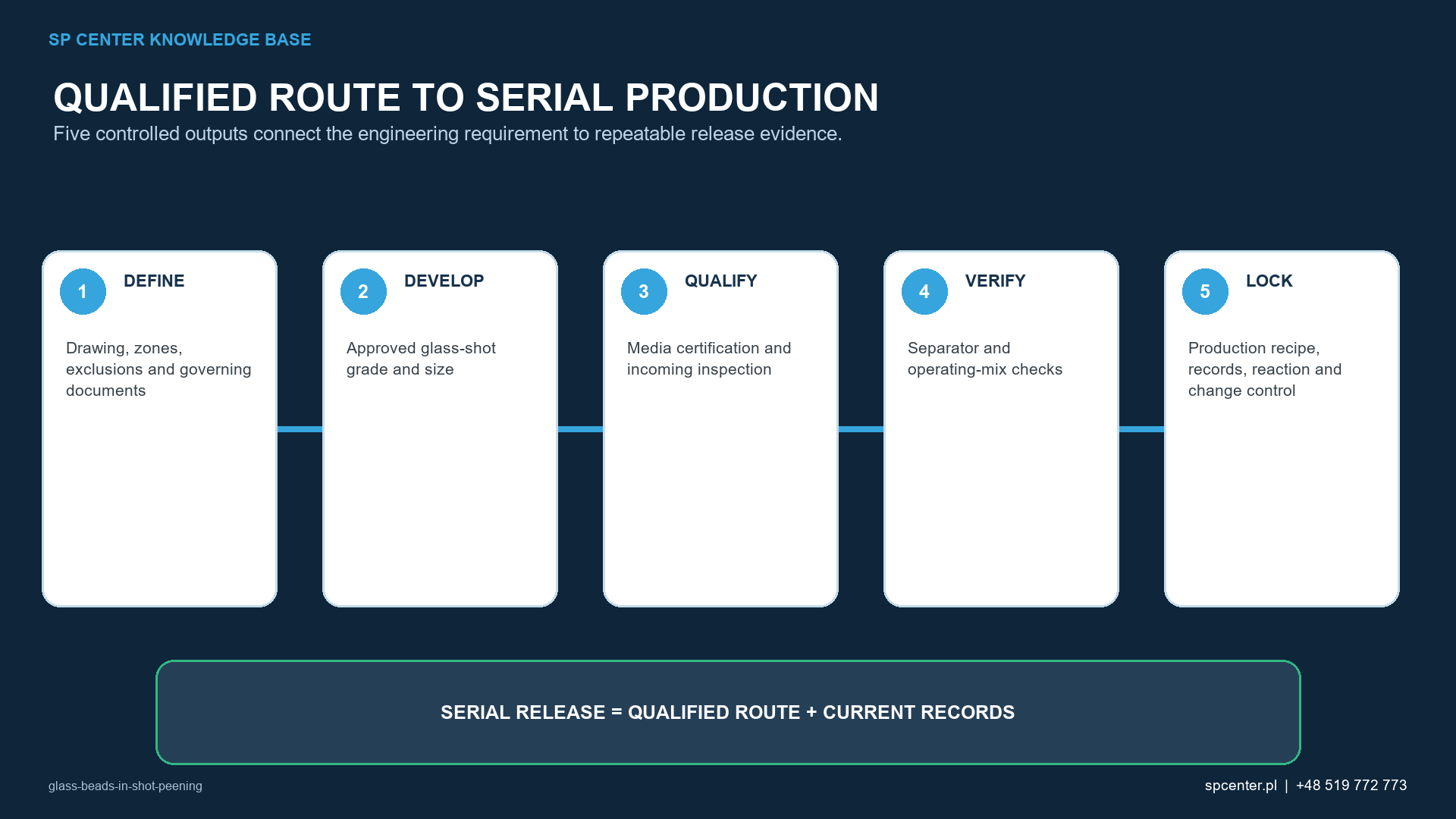
How is a glass-shot route qualified?
| Qualification stage | Required output |
|---|---|
| Requirements review | Drawing, material, heat treatment, zones, exclusions and permitted media |
| Media and equipment review | Glass-shot specification, size, delivery, recovery, classification and contamination controls |
| Process development | Saturation curve, Almen intensity, motion, exposure and coverage method |
| Component evaluation | Coverage, boundaries, surface condition, cleanliness and invoked dimensions |
| Serial control | Operating-mix sampling, replenishment, removal limits, records and change approval |
Table 5. Qualification covers the initial setup and the evolution of the operating mix during production.
Frequently asked questions
Can glass shot be used for controlled shot peening?
Yes, when the governing requirements permit glass shot and the specified grade, size, equipment, intensity, coverage, operating-mix controls and component acceptance are qualified.
Is glass-bead blasting the same as glass-shot peening?
No. Blasting may target cleaning, texture or appearance. Controlled shot peening requires defined media, intensity, coverage or exposure, process controls and acceptance evidence.
Is glass always gentler on delicate components?
No. Lower density does not guarantee a harmless result. Size, velocity, angle, exposure, component hardness, existing surface and local geometry still determine the response.
Why does glass shot break down?
Glass is brittle. Repeated impact can generate fractured particles, angular fragments and undersize material. The rate depends on grade, velocity, equipment, recovery and component geometry.
Does a uniform satin finish prove coverage?
No. Appearance is not the approved coverage method. Coverage must be evaluated according to the governing specification and qualified inspection route.
Can glass replace steel or ceramic shot without redevelopment?
No. Density, hardness, fracture behaviour, acceleration, surface response and contamination compatibility differ. A media-family change requires the prescribed technical review and qualification.
Key takeaways
- Use glass shot only when the governing requirements permit it.
- Specify peening-quality glass shot rather than generic blasting beads.
- Treat lower density and fine size as development options, not safety guarantees.
- Control fracture, undersize particles, replenishment and contamination.
- Keep Almen intensity, coverage, exposure, appearance and component validation separate.
Related SP Center guides
Technical references
1. SAE AMS2431E: Peening Media, General Requirements, revised April 2023
2. SAE AMS2431/6D, Peening Media Glass Shot
3. SAE J1173_201905, Size Classification and Characteristics of Glass Beads for Peening
4. SAE J443_202512: Procedures for Determining and Verifying Peening Intensity, revised December 2025
5. SAE J2277_202301: Shot Peening Coverage Determination, revised January 2023
Standards note: Use the complete specifications and revisions invoked by the drawing, contract and customer requirements.
Author: Paweł Kmieć
Discuss your shot peening requirement: +48 519 772 773 | [email protected]