


Link the actual failure origin and service duty to a feature-specific process, component acceptance and authorised life-management route
Shot peening can support selected rotating and cyclically loaded energy components when the relevant fatigue mechanism initiates at an accessible surface. Turbine or compressor features, shafts, couplings, gears and certain explicitly authorised pressure-system surfaces may be candidates. The decision depends on material and condition, geometry, load, temperature, corrosion environment, coating/process sequence, operating history and the responsible design or asset authority.
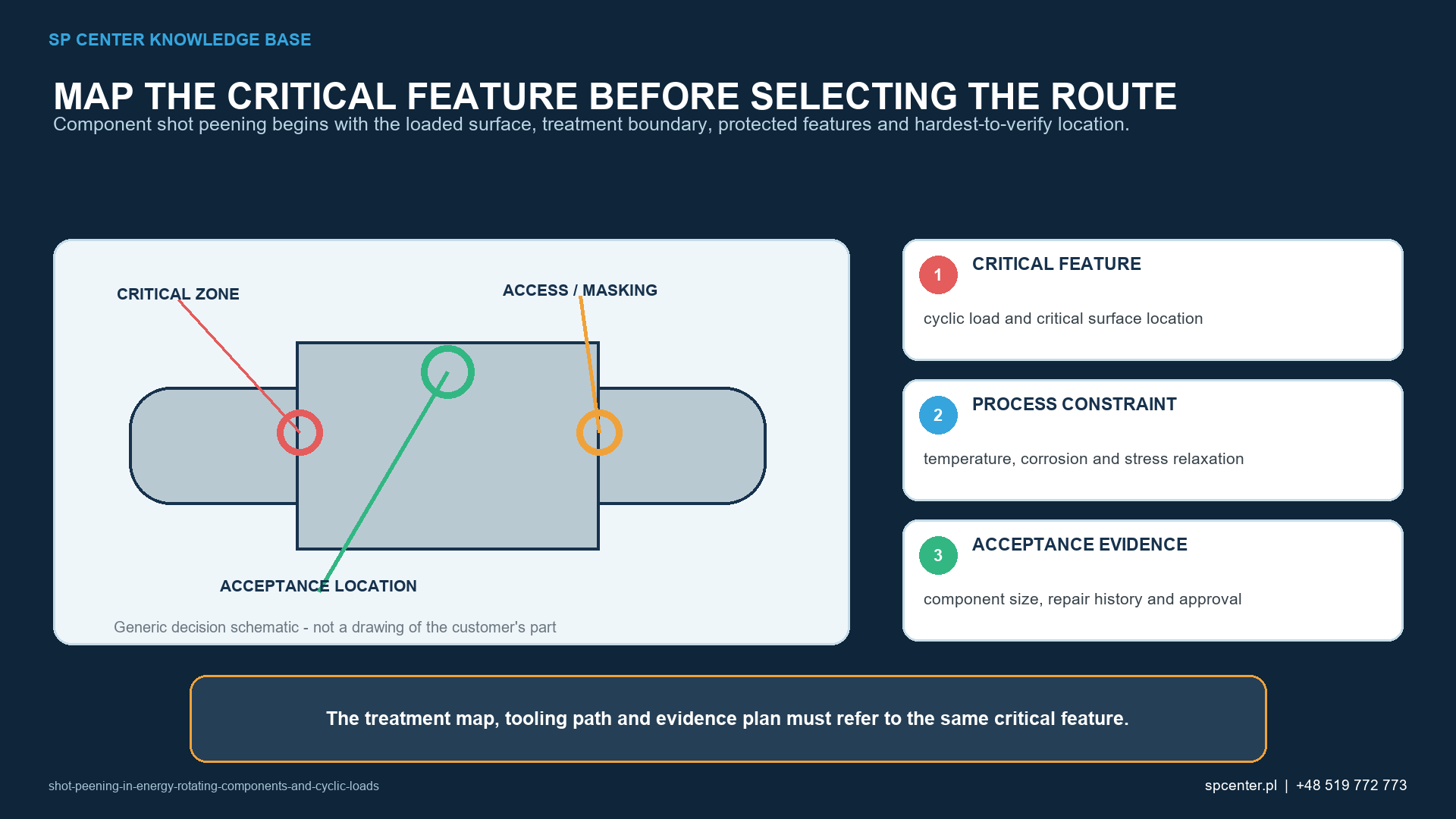
What must be known before shot peening is selected?
| Engineering input | Question before peening | Decision boundary |
|---|---|---|
| Failure mechanism and origin | Is the relevant initiation at the accessible surface, subsurface or internal? | Do not credit a surface process for an unrepresented internal/subsurface mechanism |
| Material and condition | What alloy, heat treatment, hardness, coating and manufacturing/repair history apply? | Existing defects or unsuitable material condition require disposition before peening |
| Service loading | Which cyclic, vibratory, thermal, contact or transient loads act at the feature? | Validation must represent the claimed load and location |
| Temperature and environment | Can temperature relax residual stress; are corrosion, water chemistry or deposits relevant? | Ambient-air evidence alone cannot establish hot or corrosive service benefit |
| Authority and life management | Which drawing, OEM/owner, sector code, repair plan, interval and records control? | No processing while the technical or contractual route is unresolved |
Table 1. The surface-treatment decision is limited by the real failure mechanism and service route.
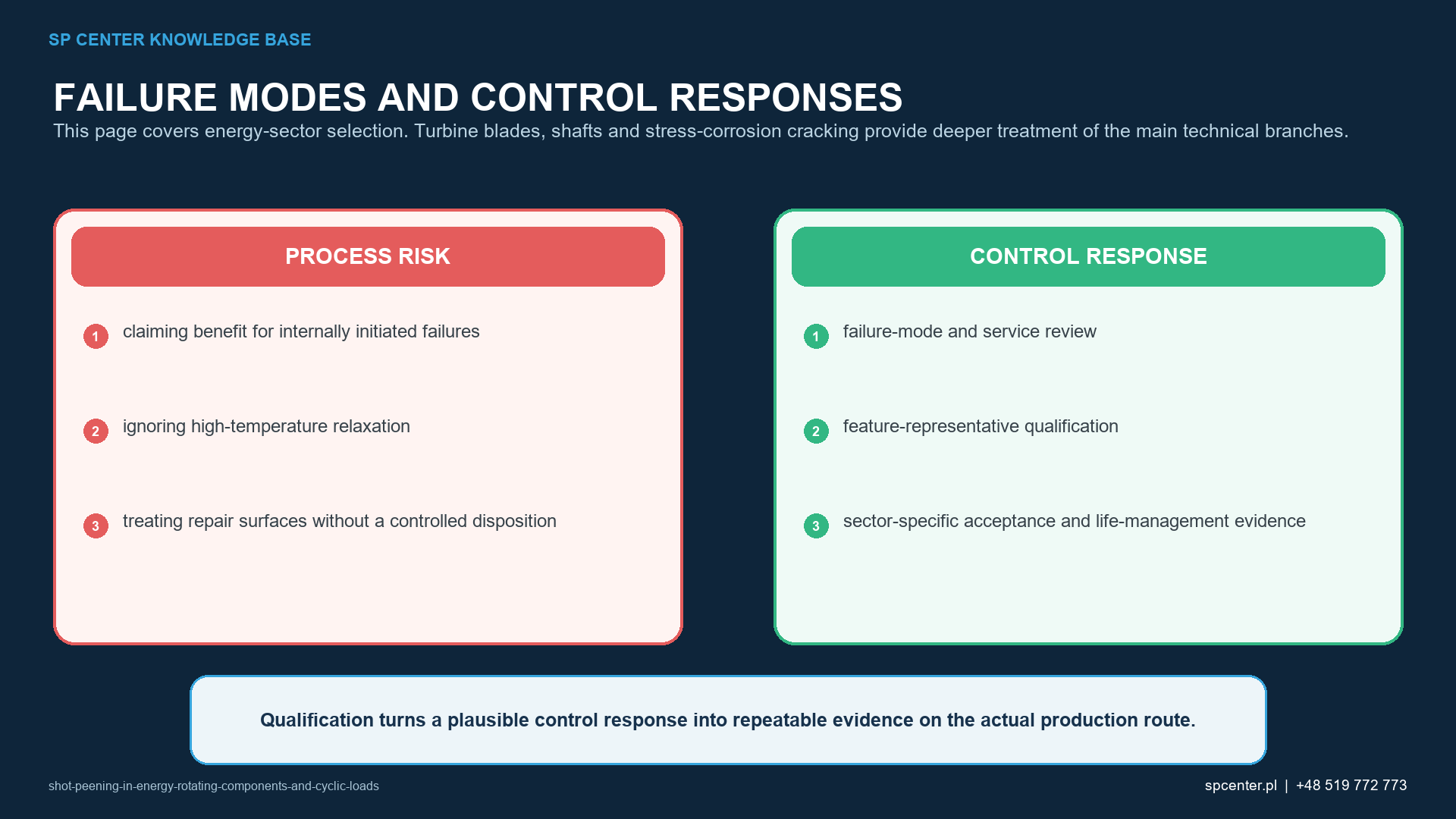
Shot peening is not a generic life-extension action. It cannot remove cracks, corrosion damage, weld defects, wall loss or an unsuitable material condition. It also cannot be credited for an internally initiated failure merely because compressive residual stress is produced near the surface.
Which energy components need feature-specific qualification?
| Component/feature | Potential rationale | Primary qualification concerns |
|---|---|---|
| Turbine/compressor blade or vane feature | Selected root, attachment, fillet or other surface-sensitive fatigue location | Alloy/coating, thin edge protection, access, roughness, distortion, temperature and feature-specific evidence |
| Shaft, axle or coupling transition | Rotating-bending/torsional fatigue near radius, spline or transition | Load path, radius/access, masking, dimensions, runout, surface finish and representative fatigue basis |
| Gear or drive feature | Tooth-root or other contact/fatigue-sensitive surface | Impact angle, media size, local coverage, finish, distortion and transfer to actual duty |
| Pressure-system feature | Only a specifically authorised surface-fatigue application | Pressure-boundary integrity, defect/customer-specified inspections outside SP Center's service scope decision, environment and design/repair authority before peening |
| Previously operated or repaired surface | Possible restoration of an explicitly approved surface-treatment state | Operating damage, remaining dimensions, removed compressive layer, contamination and authorised repair/life decision |
Table 2. The same component can contain treated, protected and excluded features with different acceptance risks.
A treatment map should identify prescribed zones, boundaries and exclusions and then address the hardest-to-reach and most damage-sensitive feature. Pressure-boundary or previously operated parts require the applicable defect inspection, dimensional assessment and authorised repair/life-management decision before peening.
How do temperature, corrosion and residual-stress relaxation affect the claim?
The induced field depends on material, hardness, media, intensity, coverage, exposure, impact angle, geometry and incoming stress state. Its retention can depend on temperature, time, mechanical loading and environment. Therefore an ambient residual-stress or fatigue result is not automatically transferable to hot, wet, corrosive, vibrating or transient service.
ASTM E466-21 covers force-controlled constant-amplitude axial specimen fatigue testing in air at room temperature; it does not cover full components. Results support design only when test conditions represent service or a defined method accounts for the differences. Energy qualification may need component-representative loading, temperature, environment and statistical treatment beyond this practice.
Which evidence layers must remain separate?
| Evidence layer | What it answers | What it cannot answer alone |
|---|---|---|
| Almen intensity | Standardised response of the qualified stream/configuration | Component coverage, residual-stress profile or service life |
| Coverage and treatment boundary | Impact coverage on the prescribed accessible surface by the approved method | Correct intensity, defect absence or performance |
| Surface/dimensional/customer-specified inspections outside SP Center's service scope acceptance | Specified condition of the actual component at the stated process stage | General fatigue, corrosion or pressure-integrity benefit |
| Residual-stress measurement | Stress at stated locations, directions, depths and method conditions | Durability outside the measured/validated configuration |
| Fatigue/corrosion/service validation | Performance under stated material, surface, geometry, load, temperature and environment | Universal transfer to another component or duty |
Table 3. A correct process surrogate must not be presented as proof of a different component or service claim.
When residual stress is measured, state method, location, orientation, depth method/removal sequence, uncertainty and surface condition. SAE AS7045 provides a framework for defining, quantifying and classifying residual stresses in metallic products and finished parts; it does not convert one measurement into a universal fatigue or corrosion qualification.
How are new manufacture, repair and change controlled?
| Event | Containment/review | Possible authorised outcome |
|---|---|---|
| Internal or subsurface failure origin identified | Stop surface-treatment credit and review failure mechanism | Redesign, material/process change or separate validation; peening benefit not assumed |
| High-temperature or corrosive duty differs from qualification | Hold transfer and review relaxation/environment effects | Service-representative testing, residual-stress assessment or revised limitation |
| Crack, corrosion damage, wall loss or repair blend | Inspect, measure and route through owner/design repair authority | Approved repair and re-establishment of the peened state where explicitly permitted |
| Machine, media, tooling, geometry, coating or inspection change | Protect baseline and identify affected product/configuration | Targeted verification, representative trial, requalification and/or customer approval |
| Interrupted cycle or process excursion | Contain the batch and assess cumulative exposure/surface/dimensions | Authorised disposition; no automatic additional cycle |
Table 4. Repair and life-extension decisions remain with the authorised owner/design route.
Reprocessing is not an automatic correction. Additional exposure can change roughness, dimensions, distortion, cold work and the coating or heat-treatment sequence. Another cycle requires product containment, cumulative-exposure assessment and explicit authority.
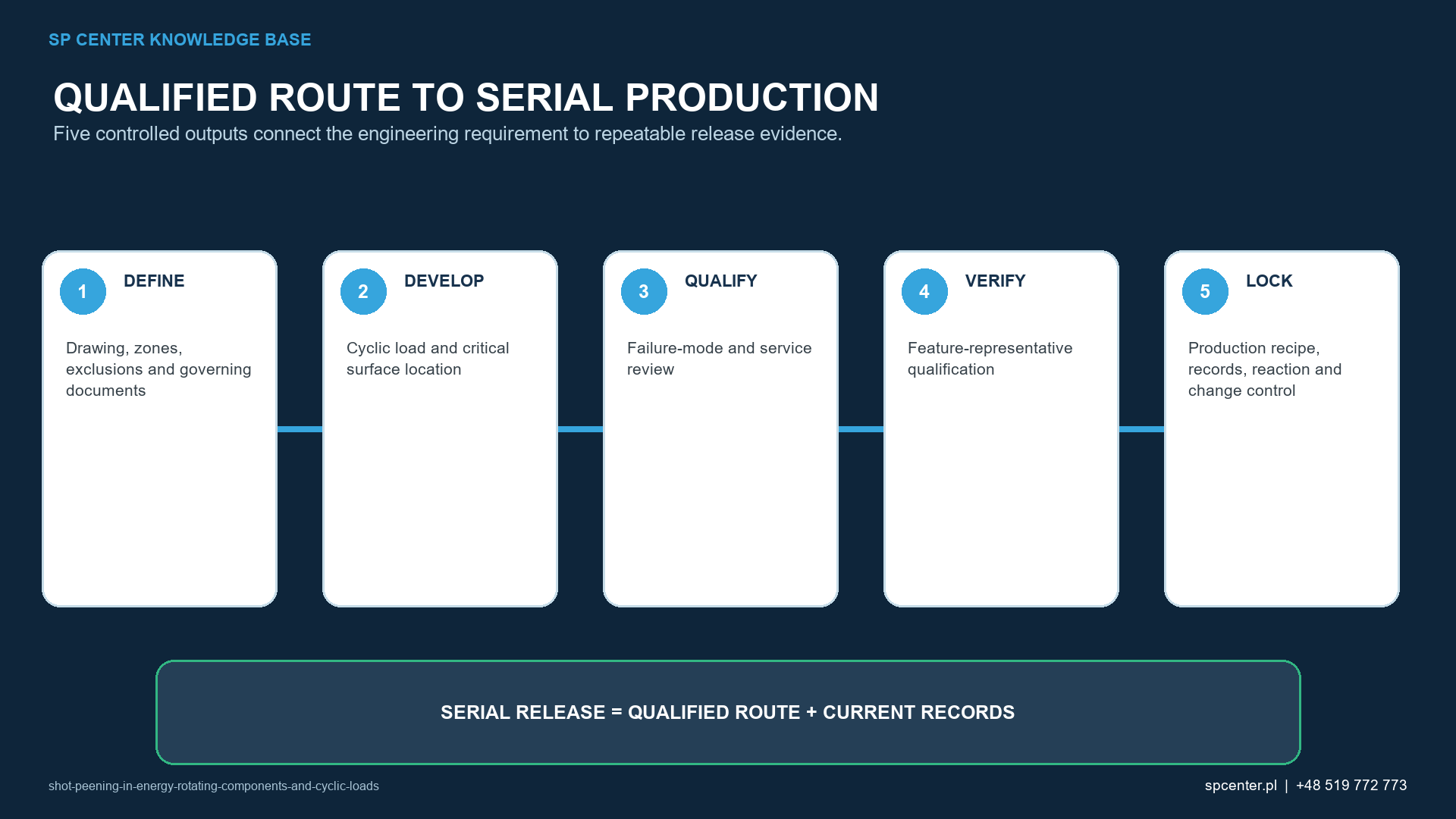
What records support release?
Link component/revision and lot or serial identity to the approved machine, media, tooling, program and process sequence. Retain the invoked Almen, coverage, surface/dimensional/customer-specified inspections outside SP Center's service scope, residual-stress or performance evidence, together with operating/repair status, deviations, changes and approvals required by the owner or customer. There is no universal release package for every energy sector.
Which energy-sector components may be considered for shot peening?
Selected turbine or compressor features, shafts, couplings, gears and other rotating or cyclically loaded surfaces may be candidates. The actual failure origin, material, geometry, service and design authority determine suitability.
Can shot peening prevent an internally initiated fatigue failure?
A surface treatment should not be credited for an internal or subsurface origin unless a validated mechanism explicitly supports that claim. The failure-mode review must precede process selection.
Does the compressive residual-stress field remain unchanged at service temperature?
Not necessarily. Relaxation depends on material, temperature, time, load and initial stress state. The credited profile and benefit require a service-relevant basis.
Does correct Almen intensity prove the residual stress in a turbine or shaft?
No. Almen intensity verifies a standardised stream response. Component residual stress requires a separate measurement/validation plan when it is an acceptance or design variable.
Can peening repair a crack, corrosion pit or loss of wall thickness?
No. Those conditions require detection, engineering assessment and an authorised repair or life-management decision before any surface treatment.
Can a production recipe be used for an in-service repair?
Not automatically. Operating history, contamination, damage, remaining dimensions, removed material and repair authority differ from new manufacture and must be addressed by an approved repair route.
Is ASTM E466 a full validation for an energy component?
No. E466-21 covers force-controlled constant-amplitude axial specimen tests in air at room temperature. It can support a programme but does not by itself represent full components, rotating bending, thermal duty or corrosive service.
What should an energy-sector RFQ include?
Provide controlled drawing/revision, material/condition, new or in-service status, critical features, load/temperature/environment, coatings and process sequence, specifications, intensity/coverage, surface/dimensional/customer-specified inspections outside SP Center's service scope limits, qualification, records and owner/customer approvals.
Key takeaways
- Confirm that the claimed failure mechanism originates at the accessible treated surface.
- Review material, service load, temperature, environment, coating and component history before process selection.
- Do not use peening to repair cracks, corrosion damage, weld defects or wall loss.
- Qualify the actual feature, including worst access and damage-sensitive surfaces.
- Separate Almen intensity, coverage, component acceptance, residual stress and service performance.
- Account for temperature-, time-, load- and environment-dependent relaxation or degradation.
- Treat repair, change and reprocessing through the authorised life-management route.
Related SP Center guides
Technical sources
1. SAE J2441_202511: Shot Peening, stabilized November 2025
2. SAE ARP7488: Peening Design and Process Control Guidelines, issued January 2018
3. SAE J443_202512: Procedures for Determining and Verifying Peening Intensity, revised December 2025
4. SAE J2277_202301: Shot Peening Coverage Determination, revised January 2023
Standards note: The complete contract, drawing, sector code, OEM/owner repair route and customer requirements determine applicability and acceptance. This guide does not create pressure-integrity, life-extension or fitness-for-service approval.
Author: Paweł Kmieć
Discuss an energy-component shot peening project: +48 519 772 773 | [email protected]