


Use ISO 12686 within its automated controlled-peening scope and connect material suitability, coating sequence, qualification and batch evidence
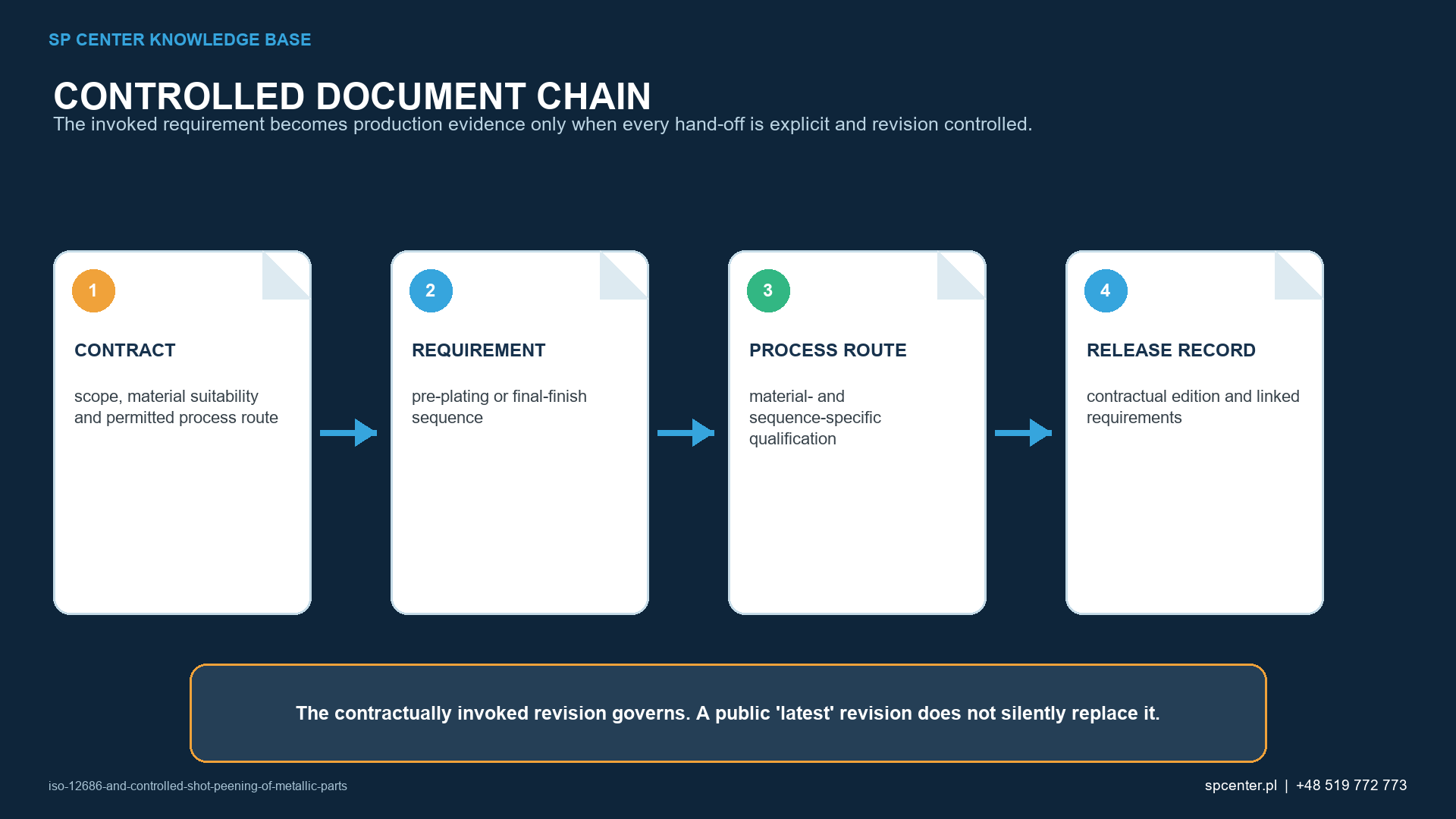
ISO 12686:1999 addresses automated, controlled shot peening of metallic articles before electrolytic or autocatalytic nickel or chromium deposition, or as a final finish. The ISO catalogue states that the first edition was confirmed in 2022 and remains current. Its scope is narrower than “all shot peening”: hand peening and rotary flap peening are excluded, and brittle materials are usually unsuitable. The complete standard and the edition invoked by the contract remain authoritative.
What does ISO 12686 cover?
| Scope question | Public ISO information | Contract-review consequence |
|---|---|---|
| Process mode | Automated, controlled shot peening | Do not assume hand peening or rotary flap peening is covered |
| Component | Metallic articles | Confirm material, heat treatment, geometry and demonstrated suitability |
| Sequence | Before electrolytic or autocatalytic nickel or chromium deposition, or as a final finish | State which route and component condition the requirement addresses |
| Media named in the public scope | Cast steel shot, conditioned cut wire, ceramic shot or glass beads | The actual permitted grade and condition must follow the controlled requirement |
| Material limitation | Usually unsuitable for brittle materials; benefit must be supported by test work | Do not transfer a route without material-specific evidence and authority |
| Document status | ISO 12686:1999 was confirmed in 2022 and remains current in the ISO catalogue | The contract may still invoke a specific edition or additional customer requirements |
Table 1. The public ISO record supports a scope decision but does not replace the purchased standard or customer flow-down.
The phrase “as a final finish” does not make the standard a universal finish specification. Material, benefit, intensity range, surface requirements and acceptance still need a controlled basis. Likewise, being current in the ISO catalogue does not override an edition explicitly invoked by contract.
How is controlled shot peening different from coating-preparation blasting?
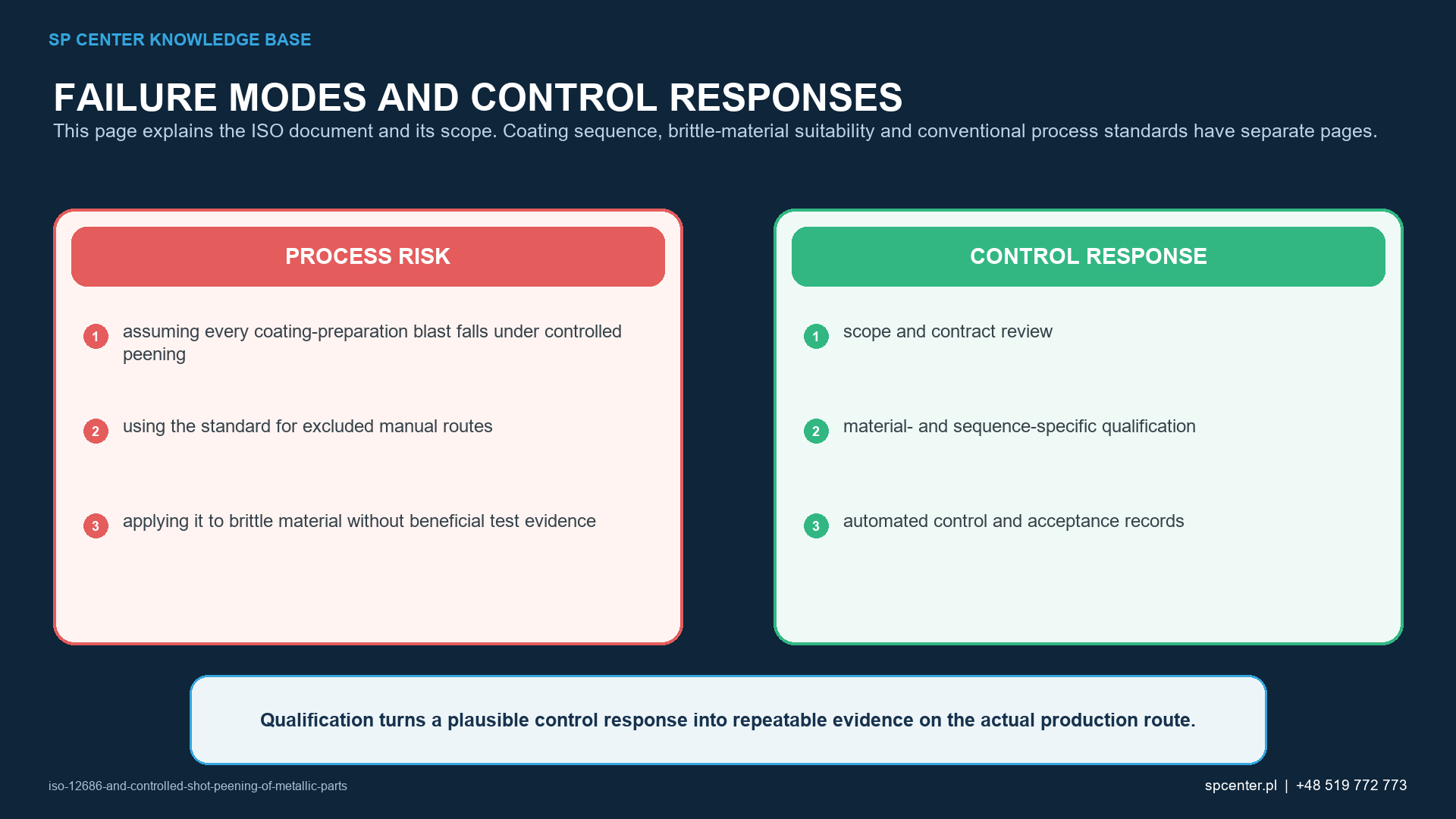
Controlled shot peening is intended to create a qualified mechanical surface effect through controlled media, intensity, coverage, exposure, equipment and records. Blasting for cleaning, oxide removal or roughening is specified for a different objective. A surface may require both operations, but one must not be silently substituted for the other.
The drawing or manufacturing plan should identify treated and excluded zones, operation order and the acceptance method for each step. If the request says only “blast before plating,” obtain a controlled clarification before selecting ISO 12686.
Why does the nickel or chromium sequence matter?
When peening is performed before nickel or chromium deposition, the engineering claim concerns the condition that enters the coating operation and the final coated component. Material preparation, peening, cleaning, handling, delay and deposition therefore form one controlled route wherever the applicable requirements make them relevant.
Do not invent universal maximum delays, cleaning methods or coating parameters from the ISO title or abstract. Use the complete invoked documents. A changed coating system, heat treatment or intermediate operation can require technical review even if the peening recipe is unchanged.
How should material suitability be established?
Start with alloy, heat-treatment condition, hardness, geometry, existing surface condition and damage sensitivity. The ISO public scope states that applicability depends on test work showing benefit within given intensity ranges and that brittle materials are usually unsuitable. That is a warning against automatic transfer, not a standalone acceptance test.
Use representative trials and the outputs required by design or qualification. These may include intensity, coverage, roughness, dimensions, coating response, residual stress or fatigue evidence, but only the invoked plan defines which results are mandatory.
Which approvals and records are separate?
| Evidence layer | Typical controlled input | What the evidence does not prove alone |
|---|---|---|
| Requirement | Drawing, purchase order, ISO edition and customer flow-down | That the part is feasible or the route is qualified |
| Process qualification | Representative material, geometry, equipment, media, tooling, sequence and acceptance methods | Automatic approval of another part, coating or machine |
| Stream verification | Applicable Almen intensity system and saturation determination | Coverage or component performance |
| Surface acceptance | Defined coverage method and required surface or dimensional checks | Residual-stress depth, coating adhesion or fatigue life |
| Batch release | Part and lot identity, approved program, media, inspections, deviations and sequence records | Product certification beyond the invoked acceptance basis |
Table 2. Qualification of a process route, approval of a supplier and release of a production batch are different decisions.
ISO 12686 is not a Nadcap product certificate. If the customer requires Nadcap accreditation, source approval, first-article approval or another qualification, record each requirement separately and use the current applicable criteria and customer documents.
How are intensity and coverage used?
Almen intensity characterizes the peening stream through the applicable Almen system and a properly determined saturation curve. Coverage describes the proportion of the specified surface showing impact evidence when assessed by the approved method. Neither result substitutes for the other.
Location, strip designation, holder, fixture, observation method, lighting or tracer qualification and acceptance authority must follow the invoked requirements. Do not claim that intensity alone proves coating adhesion, residual-stress depth or fatigue performance.
What must be controlled in serial production?
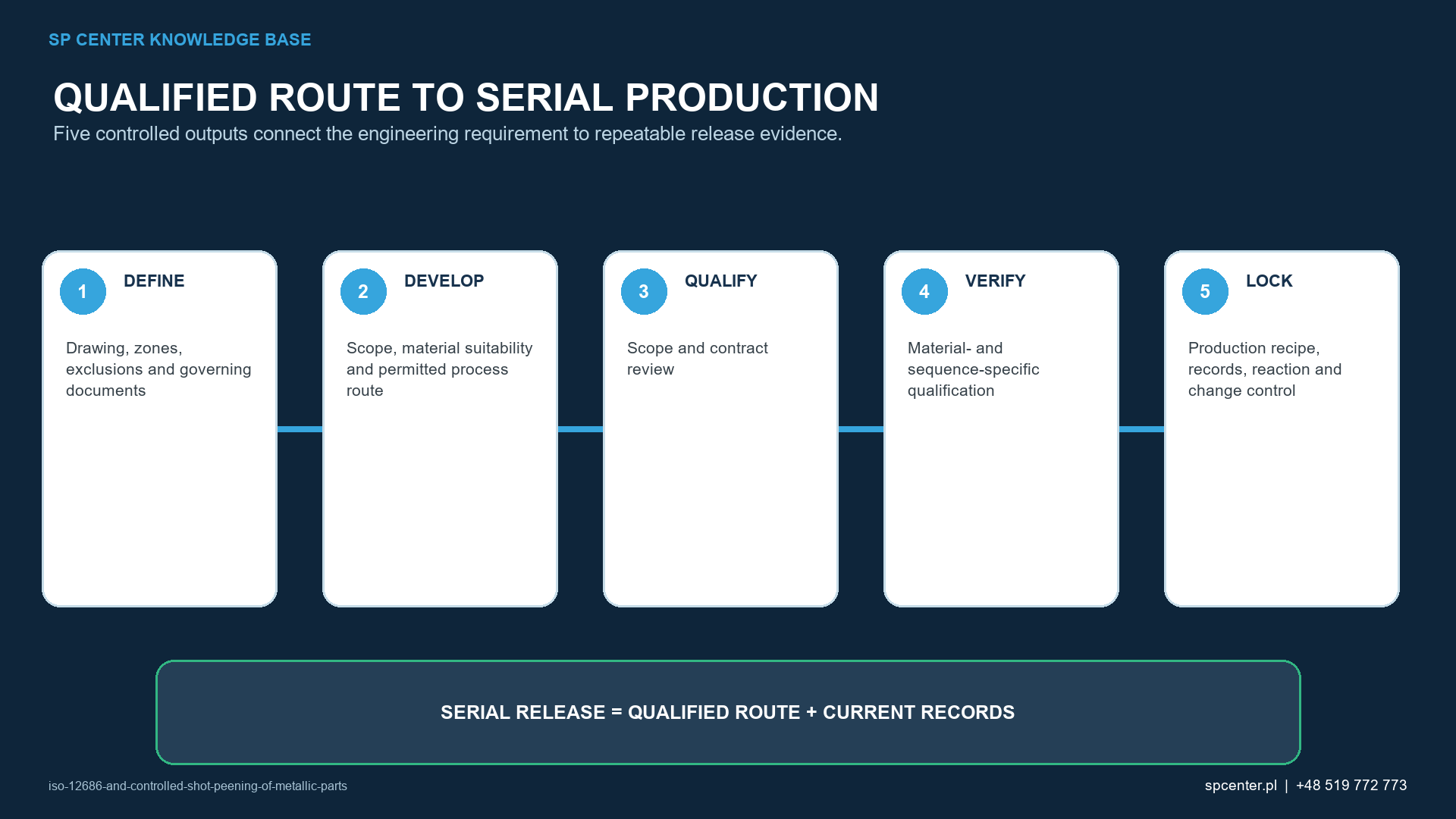
Link part and batch identity to the approved machine, media, fixture, program and sequence. Maintain the specified media condition, equipment checks, intensity evidence, coverage records, surface or dimensional inspections, alarms, maintenance, deviations and release authorization.
Changes to machine, nozzle or wheel, media, separator, tooling, program, geometry, preparation, coating route or inspection method require a documented assessment. Requalification depends on possible effect and the governing documents, not on a generic list copied from another contract.
Which requests require clarification before work starts?
| Ambiguous request | Why it is unsafe | Controlled clarification |
|---|---|---|
| Peen to ISO 12686 | Edition, route, material, zones, intensity, coverage and sequence may be missing | Obtain the complete drawing, purchase-order clauses and required results |
| Prepare for plating by blasting | Cleaning or roughening is not automatically controlled shot peening | Identify whether the design requires cleaning, texture, residual-stress enhancement or more than one operation |
| Use the same setting as another part | Geometry, material, access and coating sequence can change the outcome | Qualify or approve transfer with representative evidence |
| Automated means computer monitored | Automation and a specific monitoring standard are not synonymous | List the required parameters, alarms, records and governing specifications |
| Correct intensity proves conformance | Intensity is only one process characteristic | Add required coverage, media, surface, dimension and sequence evidence |
| Rework until it passes | Cumulative exposure and sequence can make further processing inadmissible | Stop and obtain an approved technical disposition |
Table 3. Missing authority is resolved before parameters are selected or product is processed.
How should nonconforming product be handled?
Stop and contain product when the process route, material suitability, intensity, coverage, media condition or sequence cannot be demonstrated. Identify the last known acceptable state and preserve the raw records. Obtain a controlled engineering or customer disposition where the acceptance authority requires it.
Additional exposure or repeating the sequence is not an automatic repair. It may change roughness, dimensions, cold work, residual stress or coating preparation and may be prohibited. Rework requires an explicit approved route and renewed acceptance evidence.
Frequently asked questions
Is ISO 12686:1999 still current?
Yes. The ISO catalogue identifies ISO 12686:1999 as published and confirmed in 2022. Contract review must still use the edition and additional requirements invoked for the component.
Does ISO 12686 apply to every shot peening operation?
No. Its public scope is automated controlled shot peening of metallic articles before specified nickel or chromium deposition routes or as a final finish. Other applications may be governed by different standards or customer specifications.
Does ISO 12686 cover shot blasting for cleaning?
Not automatically. Shot blasting used for cleaning, scale removal or texture has a different objective. If both cleaning and controlled peening are required, define and qualify each operation and its sequence.
Are manual peening and rotary flap peening included?
No. The public ISO scope specifically excludes hand peening and rotary flap peening. A different approved process and requirement would be needed.
Can the standard be used for a brittle material?
The public scope says brittle materials are usually unsuitable and that applicability depends on test work showing benefit within given intensity ranges. Do not proceed without material-specific evidence and the required authority.
Does ISO 12686 require Nadcap accreditation?
The ISO catalogue does not make Nadcap a product certification. Nadcap accreditation, customer source approval and contractual requirements are separate matters and apply only when invoked.
Does correct Almen intensity prove the plated part is acceptable?
No. Intensity characterizes the peening stream under standardized conditions. Coverage, part condition, process sequence, plating results and other invoked acceptance criteria remain separate.
What should an RFQ include?
Provide the controlled drawing and revision, material and heat treatment, peening and exclusion zones, invoked ISO edition, intensity and coverage requirements, media restrictions, coating or final-finish sequence, quantity, lot logic and required records.
Key takeaways
- ISO 12686:1999 remains current after confirmation in 2022.
- Its public scope is automated, controlled peening before specified nickel or chromium deposition routes or as a final finish.
- Hand peening and rotary flap peening are outside that scope.
- Cleaning or roughening by shot blasting is not automatically ISO 12686 peening.
- Brittle materials require particular caution and material-specific evidence.
- Contract, qualification, serial control and batch release remain separate evidence layers.
Related SP Center guides
Technical references
2. SAE J2441_202511: Shot Peening, stabilized November 2025
3. SAE ARP7488: Peening Design and Process Control Guidelines, issued January 2018
4. SAE J443_202512: Procedures for Determining and Verifying Peening Intensity, revised December 2025
5. SAE J2277_202301: Shot Peening Coverage Determination, revised January 2023
Standards note: This article summarizes public scope information and engineering relationships; it does not reproduce the copyrighted clauses. Use the complete documents invoked by drawing and contract.
Author: Paweł Kmieć
Discuss an ISO 12686 project: +48 519 772 773 | [email protected]