


Apply the current spring-peening standard through controlled document review, representative geometry, qualified access and separate intensity, coverage and product evidence
ISO 26910-1:2023 specifies general procedures for shot peening springs to improve resistance to fatigue and stress-corrosion cracking, mainly by introducing compressive residual stresses into surface layers. It is the current second edition and replaced ISO 26910-1:2009 and its 2017 amendment. It does not create one universal spring recipe: the drawing, material, geometry, product specification, contract and customer requirements define the actual route and acceptance.
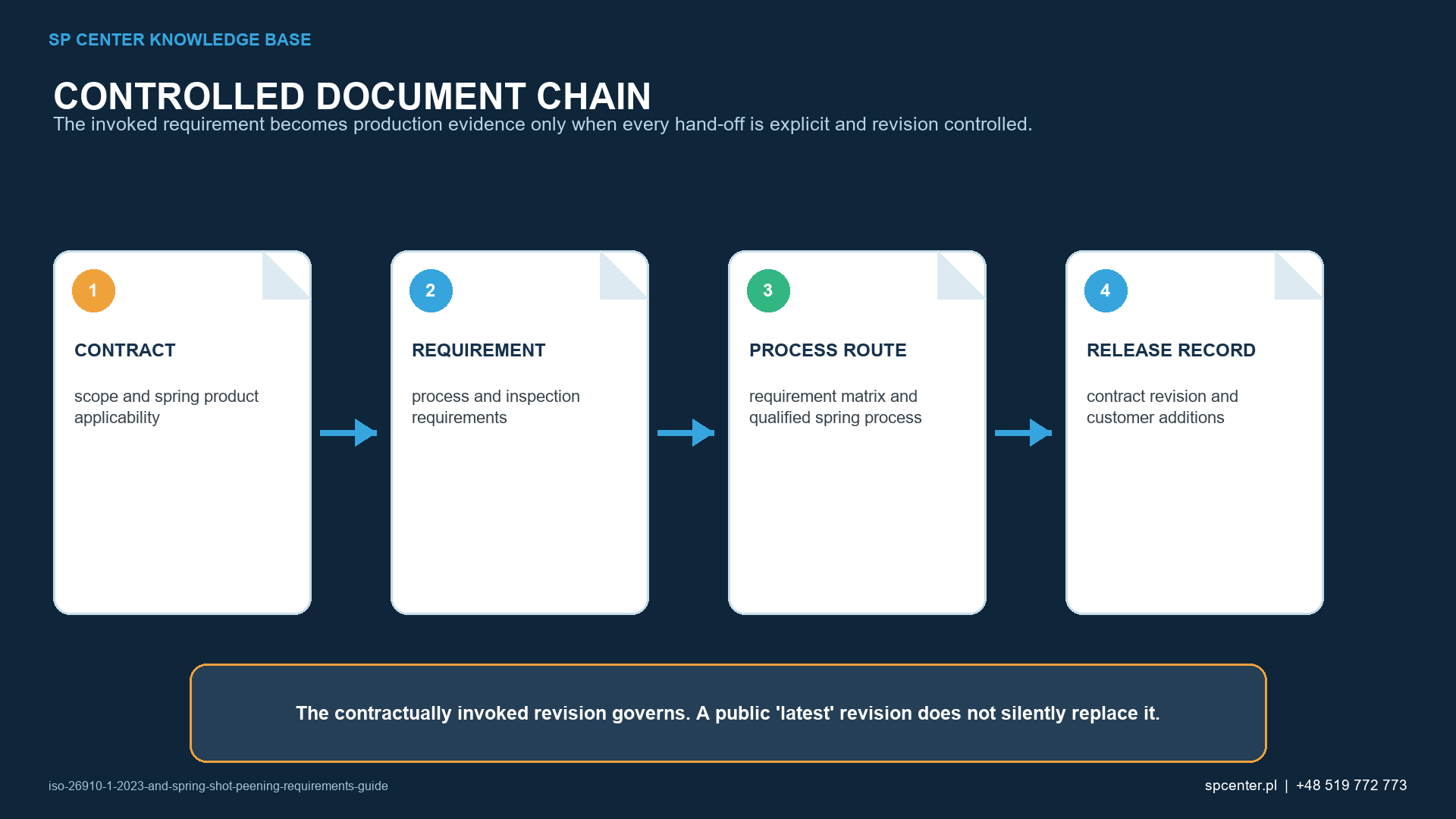
What is the status and scope of ISO 26910-1:2023?
The ISO catalogue identifies ISO 26910-1:2023, Springs — Shot peening — Part 1: General procedures, as published in October 2023. The public abstract establishes its general spring-peening purpose but does not expose the complete process clauses. Use the purchased standard and invoked customer documents for execution.
| Document-control question | Decision | Record |
|---|---|---|
| Which edition is invoked? | ISO 26910-1:2023 is the current second edition; the 2009 edition and its 2017 amendment are withdrawn | Drawing, order and specification revision review |
| Which spring is in scope? | Identify spring type, material, heat treatment, dimensions and application-specific requirement | Part family and applicability matrix |
| Which surfaces are treated? | Define required and excluded zones, including inside coils, ends and contact features | Controlled treatment map |
| Which acceptance results apply? | Separate intensity, coverage, media, surface, dimension and any performance evidence | Requirement-to-record matrix |
| Do documents conflict? | Stop selection of parameters and obtain controlled clarification | Approved deviation or customer response |
Table 1. A current public edition and a contractually invoked edition are two facts that must be reconciled, not silently substituted.
Why does spring geometry require a dedicated process review?
A spring is not a flat coupon. Coil pitch, inside diameter, wire or strip section, ends, hooks, transitions and contact marks can change access and local response. Areas with high operating stress may coincide with the hardest surfaces to reach or inspect.
Map required surfaces and exclusions on the controlled drawing. Establish the worst-case geometry and part presentation before choosing nozzle or wheel arrangement, media size, fixture, motion, load size and observation method.
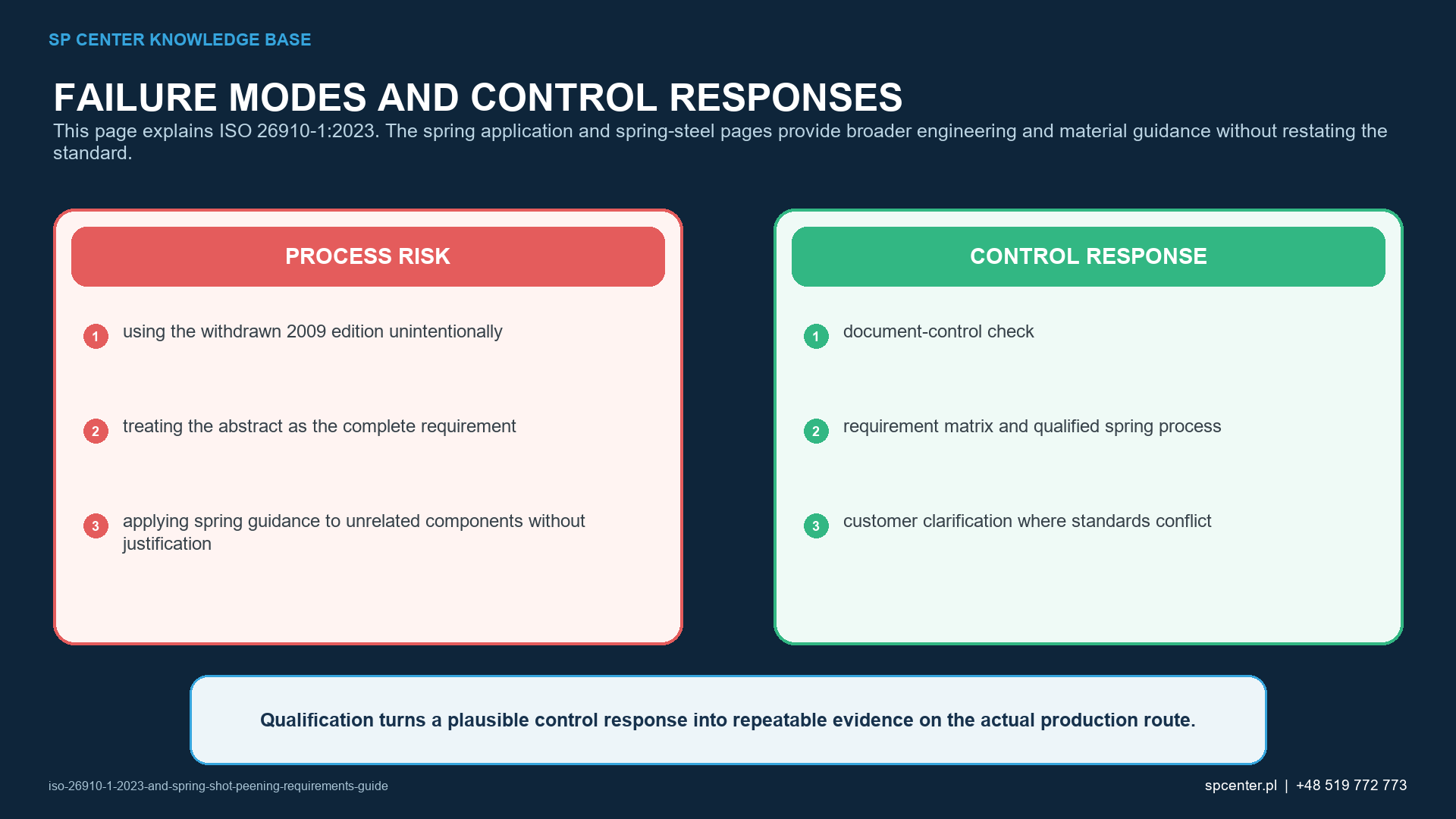
Which spring features drive qualification?
| Spring feature | Process risk | Qualification focus |
|---|---|---|
| Inside diameter of close coils | Shadowing, reduced angle or incomplete media access | Representative pitch, orientation, motion and approved coverage assessment |
| Wire or strip edge | High local impact severity, roughness or damage | Media size, intensity window and surface acceptance at the edge |
| Ends, hooks or transitions | Changed stress concentration and non-uniform exposure | Defined target and exclusion zones with fixture repeatability |
| Nested or bulk-loaded springs | Part-to-part shielding and variable residence time | Load size, separation, flow and worst-case coverage |
| Preset, coating or heat-treatment sequence | Residual-stress state or surface condition changes after peening | Controlled order and any required validation after downstream operations |
| High-strength or damage-sensitive material | Overexposure, defects or roughness can offset benefit | Material-specific stop criteria and representative performance evidence when invoked |
Table 2. Qualification challenges access and damage sensitivity on a production-representative spring, not only on an open flat witness.
How are intensity, coverage and media controlled?
Almen intensity is established through the applicable strip, holder and properly determined saturation curve at the defined verification location. Coverage is assessed on the required spring surface through the approved direct or qualified indirect method. These are separate results.
Operating media size, shape, hardness and contamination influence impact response and access. A smaller particle can improve access but also changes the qualified stream and surface effect. Do not change media merely to reach a close coil without technical review.
How should the manufacturing sequence be treated?
Heat treatment, forming, grinding, presetting or scragging, peening, cleaning and coating can change the final spring condition. Their approved order comes from the drawing, spring specification and qualification. This guide does not prescribe a universal position for peening.
If a downstream thermal or mechanical operation can relax or alter the induced state, the performance claim must be supported in the final relevant condition. The same applies when an incoming decarburized, damaged or contaminated surface can dominate fatigue behaviour.
What evidence is needed for qualification and release?
| Evidence | What it demonstrates | What it does not prove alone |
|---|---|---|
| Almen intensity and saturation curve | The standardized peening stream meets the invoked intensity condition | Coverage on the inside coil or spring fatigue life |
| Coverage assessment | The defined surface shows the required impact coverage by the approved method | Residual-stress magnitude or depth |
| Media inspection | Operating media size, shape and condition meet the invoked limits | Energy and access at every feature |
| Surface and dimensional inspection | The spring meets the specified post-process condition | Resistance to fatigue or stress-corrosion cracking |
| Representative fatigue or corrosion validation | The application-specific response is supported for the tested route | Automatic transfer to another spring family |
Table 3. Process evidence, surface acceptance and product performance answer different engineering questions.
Qualification should use production-representative equipment, media, fixture, load, motion and spring condition. Serial records link part and lot to the approved program, equipment, media, intensity, coverage, required surface or dimensional checks, deviations and release.
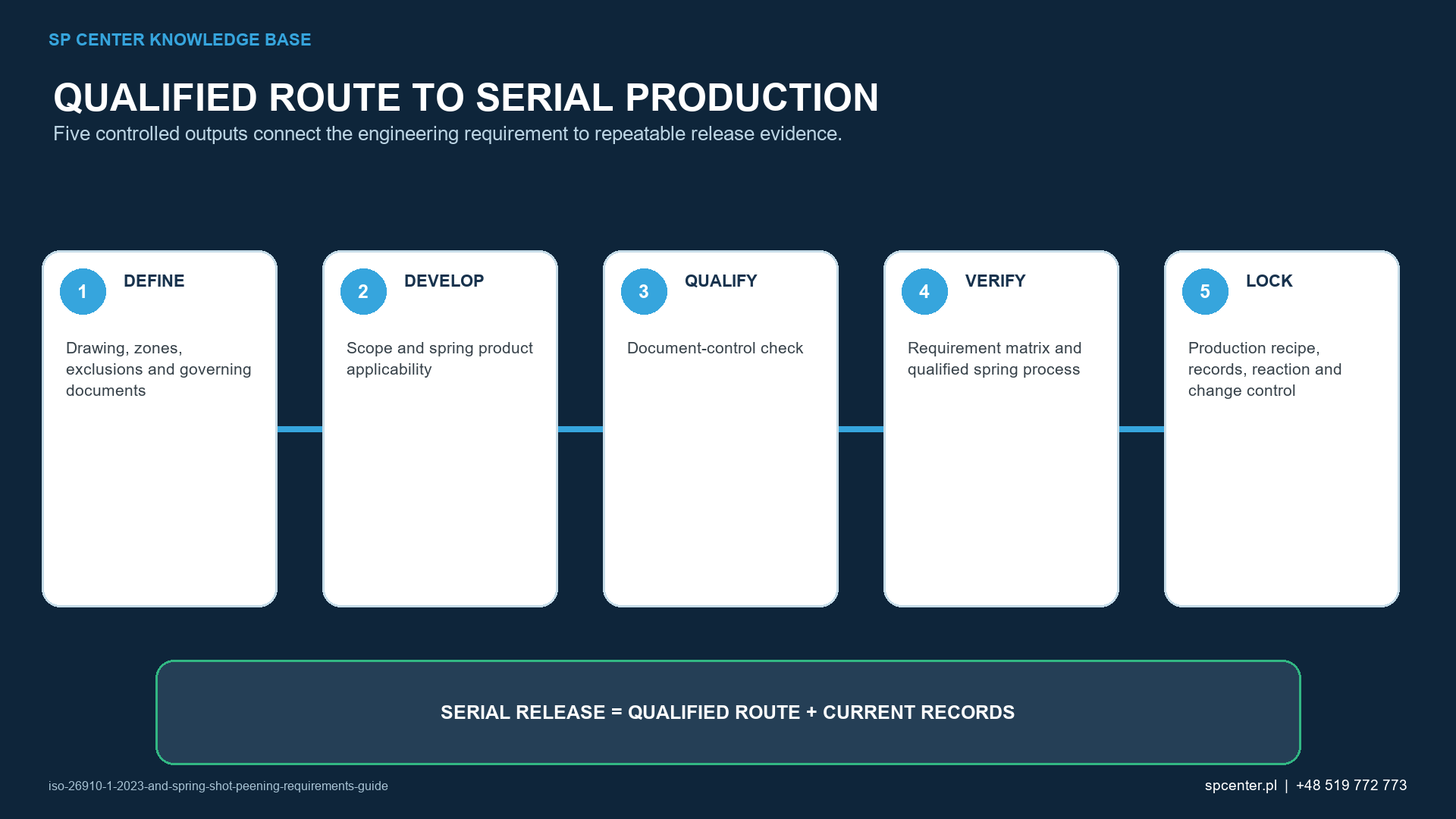
When is a transfer or change review required?
Review changes to spring material, heat treatment, wire or strip size, diameter, pitch, ends, surface condition, machine, nozzle or wheel, media, separator, fixture, program, load size, motion or inspection method. The required requalification depends on possible effect and the governing documents.
A successful setting on one spring does not prove another family. If documents conflict or a required input is missing, stop and obtain a controlled engineering or customer clarification rather than completing the route from assumptions.
Which failures require containment?
- The wrong edition or product requirement was used.
- Inside-coil or end coverage cannot be demonstrated.
- Media condition, intensity or equipment configuration is outside the approved state.
- Parts shielded one another or were damaged during bulk handling.
- A downstream operation changed the qualified sequence.
- The last acceptable batch cannot be identified after an alarm or failed check.
Reprocessing is not an automatic correction. Additional exposure can change roughness, dimensions, cold work and residual stress. Use only an explicitly approved rework route and repeat the required acceptance.
Frequently asked questions
Is ISO 26910-1:2023 the current edition?
Yes. ISO lists the 2023 second edition as published. ISO 26910-1:2009 and its 2017 amendment are withdrawn. A contract may still invoke a specific edition, which must be resolved during document review.
What is the purpose of spring shot peening under ISO 26910-1?
The public ISO abstract states that the general procedures aim to improve resistance to fatigue and stress-corrosion cracking, mainly by introducing compressive residual stresses into spring surface layers.
Does the standard provide one recipe for every spring?
No. Material, heat treatment, spring type, wire or strip size, geometry, access, surface condition and customer requirements determine the qualified route.
Why is coverage difficult on helical springs?
Close pitch and the inside diameter can shadow the media stream. Fixture, orientation, relative motion, media size and the approved observation method must represent the most difficult required area.
Does correct Almen intensity prove the spring is acceptable?
No. Intensity characterizes the standardized stream. Coverage, media condition, surface quality, dimensions and any spring-performance requirement remain separate.
Can springs be peened in bulk?
Only when the approved equipment, load size, part separation and motion deliver the qualified intensity and coverage without unacceptable part-to-part shielding or damage.
Does peening always prevent relaxation?
No. Relaxation depends on material, stress, temperature, time, manufacturing sequence and residual-stress stability. A claim requires application-specific evidence.
What belongs in a spring-peening RFQ?
Provide drawing and revision, spring type and dimensions, material and heat treatment, treatment and exclusion zones, invoked standard editions, intensity and coverage, media restrictions, process sequence, quantity, lot logic and required records.
Key takeaways
- ISO 26910-1:2023 is the current second edition; the 2009 edition and amendment are withdrawn.
- The standard provides general procedures, not one setting for every spring.
- Inside-coil access, ends, pitch and bulk loading can control the real process risk.
- Intensity, coverage, media condition and spring performance remain separate evidence.
- Manufacturing sequence and final relevant condition must support the claimed benefit.
- Missing or conflicting requirements require controlled clarification before processing.
Related SP Center guides
Technical references
1. ISO 26910-1:2023, Springs — Shot peening — Part 1: General procedures
2. SAE J2441_202511: Shot Peening, stabilized November 2025
3. SAE J442_202602: Tools for Peening Intensity Determination and Verification, revised February 2026
4. SAE J443_202512: Procedures for Determining and Verifying Peening Intensity, revised December 2025
5. SAE J2277_202301: Shot Peening Coverage Determination, revised January 2023
Standards note: This guide summarizes public scope and engineering relationships, not copyrighted clauses. Use the complete revisions invoked by drawing, contract and customer flow-down.
Author: Paweł Kmieć
Discuss a spring shot peening requirement: +48 519 772 773 | [email protected]