


Separate aerospace FAI, automotive PPAP, process qualification, approved-source status and production batch release while building traceable shot peening evidence
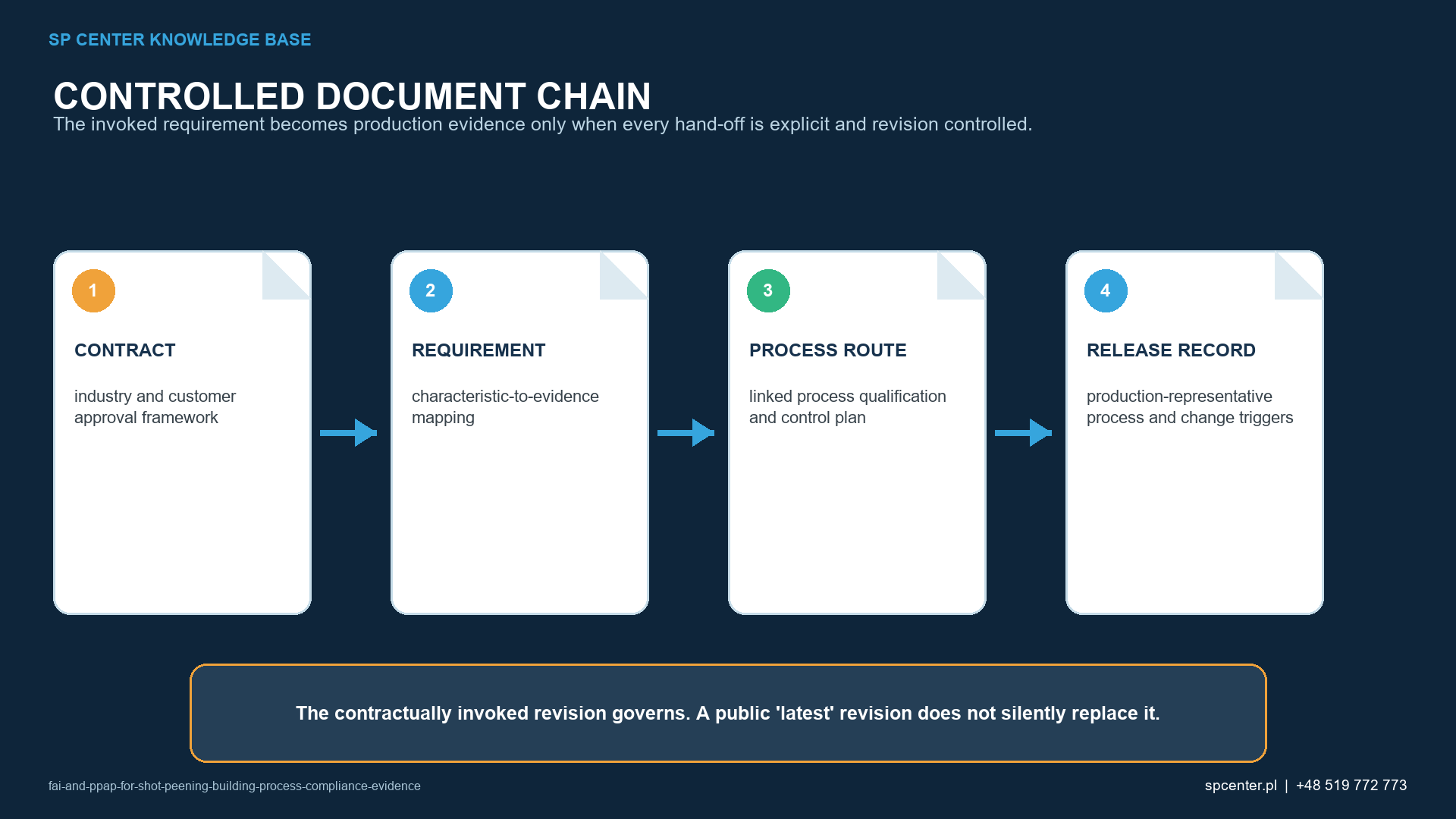
FAI and PPAP are different approval frameworks that can include shot peening evidence. AS9102C establishes requirements for performing and documenting aerospace first article inspection. The AIAG PPAP manual defines an automotive production-part approval process intended to demonstrate that engineering and specification requirements can be met consistently under production conditions. Neither framework replaces shot peening qualification, customer source approval or release of the actual production lot.
What is the difference between FAI and PPAP?
| Control framework | Primary question | Shot peening contribution |
|---|---|---|
| Aerospace FAI | Does the first production process produce a part that accounts for the applicable design characteristics? | Special-process identity, approved source where required, specification revision, certificate and characteristic evidence supplied to the FAIR owner |
| Automotive PPAP | Can the production process consistently meet the engineering record and customer requirements at the approved production condition? | Process flow and control-plan inputs, special-characteristic controls, qualified process evidence, results and submission records as contractually required |
| Shot peening qualification | Does the exact equipment, media, fixture, motion and acceptance route deliver the required process result? | Saturation and intensity basis, coverage method, access, media, surface, dimensional and component evidence as invoked |
| Approved-source control | Is the processor and scope accepted by the customer or prime? | Source status, scope, expiry or surveillance information and customer limitations when applicable |
| Production batch release | Did this actual lot follow the approved route and meet its acceptance criteria? | Part and batch traceability, current intensity, coverage, media, configuration, inspection, deviations and certificate |
Table 1. Similar document names can answer different approval questions and must not be treated as interchangeable.
FAI focuses on accountability and verification of applicable design characteristics using a production-representative first article when required. PPAP is broader production approval evidence and is connected to the automotive core-tool system and customer-specific requirements. Exact applicability, submission content and approval authority come from the controlled standard, contract and customer rules.
Where does shot peening fit into an FAI?
Shot peening is a special process whose complete result cannot be verified only by measuring finished dimensions. The FAIR owner can therefore need controlled evidence of the process invoked by the drawing or specification. This can include processor identity and approval status, process specification and revision, treatment zones, certificate, media restrictions, intensity and coverage evidence, and required surface or dimensional results.
That evidence does not permit a supplier to invent a characteristic or approval rule. The current AS9102C, customer instructions and organizational procedures determine how process and product accountability are documented. The special-process provider and the organization responsible for the finished part should agree who supplies, verifies and submits each record.
Where does shot peening fit into a PPAP?
PPAP can connect the shot peening operation to the approved manufacturing flow, process risk analysis, control plan, special characteristics, measurement capability, material or performance results and production-part submission. The exact elements and submission level are customer-controlled; a universal Level 3 or other default must not be promised without the purchase order or supplier manual.
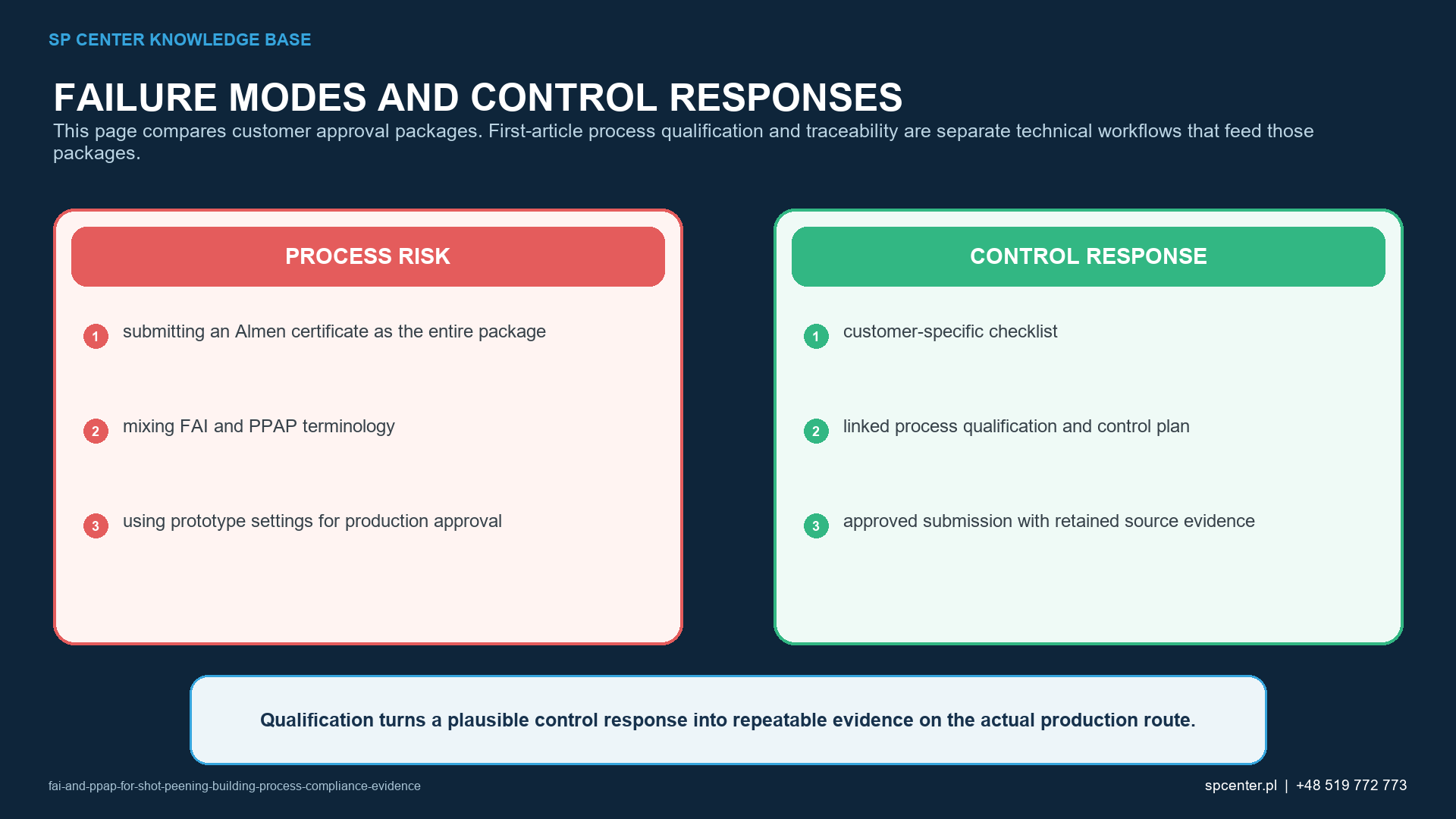
The process evidence should represent the intended serial equipment, media, fixture, programmes, operators or qualifications, lot pattern and monitoring plan. A laboratory coupon or development recipe that does not represent production cannot silently become the PPAP baseline.
Which shot peening records support either framework?
| Evidence topic | Processor record | FAI or PPAP interface |
|---|---|---|
| Requirement hierarchy | Purchase order, drawing, specification and customer supplement revisions | Submission index identifies the exact design and customer baseline |
| Process identity | Machine, air-blast or wheel route, programme, fixture, masks, media and approved-source scope | Process flow, accountability or special-process record links to the actual route |
| Intensity and coverage | Required Almen evidence and component coverage under approved methods | Objective results support the invoked characteristic or process requirement without claiming product performance by themselves |
| Surface and dimensions | Damage, roughness, cleanliness, retained media and dimensional checks as invoked | Results are reported against the drawing or control-plan requirement |
| Deviations | Nonconformance, authorized disposition and affected lot identity | Submission status remains open or conditional until the responsible customer authority accepts the disposition |
| Traceability | Operator, date, equipment, media batch, process revision, part or lot and release authorization | The FAIR or PPAP package can trace its evidence to the production-representative parts |
Table 2. Each result is linked to the requirement it supports and to the production-representative part or lot.
What does AS9102C establish?
The official SAE scope states that AS9102C establishes requirements for performing and documenting FAI and that these requirements complement rather than replace customer, statutory and regulatory requirements. The complete purchased standard and the customer’s forms or portal instructions govern the actual FAIR.
Do not use a legacy AS9102 revision when the contract invokes the current one. Equally, do not apply AS9102C automatically to work for which it has not been invoked. Revision and contractual applicability are separate checks.
What does the AIAG PPAP manual establish?
AIAG describes PPAP as the industry standard for defining production-part approval so that engineering design-record and specification requirements are consistently met during production. AIAG currently lists PPAP-4, fourth edition, second printing. Customer-specific requirements can change the submission content, level, portal and approval sequence.
PPAP should not be equated automatically with the German VDA production process and product approval framework. They can pursue related objectives, but the customer must identify the applicable route and accepted forms.
How are special characteristics handled?
A characteristic becomes special because the design record or customer system identifies it as such, not because the processor labels it. Treatment zones, media restrictions, intensity, coverage, surface, dimensions or traceability can be flowed into process controls according to the current customer definition.
The control plan or equivalent production document should define the control, method, frequency, limit, reaction and record. Almen intensity, component coverage and component performance remain separate evidence layers.
Does Nadcap approval replace the submission?
No. Nadcap accreditation concerns the audited supplier and approved special-process scope. Customer source approval can be separate. Process qualification applies to the exact route. FAI or PPAP applies to the product and production-approval framework. Batch release applies to the actual lot. One layer can support another but cannot replace it without explicit customer authority.
When can a change trigger renewed evidence?
| Change or event | Question before continuing | Possible controlled response |
|---|---|---|
| Drawing or specification revision | Did a product characteristic, treatment zone, medium, intensity, coverage or record requirement change? | Customer-defined FAI or PPAP review, revised qualification and updated production documents as applicable |
| New or transferred processor | Is the source approved and is its equipment route equivalent to the approved basis? | Source approval, qualification and submission activity defined by the customer |
| Machine, fixture, programme or media change | Can stream energy, access, boundaries, surface or traceability change? | Risk assessment, requalification and FAI or PPAP notification or resubmission as required |
| Production interruption or lapse | Do the current standard and customer rules trigger renewed evidence? | Documented applicability decision rather than an assumed universal time limit |
| Nonconformance or rework | Is the part still representative of the approved production route? | Authorized disposition, repeated inspection and submission update when required |
| Customer-specific rule change | Does the customer portal, supplier manual or purchase order alter content or approval authority? | Freeze production if requirements conflict and obtain controlled clarification |
Table 3. Applicability is determined from the controlled framework and customer rules for the actual change.
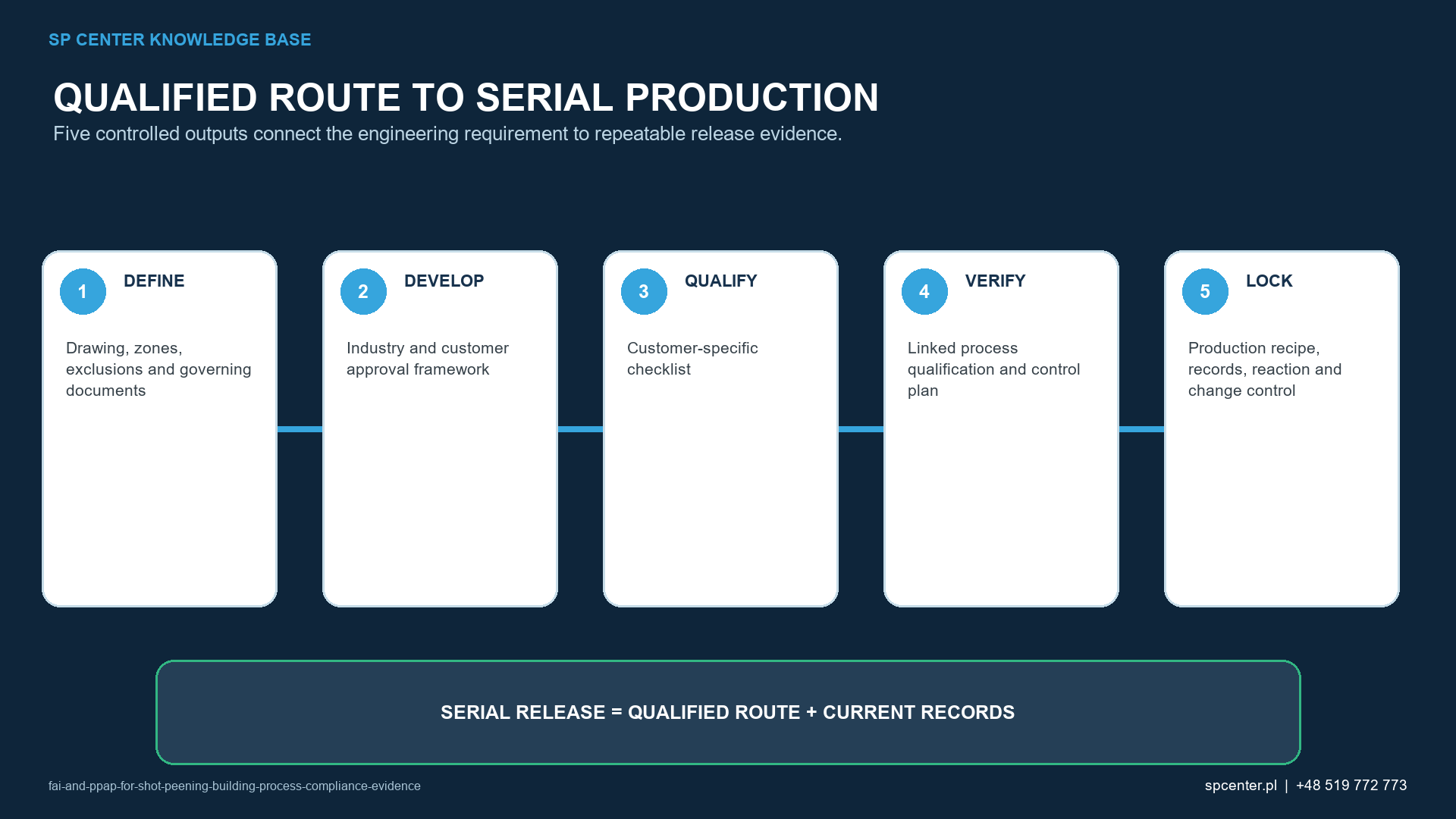
What should be agreed before the first production lot?
- Applicable FAI, PPAP, customer portal and supplier-manual requirements.
- Owner of the complete submission and owner of each special-process record.
- Current drawing, specification hierarchy and approved-source status.
- Production-representative machine, media, fixture, masks, programme and inspection route.
- Characteristic matrix linking requirements to results and responsible approvers.
- Submission timing, sample or lot identity, record format and customer approval point.
- Change, lapse, deviation and rework notification rules.
- Protection of proprietary settings while providing the objective evidence the contract requires.
Frequently asked questions
Are FAI and PPAP the same?
No. FAI is commonly used in aerospace to perform and document first article inspection under AS9102C when invoked. PPAP is an automotive production-part approval framework. Their purpose, submission structure and customer rules differ.
Is FAI required for every shot peening order?
No. FAI applies when invoked by the contract, customer, applicable quality system or governing standard. The responsible organization must determine applicability and scope from the current requirements.
Is PPAP required for every automotive shot peening part?
No. The customer contract and supplier-specific requirements determine whether PPAP applies, which submission level or elements are required, and who approves them.
Does a shot peening certificate complete the FAIR or PPAP?
Not by itself. A certificate can be one evidence input. The package can also require design accountability, characteristic results, material or performance evidence, process flow, control plan, approvals and customer-specific records.
Who owns the final FAI or PPAP submission?
The contract must define responsibility. A special-process supplier usually supplies controlled process evidence, while the organization accountable for the finished part or customer submission often assembles and submits the complete package.
Does Nadcap accreditation replace FAI or PPAP?
No. Nadcap accreditation addresses a supplier and audited special-process scope. It is not product certification and does not replace customer source approval, process qualification, FAI, PPAP or batch acceptance.
Does a conforming Almen result prove the first article is conforming?
No. Almen evidence verifies the peening stream under the test arrangement. Component coverage, dimensions, surface condition, material and all other invoked characteristics remain separate.
When is a new or partial submission needed after a change?
Use AS9102C, the current PPAP manual, customer-specific requirements and the contract. Assess the exact change and obtain customer direction when applicability or scope is unclear; do not invent a universal trigger.
Key takeaways
- FAI and PPAP are different frameworks with different customer and industry contexts.
- Neither is universal for every shot peening order.
- A process certificate is one possible evidence input, not the complete approval package.
- Qualification, approved-source status, FAI or PPAP and batch release remain separate.
- Submission ownership and record responsibility must be contractually clear.
- Changes are assessed against the current framework and customer rules, not a guessed trigger.
Related SP Center guides
- Aerospace Shot Peening Documentation and Traceability
- Choosing a Shot Peening Supplier for Critical Parts
- Shot Peening Repeatability
Technical references
1. SAE AS9102C, Aerospace Series – First Article Inspection Requirements
2. IAQG, 9102 First Article Inspection Requirement
3. AIAG PPAP-4, Production Part Approval Process
4. SAE AMS2430U: Shot Peening, revised April 2018
5. SAE AMS2432E: Shot Peening, Computer Monitored, revised October 2022
Standards note: The full current documents, contract and customer-specific requirements govern; public summaries do not define a complete submission.
Author: Paweł Kmieć
Discuss shot peening evidence for FAI or PPAP: +48 519 772 773 | [email protected]