


A risk-based qualification framework for engineering, supplier quality and technical purchasing
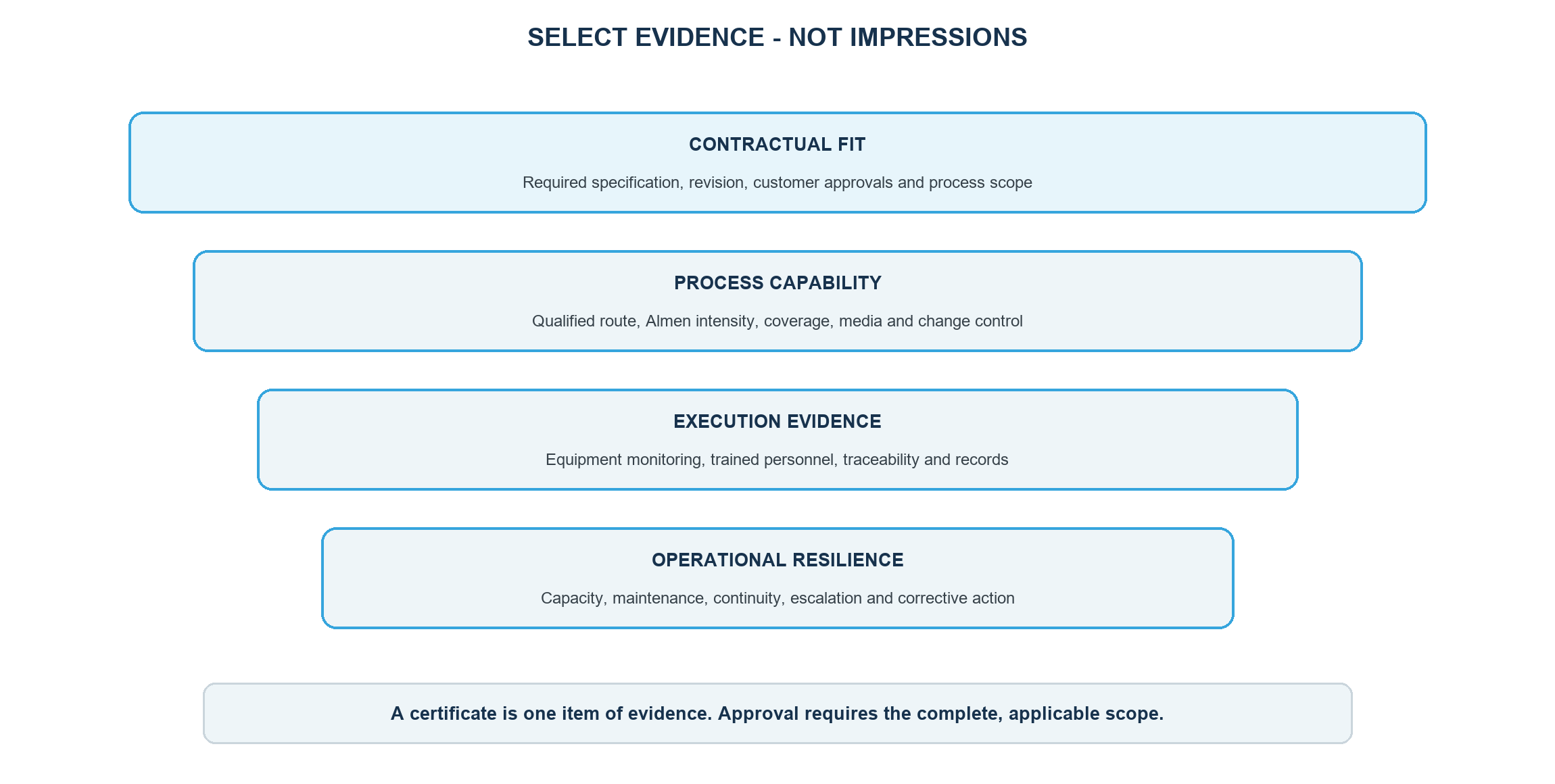
Choose a shot peening supplier for critical parts against the exact contractual scope, a feasible and qualified process route, and representative evidence of execution. A certificate or accreditation can support the decision, but it does not replace verification of the legal entity, site, published scope, specification revision, part family, customer approval, process controls and records that apply to the purchase order.
Why is supplier selection an engineering decision?
The required surface state normally cannot be confirmed by one final visual check. Confidence comes from a connected system: correct requirement flow-down, feasible access and masking, controlled media and equipment, verified Almen intensity, accepted coverage, competent personnel, traceability, nonconformance control and authorized release.
The depth of qualification should follow the consequence of failure. A development coupon and a flight-critical serial component do not need identical evidence. The buyer should define criticality, approval authority and required records before comparing quotations so that suppliers price and qualify the same obligation.
What makes a part critical for supplier qualification?
Criticality exists when an uncontrolled process condition could affect safety, fatigue performance, dimensional conformity, assembly, regulatory or customer compliance, or programme continuity. It can arise from component function, drawing notes, designated characteristics, the consequence of an escape, or the limited ability to verify the final result.
- Define treated and excluded areas, material and heat-treatment condition, geometry, intensity, coverage and invoked documents.
- Identify the consequence of under-treatment, excessive treatment, surface damage, contamination or loss of traceability.
- Separate measurable process evidence from unsupported design claims such as a guaranteed fatigue-life increase.
- State which decisions remain with the design authority and which the processor may propose.
- Assign acceptance, escalation and deviation authority before trials or production begin.
What should be defined before requesting a quotation?
A supplier cannot qualify an undefined obligation consistently. Send the current part and drawing revision, contractual document hierarchy, material and heat-treatment condition, marked treatment and exclusion zones, complete process requirements, quantity and batch pattern, evidence package, packaging, target dates and change-notification rules. Identify missing inputs as controlled open items rather than allowing assumptions to become design requirements.
Which criteria should be used to evaluate a supplier?
No single criterion proves suitability. The evidence set should show that the supplier understands the requirement, can develop and maintain the route, can reconstruct production, and can manage interruptions and changes without losing the approval basis.
| Criterion | Question to test | Representative evidence |
|---|---|---|
| 1. Contractual scope | Can the site meet the exact drawing, revision, specification and customer clauses? | Scope review, exceptions log and approved-source status |
| 2. Engineering understanding | Can the supplier explain objectives, boundaries, risks and design-owned decisions? | Technical review and controlled clarification record |
| 3. Feasibility and development | Are access, masking, tooling, motion and validation addressed before release? | Feasibility review, trial plan and route-development evidence |
| 4. Almen intensity | How is intensity established and verified for the invoked requirement? | Applicable Almen equipment, setup and saturation or verification records |
| 5. Coverage | How is the specified component area accepted? | Approved method, boundary review, visual standard and records |
| 6. Media control | How are type, size, hardness, shape, condition and contamination controlled? | Specification, inspection, segregation and replenishment records |
| 7. Equipment control | Do configuration, monitoring, maintenance and calibration support the route? | Equipment register, status, programs and reaction records |
| 8. Personnel competence | Are engineering, production and inspection roles competent and authorized? | Competence matrix, training and authorization records |
| 9. Traceability | Can a batch be reconstructed from receipt to final release? | Traveller, equipment, operator, media, verification and inspection linkage |
| 10. Nonconformance control | Are interruptions, deviations and escapes contained and correctly authorized? | NCR, disposition, concession, corrective action and notification examples |
| 11. Change control | Which changes trigger technical review, requalification or customer notification? | Procedure and representative change history |
| 12. Quality-system fit | Does the certificate match the legal entity, site and required scope? | Current certificate, issuer and scope |
| 13. Process accreditation | If required, is the activity and site within the published scope? | Current accreditation record, QML entry and customer verification |
| 14. Capacity and resilience | Can the supplier support trials, launch, serial demand and disruption? | Capacity basis, maintenance windows and continuity plan |
| 15. Governance | Are assumptions, risks, changes and escalation owned before work starts? | Named contacts, review cadence and escalation route |
Table 1. Fifteen connected criteria link each qualification question to representative evidence.
A numeric score should be used only after mandatory gates are defined. A failure in contractual scope, applicable approval, process control or traceability must not be hidden by high scores for communication, price or general quality-system maturity.
How should certification, Nadcap and customer approval be interpreted?
Quality-system certification, Nadcap accreditation, customer approval and a qualified process route answer different questions. Treating them as interchangeable creates a false approval basis.
| Evidence type | What it supports | What still requires verification |
|---|---|---|
| Quality-system certification | Management-system conformity within the certificate scope | Exact shot peening capability, site, route and contract compliance |
| Nadcap accreditation | Process-focused aerospace accreditation for an identified organization, site and published scope | Current validity, applicable scope, customer requirement and part applicability |
| Customer approval | Authorization under an organization-specific approval system | Limits by site, process, programme, part family and validity |
| Qualified process route | Controlled method and evidence for the defined part or family | Revision, change authority, current equipment and production release |
Table 2. Each evidence type supports a different part of the supplier decision.
Nadcap is an industry-managed accreditation programme for critical processes in aerospace, defence and space supply chains. If it is contractually required, verify the current supplier, site, accreditation and applicable scope through PRI EAN and the Qualified Manufacturers List. Accreditation does not certify the product or automatically authorize every part, programme or customer requirement.
What process evidence should be reviewed?
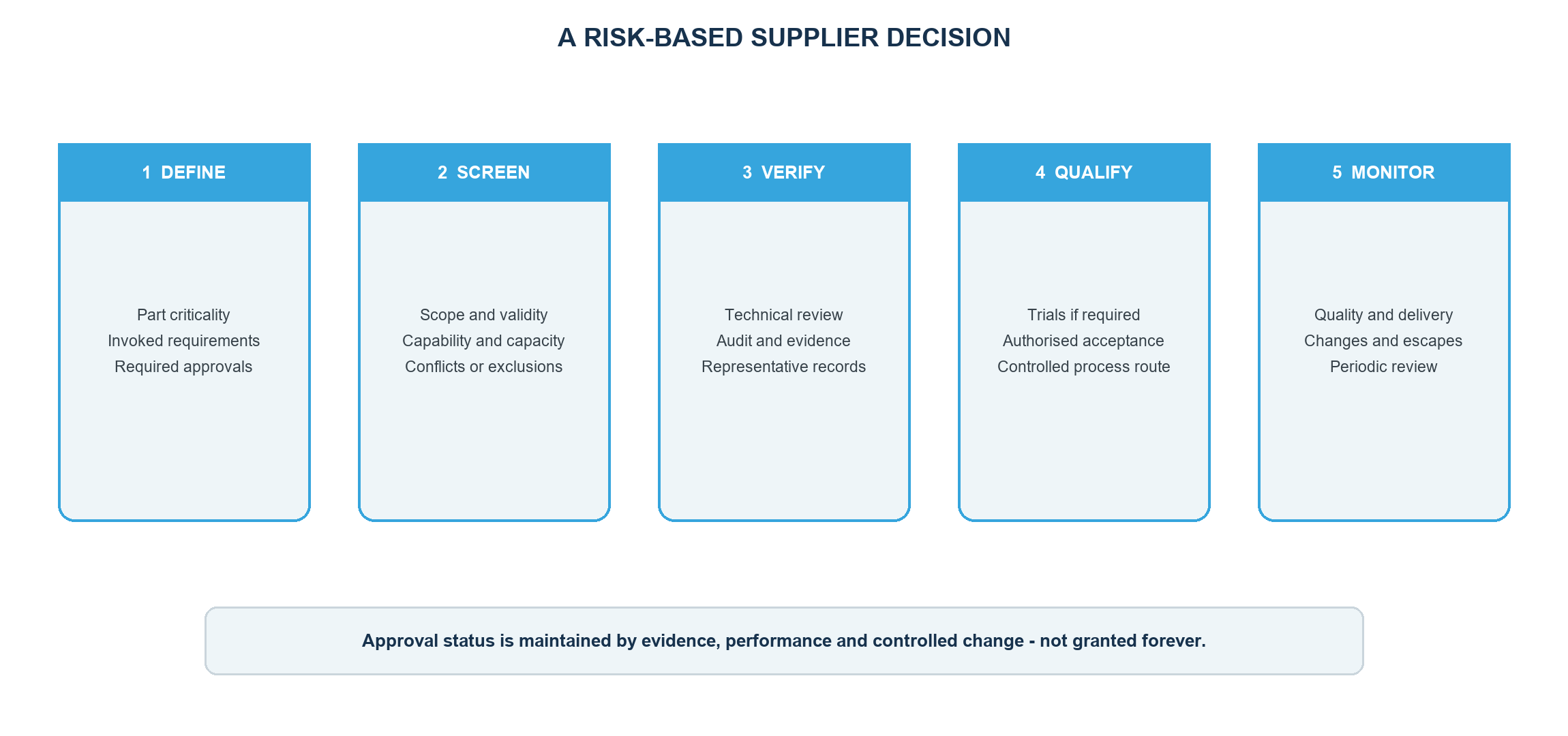
- Requirement review linking drawing, revision, customer clauses, exceptions and approval route.
- Feasibility or development record covering access, masking, tooling, part motion, media delivery, distortion and inspection access.
- Almen-intensity evidence using the equipment, setup and method required by the governing specification.
- Coverage evidence for the complete specified area, including boundaries, transitions and difficult geometry.
- Media-control records for identity, size distribution, shape, hardness, condition, segregation and contamination response.
- Controlled instructions linked to equipment, program, operator, verification and inspection status.
- Representative interruption, deviation, nonconformance and change records with authorized disposition.
- Final records connecting the delivered batch to the approved route and required evidence.
Procedures describe intended control; representative records show execution. Evidence requests should test the claimed scope without demanding unrelated customer-controlled or proprietary information.
How should intensity, coverage and media control be assessed?
Assess these as separate elements of one process system. Almen intensity characterizes the qualified peening stream under the applicable arrangement. Coverage evaluates impact evidence on the specified component surface. Media control protects the physical input that contributes to both results.
A conforming intensity result does not prove complete coverage, a particular residual-stress profile or fatigue life. A coverage result does not prove that the stream met the intensity requirement. The supplier should show how each result is established, accepted, recorded and linked to the controlled route.
What should a technical supplier audit verify?
Follow representative work through the actual process rather than stopping at a procedure review. Trace requirements from quotation and purchase order through planning, processing, inspection and final release. Ask personnel to demonstrate Almen verification, coverage assessment, media inspection, parameter protection, stop conditions and reaction plans.
Compare written procedures with equipment status, work instructions and completed records. Test whether the supplier can reconstruct who processed and inspected the batch, which equipment and program were used, which media and verification results applied, how interruptions were handled and who authorized release.
How should nonconformance and change control be evaluated?
Review examples that show containment, technical disposition, customer notification, root cause, corrective action and effectiveness verification. A supplier should not substitute internal rework or repeated peening for a disposition that belongs to the customer or design authority.
Changes to site, equipment, wheel or nozzle arrangement, tooling, masking, media, software, motion, sequence, acceptance method or subcontracted activity can affect the qualified route. The approved change plan must define review, requalification, notification and approval before implementation.
How should scoring and approval decisions work?
| Decision class | Required treatment | Typical outcome |
|---|---|---|
| Mandatory gate | Contractual scope, applicable approval, process control, traceability or unresolved safety risk | Fail or controlled closure before award |
| Risk-weighted score | Depth of capability, resilience, communication and commercial readiness | Rank suppliers that have passed every gate |
| Open item | Information can be obtained without changing the technical basis | Owner, due date and approval route recorded |
| Conditional approval | Limited scope or staged evidence is acceptable under authorized conditions | Written restrictions, surveillance and release authority |
Table 3. Gates prevent a critical weakness from being averaged away; scoring then differentiates suppliers that have already met every mandatory condition.
Conditional approval should be exceptional, time-limited and explicit. State the authorized scope, missing evidence, surveillance, release authority and expiry or closure criterion.
How should capacity and continuity be assessed?
Capacity claims should be tied to the proposed part family, batch pattern, setup, maintenance windows, inspection and release. Review bottlenecks such as specialized fixtures, a single qualified machine, limited inspection capacity or external testing. Continuity planning should address equipment failure, media availability, key personnel, record access and customer authorization for any alternative route.
Frequently asked questions
Is a quality certificate enough to approve a shot peening supplier?
No. It supports the management-system assessment but does not prove the exact site, equipment, media controls, part route, customer approval or execution evidence required by the contract.
Does Nadcap accreditation approve every shot peening job?
No. Nadcap is accreditation, not product certification. When contractually required, verify the current organization, site and applicable scope in PRI’s system of record, then confirm customer and part-specific approval requirements.
What evidence should be reviewed before a supplier audit?
Review the requirement flow-down, feasibility and qualification evidence, Almen-intensity and coverage records, media controls, equipment status, competence, traceability, nonconformance examples, change history and a representative final report.
How should Almen intensity and coverage be assessed?
Assess them separately. Almen-intensity verification addresses the qualified stream under the applicable setup; coverage assessment addresses the specified component surface. Neither result substitutes for media control, component validation or final inspection.
Should the lowest-priced qualified supplier always be selected?
Not automatically. Compare equivalent scope, capacity, delivery basis, evidence, change exposure and continuity risk after every mandatory technical and approval gate has been passed.
When is requalification or customer notification required?
The governing specification, contract and approved change-control plan decide. Changes to site, equipment, tooling, media, software, process sequence, material, part family or acceptance method may require review before use.
Key takeaways
- Qualify the exact site, scope and route—not the company name alone.
- Use mandatory gates for contract, approval, process control and traceability.
- Keep Almen intensity, coverage, media control, component acceptance and validation distinct.
- Review representative execution records as well as procedures and certificates.
- Require controlled nonconformance, change and notification routes.
- Compare price only after technical scope, evidence, capacity and risk are aligned.
Related SP Center guides
- How to Source Shot Peening Services
- How Much Does Shot Peening Cost?
- Aerospace Shot Peening: Documentation and Traceability
Technical references
1. Performance Review Institute, Nadcap
2. Performance Review Institute, Nadcap participation and Qualified Manufacturers List
3. SAE ARP7488: Peening Design and Process Control Guidelines, issued January 2018
4. SAE AMS2430U: Shot Peening, revised April 2018
5. SAE J442_202602: Tools for Peening Intensity Determination and Verification, revised February 2026
6. SAE J443_202512: Procedures for Determining and Verifying Peening Intensity, revised December 2025
7. SAE J2277_202301: Shot Peening Coverage Determination, revised January 2023
Standards note: The contractually invoked revisions and customer-specific requirements govern.
Author: Paweł Kmieć
Discuss supplier qualification or an RFQ: +48 519 772 773 | [email protected]