


How geometry, masking, tooling, qualification, batch pattern and delivery conditions shape a defensible quotation
There is no universal shot peening price per part. A defensible quotation belongs to a defined component, drawing revision, material condition, treatment scope, process requirement, batch pattern, evidence package and delivery basis. It should separate non-recurring engineering and tooling, batch-level setup and release, recurring processing, and any conditional validation or logistics. Without those inputs, a price is a budget assumption rather than a comparable production offer.
For a component-specific enquiry, see SP Center shot peening services.
Why is there no universal shot peening price?
Shot peening is priced as a controlled manufacturing route, not simply as minutes of machine use. Parts of similar size can require different access, masking, media control, Almen-intensity verification, coverage assessment, tooling, handling and records. These differences affect engineering effort, setup, cycle time, process risk and release work.
An established serial route with reusable tooling and predictable releases cannot be compared directly with a new part that requires feasibility review, trials, customer approval or external testing. The quotation must therefore state what is included, excluded and assumed.
How should shot peening cost be structured?
A useful planning model is: total programme cost equals non-recurring cost, plus batch-level cost multiplied by the number of releases, plus recurring cost multiplied by the number of parts, plus invoked validation and logistics. This is not a price formula and contains no supplier rate. It makes the commercial structure visible.
| Cost level | Typical scope | Commercial treatment | Primary driver |
|---|---|---|---|
| Non-recurring | Feasibility, process development, tooling, trials and initial qualification | One-time charge or amortization against a stated volume and period | Novelty, geometry, evidence and approval scope |
| Per batch or release | Contract review, setup, verification, records, release and packaging | Repeated whenever the controlled route is released | Number, size and cadence of batches |
| Per part | Processing, media consumption, handling, masking and recurring inspection | Applied to the conforming quantity processed | Cycle, access, masking and repeatable labour |
| Conditional | External testing, special forms, transport, expedite work or requalification | Quoted when invoked or when a defined trigger occurs | Contract, change and delivery conditions |
Table 1. Separating cost levels prevents one-time or batch work from disappearing inside an unexplained unit price.
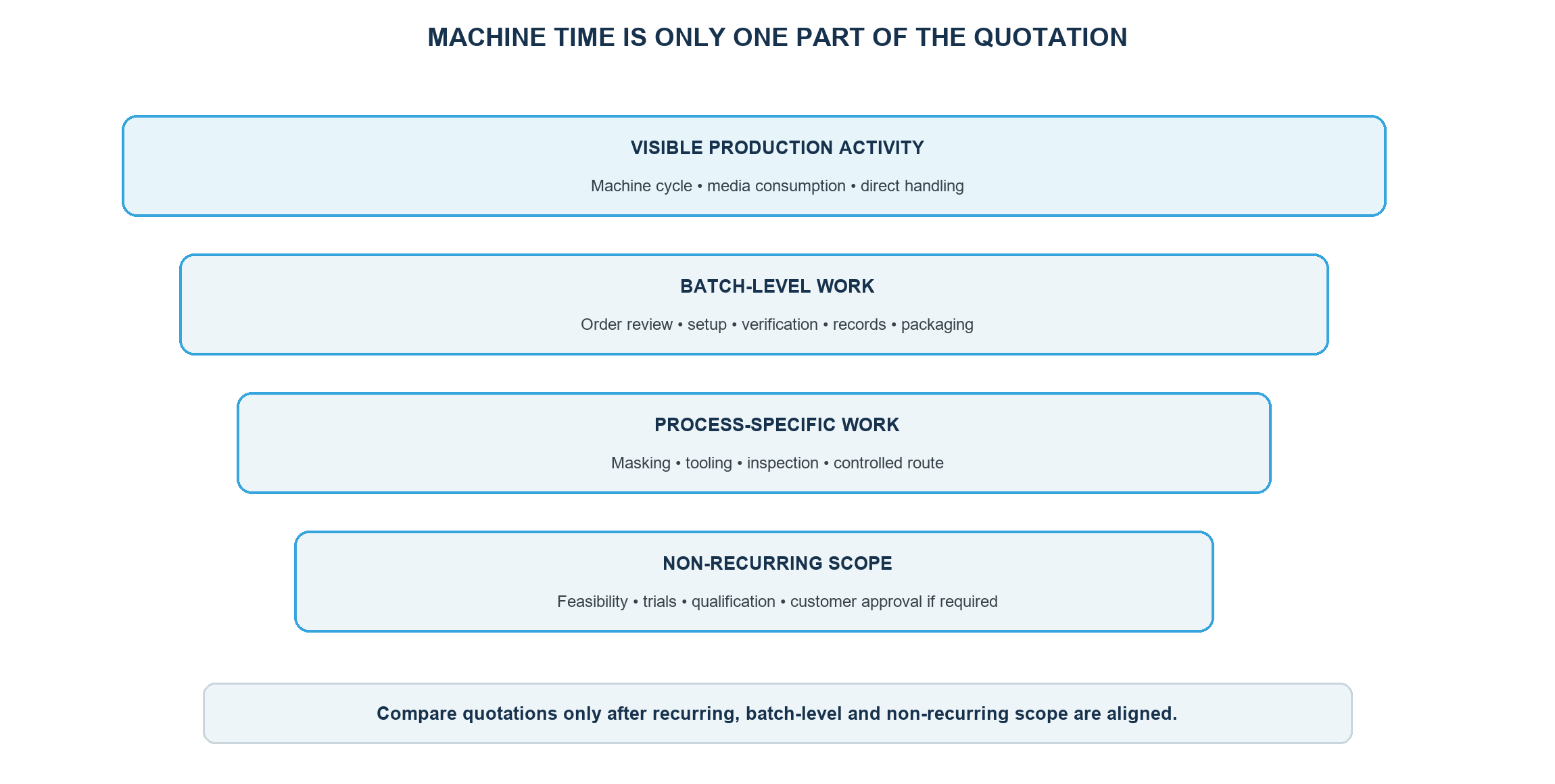
If tooling or qualification is amortized into the unit price, the quotation should identify the assumed volume and period, what happens when demand changes, and how any outstanding amount is treated after a drawing change or early programme stop.
Which part characteristics have the greatest effect on price?
Treatment geometry and access often matter more than the component envelope. A large open surface may be straightforward, while a smaller part with roots, grooves, bores, undercuts or closely spaced protected features can require several orientations, dedicated nozzles, complex masking and additional coverage evidence.
- Number, location and area of the surfaces requiring direct treatment.
- Line-of-sight access, depth, local transitions, impact-angle constraints and media shadowing.
- Part dimensions, mass, centre of gravity, fragility and loading method.
- Threads, fits, sealing faces, datums, coatings and other no-peen areas.
- Required Almen-intensity range, coverage, media and monitoring convention.
- Handling-mark limits, cleanliness, corrosion protection and packaging.
Material, product form, heat treatment, hardness and manufacturing sequence are also relevant. They influence the feasible process window, surface-protection strategy, post-process handling and consequences of nonconformance.
How do masking, tooling and handling affect the quotation?
Masking and tooling can create both one-time and recurring cost. A reusable fixture may require design, manufacture, validation and controlled storage, then reduce future setup effort. Consumable masking can require less initial engineering but add labour and material for every batch or part. Some routes require both.
Commercial terms should address tooling ownership, maintenance, replacement, storage, expected life and the changes that invalidate it. The same principle applies to special containers, lifting aids, orientation features and protective packaging.
Which development and qualification activities may be required?
The recurring production price is not the cost of creating a new controlled route. Introduction may require access review, process development, tooling, masking trials, programming, Almen saturation work, coverage trials, sample processing, dimensional review, controlled instructions and formal approval. The exact scope follows the drawing, governing specification, purchase order and customer-specific requirements.
- Feasibility review for the actual component and treatment boundaries.
- Trials and evidence needed to select or confirm the controlled route.
- Fixtures, masks, programs and verified setup documentation.
- Samples, inspection and customer or design-authority review.
- First-article or PPAP evidence only where contractually invoked and defined.
- Residual-stress measurement, fatigue testing or external laboratory work only when required and scoped.
Qualification evidence supports the approval route specified by the customer. It does not transfer design authority or independently release serial production.
How do annual volume and batch size affect unit cost?
Annual quantity is insufficient on its own. Batch size and release frequency determine how often contract review, setup, process verification, traceability, documentation, release and packaging are repeated. A stable programme with planned batches can distribute that work across more parts; small or urgent releases repeat it more often.
For this reason an RFQ should distinguish prototype, qualification, ramp-up and serial quantities. It should state typical and minimum batch sizes, cadence, forecast horizon, seasonal peaks and any capacity-reservation requirement.
How do records and traceability influence cost?
The evidence package determines what must be generated, checked, retained and released. A basic certificate against an approved serial instruction is a different scope from full parameter records, equipment and operator traceability, customer forms, independent release or long retention.
Computer monitoring can provide traceability for defined process inputs, but it does not remove the need for contract review, media control, Almen verification, coverage assessment, inspection, approval or records management. Buyers should name the required records instead of requesting an undefined “full documentation package.”
What determines shot peening lead time?
Lead time is a chain of dependencies. For an established serial route, the critical path may involve parts, capacity, setup, processing, release and transport. For a new route, drawings, controlled clarification, tooling, trials, samples, external testing and customer approval may add elapsed time.
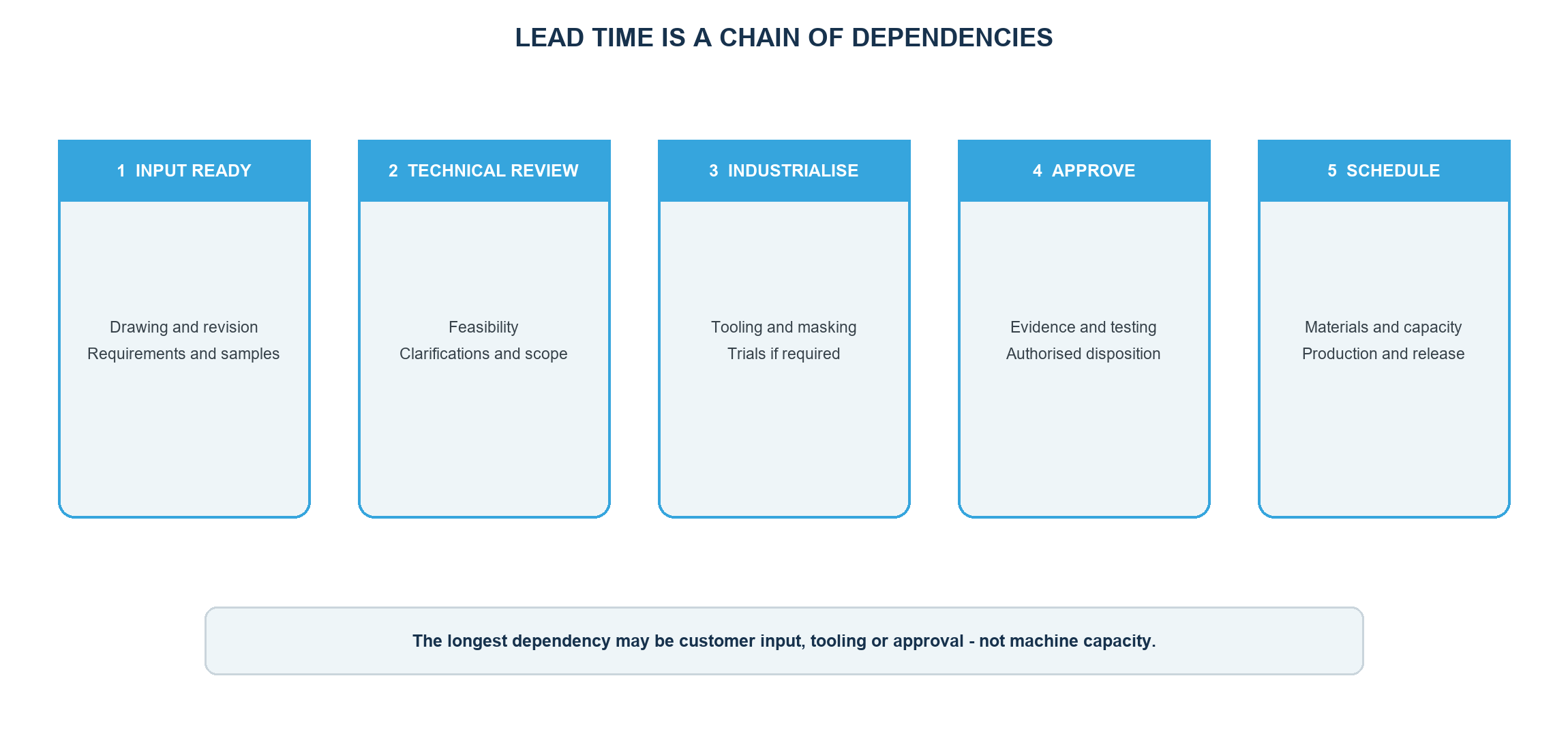
The quotation should identify the event from which lead time starts: receipt of the RFQ, purchase order, complete technical inputs, approval, or conforming parts. Two suppliers can otherwise quote the same number of weeks from different starting points.
What information produces a reliable RFQ?
- Current drawing, revision and contractual document hierarchy.
- Material, product form, heat treatment, hardness and manufacturing sequence.
- Treatment zones, exclusions, protected features and accessible CAD or photographs.
- Complete Almen-intensity and coverage requirements, media restrictions and proposal authority.
- Part dimensions, mass, handling limits, cleanliness and packaging.
- Prototype, qualification and serial quantities, batch cadence and target dates.
- Required certificates, records, samples, tests, retention and approval route.
- Delivery terms, transport responsibility, quotation validity and unresolved inputs.
Unresolved design-controlled values should be identified for formal clarification. A supplier may propose a route when authorized, but should not invent a requirement in order to complete a price.
How should competing quotations be compared?
Normalize the same technical, quality, batch, commercial and schedule baseline before comparing unit prices. A quotation that includes tooling, qualification and records is not equivalent to one that assumes an already approved route.
| Comparison area | Baseline to align | Risk if left unclear |
|---|---|---|
| Technical scope | Part, revision, material condition, zones, specification, intensity, coverage and media restrictions | Suppliers price different processes |
| Introduction work | Feasibility, trials, tooling, qualification and approvals | A low unit price hides launch cost |
| Batch structure | Typical and minimum quantity, release frequency, setup and verification | Annual-volume comparisons become misleading |
| Recurring scope | Masking, handling, monitoring, inspection, records and packaging | Labour and evidence packages are not equivalent |
| Commercial terms | Currency, validity, minimum charges, volume basis, delivery terms and tooling ownership | Price changes after award or forecast change |
| Schedule basis | Complete-input date, part receipt, samples, testing, approvals and capacity commitment | Quoted lead times start from different events |
| Change exposure | Drawing, material, process, equipment, tooling and requalification rules | Future change cost has no owner |
Table 2. Quotations become comparable only after the same scope, assumptions and starting conditions are aligned.
The lowest number can still be the correct commercial choice, but only after exclusions, capacity, change exposure and the evidence package are understood.
What should be sent to SP Center for a quotation?
Send the controlled technical package, expected demand pattern and delivery basis to [email protected]. Include marked treatment and exclusion zones, the drawing revision, material condition, governing requirements, dimensions and mass, batch pattern, required evidence, packaging and target date. SP Center can then return assumptions and clarification points together with the proposed scope.
Common cost misunderstandings
- Machine time is not the whole price. Engineering, masking, setup, verification, records, qualification, handling and logistics can be material cost elements.
- Higher annual volume does not automatically reduce unit price. Batch fragmentation, geometry, evidence and schedule constraints can offset quantity.
- Similar-looking parts need not follow the same route. Access, protected areas, material condition and approval scope may differ.
- The shortest machine cycle is not necessarily the shortest lead time. Inputs, tooling, trials, testing and approval can control the schedule.
- The lowest quotation is not automatically the lowest total cost. The compared baselines must be equivalent.
Frequently asked questions
What is the average cost of shot peening?
There is no technically defensible average that applies to every component. Geometry, access, masking, process requirements, batch pattern, qualification, records, packaging and delivery conditions must be defined before suppliers can quote on a comparable basis.
How is shot peening cost per part calculated?
A transparent model allocates non-recurring work, batch-level work, recurring processing and any conditional testing or logistics. The resulting unit cost changes with quantity, number of releases, tooling treatment and programme horizon.
Why can a one-off shot peening order be relatively expensive?
Contract review, setup, verification, masking, records and release are spread over very few parts. A new component may also require feasibility work, tooling, trials or qualification before production processing begins.
Does a larger batch always reduce the unit price?
Not always. A compatible larger batch can spread setup and release effort over more parts, but cycle time, geometry, masking, handling, capacity and the approved route still control the result.
Is shot peening tooling charged once or for every batch?
Reusable tooling may be quoted as a one-time or amortized item, while consumable masking and repeated setup normally remain batch- or part-related. Ownership, storage, maintenance, replacement and change rules should be explicit.
Which qualification costs can apply?
Depending on the governing requirements, the scope may include feasibility review, process development, tooling, intensity and coverage trials, samples, inspection, controlled documentation and approval. FAI, PPAP, residual-stress measurement, fatigue testing or external laboratory work apply only when invoked and defined.
What does SP Center need to prepare a quotation?
Provide the current drawing and revision, material condition, treatment and exclusion zones, governing requirements, part size and mass, quantities and batch pattern, required evidence, packaging, delivery basis and target date. Mark unresolved design inputs for controlled clarification.
Key takeaways
- Do not rely on a universal rate without a defined technical and commercial scope.
- Separate non-recurring, batch-level, per-part and conditional cost.
- Assess annual volume together with batch size and release frequency.
- Geometry, access, masking and evidence can matter more than overall part size.
- Define the lead-time starting point and all approval dependencies.
- Compare scope, assumptions and change exposure before comparing unit price.
Related SP Center guides
- How to Source Shot Peening Services
- How to Choose a Shot Peening Supplier
- In-House Shot Peening vs. Outsourcing
Technical references
1. SAE AMS2430U: Shot Peening, revised April 2018
2. SAE AMS2432E: Shot Peening, Computer Monitored, revised October 2022
3. SAE ARP7488: Peening Design and Process Control Guidelines, issued January 2018
4. SAE J442_202602: Tools for Peening Intensity Determination and Verification, revised February 2026
5. SAE J443_202512: Procedures for Determining and Verifying Peening Intensity, revised December 2025
6. SAE J2277_202301: Shot Peening Coverage Determination, revised January 2023
Standards note: The complete revision invoked by the contract, drawing and customer requirements governs.
Author: Paweł Kmieć
Request a structured shot peening quotation: +48 519 772 773 | [email protected]