


A controlled workflow for RFQ preparation, supplier qualification, technical audit, purchase order and serial governance
Source shot peening services by starting with the current drawing, revision, material condition, treatment and exclusion zones, governing documents, complete process requirements or proposal authority, required evidence and realistic demand. Prequalify the exact supplier site and route, compare quotations on one technical baseline, close open engineering decisions, and flow the approved requirements into the purchase order before production begins.
For the available service scope, see our shot peening services.
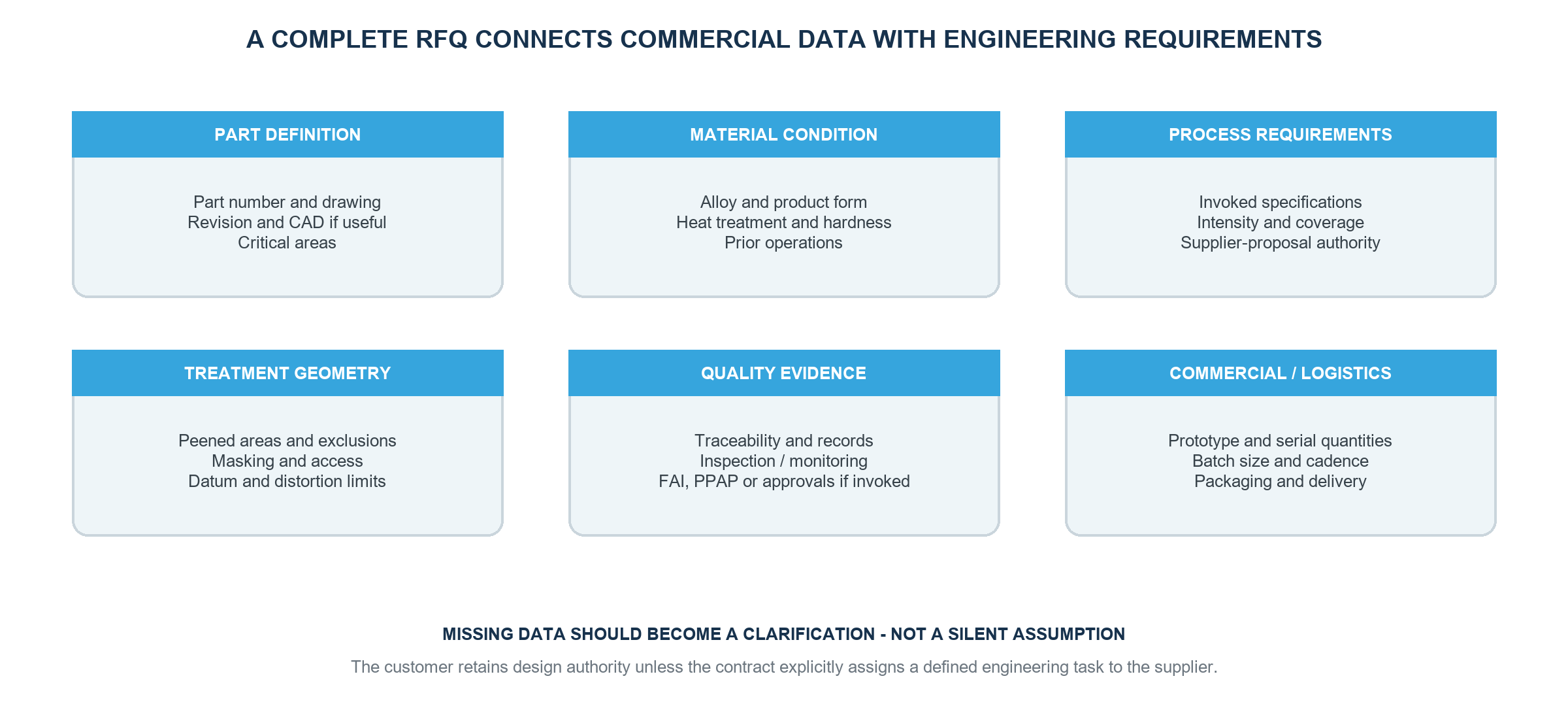
Why is shot peening sourcing different from buying a commodity service?
Controlled shot peening changes the surface layer through a qualified combination of media, energy, geometry, motion, exposure and process verification. The buyer normally cannot confirm the complete intended result through a single final inspection. Purchasing therefore depends on correct requirement flow-down, supplier capability, representative execution evidence, approval and change control.
A unit price without a controlled baseline is not comparable. One supplier may include development, tooling and qualification while another assumes an already approved serial route. Sourcing must make those differences visible before award.
What should the RFQ contain?
| RFQ input | Minimum content | Why it matters |
|---|---|---|
| Part identity | Part number, drawing, revision, model or marked views | Fixes the exact configuration being quoted |
| Material condition | Alloy, product form, heat treatment, hardness and incoming surface condition | Defines technical compatibility and qualification boundaries |
| Treatment scope | Direct-treatment zones, exclusions, transitions, masking and protected features | Controls access, tooling, cycle and surface acceptance |
| Process requirements | Governing documents, complete Almen-intensity range, coverage, media restrictions and monitoring | Prevents suppliers from pricing different technical routes |
| Manufacturing sequence | Operations before and after peening, coatings, thermal exposure, cleaning and repair | Protects the intended surface state |
| Demand pattern | Prototype, qualification and serial quantities, batch size, cadence and forecast | Determines setup frequency, capacity and commercial basis |
| Evidence and approval | Certificates, records, samples, tests, retention, source inspection and approval route | Defines what must be created, reviewed and released |
| Commercial and logistics | Packaging, transport, delivery terms, validity, target dates and change assumptions | Aligns total cost and lead-time basis |
Table 1. A complete RFQ aligns technical scope, demand, evidence and commercial conditions before suppliers develop assumptions.
If a required value is unavailable, record it as an open item with a responsible authority and due date. Do not invite the processor to invent a design requirement simply to complete the quotation.
Who owns intensity, coverage, media and other process values?
The drawing, governing process specification, purchase order and customer requirements determine ownership. The design or specification authority normally controls design-relevant requirements such as treated zones, complete Almen-intensity range, coverage, exclusions and component acceptance. The processor may propose media, equipment, tooling and parameter settings within the authorized scope, but the proposal becomes effective only through the required approval route.
Machine pressure, wheel speed or exposure time must not replace a specified Almen intensity. Coverage must not be inferred from intensity. If the source package is incomplete or conflicting, pause the affected decision and obtain controlled clarification.
How should geometry and manufacturing sequence be reviewed?
Feasibility depends on direct access, impact angle, shadowing, bores, roots, undercuts, thin sections, sensitive edges and protected features. Review part orientation, loading, masking, media removal, distortion and inspection access before a production commitment is made.
The supplier also needs the sequence relative to machining, grinding, heat treatment, coating, plating, cleaning, repair and thermal exposure. Downstream operations can remove the affected layer, relax compressive residual stress or create new surface requirements.
How should suppliers be prequalified?
Prequalify the actual legal entity, site, process scope and part-family capability. Review relevant equipment, media control, Almen system, coverage method, personnel competence, traceability, calibration and maintenance, nonconformance and change history, customer approvals, capacity and continuity.
A certificate, customer approval or Nadcap accreditation supports only the scope it states. When Nadcap is contractually required, verify the current supplier, site and applicable scope in PRI EAN and the Qualified Manufacturers List. Nadcap is accreditation, not product certification, and it does not automatically approve every part or programme.
How should quotations be compared?
Normalize the same drawing revision, treatment scope, process requirements, batch structure, tooling ownership, qualification evidence, records, packaging, delivery terms and lead-time starting point. Ask suppliers to separate non-recurring, batch-level, recurring and conditional cost. Record all assumptions, exclusions and customer responsibilities.
Price can be compared only after technical equivalence is established. A lower offer based on missing qualification, different batch assumptions or reduced evidence is a scope difference rather than proven efficiency.
What should happen between quotation and serial production?
| Sourcing stage | Required output | Release condition |
|---|---|---|
| 1. Requirement readiness | Controlled package and open-item register | Design-owned gaps have named owners and approval routes |
| 2. Supplier prequalification | Capability, site, approval, evidence and capacity review | Mandatory technical and contractual gates passed |
| 3. Comparable quotation | Assumptions, exclusions and cost structure on one baseline | Scope differences reconciled before selection |
| 4. Technical clarification | Agreed route, trials, tooling, qualification and responsibilities | No unresolved point can change processing or acceptance |
| 5. Qualification and approval | Representative evidence and authorized decisions | Governing customer and design approvals complete |
| 6. Purchase-order flow-down | Exact documents, revisions, records, notifications and delivery basis | Order matches the approved technical baseline |
| 7. Serial governance | Performance, changes, nonconformance and periodic-review records | Approval remains valid for the released scope |
Table 2. Each gate produces a controlled output before the next commitment is made.
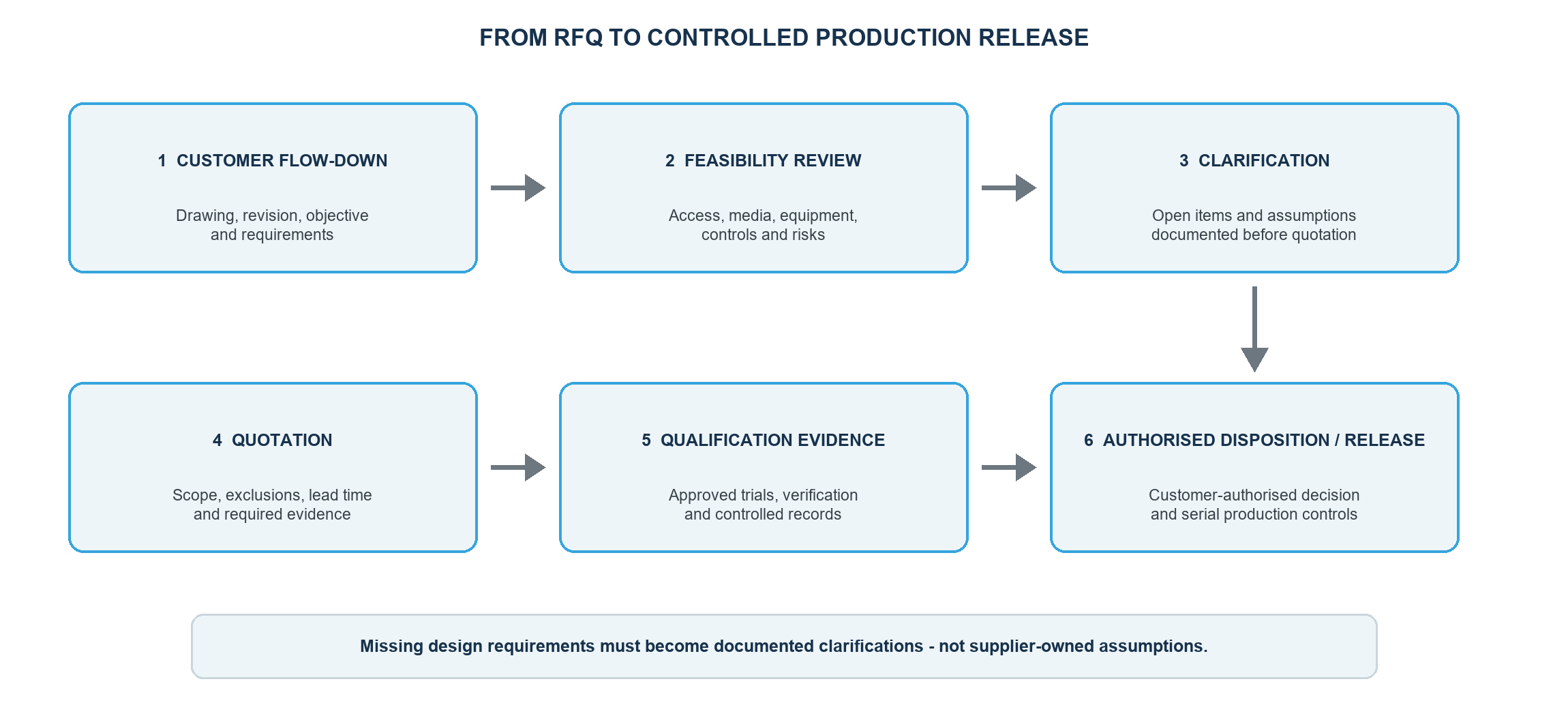
Trials and first-article activity should answer defined questions. State the representative parts or specimens, route, measurements, acceptance criteria, decision authority and record set. Almen verification and coverage acceptance demonstrate different aspects of the route; component validation such as residual-stress or fatigue testing is separate and applies only when invoked.
What must the purchase order flow down?
- Part, drawing, revision and contractual document hierarchy.
- Material and condition, treatment and exclusion zones, process sequence and approved route.
- Applicable specification revisions, customer clauses and any approved deviations.
- Complete intensity and coverage requirements, media restrictions and monitoring obligations.
- Required certificates, records, samples, tests, retention and traceability.
- Packaging, preservation, delivery terms and acceptance authority.
- Stop-work, notification and approval rules for nonconformance, interruption and change.
Do not rely on a quotation reference alone when the order must invoke controlled technical requirements. The purchase order should identify the exact approved baseline and precedence.
How should the supplier be governed during serial production?
Monitor delivery, escapes, rework, interruptions, record quality, process drift, capacity and corrective action. Review changes before implementation when they can affect the qualified route: site, equipment, wheel or nozzle arrangement, tooling, masking, media, software, motion, sequence, inspection method or subcontracted activity.
Periodic review should be risk-based. It may combine performance data, updated certificates and approvals, representative batch records, remote review or an on-site audit. Approval remains valid only for the released scope and current evidence.
Common sourcing failures
- Requesting a price from a part number without a controlled technical package.
- Allowing supplier assumptions to become unapproved design requirements.
- Comparing unit prices before aligning tooling, qualification, batch and evidence scope.
- Treating quality certification, Nadcap accreditation, customer approval and route qualification as interchangeable.
- Starting production while an open point can change treatment or acceptance.
- Failing to flow revisions, records, change notification and stop-work rules into the purchase order.
What should be sent to SP Center for a sourcing review?
Send the controlled drawing package, material condition, marked zones, governing requirements, quantities and batch pattern, required evidence, packaging, delivery basis and open-item register to [email protected]. SP Center can respond with assumptions and clarification questions tied to the proposed scope.
Frequently asked questions
What information is required for a shot peening quotation?
Provide the current drawing and revision, material and heat-treatment condition, treatment and exclusion zones, governing specifications, complete intensity and coverage requirements, part size and mass, quantities and batches, evidence, packaging and target date.
Can a supplier propose Almen intensity or coverage?
Only when the contract or design authority explicitly permits a proposal. The responsible engineering or specification authority must approve any design-controlled value before qualification or production release.
How should a shot peening supplier be qualified?
Qualify the exact legal entity, site, process scope and representative route. Review requirement flow-down, feasibility, equipment and media controls, Almen and coverage evidence, personnel, traceability, nonconformance, change control, approvals, capacity and final records.
Does a quality-system certificate eliminate the need for technical review?
No. It supports the management-system assessment but does not establish the exact shot peening capability, part route, customer approval or execution evidence required by the purchase order.
When is Nadcap required for outsourced shot peening?
Nadcap is required when the contract, customer or governing approval system invokes it. Verify the current supplier, site and applicable accreditation scope in PRI’s system of record; accreditation does not certify the product.
How should two quotations be compared?
Align the same drawing revision, technical requirements, batch pattern, qualification, tooling, records, packaging, delivery basis, lead-time starting point and change rules before comparing price.
How long does supplier qualification take?
There is no universal duration. Readiness of inputs, supplier capability, tooling, trials, samples, external testing, customer decisions and audit scheduling can control the critical path.
Key takeaways
- Begin with a controlled requirement set, not a generic service description.
- Keep design authority and supplier proposal authority explicit.
- Qualify the exact site, scope and representative process route.
- Compare quotations only after technical, evidence, batch and schedule baselines match.
- Close open decisions before qualification or production release.
- Maintain approval through traceability, performance monitoring and controlled change.
Related SP Center guides
- How to Choose a Shot Peening Supplier for Critical Parts
- How Much Does Shot Peening Cost?
- In-House Shot Peening vs. Outsourcing
Technical references
1. Performance Review Institute, Nadcap
2. Performance Review Institute, Nadcap participation and Qualified Manufacturers List
3. SAE ARP7488: Peening Design and Process Control Guidelines, issued January 2018
4. SAE AMS2430U: Shot Peening, revised April 2018
5. SAE J442_202602: Tools for Peening Intensity Determination and Verification, revised February 2026
6. SAE J443_202512: Procedures for Determining and Verifying Peening Intensity, revised December 2025
7. SAE J2277_202301: Shot Peening Coverage Determination, revised January 2023
Standards note: The revisions invoked by the contract and customer requirements govern.
Author: Paweł Kmieć
Discuss an RFQ or sourcing review: +48 519 772 773 | [email protected]