


Aerospace components, approval layers, production records and change control for controlled shot peening
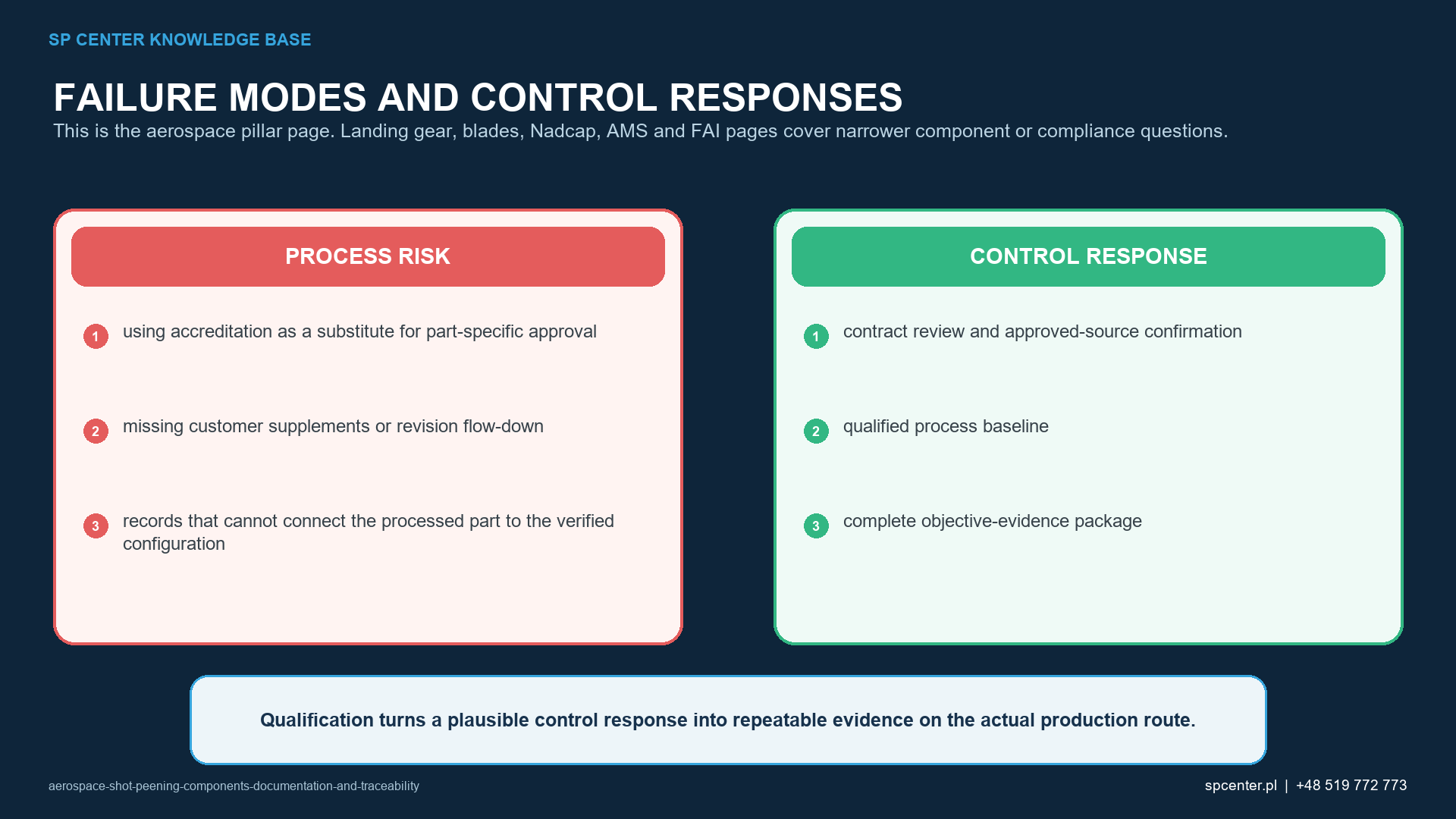
Controlled shot peening for aerospace hardware must satisfy the drawing, purchase order, governing process specification, customer-specific supplements and approved-source requirements. A stable machine setting is not enough: the qualified configuration, Almen intensity, coverage, media condition, component acceptance and batch traceability must all be linked to the work performed.
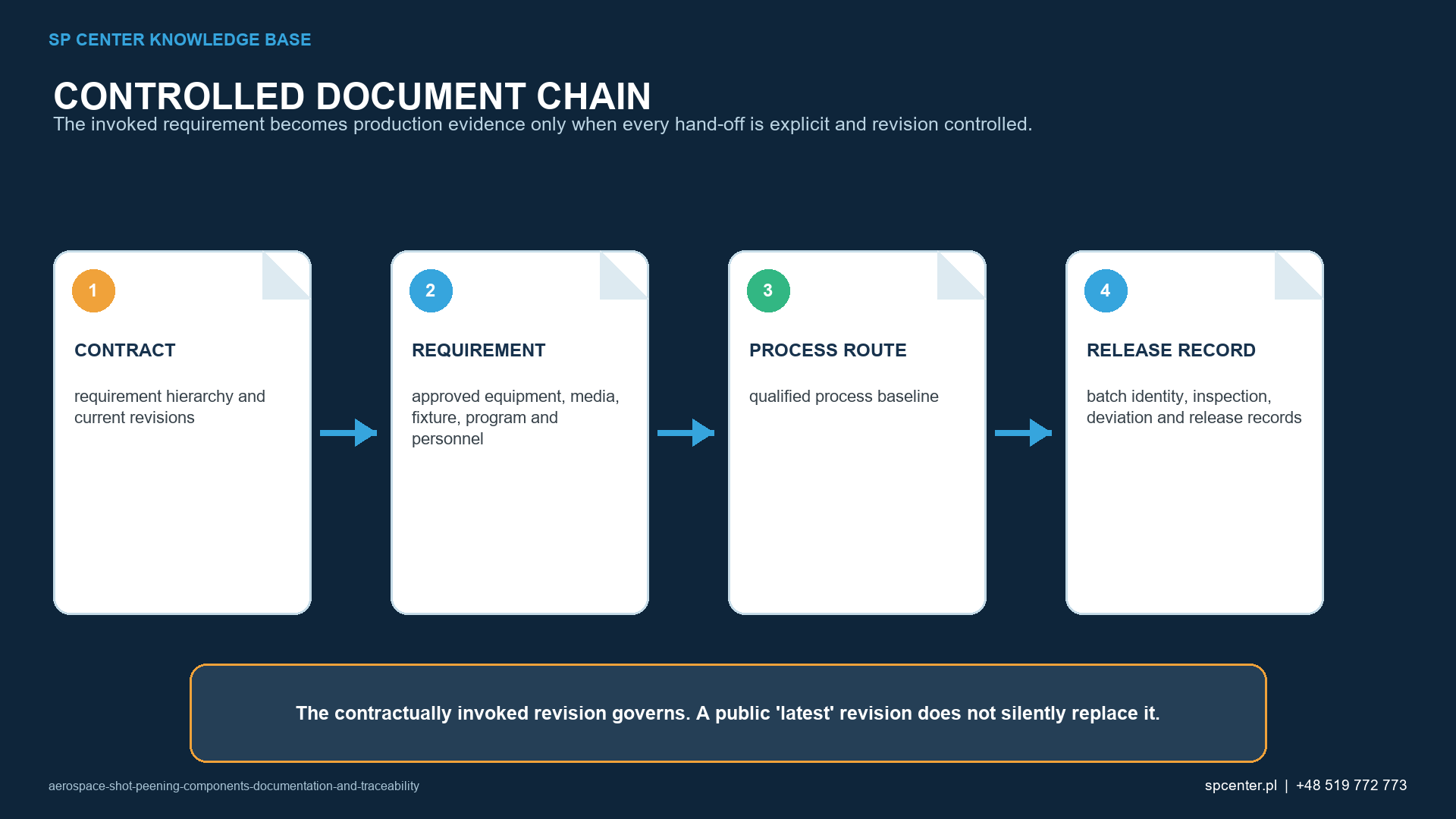
The applicable revision is the one established by the contract and document hierarchy. If a specification, customer supplement or approval condition is missing or contradictory, the affected work should be placed on hold until the authorized customer or design function issues a controlled clarification.
Which aerospace components are commonly shot peened?
Shot peening may be specified for landing-gear and actuation parts, gears, shafts, springs, turbine or compressor components and other hardware exposed to fatigue, fretting or stress-corrosion risk. The component name alone never defines the process. Treatment zones, exclusions, material condition and manufacturing sequence must come from the drawing and approved technical requirements.
Critical locations can include fillets, holes, roots, splines, threads or transitions, but their relevance is component-specific. Access, masking and inspection must therefore be demonstrated on the actual geometry or an authorized representative configuration.
How do Nadcap accreditation, customer approval and part release differ?
Nadcap is an accreditation of an organization and its audited special-process scope; it is not a product certification and does not replace customer source approval. Process qualification, part or first-article approval, production-lot release and record traceability are additional, separate layers of evidence.
| Approval or control layer | Question to resolve | Representative evidence |
|---|---|---|
| Nadcap accreditation | Is the supplier accredited for the applicable special-process scope? | Current PRI scope and accreditation status |
| Customer source approval | Is the organization and site approved for this customer, part family or programme? | Customer approval or approved-source record |
| Process qualification | Has the actual machine, media, tooling, motion and acceptance route been qualified? | Approved process baseline and qualification record |
| Part or first-article approval | Has the component-specific configuration and submission been accepted where required? | Customer disposition, first-article or equivalent approval |
| Production lot release | Did the actual lot meet all invoked process and component acceptance criteria? | Traceable job, inspection and release records |
| Record traceability | Can every result be linked to the part or lot, configuration, operator and applicable revision? | Controlled record set with retention and change history |
Table 1. Accreditation, customer source approval, process qualification, part approval, lot release and traceability are separate control layers.
No single approval automatically satisfies the others. Contract review must identify which layers apply to the actual programme, site, part and purchase order.
How should the aerospace shot peening process be qualified?
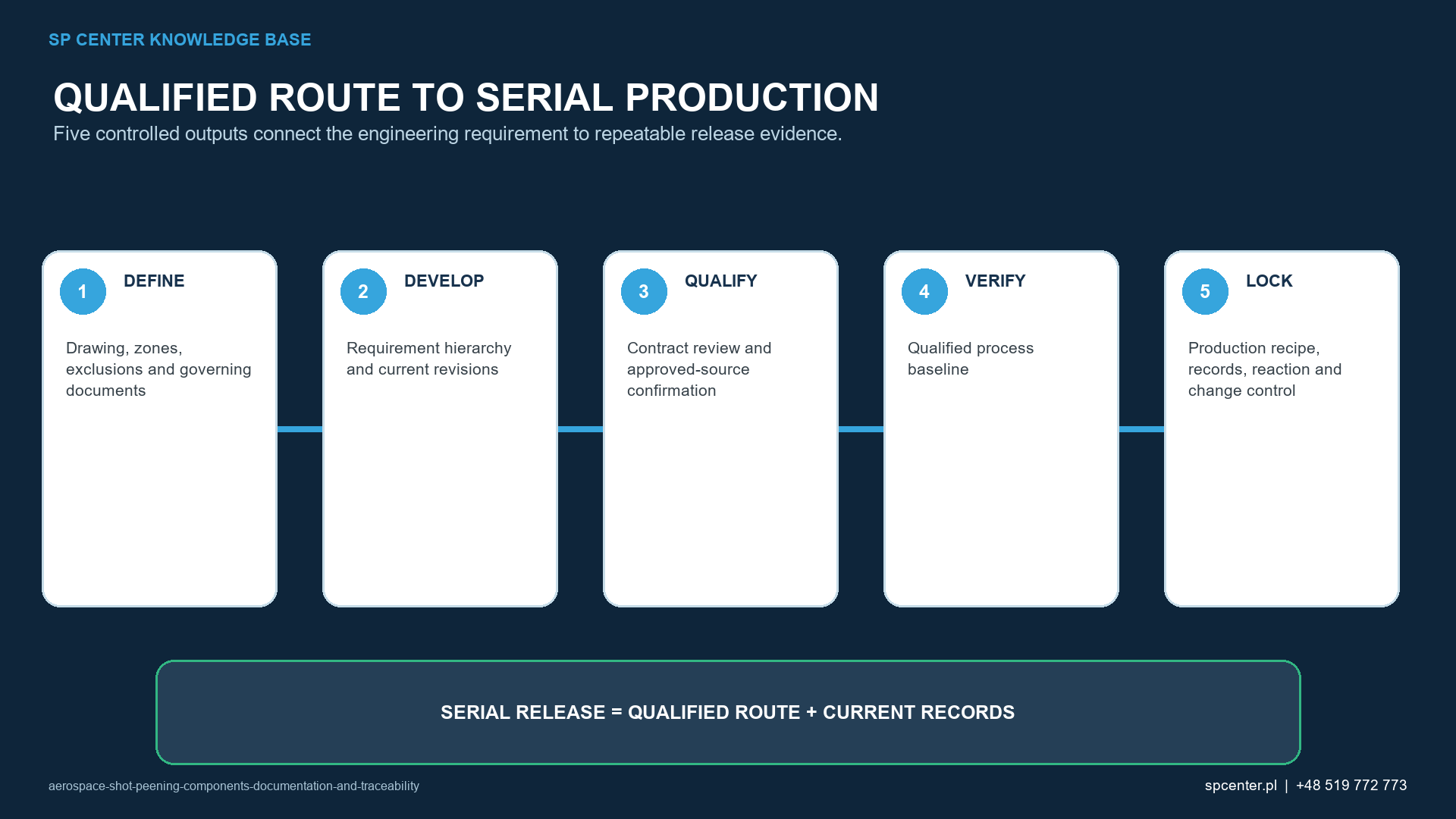
The qualification must use production-representative equipment, media, fixtures, masking, programmes, motion and inspection methods. It should establish the required Almen intensity from the applicable Almen system and saturation procedure, then demonstrate coverage and component acceptance separately on the required surfaces.
- Freeze the controlled drawing, material and heat-treatment condition, treatment zones and exclusions.
- Identify the authorized machine, nozzles or wheel, media, fixture, masking, programme and trained personnel.
- Define process limits, monitoring, calibration or verification, reaction plans and record retention.
- Demonstrate access, coverage, surface condition and dimensional acceptance on representative geometry.
- Use XRD, fatigue, SCC or other component validation only when the drawing or approved qualification plan requires it.
Which evidence proves process control and component acceptance?
Almen intensity, coverage and component validation answer different questions. A compliant Almen result does not prove that a recessed feature received complete coverage, and a coverage result does not establish a residual-stress profile or fatigue-life increase.
| Evidence layer | What it establishes | What it does not establish by itself |
|---|---|---|
| Process verification | The qualified stream and process configuration were maintained, including Almen, media, equipment, programme and monitoring controls | Coverage on every component feature or component fatigue performance |
| Component surface acceptance | The drawing-defined area, boundary, surface condition and other invoked part checks are acceptable | The depth or magnitude of the residual-stress profile |
| Component validation | The specified component-level effect was demonstrated by XRD, fatigue, SCC or another approved qualification method where required | Automatic transferability to another material, geometry or service condition |
Table 2. Process verification, component surface acceptance and component validation answer different technical questions.
XRD may characterize a component-specific residual-stress profile during qualification or validation. It is not a routine substitute for Almen intensity, coverage verification or control of the production configuration unless the governing requirement explicitly says otherwise.
What documentation and traceability are needed?
The release package must be defined by the contract. Depending on the programme, it can include part and lot identity, drawing and specification revisions, machine and programme identification, media records, Almen results, coverage evidence, operator status, component inspections, nonconformance dispositions and release authorization. One identical package is not universally required for every customer.
Records should connect the processed part or lot to the configuration and evidence used for release. Changes, deviations and rework decisions must remain traceable to the authorized function that approved them.
How should deviations, changes and requalification be controlled?
An unresolved deviation must not be converted into an informal process change. Missing requirements, conflicting revisions, out-of-limit monitoring, media-control failures or incomplete traceability require containment and controlled disposition before release.
Changes to the machine, nozzle or wheel, media, separator, fixture, masking, programme, motion, component geometry, surface condition, inspection method or governing specification should be assessed against the approved baseline. The responsible authority must determine whether review, re-verification, requalification, first-article activity or customer approval is required.
Additional exposure is not an automatic correction. Excessive peening can increase roughness, damage edges, distort thin features or create other unacceptable surface conditions, depending on the material and component.
What should an aerospace shot peening RFQ contain?
| RFQ input | Why it matters |
|---|---|
| Controlled drawing, part number and revision | Defines identity, treatment zones, boundaries and exclusions |
| Material, heat treatment and incoming surface | Supports evaluation of surface damage, contamination, roughness and manufacturing sequence |
| Governing specifications and customer flow-down | Defines the authority for media, intensity, coverage, qualification, records and approvals |
| Geometry, size, mass and critical features | Supports access, fixturing, masking and worst-case process development |
| Quantity, lot logic and delivery plan | Defines production strategy, capacity, traceability and commercial basis |
| Surface, dimensional and documentation requirements | Prevents Almen intensity or coverage from being treated as the only release evidence |
Table 3. A controlled aerospace RFQ connects part identity, requirements, geometry, quantity and release evidence.
RFQ support: Send the controlled documentation and quantity to [email protected] or call +48 519 772 773.
Frequently asked questions about aerospace shot peening
Which aerospace components may require shot peening?
Applications can include landing-gear and actuation parts, gears, shafts, springs, turbine or compressor components and other fatigue-critical hardware. The drawing and design authority define whether a component and its treatment zones require shot peening.
Does Nadcap accreditation approve a component?
No. Nadcap accreditation applies to the organization and audited process scope. Customer source approval, process qualification, part approval and production-lot release remain separate decisions governed by the contract.
What should happen if a customer supplement is missing?
Place the affected work on hold and obtain controlled clarification from the authorized customer or design function. An internal procedure must not be used to replace missing contractual requirements.
Does a conforming Almen intensity prove the component is acceptable?
No. Almen intensity verifies the standardized response of the peening stream. Coverage, treatment boundaries, surface condition, dimensions and any required component validation need their own evidence.
Is one release-data package mandatory for every aerospace customer?
No. The required records depend on the drawing, purchase order, process specification and customer-specific flow-down. The deliverables must be agreed during contract review.
When should requalification be assessed?
Assess requalification after any change that may alter the qualified relationship between process inputs and outputs, including equipment, media, tooling, programme, part geometry, inspection method or governing requirement.
Can shot blasting replace aerospace shot peening?
Not without formal engineering and contractual approval. Shot blasting is generally used for cleaning or surface preparation, while controlled shot peening is qualified to produce a defined surface-enhancement effect.
What information should be sent to SP Center?
Send the controlled drawing, material and heat-treatment condition, governing specifications, treatment and exclusion zones, quantity, required approvals and release records. Call +48 519 772 773 for an initial technical review.
Key takeaways
- Treat Nadcap accreditation, customer approval, process qualification, part approval and lot release as separate decisions.
- Keep Almen intensity, component coverage and component validation as separate evidence layers.
- Place affected work on hold when contractual requirements or customer supplements are missing or contradictory.
- Control deviations, configuration changes, requalification and record traceability against the approved baseline.
- Do not assume that more exposure, automation or one certificate proves the complete aerospace result.
Related SP Center guides
- Landing Gear Shot Peening
- What Is Shot Peening?
- Shot Peening Coverage
- Almen Intensity in Shot Peening
Technical references
1. SAE AMS2430U: Shot Peening, revised April 2018
2. SAE AMS2432E: Shot Peening, Computer Monitored, revised October 2022
3. SAE ARP7488: Peening Design and Process Control Guidelines, issued January 2018
4. Performance Review Institute, Nadcap Accreditation
5. Performance Review Institute, Surface Enhancement Nadcap Audit Criteria Review
6. SAE AS7117A (canceled; not current Nadcap audit criteria)
7. SAE J442_202602: Tools for Peening Intensity Determination and Verification, revised February 2026
8. SAE J443_202512: Procedures for Determining and Verifying Peening Intensity, revised December 2025
Reference control: The documents and revisions invoked by the drawing, contract and customer flow-down govern the part. Publisher status does not replace a contractually applicable revision without authorized approval.
Author: Paweł Kmieć
Discuss this shot peening requirement: +48 519 772 773 | [email protected] | shot peening service