


How to remove ambiguity from drawings, RFQs and quality flow-down before process development begins
The most damaging errors in shot peening drawings, RFQs, purchase orders and process specifications are missing treatment boundaries, material condition, governing documents, complete intensity notation, coverage criteria, masking instructions and acceptance evidence. A controlled requirement must also identify revision hierarchy, qualification scope, engineering objective, production context and the authority that will resolve open points. These 12 information groups let a processor quote, develop, verify and release shot peening without guessing.
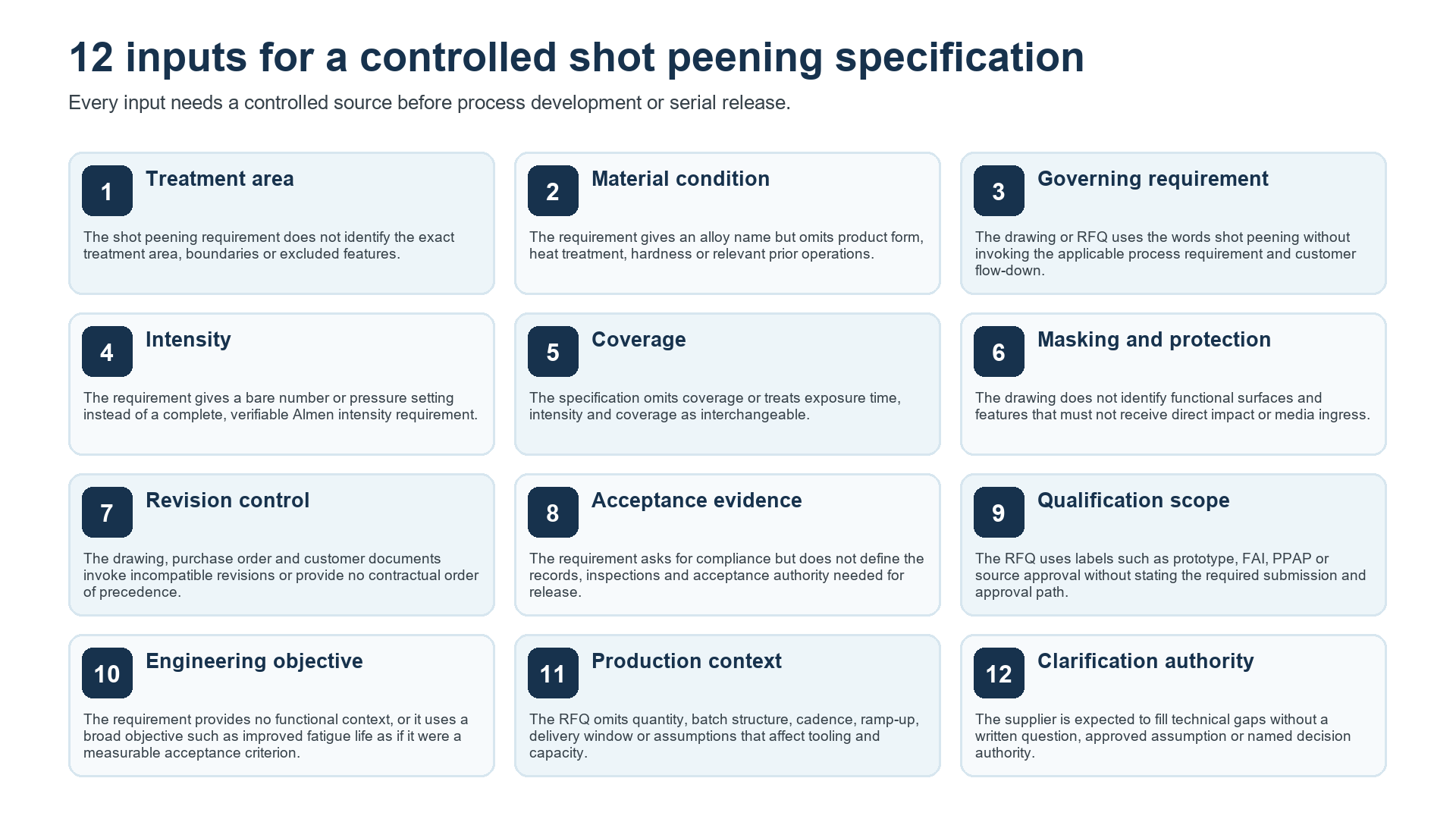
Figure 1. Twelve controlled information groups reduce ambiguity before shot peening process development or serial release.
Why does shot peening specification quality matter?
Shot peening is normally controlled as a special process because a final visual check cannot reconstruct every process input or prove the intended subsurface stress state. The drawing and contractual flow-down therefore have to define what is treated, which requirements apply and what evidence is needed. The supplier then develops and controls a process against those approved inputs.
Ambiguity creates more than a paperwork problem. It can produce an incomplete quotation, the wrong masking concept, repeated trials, a disputed first-article package, schedule delay or treatment of a surface that the design authority intended to protect. The cost of clarification is usually lowest before the purchase order and highest after parts arrive for processing.
A specification should be complete enough to support reproducible work but should not prescribe machine settings that belong to qualified process development unless the governing document requires them. The objective is controlled responsibility: the design authority defines the component requirement; the processor defines and controls the processing route within that requirement.
Mistake 1: Which surfaces must receive shot peening?
Problem: The shot peening requirement does not identify the exact treatment area, boundaries or excluded features.
A note such as “shot peen component” is not a reproducible treatment definition. The processor needs controlled drawing views, zone identifiers, dimensions or datums that show every surface to be peened and every surface to remain untouched. Blend regions and transition zones also matter because a sharp, undefined boundary can leave different interpretations at quotation, programming and inspection.
Undefined scope affects tooling, nozzle or wheel access, cycle time, inspection and distortion risk. It can also hide a geometric conflict: a recess may be listed as treated but physically inaccessible at the required impact angle, or a critical edge may sit directly on an assumed boundary. These questions should be resolved before process development begins.
Correct the requirement by marking treatment zones and exclusions on the controlled drawing. State how the boundary is located, what tolerance applies where function depends on it and which document controls if a model, drawing and purchase-order note disagree.
Example: “Shot peen surfaces identified as Zone SP-1 on drawing [number/revision]. Do not peen the excluded features shown in Detail [reference]. Boundary location and transition requirements shall follow the drawing.”
Mistake 2: Is the material condition fully defined?
Problem: The requirement gives an alloy name but omits product form, heat treatment, hardness or relevant prior operations.
Shot peening response depends on the condition presented for processing, not only the alloy designation. Strength level, hardness, microstructure, product form and prior machining or thermal operations affect indentation, cold work, roughness, retained residual stress and sensitivity to damage. Two parts with the same alloy name can require different risk controls.
Material condition also affects quotation and feasibility. A processor may need to review media compatibility, thin sections, hardened edges, pre-existing coatings, decarburisation, plating sequence or the risk that a later operation removes or relaxes the affected layer. Without that context, an apparently valid process plan may not match the released production condition.
State the complete material specification, product form, heat-treatment condition and hardness range where applicable. Identify relevant prior and subsequent operations, especially machining, grinding, thermal treatment, coating and cleaning steps that can change the treated surface.
Example: “Material and condition: [specification, grade, product form and heat-treatment condition], hardness [range and method if required]. Shot peening shall occur after [operation] and before [operation], subject to the approved manufacturing sequence.”
Mistake 3: Which governing shot peening requirement applies?
Problem: The drawing or RFQ uses the words shot peening without invoking the applicable process requirement and customer flow-down.
A process name is not a complete technical requirement. The contract should identify the governing specification, customer clauses and any approved deviations. AMS2430U is one aerospace shot peening specification, but it is not a universal default and must not be silently imported into a contract that invokes something else.
The governing document determines definitions, process controls, media requirements, inspection rules, records and sometimes approval responsibilities. A customer supplement may modify or add to those rules. The processor needs the complete invoked set before confirming compliance or preparing a quotation.
List every applicable document by identifier and revision, or define a controlled rule for revision status if the purchasing system does not place revisions on the drawing. Make referenced documents available through the authorised route and record any proposed exception before order acceptance.
Example: “Perform shot peening to [process specification and revision], together with [customer clause and revision]. Contract-specific requirements in [document] apply. Any exception requires written approval from [authorised function] before processing.”
Mistake 4: Is the Almen intensity requirement complete?
Problem: The requirement gives a bare number or pressure setting instead of a complete, verifiable Almen intensity requirement.
A value such as “0.012” is ambiguous. It does not identify the permitted range, arc-height unit or Almen strip designation. A machine pressure, wheel speed or nozzle setting is also not a substitute for intensity because nominal machine inputs do not directly express the energy effect measured by the applicable strip system and procedure.
A complete requirement should state the permitted intensity value or range, unit, strip designation and the notation or verification convention required by the invoked document. SAE J442 defines tools used for intensity determination and verification, while SAE J443 defines procedures for determining and verifying intensity. The contractually invoked documents and revisions remain controlling.
Do not copy a value from another component without design authority. Geometry, material, prior surface condition and engineering intent can make an apparently familiar intensity inappropriate. The processor can review feasibility and propose a controlled development route, but the authorised requirement owner must approve any design value.
Example: “Almen intensity: [lower–upper] [arc-height unit] [strip designation], determined and verified in accordance with [invoked specification/procedure and revision].”
Mistake 5: Is coverage defined separately from intensity?
Problem: The specification omits coverage or treats exposure time, intensity and coverage as interchangeable.
Coverage describes the extent to which the specified component surface shows impact evidence under the applicable determination convention. Almen intensity characterises the shot stream through a standard test arrangement. A conforming intensity result does not prove that every recess, flank or boundary on the component received the required coverage.
Exposure time is a process variable, not coverage itself. A previously established time may support a qualified route, but access, presentation, media flow, equipment condition and part geometry still affect the surface. SAE J2277 provides a coverage-determination framework, while the governing contract defines what is required for the job.
State the required coverage, the treatment zone, the applicable determination or verification method and any restrictions on excessive exposure or multiple coverage. When direct examination is difficult, define the authorised indirect or representative approach rather than leaving the operator to invent one.
Example: “Achieve [required coverage] on Zone SP-1 using the coverage determination method required by [invoked document/revision]. Intensity conformity and coverage conformity shall be recorded as separate results.”
Mistake 6: What must be masked or protected?
Problem: The drawing does not identify functional surfaces and features that must not receive direct impact or media ingress.
Threads, sealing faces, bearing seats, precision fits, small holes, sharp edges, thin sections and finished surfaces may require masking or other protection. The need depends on function and the approved design, so the processor should not infer protection only from appearance. An unmarked feature may be treated as part of the general peening zone.
Masking also creates a boundary condition. The drawing may need to define where full treatment ends, where a transition is acceptable and how close the impact may approach a critical feature. For holes and cavities, containment and post-process media removal may need their own controls.
Identify protected features on a controlled view and define the acceptable boundary where necessary. Allow the supplier to develop the mask and fixture concept unless a mandated method is contractually required, then approve the concept through the agreed qualification route.
Example: “Protect the features marked MP-1 through MP-4 from direct shot impact. Maintain the treatment boundary within [drawing-defined tolerance]. Prevent media retention in [identified cavities] and verify removal by [approved method].”
Mistake 7: What happens when document revisions conflict?
Problem: The drawing, purchase order and customer documents invoke incompatible revisions or provide no contractual order of precedence.
A supplier cannot safely resolve a technical conflict by selecting the newest document or the most convenient statement. A drawing may invoke one revision while the purchase order lists another, and a customer specification may contain a clause that changes the general process specification. Each can carry different inspection or record requirements.
Uncontrolled revision selection can invalidate a quotation, qualification or certificate even when the physical process appears acceptable. It can also create a false claim of compliance because the certificate names a revision that was never reviewed with the complete contractual package.
Create a document register before quotation or release. Compare identifiers, revisions, dates and referenced clauses. The purchaser or authorised design function should provide a written disposition for conflicts and state the order of precedence. The processor should keep that disposition with the job record.
Example: “The contractual order of precedence is [defined sequence]. Conflicts between drawing [revision], purchase order [revision] and process documents shall be referred to [authorised function] for written disposition before work proceeds.”
Mistake 8: Which evidence proves acceptance?
Problem: The requirement asks for compliance but does not define the records, inspections and acceptance authority needed for release.
Process-control evidence and component-performance evidence answer different questions. Media records, intensity results, coverage evidence, equipment records and traceability can show that a controlled route was executed. They do not by themselves establish a residual-stress profile, fatigue life or dimensional result unless those properties are separately required and verified.
Vague requests for a “full report” are also risky. One customer may expect a certificate of conformity; another may require raw intensity data, saturation information, coverage records, machine monitoring, operator status, media certification or component inspection. The deliverable must be known before pricing and production.
Define required records, retention period, language, format, traceability level, inspection method and release authority. If component-specific testing is required, state the sample, location, method, acceptance limit and disposition route for nonconforming results.
Example: “Release evidence shall include [listed records] linked to the job and part/batch identity. Component inspection or validation is required only where explicitly defined by [drawing or approved plan]. Approval authority: [named function].”
Mistake 9: Is qualification scope and approval route stated?
Problem: The RFQ uses labels such as prototype, FAI, PPAP or source approval without stating the required submission and approval path.
Qualification terms are not interchangeable. A feasibility trial may demonstrate access and process stability, while a first-article or production-part approval package can require controlled documentation and customer disposition. The exact meaning comes from the contract, customer procedure and industry context.
Missing scope creates schedule and cost surprises. Tooling may need approval before manufacture, test coupons may require witness, records may need customer templates, and serial production may be blocked until an authorised signature is received. None of these steps should be assumed from a single acronym.
State the phase, required deliverables, representative parts or coupons, witness points, submission format, approval authority and rule for transition to serial production. Invoke FAI, PPAP or source approval only when the contract actually requires it.
Example: “This order covers [feasibility/prototype/qualification/serial] scope. Submit [defined package] to [authority] through [route]. Serial processing may begin only after [defined approval or release condition].”
Mistake 10: What engineering objective must the requirement protect?
Problem: The requirement provides no functional context, or it uses a broad objective such as improved fatigue life as if it were a measurable acceptance criterion.
A concise engineering objective helps the processor identify risks and ask better questions. The critical location may be a fillet, root, transition or contact surface, and later manufacturing operations may threaten the intended near-surface condition. That context improves feasibility review and tooling decisions.
The objective does not replace measurable requirements. “Improve fatigue life” does not define intensity, coverage, treatment area or acceptance evidence. Component fatigue performance depends on material, geometry, loading, environment, surface condition and the retained residual-stress state. A performance claim needs an approved validation basis.
State the functional purpose and critical location as context, then connect them to controlled drawing and process requirements. If residual stress, roughness, dimensional stability or fatigue testing is an acceptance characteristic, define the authorised method and limit separately.
Example: “Engineering objective: support fatigue resistance at [critical feature]. Acceptance remains based on the measurable requirements in [drawing/specification/approved validation plan]; no fatigue-life multiplier is implied by process conformity alone.”
Mistake 11: Is the production context available before quotation?
Problem: The RFQ omits quantity, batch structure, cadence, ramp-up, delivery window or assumptions that affect tooling and capacity.
A technically identical part can require a different industrial route at prototype and serial volume. Batch size, annual demand, release pattern, mix of variants and delivery expectation influence fixture strategy, automation, inspection sampling, record handling, capacity reservation and lead time.
Missing production data weakens the quotation. A supplier may price a manual prototype route when repeat production needs dedicated tooling, or reserve serial capacity for a quantity that never materialises. The result is avoidable re-quotation and schedule risk after technical approval.
Provide prototype quantity, expected serial quantity, batch size, cadence, ramp-up date, forecast horizon and delivery assumptions. Identify part families and expected changes. These inputs are planning data, not a guarantee, but they allow the supplier to state quotation assumptions transparently.
Example: “RFQ basis: [prototype quantity], [serial quantity per period], typical batch [quantity], planned start [date] and requested lead time [days/weeks]. Supplier shall identify capacity and tooling assumptions in the quotation.”
Mistake 12: Who is authorised to resolve missing information?
Problem: The supplier is expected to fill technical gaps without a written question, approved assumption or named decision authority.
Experienced shot peening suppliers should detect gaps and propose technically reasoned options. They should not silently become the design authority. Selecting a treatment zone, intensity, coverage level or acceptance criterion changes the requirement and can affect component performance or compliance.
A verbal answer can be lost between purchasing, engineering, quality and production. The approved clarification should connect the question, affected document, proposed disposition, responsible function, date and revision. It should also show whether the answer changes price, timing, tooling or qualification.
Use a controlled clarification log. Stop affected work until safety- or compliance-relevant gaps are resolved. Quote assumptions explicitly, obtain written approval from the authorised function and incorporate the disposition into the released requirement set before serial processing.
Example: “Open technical points shall be recorded in the clarification log. Only [authorised function] may approve requirement changes. Supplier proposals become requirements only after written disposition and controlled document update.”
How should an ambiguous requirement be clarified and released?
A controlled clarification route has five gates: screen the complete document set, record each gap or conflict, obtain written disposition from the authorised function, update the released inputs and verify only the evidence that the approved requirement defines. The processor should not start affected serial work while an unresolved point could change treatment, acceptance or compliance.
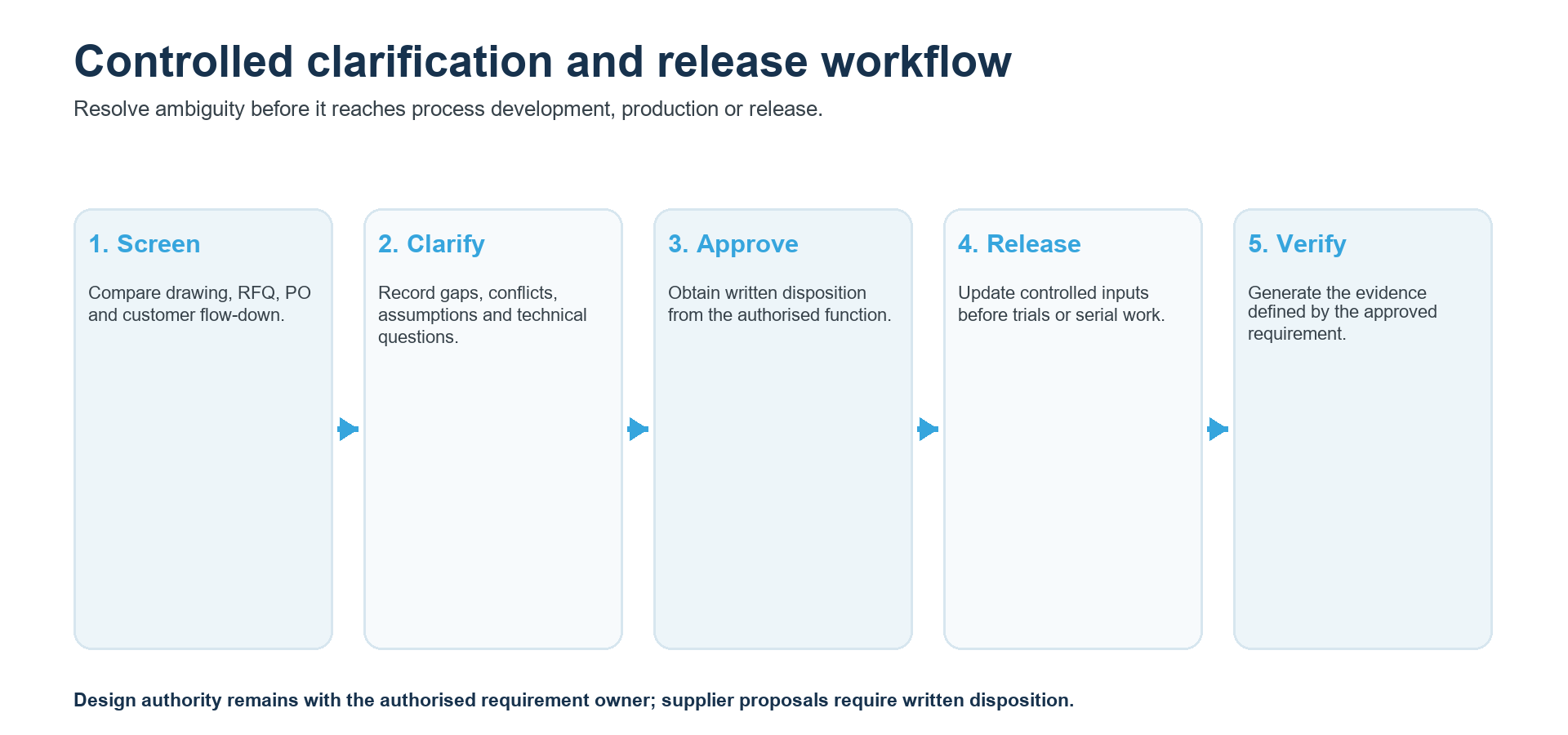
Figure 2. Clarification converts ambiguous inputs into an approved requirement set without silently transferring design authority.
What is the minimum drawing and RFQ checklist for shot peening?
| Information group | Minimum controlled input | Typical release evidence |
|---|---|---|
| Treatment area | Peened zones, exclusions, boundaries and drawing references | Marked drawing or controlled 3D definition |
| Material condition | Alloy, product form, heat treatment, hardness and sequence | Drawing, material specification and route |
| Governing requirement | Process specification, customer clauses and revisions | Contract document register |
| Intensity | Permitted range/value, unit, strip and verification basis | Drawing or approved process requirement |
| Coverage | Required level, zone and determination convention | Drawing or approved inspection plan |
| Masking | Protected features, boundaries and media-retention risks | Drawing detail and approved tooling concept |
| Revision control | Compatible document set and precedence rule | Reviewed contract matrix or disposition |
| Acceptance evidence | Records, inspection, retention and release authority | Quality clause or approved plan |
| Qualification | Phase, submissions, witness points and approval route | Qualification or industrialisation plan |
| Engineering objective | Function, critical feature and later operations | Design note plus measurable requirements |
| Production context | Quantity, batches, cadence, variants and schedule | RFQ assumptions and forecast |
| Clarification authority | Question log, decision owner and document update | Written disposition linked to the job |
Table 1. Minimum controlled inputs for release; customer-specific flow-down may add further requirements.
Which evidence answers each shot peening acceptance question?
| Question | Representative evidence | What it does not prove by itself |
|---|---|---|
| Was the shot stream at the required intensity? | Applicable Almen strip, holder, gage and determination/verification record | Coverage on every component feature or residual stress in the part |
| Did the specified area receive the required impacts? | Approved coverage determination and treatment-zone inspection | Correct intensity, fatigue life or residual-stress depth |
| Was the permitted media used and controlled? | Media identity, certification, size/shape condition and segregation records | Correct treatment boundary or component performance |
| Was the approved route executed? | Job traceability, equipment/programme record, operator status and process log | A design change or unrequired component property |
| Did critical dimensions remain acceptable? | Drawing-defined dimensional inspection | Residual stress, coverage or surface cleanliness |
| Was the intended residual-stress state achieved? | Approved component/coupon measurement plan where invoked | Universal fatigue performance in every service condition |
| Was component fatigue performance demonstrated? | Approved representative fatigue test or authorised design substantiation | Compliance of every production process record |
Table 2. Process control, component acceptance and performance evidence answer different questions.
Which technical distinctions prevent misleading specifications?
| Concept A | Concept B | Why the distinction matters |
|---|---|---|
| Almen intensity | Coverage | Intensity characterises the stream through a standard test; coverage concerns the treated component surface. |
| Coverage | Exposure time | Time can support a qualified route, but it is not itself a direct coverage result. |
| Process conformity | Component performance | Executing an approved route does not create an unstated fatigue-life or residual-stress guarantee. |
| Qualification | Serial release | A successful trial does not automatically authorise recurring production. |
| Supplier proposal | Design approval | A proposal becomes a requirement only after authorised written disposition. |
| Certificate of conformity | Full process-data package | The documents contain different levels of evidence and must be requested explicitly. |
| Current standard revision | Contractually invoked revision | The contract controls unless the authorised parties approve a revision change. |
Table 3. Separating related concepts prevents unsupported acceptance or performance conclusions.
Which misconceptions create errors in shot peening requirements?
The assumption “The supplier can choose a sensible intensity” is not a reliable engineering rule. The supplier may propose a development range, but only the authorised requirement owner can approve a design value.
The assumption “Complete coverage proves the process was correct” is not a reliable engineering rule. Coverage does not prove intensity, media control, residual stress or component performance.
The assumption “The latest standard revision always applies” is not a reliable engineering rule. The contractually invoked revision applies until the authorised parties approve a change.
The assumption “A certificate of conformity contains every process record” is not a reliable engineering rule. A certificate and a detailed data package are different deliverables; define both explicitly.
The assumption “FAI or PPAP tells the supplier exactly what to submit” is not a reliable engineering rule. The invoked customer or industry procedure defines the submission content and approval route.
The assumption “Shot peening the whole part is safer than defining zones” is not a reliable engineering rule. Unintended treatment can affect functional surfaces, dimensions, roughness and media retention.
Frequently asked questions about shot peening drawings, RFQs and specifications
What must a shot peening specification include?
A shot peening specification should identify the treatment area, material condition, governing documents, complete intensity requirement, coverage, masking, revision hierarchy, acceptance evidence, qualification scope, engineering objective, production context and clarification authority.
Is an Almen intensity number enough on a drawing?
No. A complete Almen intensity requirement needs the permitted value or range, arc-height unit, strip designation and applicable notation or verification basis required by the invoked document.
Are intensity and coverage the same in shot peening?
No. Almen intensity characterises the energy effect of the shot stream through a standard test arrangement; coverage describes impact evidence over the specified component surface under the applicable determination convention.
Should a drawing invoke the newest revision of every standard?
Not automatically. The contractually invoked revision governs until the authorised parties approve a change. Conflicting revisions should be resolved in writing before processing.
Can a shot peening supplier select missing process requirements?
A supplier can identify gaps and propose values or a development plan, but the supplier should not silently assume design authority. Requirement changes need written approval from the authorised function.
What records should be requested after shot peening?
Request the records required by component risk and contract, such as a certificate of conformity, part or batch traceability, intensity and coverage evidence, media records, machine data and any explicitly invoked component inspection.
Does process conformity prove improved fatigue life?
No. Process conformity proves that the approved shot peening route met its defined controls. A fatigue-life claim requires an authorised design basis, representative testing or another approved substantiation route.
When should masking be specified?
Masking or protection should be specified when required by the drawing, governing specification, customer requirement, approved risk assessment or controlled engineering clarification. The requirement should identify the features and boundaries that must be protected from direct impact or retained media.
What information helps SP Center review a shot peening RFQ?
Send the controlled drawing, material and heat-treatment condition, treatment and masking zones, invoked documents and revisions, intensity, coverage, evidence requirements, qualification status, quantities and required timing.
Key takeaways
- Define shot peening treatment zones, exclusions and boundaries on controlled documents.
- State the full material condition and manufacturing sequence, not only the alloy name.
- Specify Almen intensity and coverage as separate, complete and verifiable requirements.
- Control document revisions, contractual precedence and authorised deviations before processing.
- Separate process-control evidence from component acceptance and performance substantiation.
- Define qualification submissions, production assumptions and the authority that resolves open points.
- Use written clarification; a supplier proposal does not transfer or replace design authority.
Related SP Center shot peening guides
- What Is Shot Peening? How It Works and When to Use It – foundation guide to the process, mechanisms and suitable applications
- Shot Peening Process Step by Step – process-development, control and production workflow
- How to Source Shot Peening Services – RFQ inputs, supplier clarification and sourcing route
Technical references
1. SAE AMS2430U: Shot Peening, revised April 2018
2. SAE J442_202602: Tools for Peening Intensity Determination and Verification, revised February 2026
3. SAE J443_202512: Procedures for Determining and Verifying Peening Intensity, revised December 2025
4. SAE J2277_202301: Shot Peening Coverage Determination, revised January 2023
5. SAE ARP7488: Peening Design and Process Control Guidelines, issued January 2018
6. SAE AMS2432E: Shot Peening, Computer Monitored, revised October 2022
Applicable revisions: Verify the exact specification revisions and customer requirements invoked by the contract. The current revision shown on a publisher page does not replace the contractually applicable revision without authorised approval.
Shot peening specification support from SP Center
SP Center supports drawing and RFQ feasibility review, clarification of treatment and masking areas, trials, tooling concepts, Almen intensity and coverage control, qualification planning, industrialisation, controlled serial shot peening, traceability and reporting against confirmed customer requirements.
SP Center – We strengthen what matters.
Shot peening service: spcenter.pl/en/services/shot-peening/
SP Center sp. z o.o. | ul. Biznesowa 5, 35-213 Rzeszow, Poland | [email protected] | +48 519 772 773
Author: Paweł Kmieć