


Fifty controlled terms for separating process inputs, Almen verification, coverage, media condition, component outputs and quality records
A useful shot peening glossary prevents terms from carrying claims they cannot support. Intensity is not coverage, arc height is not component residual stress, exposure is not intensity and operating mix is not new media. The definitions below provide engineering context; the controlled drawing, contract and complete invoked specification remain the authority for acceptance.
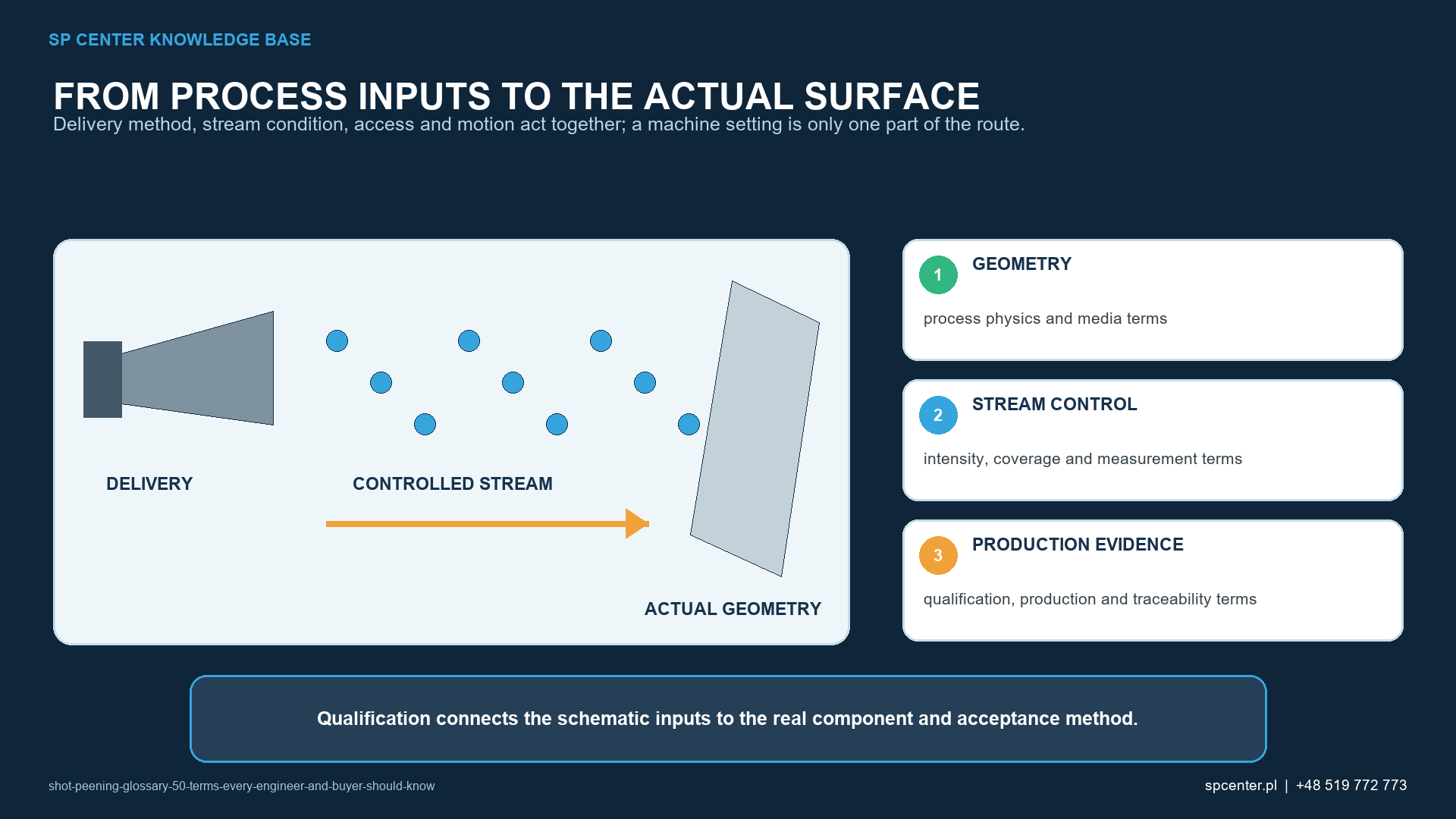
Process and delivery terms
| No. | Term | Working definition |
|---|---|---|
| 1 | Shot peening | Controlled impact treatment intended to modify the near-surface condition, commonly by introducing compressive residual stress; it is not defined by cleaning alone. |
| 2 | Shot blasting / blast cleaning | Abrasive or impact blasting primarily specified for cleaning, scale removal or surface preparation; it is not automatically controlled shot peening. |
| 3 | Peening stream | The moving population of media delivered toward the target under the defined equipment and process conditions. |
| 4 | Air-blast peening | Peening in which compressed air accelerates media through a nozzle. |
| 5 | Wheel peening | Peening in which a rotating wheel accelerates and directs media; not automatically interchangeable with air-blast peening. |
| 6 | Peening media | Qualified particles used to create controlled impacts, such as specified metallic, glass or ceramic media. |
| 7 | Shot | A particle or population of particles used as peening media; its material, size, hardness, shape and condition matter. |
| 8 | Impact angle | Angle at which the media trajectory meets the local component surface under the stated convention. |
| 9 | Stand-off distance | Controlled distance between the nozzle or other defined stream origin and the target or verification surface. |
| 10 | Exposure time | Duration for which a location receives the peening stream under the defined motion and process conditions. |
Table 1. Terms 1-10 describe the process purpose, stream and delivery geometry.
Almen intensity and saturation terms
| No. | Term | Working definition |
|---|---|---|
| 11 | Almen strip | Standardized steel test strip used with the specified holder and gage to determine and verify peening intensity. |
| 12 | A strip | Almen strip designation used for an applicable middle response range; selection follows the governing requirement and expected intensity. |
| 13 | N strip | Thinner Almen strip designation used for lower response ranges than an A strip; values are not directly interchangeable between designations. |
| 14 | C strip | Thicker Almen strip designation used for higher response ranges than an A strip; use only where specified or technically justified. |
| 15 | Almen strip holder | Standardized fixture that constrains the strip during exposure in the required orientation. |
| 16 | Almen gage | Instrument used to measure the arc height of an exposed Almen strip under the applicable procedure. |
| 17 | Arc height | Measured curvature response of the exposed strip; it is not component residual stress. |
| 18 | Saturation curve | Fitted relationship between strip arc height and exposure used to determine saturation and intensity. |
| 19 | Saturation | Point determined from the valid curve by the governing procedure, commonly using the doubling-time criterion; it is not component coverage. |
| 20 | Almen intensity | Arc-height value at the saturation point, reported with the strip designation and applicable units or convention. |
Table 2. Terms 11-20 describe standardized stream verification and must not be converted directly into component stress.
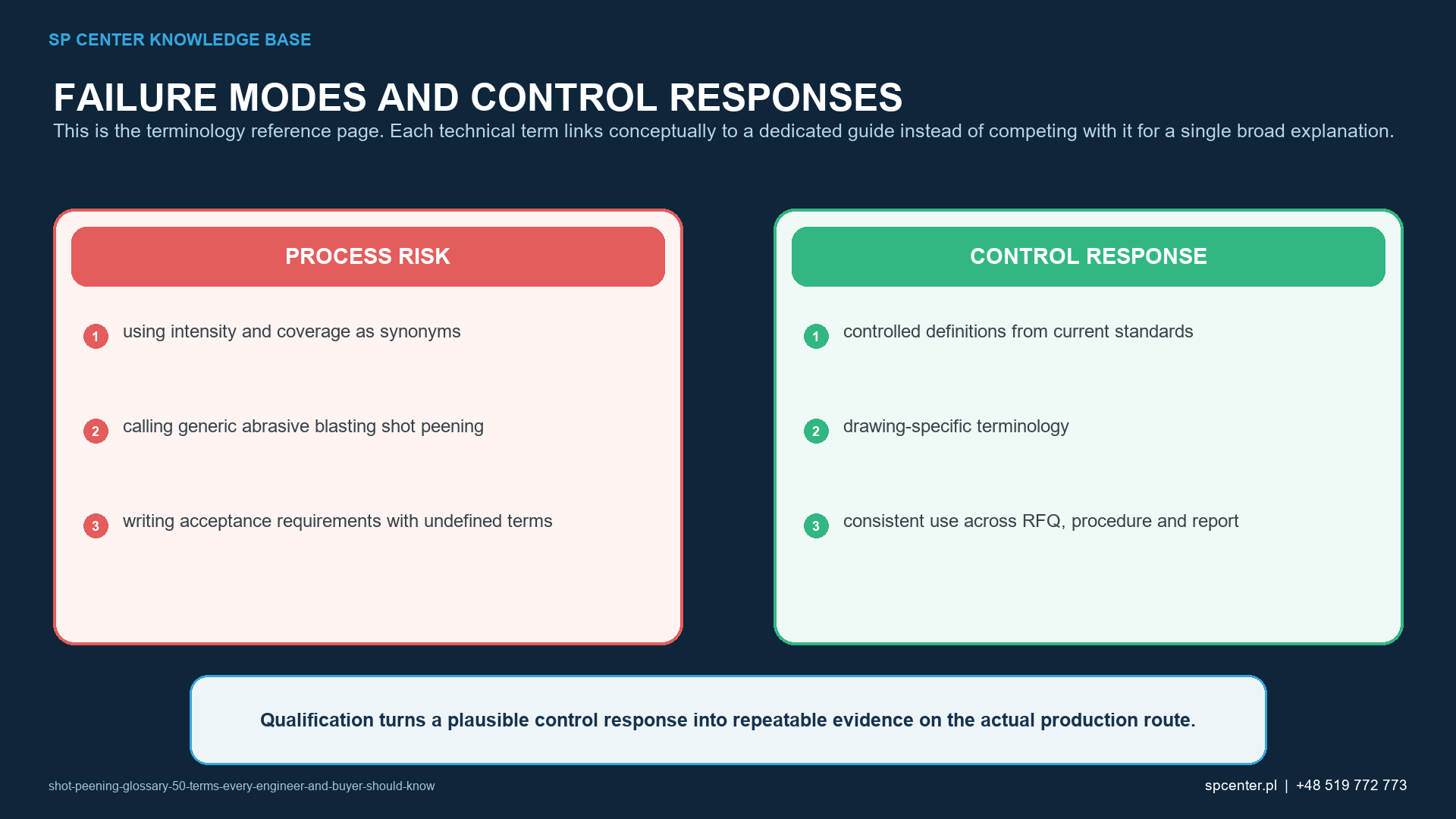
Coverage, motion and protection terms
| No. | Term | Working definition |
|---|---|---|
| 21 | Coverage | Extent to which the specified surface shows impact evidence when evaluated by the approved method. |
| 22 | 100% coverage | Complete coverage of the required surface with no visible unpeened areas under the approved evaluation method. |
| 23 | 200% coverage | When defined by the governing requirement, total exposure equal to twice the time required to achieve 100% coverage; not a claim of two physical layers. |
| 24 | Dwell time | Time the stream remains over a location without the normal translating or scanning motion. |
| 25 | Traverse speed | Controlled linear speed of nozzle, wheel footprint or component relative to the treated surface. |
| 26 | Rotation speed | Controlled angular speed of the part or delivery device during exposure. |
| 27 | Footprint overlap | Planned overlap between adjacent stream passes needed to avoid gaps or excessive local dwell. |
| 28 | Masking | Qualified physical protection used to prevent or limit impact on an excluded surface. |
| 29 | No-peen area | Surface explicitly excluded from peening by the controlled drawing, specification or approved process plan. |
| 30 | Transition zone | Controlled boundary between treated and excluded areas, including any permitted feathering or tolerance. |
Table 3. Terms 21-30 describe impact evidence, exposure motion and treatment boundaries.
Media and equipment terms
| No. | Term | Working definition |
|---|---|---|
| 31 | Media size | Specified particle-size designation and its verified distribution; nominal label alone does not describe every particle. |
| 32 | Media shape | Roundness and defect condition of particles, including unacceptable elongated, sharp or broken forms where the requirement defines them. |
| 33 | Media hardness | Hardness range of the peening media measured and controlled by the applicable specification or method. |
| 34 | Operating mix | In-machine media population resulting from controlled additions, use, wear, classification and removal. |
| 35 | New media | Unused media meeting the applicable procurement requirement before it enters the operating system. |
| 36 | Broken particle | Media fragment or fractured particle that can change impact behaviour and surface-damage risk. |
| 37 | Media contamination | Unwanted foreign material, wrong media or incompatible carryover in the peening system. |
| 38 | Classifier / separator | Equipment that removes or separates particles according to size, shape, density or another controlled characteristic. |
| 39 | Media mass flow | Mass of media delivered per unit time; it is distinct from compressed-air flow and air pressure. |
| 40 | Nozzle or wheel speed | Controlled delivery setting that influences particle velocity and stream behaviour but does not alone define intensity. |
Table 4. Terms 31-40 describe the media population and the delivery system that must remain controlled.
Component response and quality terms
| No. | Term | Working definition |
|---|---|---|
| 41 | Compressive residual stress | Residual stress component in compression at a defined location and direction after external loads are removed. |
| 42 | Residual-stress depth profile | Residual-stress values evaluated versus depth for stated location, direction, method and material-removal procedure. |
| 43 | Surface roughness | Measured surface-texture characteristic reported with the selected parameter, filter, cut-off or evaluation length and direction. |
| 44 | Surface integrity | Combined condition of surface and near-surface region, including defects, texture, microstructure, hardness and residual stress as relevant. |
| 45 | Cold work | Plastic deformation and associated microstructural change created without bulk heat treatment; the measured indicator must be named. |
| 46 | Distortion | Change in dimensions or form caused or revealed by processing; it can be local or global. |
| 47 | Qualification | Documented demonstration that a defined configuration can meet specified process and component requirements. |
| 48 | Requalification | Renewed qualification after a change, lapse or condition defined by the governing requirement or approved control plan. |
| 49 | Traceability | Ability to link part and batch identity to requirements, equipment, media, fixture, program, inspections and release records. |
| 50 | Nonconformity | Failure to meet a specified requirement; its disposition must follow the authorized quality system. |
Table 5. Terms 41-50 describe component condition, qualification and records rather than machine settings.
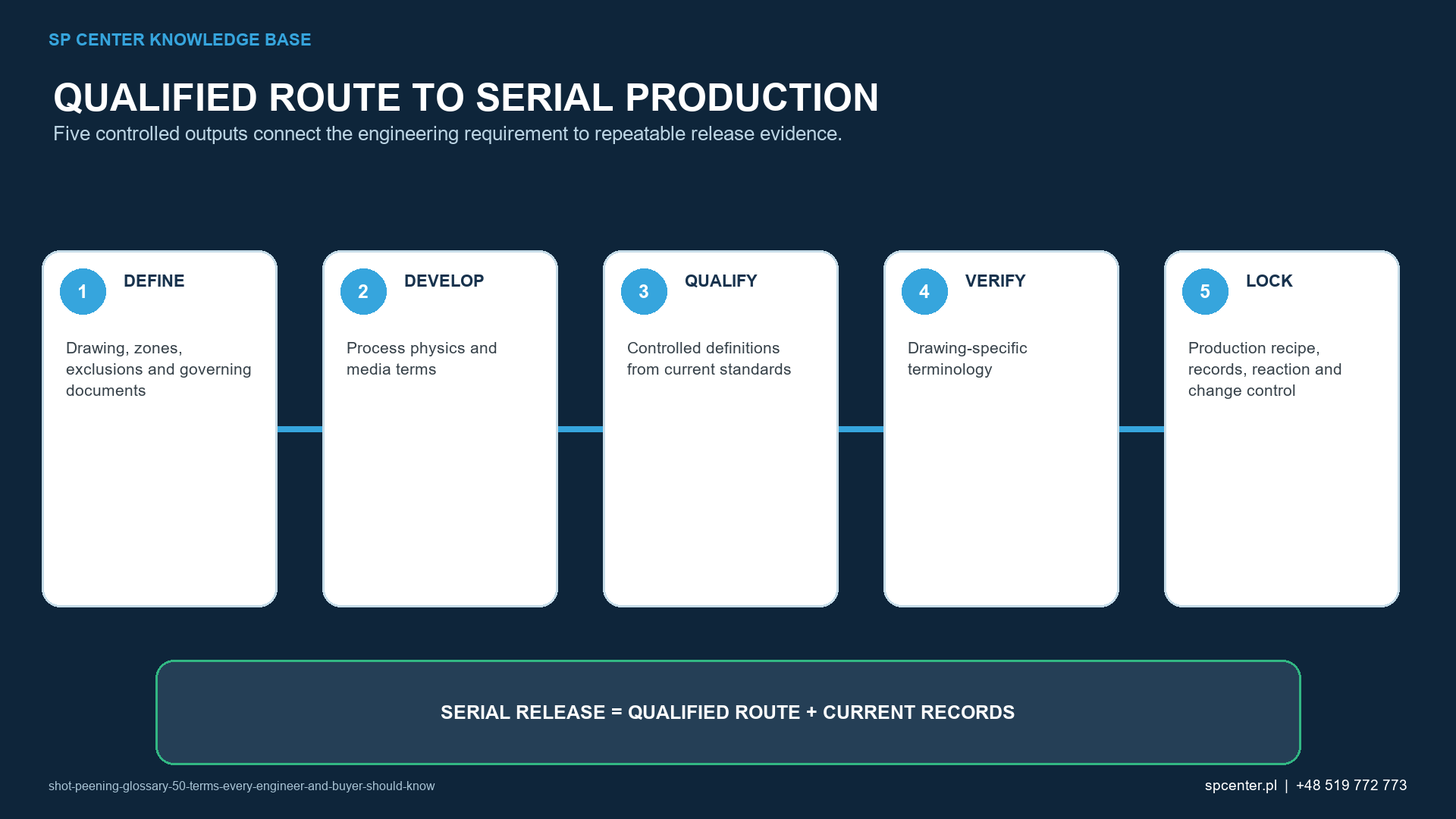
Which terms must never be used as synonyms?
| Terms often confused | Correct distinction |
|---|---|
| Intensity vs coverage | Intensity characterizes the verified stream; coverage evaluates impact evidence on the specified component surface. |
| Arc height vs residual stress | Arc height is the Almen strip response; component residual stress is a location- and direction-specific material quantity. |
| Exposure vs intensity | Exposure is time or pass history; intensity comes from a valid saturation-curve procedure. |
| Operating mix vs new media | Operating mix is the in-machine distribution after use and classification; new media is the procurement input. |
| Shot peening vs shot blasting | Peening is a controlled surface-enhancement process; blasting can be specified only for cleaning or preparation. |
| Qualification vs production release | Qualification proves a configuration can work; release verifies the actual batch against the approved requirements. |
Table 6. These distinctions prevent common specification, purchasing and audit errors.
How should engineers use the glossary in a drawing or RFQ?
Define the requested result and its authority before listing machine settings. A complete requirement identifies part and revision, material and heat treatment, treatment and exclusion zones, invoked standard and revision, Almen strip designation and intensity, coverage definition, media, surface and dimensional limits, records and deviation authority.
Avoid isolated phrases such as “fully peened”, “high intensity”, “standard shot” or “light blasting”. They do not define a measurable process or acceptance condition. Where the customer uses a different established term, keep the contractual wording and add a controlled clarification instead of silently changing meaning.
Frequently asked questions
Are shot peening and shot blasting synonyms?
No. Shot blasting commonly describes cleaning or surface preparation, while controlled shot peening requires defined process verification and component acceptance.
Are intensity and coverage the same?
No. Intensity is determined from Almen strip response and saturation; coverage is impact evidence on the specified surface.
Is arc height the residual stress in a component?
No. Arc height is the standardized strip response. Component residual stress requires a defined measurement at a stated location and direction.
Does 200% coverage mean two coating layers?
No. When the requirement uses this definition, it means twice the exposure time required for 100% coverage.
Is operating mix the same as new media?
No. Operating mix is the circulating in-machine population shaped by additions, wear, classification and removal.
Can machine pressure be used as a synonym for intensity?
No. Pressure is one pneumatic input. Intensity is verified through the applicable Almen saturation procedure.
What is the preferred German term for shot peening?
Verfestigungsstrahlen is the precise industrial term in this series. Kugelstrahlen is not used as a universal translation because the process may use non-metallic media and the word can be ambiguous.
Which document controls a term when definitions differ?
The drawing, contract, invoked specification and customer flow-down control. Record and resolve conflicts before processing.
Key takeaways
- Use shot peening only for the controlled enhancement process, not as a generic name for blasting.
- Keep Almen intensity, coverage, exposure and component residual stress separate.
- Report strip designation with intensity and the evaluation method with coverage.
- Describe operating mix independently from new-media procurement.
- Define component response by location, direction, method and acceptance authority.
- Let controlled contractual documents resolve terminology conflicts.
Related SP Center guides
Technical references
1. SAE J2441_202511: Shot Peening, stabilized November 2025
2. SAE AMS2430U: Shot Peening, revised April 2018
3. SAE AMS2431E: Peening Media, General Requirements, revised April 2023
4. SAE J442_202602: Tools for Peening Intensity Determination and Verification, revised February 2026
5. SAE J443_202512: Procedures for Determining and Verifying Peening Intensity, revised December 2025
6. SAE J2277_202301: Shot Peening Coverage Determination, revised January 2023
7. SAE ARP7488: Peening Design and Process Control Guidelines, issued January 2018
Standards note: Working definitions support communication but do not reproduce every normative clause. Use the complete controlled revision invoked by the job.
Author: Paweł Kmieć
Clarify a shot peening requirement with SP Center: +48 519 772 773 | [email protected]