


Define fine-media distribution, shape, hardness and equipment capability, then verify intensity, coverage, roughness and component response separately
Micro shot peening uses substantially finer media than a conventional comparison route to produce a finer impact field or improve access to small features. There is no universal particle-size threshold that makes every proprietary process equivalent. It is also not automatically low damage: media hardness, density, shape, velocity, equipment capability and incoming surface still determine roughness, residual stress, deformation and risk.
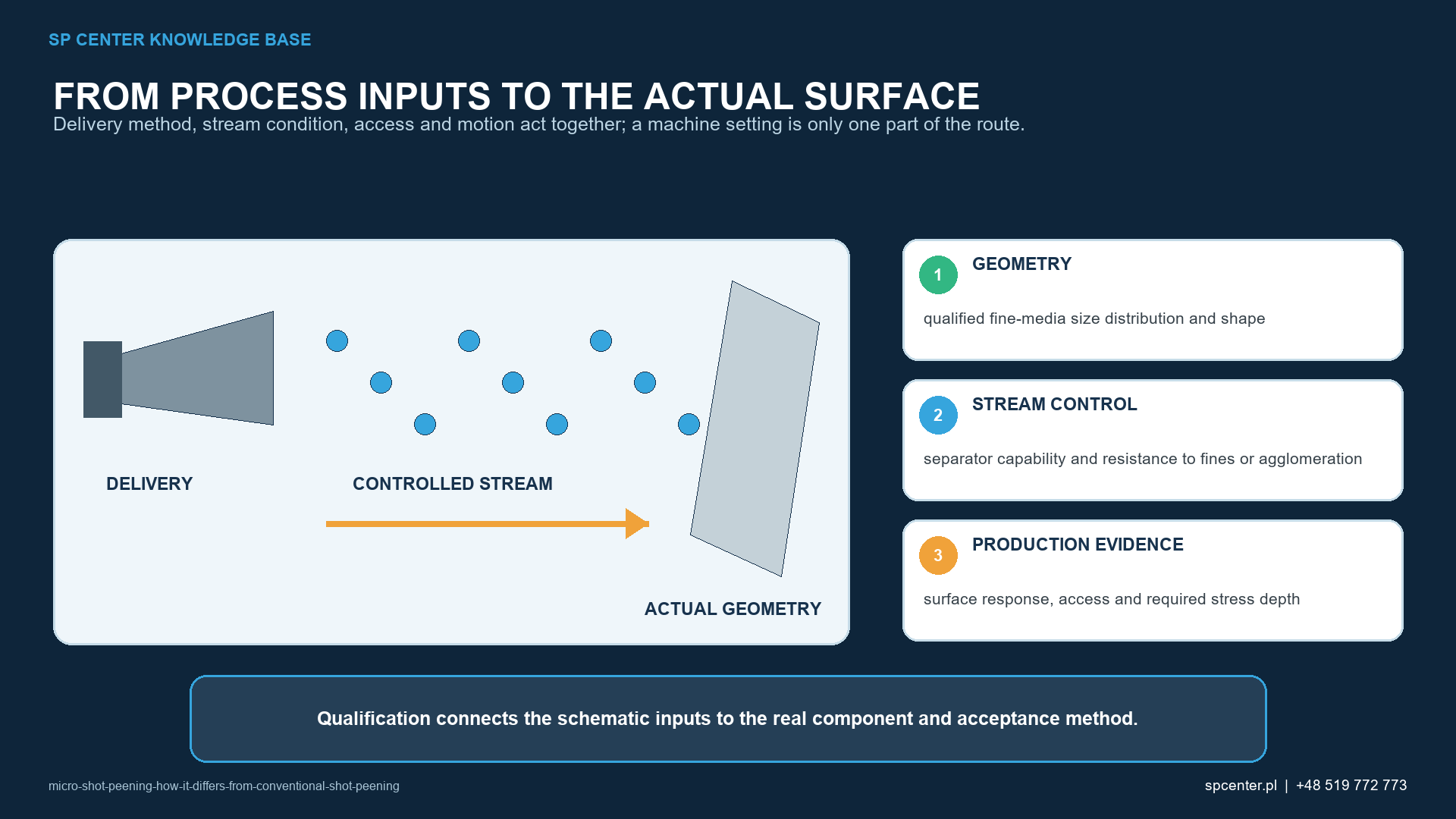
How does micro shot peening differ from conventional peening?
| Engineering difference | Fine-media implication | Qualification question |
|---|---|---|
| Particle size | Smaller individual impact and potentially finer footprint | Does the invoked specification define the permitted distribution and method? |
| Access | Smaller media may reach narrow features more readily | Can equipment deliver and recover it consistently at the real geometry? |
| Surface texture | A finer texture may be possible under comparable conditions | Do hardness, velocity, shape and exposure still meet roughness and damage limits? |
| Affected depth | A shallower response may occur | Does the measured residual-stress or material response meet the actual design need? |
| Equipment | Feeders, valves, separators and sensors can lose resolution | Is the machine qualified for the fine operating mix rather than merely capable of moving it? |
| Inspection | Small impressions can be harder to distinguish | Can the approved intensity and coverage methods resolve the required result? |
Table 1. The process is compared through physical scale and qualified outputs, not through its marketing name.
Fine media can create smaller impressions and may affect a shallower material volume, but this is a tendency rather than a universal design rule. A high-velocity hard particle can still damage an edge, thin wall, coating or sensitive surface.
Is micro peening the same as microblasting?
No automatic equivalence exists. Microblasting often describes a fine abrasive stream used to clean, deburr, roughen or texture. Controlled peening is defined by the intended mechanical surface effect and by qualified media, intensity, coverage, exposure, equipment and records.
If one component needs both cleaning and peening, specify two functions and their sequence. Do not use a cleaning result as evidence of peening intensity or coverage.
Why is the operating media mix difficult to control?
| Fine-media control | Failure mode | Evidence |
|---|---|---|
| Incoming size distribution | Wrong fraction or broad distribution | Approved procurement specification and lot inspection |
| Shape and broken particles | Angular or fractured particles change surface response | Defined morphology method and rejection limits |
| Hardness and material | Small particles are assumed to be gentle despite high hardness or speed | Material certificate and applicable verification |
| Feeding and mass flow | Pulsing, blockage or poor metering resolution | Capability trial and trended delivery data |
| Separation and recovery | Fines, oversize, foreign media or agglomerates remain in the mix | Classifier or separator study and operating-mix checks |
| Moisture, static and cleanliness | Agglomeration, adhesion or contamination changes delivery | Controlled storage, environment, cleaning and reaction plan |
Table 2. Fine media require a measurement system and equipment resolution matched to their scale.
A separator that works for a conventional mix may not remove the relevant fine or oversize fractions at smaller scale. Screens can blind, particles can agglomerate and foreign media can be proportionally more significant. Qualification challenges the actual machine and recovery loop.
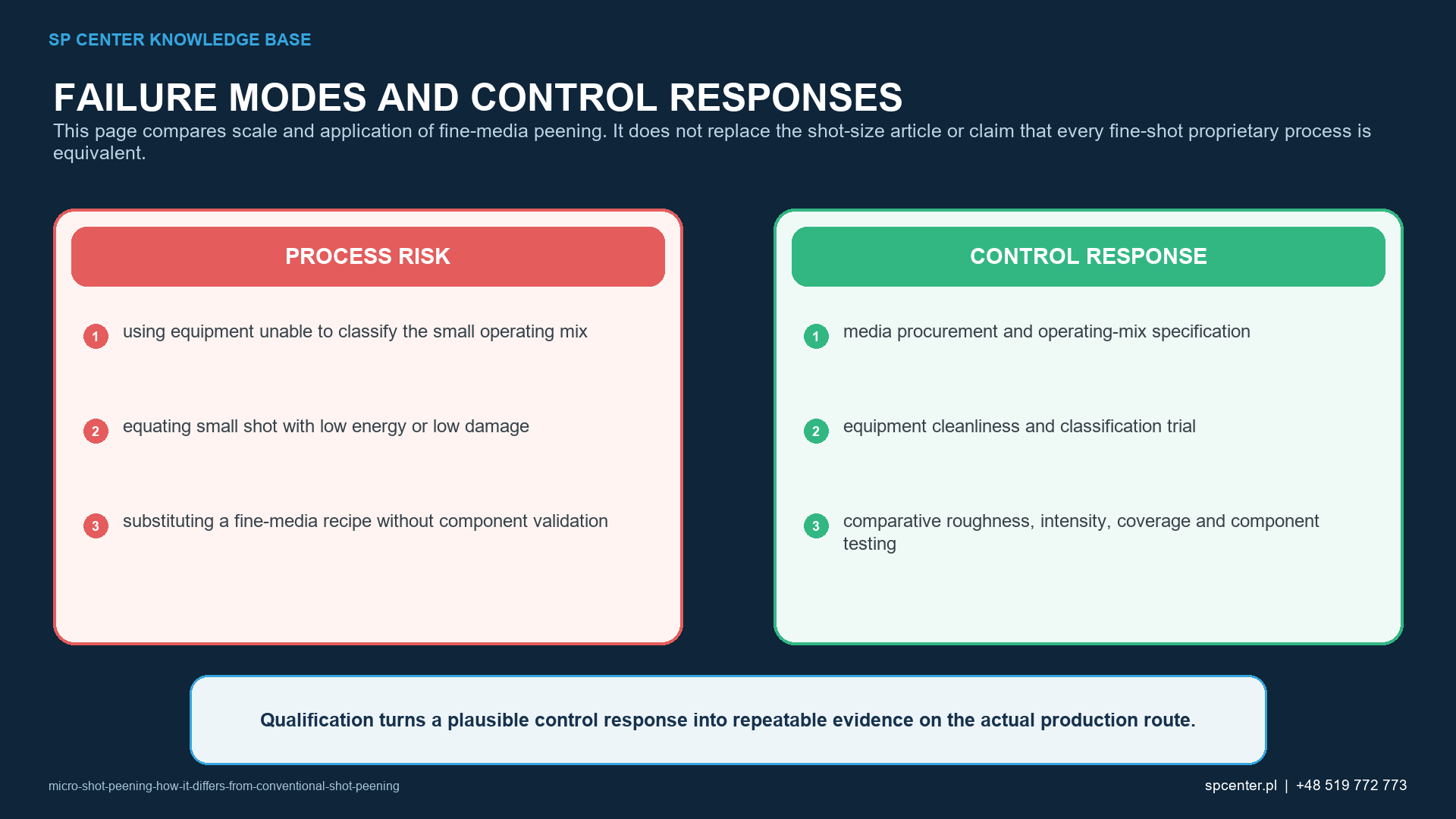
Which delivery variables matter?
For pneumatic equipment, air pressure, airflow and media mass flow are different quantities. Nozzle bore, distance, angle and wear influence velocity and footprint. For other delivery systems, speed, feed and pattern controls must offer adequate stability and resolution.
Do not select a nominal pressure as a universal intensity setting. Establish the required intensity through the applicable method and control the complete qualified configuration.
How are intensity and coverage measured?
The governing requirement determines whether the Almen system provides suitable range and resolution. Any alternative witness, transfer curve or correlated method requires explicit approval and validation; it must not be invented because a result is difficult to measure.
Small impact marks can be difficult to distinguish from the starting texture. Coverage inspection therefore needs adequate optics, lighting, focus, sampling and decision rules. Fluorescent or tracer methods remain indirect and require approval and correlation.
Which result proves the component benefit?
| Claim | Relevant evidence | Invalid shortcut |
|---|---|---|
| The stream has the specified intensity | Applicable Almen or expressly approved correlated method with saturation evidence | Pressure, speed or media size alone |
| The surface has the specified coverage | Approved observation method with sufficient resolution at the required feature | Assuming longer exposure guarantees 100% |
| Roughness is acceptable | Defined profile or areal method, filter, direction and locations | Describing the texture as visually fine |
| Residual-stress depth is suitable | Validated XRD or another invoked stress method and removal protocol | Inferring depth from particle diameter |
| Fatigue or functional benefit is achieved | Representative specimen or component validation when required | Treating micro peening as automatically low damage |
Table 3. Fine media do not collapse five different engineering questions into one result.
Residual-stress depth, cold work, hardness, roughness, dimensions and fatigue response depend on material and process. When a design claim relies on one of them, qualify and measure that output on representative material and geometry.
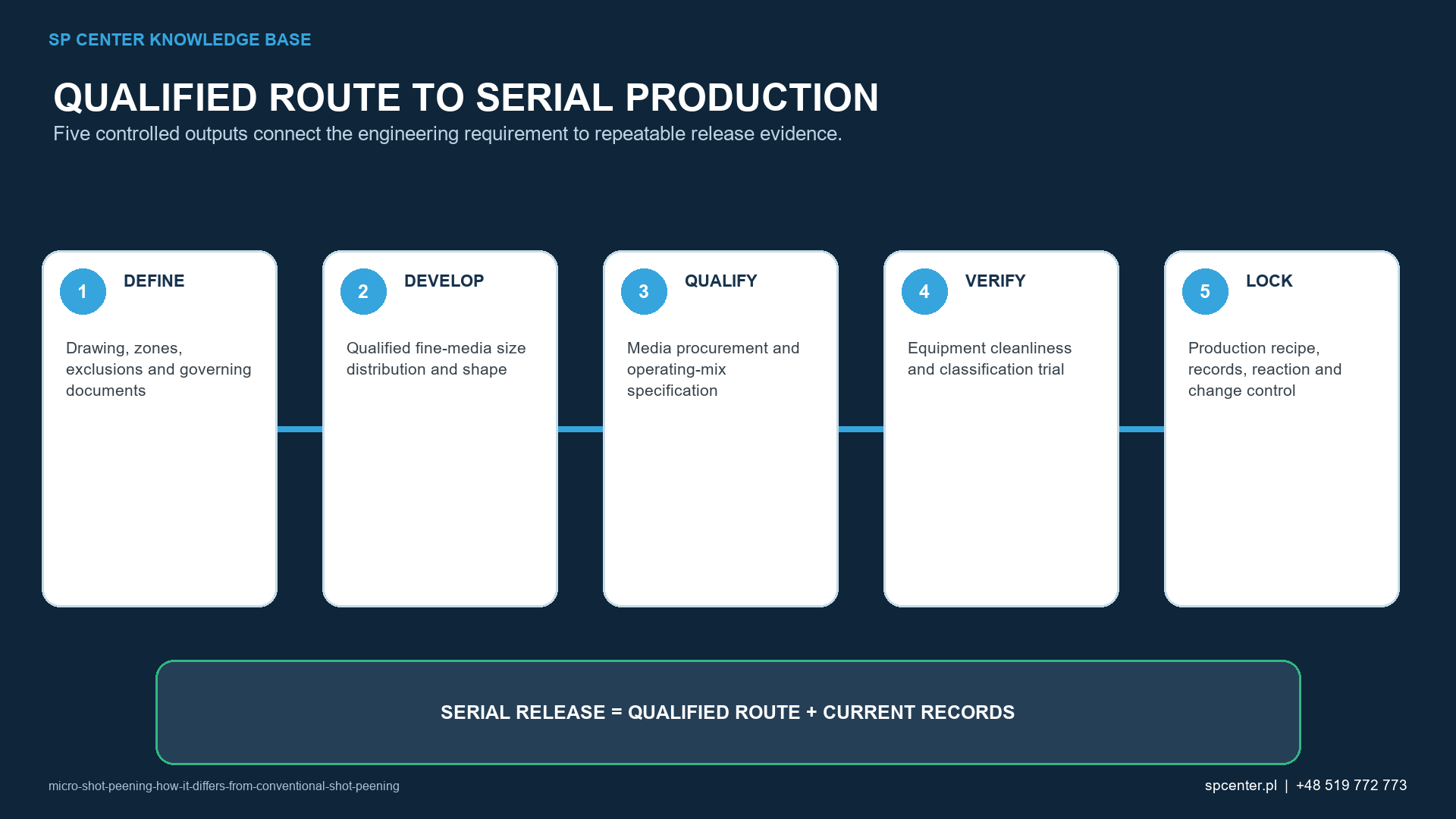
How should the process be qualified?
- Freeze drawing, material condition, treatment map, governing specifications and acceptance outputs.
- Define new and operating media by size distribution, material, hardness, shape and contamination limits.
- Qualify feeding, classification, recovery, storage, cleaning and measurement capability.
- Use production-representative geometry, tooling, motion and least-accessible features.
- Verify intensity, coverage, roughness, dimensions and any performance result separately.
- Approve serial checks, action limits, records, maintenance and requalification triggers.
A recipe does not transfer merely because two media have similar nominal size. Density, hardness, shape, distribution, equipment and component geometry must remain within the approved basis.
Which events require containment?
- Incoming media or operating mix cannot be classified by the approved method.
- Feeding pulses, blocks or drifts below the measurement capability.
- Foreign media, moisture, agglomeration or contamination is found.
- Intensity method or coverage observation lacks adequate resolution.
- Roughness, dimensions or surface integrity exceed the invoked limit.
- A conventional or proprietary recipe was substituted without component validation.
Contain affected batches to the last known acceptable state. Reprocessing requires explicit authority because further fine-media exposure can still change roughness, cold work and residual stress.
Frequently asked questions
What is micro shot peening?
It is a controlled shot peening route using media substantially finer than a conventional comparison route to create a finer impact field or improve access. The governing specification or qualification must define the actual media and process.
Is there a universal particle size for micro shot peening?
No. Terminology varies across suppliers and proprietary processes. Use the exact size distribution, material, shape and acceptance method invoked by the project.
Is micro shot peening always gentler?
No. Media hardness, density, shape, velocity, angle, exposure and incoming surface can still create roughness or damage. A smaller particle does not by itself prove low energy or low risk.
Is micro shot peening the same as microblasting?
Not automatically. Microblasting may be used for cleaning, deburring or texturing. Shot peening requires controlled impact intended to create a qualified mechanical surface effect with intensity, coverage and traceability.
Can conventional equipment use fine media?
Only if feeding, metering, classification, recovery, filtration, sensors, cleaning and inspection are capable and qualified for the fine operating mix.
How is coverage checked with very small impressions?
Use an approved method with suitable optics, lighting, image analysis or qualified tracer correlation. The method must distinguish impact evidence from roughness and contamination.
Does low Almen intensity mean shallow residual stress?
Not as a universal conversion. Intensity is a standardized stream characteristic. Material, media and process determine the residual-stress profile, which requires its own measurement when specified.
What belongs in a micro-peening RFQ?
Provide drawing, material and heat treatment, treatment zones, exact media requirement if known, intensity and coverage, roughness and dimensional limits, required residual-stress or performance evidence, quantity and records.
Key takeaways
- No universal particle-size threshold defines every micro shot peening route.
- Fine media are not automatically gentle or low energy.
- Feed, classification, recovery and inspection must resolve the finer operating mix.
- Microblasting for cleaning or texture is not automatically controlled peening.
- Intensity, coverage, roughness, residual stress and fatigue remain separate results.
- Alternative measurement methods require approval and correlation.
Related SP Center guides
Technical references
1. SAE J2441_202511: Shot Peening, stabilized November 2025
2. SAE AMS2430U: Shot Peening, revised April 2018
3. SAE AMS2431E: Peening Media, General Requirements, revised April 2023
4. SAE ARP7488: Peening Design and Process Control Guidelines, issued January 2018
5. SAE J443_202512: Procedures for Determining and Verifying Peening Intensity, revised December 2025
6. SAE J2277_202301: Shot Peening Coverage Determination, revised January 2023
Standards note: Use the complete documents invoked by drawing and contract. “Micro” does not create a universal media range, intensity method or acceptance rule.
Author: Paweł Kmieć
Discuss a fine-media shot peening requirement: +48 519 772 773 | [email protected]