


Identify the component fatigue mechanism, qualify the actual part family and production route, and maintain evidence at automotive cycle time
Automotive shot peening delivers its greatest value where fatigue initiates at a controlled surface and a repeatable production process can be linked to component-specific validation. Selected springs, gears, shafts, crankshafts, connecting rods and transmission parts are established applications, but the business case is not a universal durability multiplier. It depends on material condition, geometry, access, surface acceptance, automation, production volume and the customer approval route.
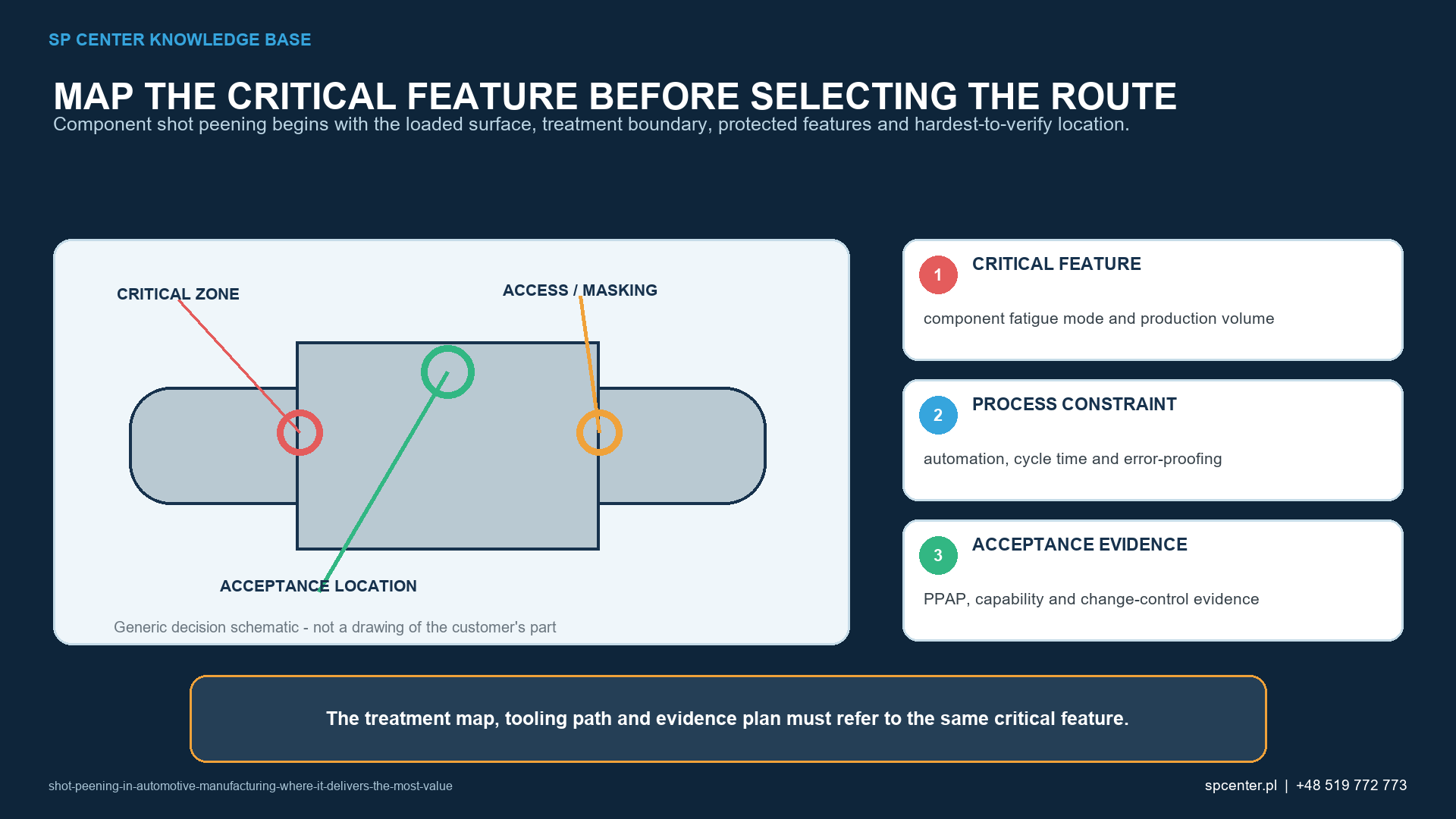
Where can automotive shot peening deliver value?
| Application | Why peening may be considered | Qualification focus |
|---|---|---|
| Coil, leaf or torsion spring | Surface-initiated cyclic loading, including feature-specific bending or torsion | Wire/leaf condition, decarburisation, hardening state, access, coverage, relaxation and durability |
| Gear or transmission component | Tooth-root or other local fatigue-sensitive surface | Root access, impact angle, media size, masking, surface finish, distortion and representative fatigue evidence |
| Shaft or crankshaft feature | Fillet, journal transition, oil-hole or other stress concentration | Feature map, access, dimensions, prior machining, hardness and location-specific acceptance |
| Connecting rod or forged component | Selected transition, bore or fillet with surface-sensitive fatigue mode | Forging/machining condition, residual scale or defects, geometry, media retention and component validation |
| General high-volume part | Repeatable surface treatment can support an already justified design route | Part-family boundary, production rate, control plan, measurement capability and change approval |
Table 1. Application families share a process principle, not an automatically transferable recipe.
Peening is considered only after the design team identifies a surface-sensitive fatigue mechanism and the incoming part is acceptable. It cannot repair a crack, forging fold, grind burn, decarburised layer, corrosion damage or dimensional nonconformance. Those conditions require detection and authorised disposition before peening.
Why must the part-family boundary be explicit?
A family should be justified by the variables that govern response: alloy and heat treatment, hardness, manufacturing history, surface condition, geometry, stress concentration, access, loading and acceptance method. A recipe proven on one spring diameter, tooth root or fillet does not transfer merely because the new part uses the same vehicle platform or machine.
The qualification should represent the most difficult prescribed feature and the intended production rate. Short cycle time is a constraint to validate, not evidence that coverage or the component result has been achieved.
What must a high-volume process control?
| Control layer | Controlled variables | Required evidence/reaction |
|---|---|---|
| Striking media | Specification, size/shape condition, hardness, contamination, operating mix and replenishment | Sampling/classification plan, separator limits, segregation and out-of-limit containment |
| Energy and flow | Air pressure/flow and media mass flow, or wheel speed and feed, as applicable | Qualified settings plus monitored limits; Almen verification remains independent |
| Geometry and motion | Nozzle/wheel position, angle, stand-off, fixture, orientation, speed, indexing and cycle | Locked program/tooling, error-proofing and challenge of the worst-access feature |
| Output verification | Almen intensity, coverage, surface/dimensions and invoked component checks | Defined method, location, frequency, acceptance and reaction plan |
| Production system | Maintenance, alarms, measurement system, traceability and software/recipe access | Approved control plan, response to drift and controlled restoration of the last known-good state |
Table 2. Repeatability comes from the coupled process system and its reaction plan.
Air-blast and wheel equipment can both support automotive production, but they are not automatically interchangeable. They differ in stream geometry, access and the way energy and media flow are controlled. Equipment selection follows the component, required zones, throughput and qualified evidence.
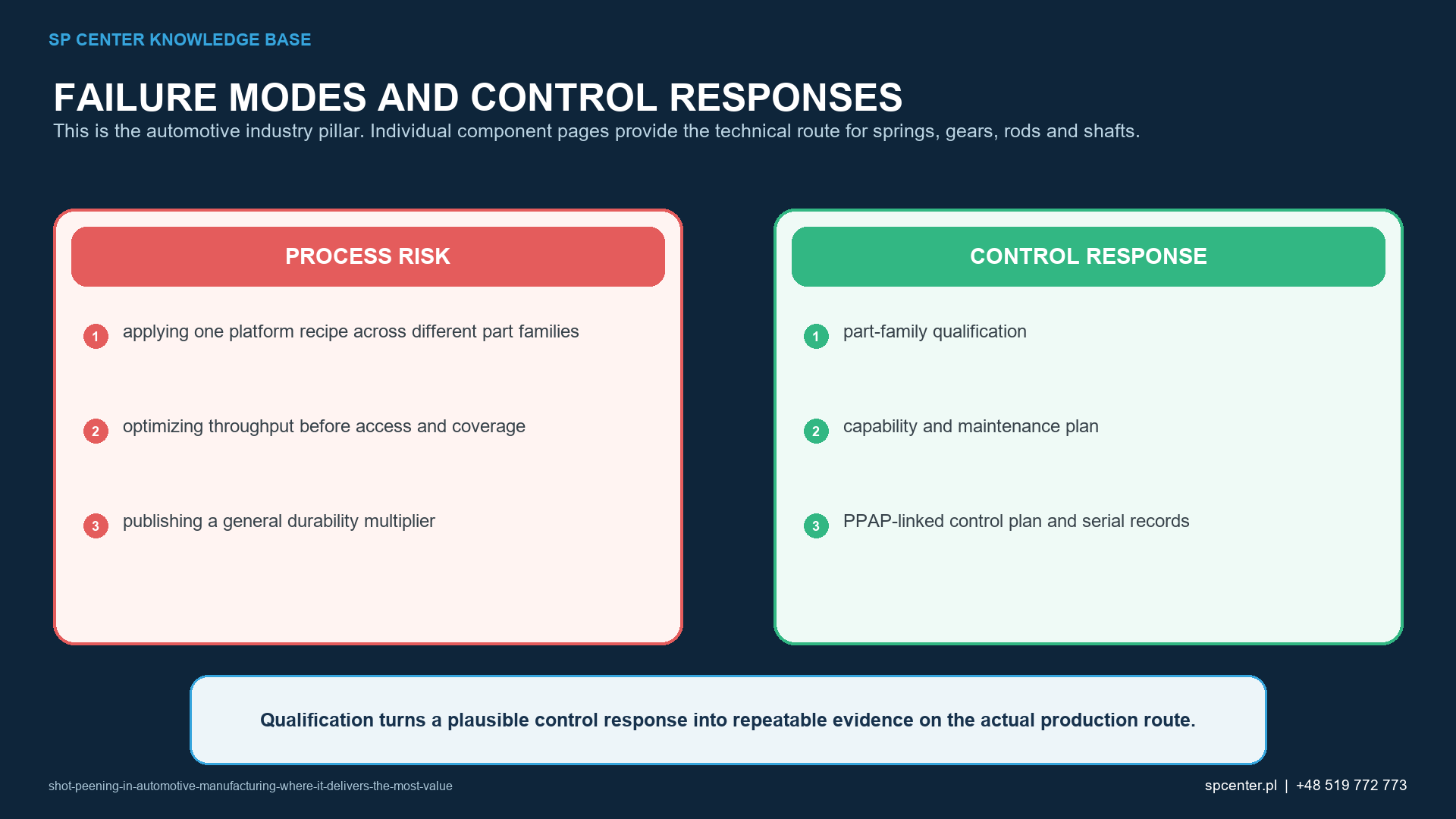
How should automotive qualification and PPAP evidence be separated?
| Evidence level | Question answered | Boundary |
|---|---|---|
| Almen intensity and saturation/verification | Does the defined stream produce the required standardised response? | Does not prove component coverage, residual-stress profile or durability |
| Coverage and treatment-zone evidence | Did the prescribed surface receive the required impact coverage by the approved method? | Does not prove correct intensity or fatigue benefit |
| Surface and dimensional acceptance | Are roughness, damage, masking, cleanliness and dimensions within invoked limits? | Does not establish life improvement |
| Part-family/representative validation | Does the route satisfy the stated component mechanism and performance criteria? | Transfer is limited to the justified family and configuration |
| Production and PPAP/customer evidence | Is the approved process reproduced at production rate with required records? | Submission content and approval depend on customer-specific requirements |
Table 3. No single surrogate proves process control, component acceptance and durability.
AIAG describes PPAP as the production-part approval process used to demonstrate that design-record and specification requirements can be met consistently at production rate. PPAP is not automatically the governing route for every customer or programme: use the level, customer-specific requirements, control plan, measurement-system evidence and notification rules actually invoked by the contract.
Qualification should use production-representative machine, media, separator, tooling, motion, program, preparation and inspection. Lock the approved configuration only after intensity, coverage, surface/dimensions and any required component durability or residual-stress evidence have passed independently.
Which changes and failures require containment?
| Change or failure | Immediate action | Engineering decision |
|---|---|---|
| Media condition, flow, separator or intensity outside limit | Stop, identify affected interval and contain product | Restore control and determine verification, disposition and requalification scope |
| Coverage or access failure | Do not compensate automatically with extra exposure | Separate stream, motion, geometry and surface causes; authorise any cumulative reprocessing |
| New part number or altered geometry/material/heat treatment | Hold automatic transfer from the old recipe | Review part-family boundary and repeat affected qualification/approval evidence |
| Machine, wheel/nozzle, fixture, program or measurement change | Protect current baseline and trace affected production | Evaluate effect on intensity, coverage, component acceptance, MSA and customer notification |
| Crack, fold, grind burn, corrosion or other incoming defect | Segregate before peening | Use the authorised defect/repair route; peening is not a repair method |
Table 4. The reaction protects both product and the approved production baseline.
Process capability is meaningful only for a stable, capable measurement system and a defined characteristic. A capability result for pressure, wheel speed or cycle time cannot substitute for coverage or component acceptance. Alarm-free production likewise does not prove an unmonitored feature.
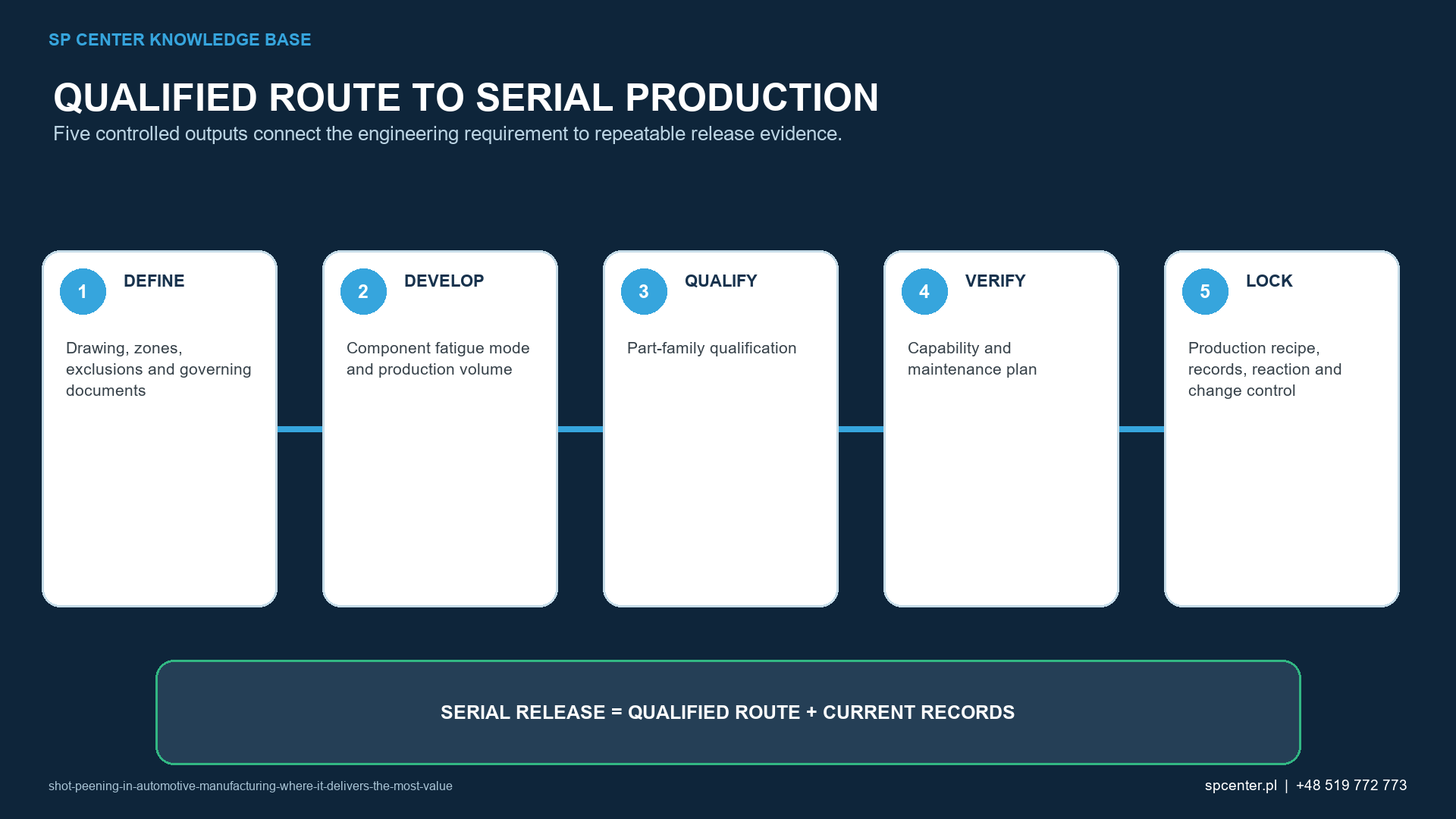
What belongs in the production record?
Link part number/revision and lot or serial identity to the approved machine, media, fixture and program. Record the invoked intensity and coverage evidence, required component inspections, operators/dates, deviations, maintenance or alarms that affect acceptance, and the applicable customer release or PPAP status. Retention and submission content follow the contract and customer-specific rules.
Which automotive components are commonly considered for shot peening?
Selected springs, gears, shafts, crankshafts, connecting rods and transmission parts are established application families. Suitability still depends on the actual fatigue mechanism, material condition, geometry, surface and customer requirement.
Can one shot peening recipe cover an entire vehicle platform?
Not automatically. Part family, material, hardness, geometry, access, fatigue mechanism and acceptance route define transferability. Shared equipment settings are not proof of a shared qualification.
Does high-volume automation guarantee coverage?
No. Automation improves repeatability only when tooling, orientation, motion, media stream and monitoring are qualified. Coverage on the specified component surface remains a separate acceptance question.
Is PPAP always required for automotive shot peening?
PPAP or another customer approval route applies when invoked by the customer or contract. The submission level, evidence and change-notification obligations must be taken from the applicable customer requirements.
Does correct Almen intensity prove longer component life?
No. Almen intensity verifies a standardised stream response. Coverage, surface condition, dimensions, residual stress and component durability require their own invoked evidence.
Are air-blast and wheel peening interchangeable?
No. Each offers different stream geometry, access, energy and flow controls. Selection and transfer require qualification on the actual component, equipment and production route.
Can a nonconforming part simply receive another cycle?
No. Additional exposure can alter roughness, dimensions, distortion and material response. The product must be contained and reprocessing authorised with cumulative exposure considered.
What should an automotive RFQ include?
Provide the controlled drawing/revision, material and heat treatment, part-family and fatigue-critical features, treatment/exclusion zones, specifications, intensity and coverage, surface/dimensional limits, volume, production rate, customer approval route and required records.
Key takeaways
- Start with the component fatigue mechanism and acceptable incoming condition.
- Define and justify the part-family boundary; do not copy one platform recipe indiscriminately.
- Qualify the actual equipment, media, tooling, motion, rate and worst-access feature.
- Keep Almen intensity, coverage, surface/dimensions and component durability as separate evidence.
- Use PPAP and customer-specific requirements only where invoked, with an approved control plan and change route.
- Contain excursions and changes; do not compensate automatically with extra exposure.
- Keep production records traceable to the approved configuration and actual batch.
Related SP Center guides
Technical sources
1. SAE J2441_202511: Shot Peening, stabilized November 2025
2. SAE J442_202602: Tools for Peening Intensity Determination and Verification, revised February 2026
3. SAE J443_202512: Procedures for Determining and Verifying Peening Intensity, revised December 2025
4. SAE J2277_202301: Shot Peening Coverage Determination, revised January 2023
5. SAE ARP7488: Peening Design and Process Control Guidelines, issued January 2018
6. AIAG PPAP-4, Production Part Approval Process
7. SAE Technical Paper 850365, Controlled Shot Peening of Automotive Components
Standards note: The controlled drawing, contract and customer-specific requirements determine the applicable revisions, submission route and acceptance. The SAE automotive paper is background literature, not a current universal process specification.
Author: Paweł Kmieć
Discuss an automotive shot peening project: +48 519 772 773 | [email protected]