


How to qualify the exact processing site, issue a controlled RFQ and manage evidence, lead time and cross-border delivery
Shot peening services in Europe should be purchased as a controlled special process, not as a generic surface treatment. A sound sourcing decision connects the exact processing site, contract requirements, component geometry, equipment, media, Almen intensity, coverage, qualification evidence, serial records and logistics. SP Center accepts European enquiries from its base in Rzeszów, Poland; capability, approvals, processing location, documentation, price and schedule must be confirmed for each project in the written quotation.
What are shot peening services in Europe?
The service applies a controlled stream of peening media to specified component surfaces under an approved requirement. Repeated impacts can create a beneficial near-surface compressive residual-stress state and modify surface topography. The drawing, process specification and customer flow-down define the required zones, intensity, coverage, media, controls and acceptance evidence.
“In Europe” identifies geography, not a technical standard. A nearby processor may simplify communication, site access and transport, but location does not establish process capability. The customer must still verify where the work will physically be performed, which entity owns the records, whether subcontracting is permitted and whether the exact site meets every invoked approval.
What must a European RFQ contain?
| RFQ input | Minimum information | Decision supported |
|---|---|---|
| Controlled documents | Drawing and revision, purchase-order flow-down, process specification and document hierarchy | Which requirement governs and which questions require formal clarification |
| Part condition | Material, product form, heat treatment, hardness, incoming surface, dimensions and mass | Media compatibility, damage sensitivity, handling and distortion risk |
| Treatment definition | Marked peening zones, exclusions, transition limits, holes, threads, edges and masking | Access, tooling, protection and inspection feasibility |
| Process requirement | Complete Almen range and strip designation, coverage or exposure, media restrictions and monitored features | Technical route and verification basis |
| Demand and logistics | Prototype or serial status, lot pattern, annual demand, destination, packaging and target milestones | Capacity, tooling, transport and total lead time |
| Required evidence | Certificate, batch record, customer forms, FAI or other qualification and laboratory work when invoked | Scope of release records and quotation exclusions |
Table 1. Comparable quotations require the same controlled technical and commercial inputs.
A fast quotation based only on a part name or a generic request for “standard shot peening” is not technically comparable. Undefined intensity, coverage, media, masking or documentation will return later as clarification, qualification risk or a change in price and schedule. If a design input is genuinely open, identify the responsible authority and ask for a documented supplier proposal rather than hiding an assumption.
How should supplier site and approval scope be verified?
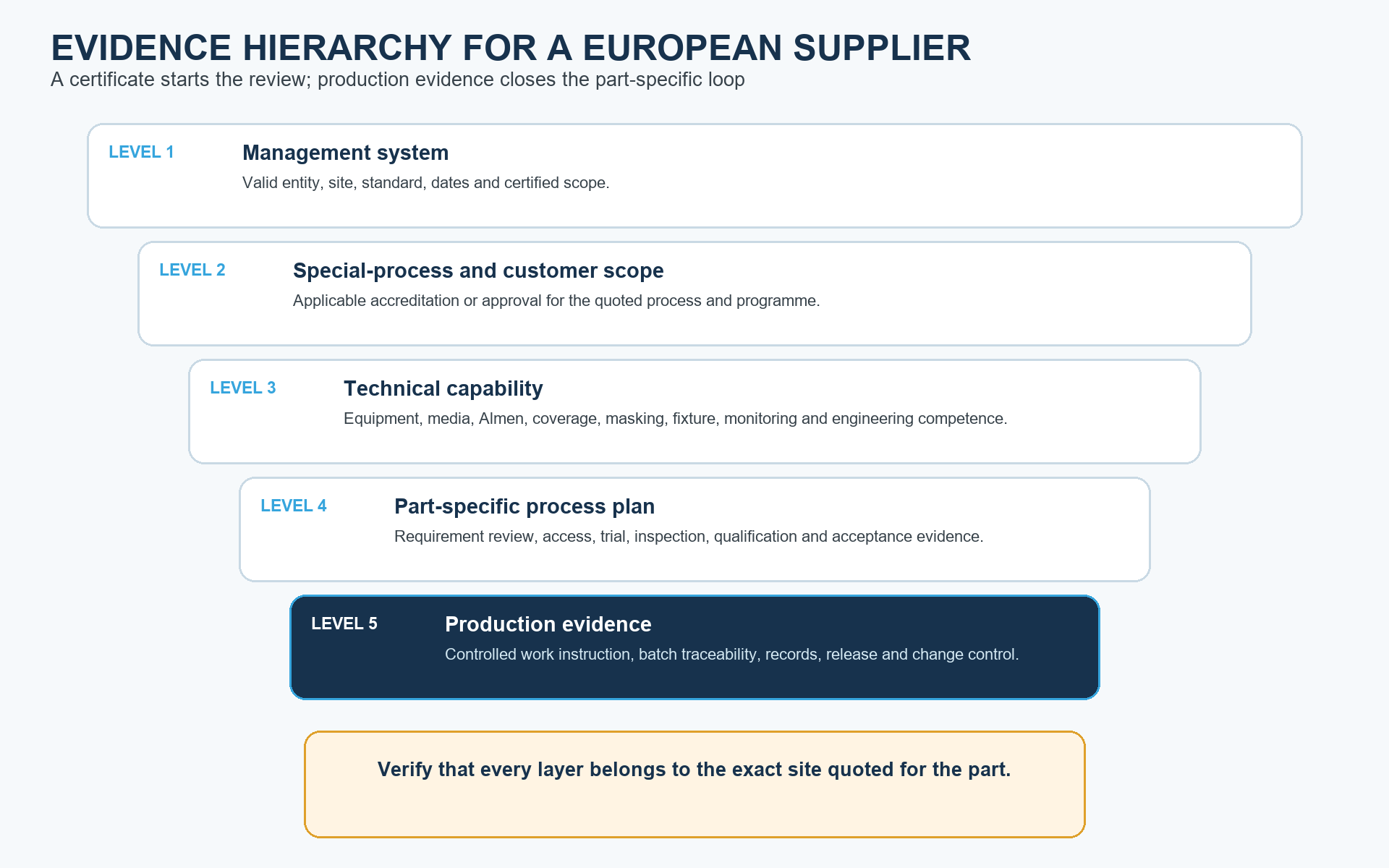
Confirm the legal entity and physical processing address in the quotation. Groups can operate several facilities with different machines, personnel, certificates, customer approvals and Nadcap scopes. Review the actual certificate or primary database record, including issuer, validity, standard, scope and exclusions. Confirm that the quoted operation remains at the reviewed site.
For Nadcap, use PRI’s published records or the eAuditNet Qualified Manufacturers List and verify the exact site and current special-process scope. Describe it as accreditation, not certification of the component. A customer or programme may additionally require approved-source status, a part qualification, a first article or its own release route.
| Evidence layer | What it supports | What it does not establish by itself |
|---|---|---|
| Management-system certification | The named legal entity, site, standard, validity and certified scope | Shot peening capability or approval for the quoted part |
| Nadcap accreditation | The exact site and published special-process scope shown in PRI records | Product certification or automatic approval for every customer, programme and specification |
| Customer or programme approval | Authorization within the stated customer route and limits | Transfer to another site, part family, process or revision |
| Technical capability | Suitable equipment, media control, Almen verification, coverage route, tooling and inspection | A released route for the actual component |
| Part or process qualification | Accepted evidence within a defined configuration and qualification basis | Permission for uncontrolled changes |
| Production-batch record | Traceable execution and acceptance of the approved route | A universal fatigue-life or residual-stress claim unless separately demonstrated |
Table 2. Each evidence layer has a distinct scope and cannot silently replace another.
How should process-control capability be assessed?
Ask the supplier to trace a representative job from contract review to release. The route should connect controlled documents to work instructions, equipment, media, Almen verification, coverage, masking, inspection, deviations, changes and batch records. A slide showing machine capacity or certificate logos is not equivalent to an executable and traceable part route.
| Control area | Evidence to review | Risk if unresolved |
|---|---|---|
| Almen intensity | Applicable strip, holder, gage, locations, determination or verification route, frequency and reaction plan | Machine pressure, wheel speed or time is mistaken for standardized stream evidence |
| Coverage and exposure | Approved inspection method, conditions, treatment boundary, difficult geometry and any exposure multiplier | A conforming intensity result hides incomplete or excessive treatment |
| Peening media | Specification, type, size distribution, shape, hardness, cleanliness, segregation, working mix and replenishment | Contamination or degraded media changes the surface response |
| Equipment and motion | Nozzle or wheel arrangement, fixture, part motion, programme, monitoring, maintenance and access control | The nominal setup does not represent the critical surface |
| Masking and handling | Materials, limits, installation, verification, removal, cleaning and retained-media controls | Prohibited surfaces are impacted or parts are damaged after processing |
| Change and nonconformance | Notification triggers, approval authority, containment, disposition and requalification rules | Serial production drifts beyond the approved basis |
Table 3. Supplier assessment should connect each control to evidence and a defined reaction.
What do Almen intensity and coverage prove?
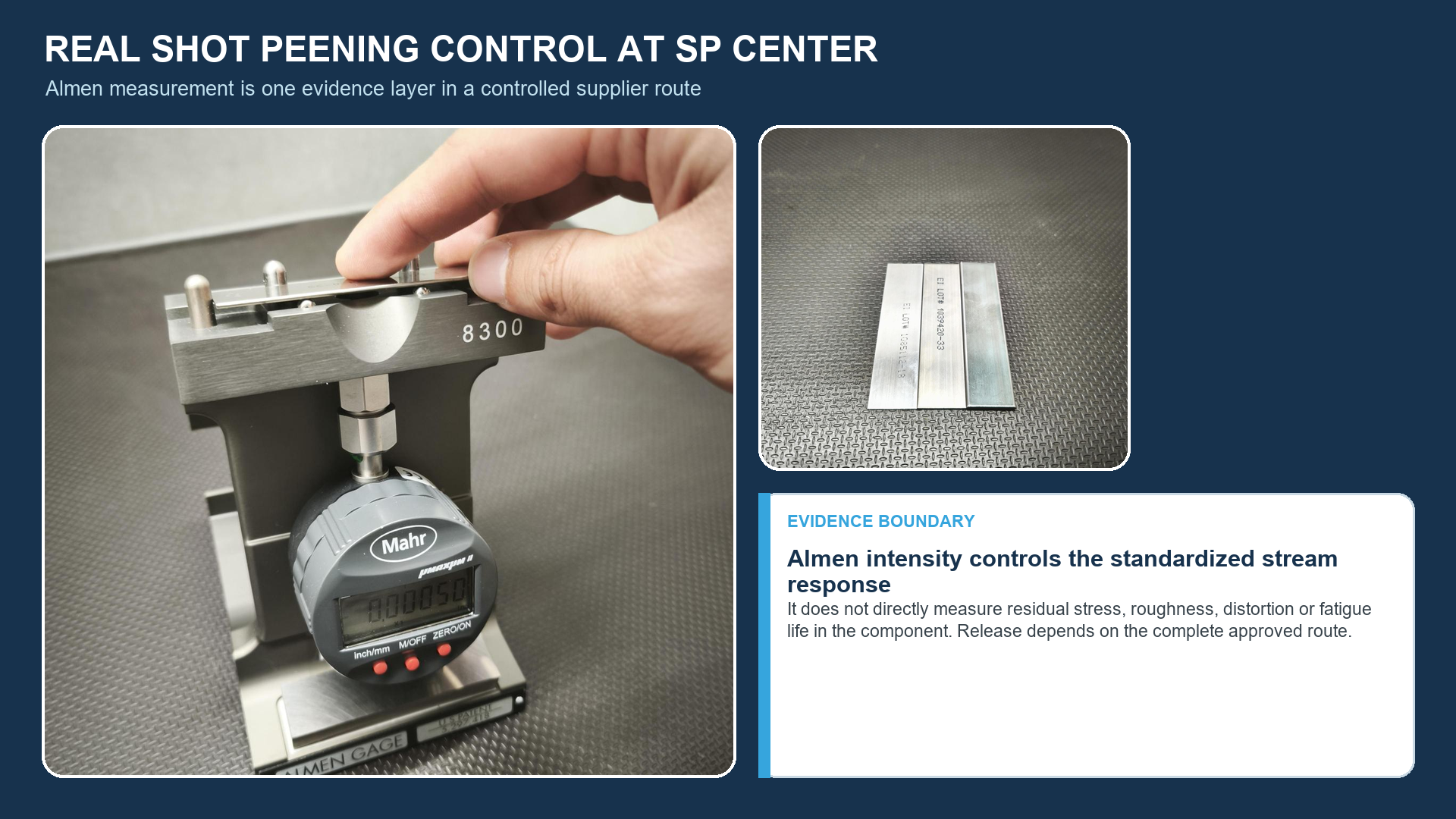
Almen intensity is determined or verified with the applicable strip, holder, gage, locations and procedure. It characterizes the qualified peening stream under that arrangement. Pressure, air flow, wheel speed, media flow or exposure time can be monitored inputs, but none is a substitute for the required Almen evidence.
Coverage is the degree to which the specified component surface shows impact evidence under the approved inspection method. One hundred percent coverage means that no visible unpeened area remains within the required zone under the defined conditions. Where 150% or 200% is invoked, it normally refers to an exposure multiplier relative to the qualified time for complete coverage under unchanged conditions. It is not additional surface area and does not automatically improve component life.
Neither result directly measures the component’s residual-stress profile, roughness, distortion or fatigue performance. When the design or qualification basis requires XRD, fatigue testing, dimensional inspection, roughness or another part-level test, define the sample, location, method, acceptance limits and approval authority before award.
How should trials, qualification and serial production connect?
Trials should represent the intended production route: material condition, geometry or representative feature, equipment, media, fixture, motion, masking, sequence and inspection. Record assumptions and limitations where a coupon cannot represent rebound, support, access, edge condition or retained-media risk on the component.
Qualification is complete only when the responsible authority accepts the defined evidence and the production basis is released. Serial batches then reproduce that controlled configuration. Changes to the processing site, machine, media, fixture, programme, treatment boundary, monitored window, inspection method or subcontracted operation require the review and approval specified by the contract and qualified route.
How should European lead time be calculated?
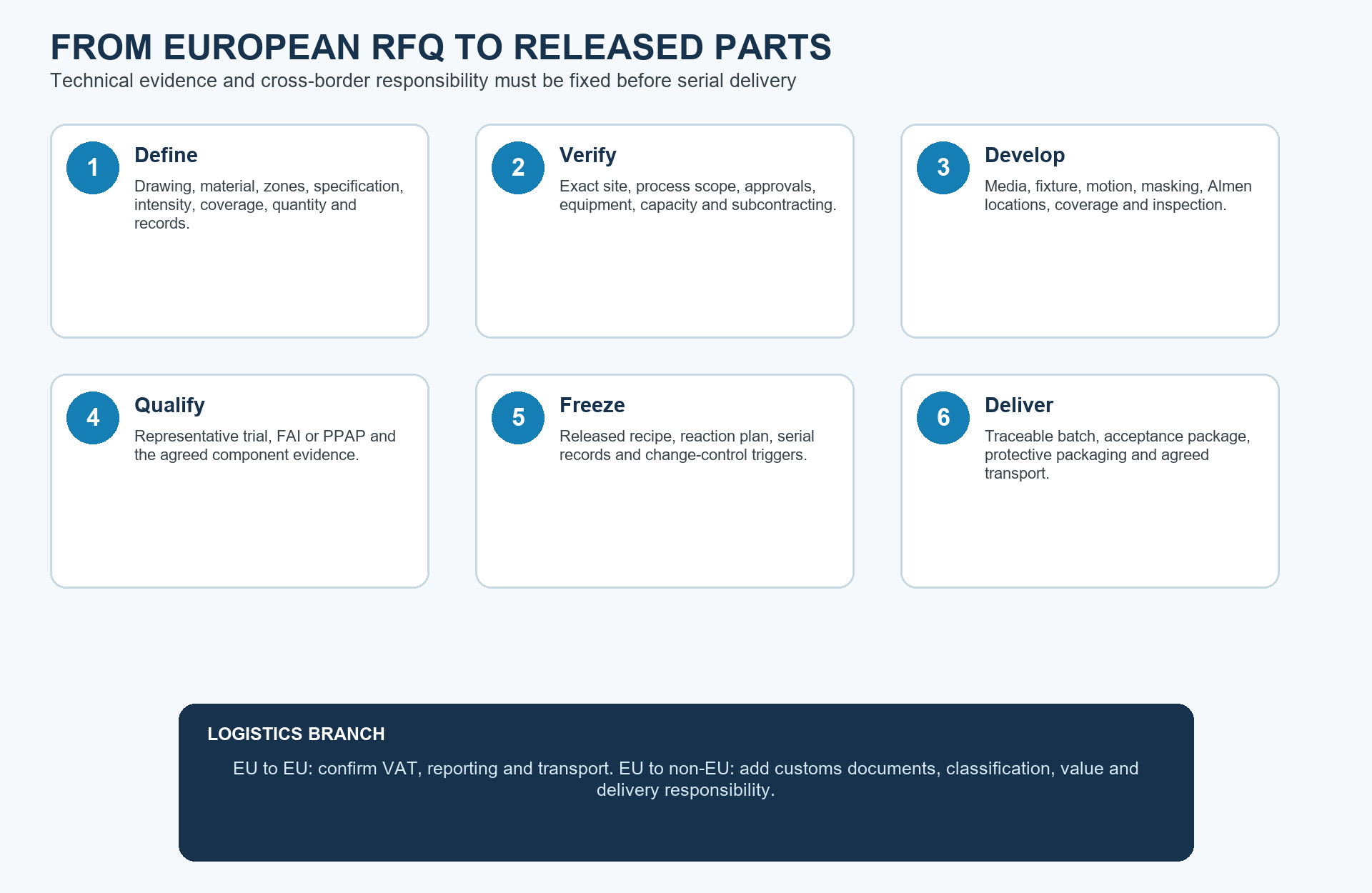
Total lead time starts before the machine cycle and ends after release and delivery. New parts can wait for clarification, tooling, trials, qualification, laboratory work, customer approval, documentation or transport. A reliable quotation separates these elements and states the assumptions, customer actions and milestone owners.
| Lead-time element | Typical driver | Question for the quotation |
|---|---|---|
| Technical review | Missing or conflicting requirements, access and risk review | Which inputs and approvals are still open? |
| Tooling and trials | Masking, fixture, nozzle or wheel arrangement and representative evidence | What must be designed, manufactured and approved? |
| Qualification | Customer review, first article, laboratory work or source inspection when invoked | Who approves each result and what is the planned milestone? |
| Production | Lot size, equipment loading, verification frequency and inspections | What is the controlled processing window and capacity assumption? |
| Release | Record review, nonconformance status and customer forms | Which documents are required before dispatch? |
| Transport | Packaging, destination, carrier, customs status and delivery term | Who owns damage risk, formalities and delivery confirmation? |
Table 4. A credible schedule exposes the complete route and the owner of every dependency.
What changes for cross-border delivery?
For Union goods moving directly between EU Member States, import and export customs formalities are normally not performed at an internal border. This does not remove VAT, statistical reporting, transport, product, security, customer-property or contract duties. Non-Union goods, goods travelling through a third country and movements between the EU and a non-EU country can require customs or transit procedures.
The order should identify the origin and customs status of the parts, destination, delivery term, packaging, insurance, carrier, export-control or controlled-data route, temporary-import or repair considerations where relevant, and ownership of formalities. Obtain qualified customs or tax advice for the actual transaction rather than treating a European address as a universal rule.
How should quotations be compared?
| Comparison factor | Evidence-based question | Warning sign |
|---|---|---|
| Technical fit | Can the exact zone be reached, controlled and inspected with the proposed equipment? | A generic capability statement replaces a geometry review |
| Approval fit | Does the exact site hold every contractually required approval and scope? | A group logo or certificate from another site is used |
| Qualification risk | Are trials, acceptance criteria, owners and change limits defined? | Qualification is described only as ‘included’ |
| Schedule confidence | Are review, tooling, qualification, production, release and transport shown separately? | One dispatch date has no assumptions |
| Commercial comparability | Do price, exclusions, records, packaging, delivery term and validity cover the same scope? | The lowest price omits required evidence or engineering |
| Continuity | Are capacity, maintenance, backup, interruption and communication routes defined? | Recovery depends on an unapproved alternative site or process |
Table 5. Compare equivalent scope and controlled risk—not only unit price or distance.
Normalize each quotation against the same drawing, revision, quantity, evidence package, packaging and delivery basis. Separate recurring unit cost from one-time engineering, tooling, qualification and customer-specific documentation. Record exclusions and open points. The lowest price is not the lowest total cost when it depends on missing controls or an unapproved route.
When should award be withheld?
- The exact processing site, legal entity or subcontracted operation is unclear.
- The drawing, revision, treatment boundary or governing document hierarchy is incomplete or conflicting.
- A required approval is absent, expired, outside scope or belongs to another site.
- Critical geometry cannot be reached, masked or inspected by a qualified route.
- Machine settings are offered as a substitute for Almen intensity or coverage evidence.
- Qualification, change, interruption, nonconformance or release authority is undefined.
- Price or lead time depends on undocumented technical or logistics assumptions.
What should be sent to SP Center?
Send the current drawing and revision, material and condition, marked treatment and exclusion zones, complete process requirements or authorized proposal scope, component dimensions and mass, prototype and serial quantities, required qualification and batch records, destination, packaging and target milestones to [email protected]. SP Center will confirm feasibility, processing location, scope and quotation assumptions in writing.
Frequently asked questions
How do I find a shot peening supplier in Europe?
Issue the same controlled RFQ to candidate sites, then verify the exact site’s process scope, equipment, approvals, part access, media controls, Almen and coverage route, qualification evidence, capacity, records and logistics. Geography is useful only after technical fit is established.
Is a European location proof of shot peening capability?
No. Europe describes location, not a process standard or approval. Capability must be established for the exact legal entity, processing site, equipment, component geometry and contractually invoked requirements.
Is ISO 9001 or an EN 9100-series certificate enough?
No. A management-system certificate applies only to its stated entity, site and scope. It does not by itself prove shot peening capability, Nadcap accreditation, customer approval or part-specific qualification.
Is Nadcap required for shot peening in Europe?
Only when the contract, customer or programme invokes it. Verify current accreditation in PRI records for the exact processing site and applicable scope. Nadcap is not product certification and does not replace customer source approval.
What does an Almen result prove?
It provides standardized evidence of the peening stream under the applicable arrangement and procedure. It does not directly prove component coverage, residual-stress profile, roughness, dimensions or fatigue life.
Do goods moving between EU Member States require customs clearance?
Union goods normally move without import or export customs formalities at internal EU borders, but VAT, statistical, transport, product, security and contract obligations can still apply. Non-Union goods, movements through third countries and EU–non-EU routes can require customs or transit procedures.
Which records should accompany a processed batch?
The contract should define the package. It may include a certificate of conformity, part and batch traceability, released route or specification reference, Almen and coverage evidence, media and equipment records, inspections, deviations, approved dispositions and customer forms.
How should first-order and repeat-order lead times be compared?
Separate requirement review, tooling, trials, qualification, customer approval, production, record review, packaging and transport. A repeat order can be shorter only while the approved configuration, validity, capacity and requirements remain unchanged.
Key takeaways
- Choose geography for access and logistics; choose the supplier for verified scope and evidence.
- Issue a complete, controlled RFQ to every candidate site.
- Keep certification, Nadcap accreditation, customer approval, qualification and batch release distinct.
- Assess Almen intensity, coverage, media, equipment, geometry and records as one controlled route.
- Compare total lead time and total scope, including qualification, documentation and transport.
- Confirm customs, VAT, transport and delivery responsibilities for the actual cross-border movement.
Related SP Center guides
- How to Source Shot Peening Services
- How to Choose a Shot Peening Supplier for Critical Parts
- Almen Intensity in Shot Peening
- Shot Peening Coverage
Technical and official references
1. SAE AMS2430U: Shot Peening, revised April 2018
2. SAE AMS2432E: Shot Peening, Computer Monitored, revised October 2022
3. SAE ARP7488: Peening Design and Process Control Guidelines, issued January 2018
4. SAE J442_202602: Tools for Peening Intensity Determination and Verification, revised February 2026
5. SAE J443_202512: Procedures for Determining and Verifying Peening Intensity, revised December 2025
6. SAE J2277_202301: Shot Peening Coverage Determination, revised January 2023
7. Performance Review Institute, Nadcap accreditation
8. European Commission, Single market for goods
9. European Commission, Union and common transit
Standards note: The complete revisions and customer-specific requirements invoked by the contract govern.
Author: Paweł Kmieć
Discuss a European shot peening enquiry: +48 519 772 773 | [email protected]