


Build a reconstructable link from product identity and invoked requirements to the qualified configuration, actual process evidence, exceptions and authorized release
A useful shot peening batch report is not a decorative certificate or an uncontrolled machine printout. It is a concise release record that lets an authorized reviewer reconstruct which product was processed, against which effective requirements, on which qualified configuration, with which media and settings, how the results were accepted, what exceptions occurred and who released the work. The exact package is contract-specific; one universal report cannot satisfy every customer automatically.
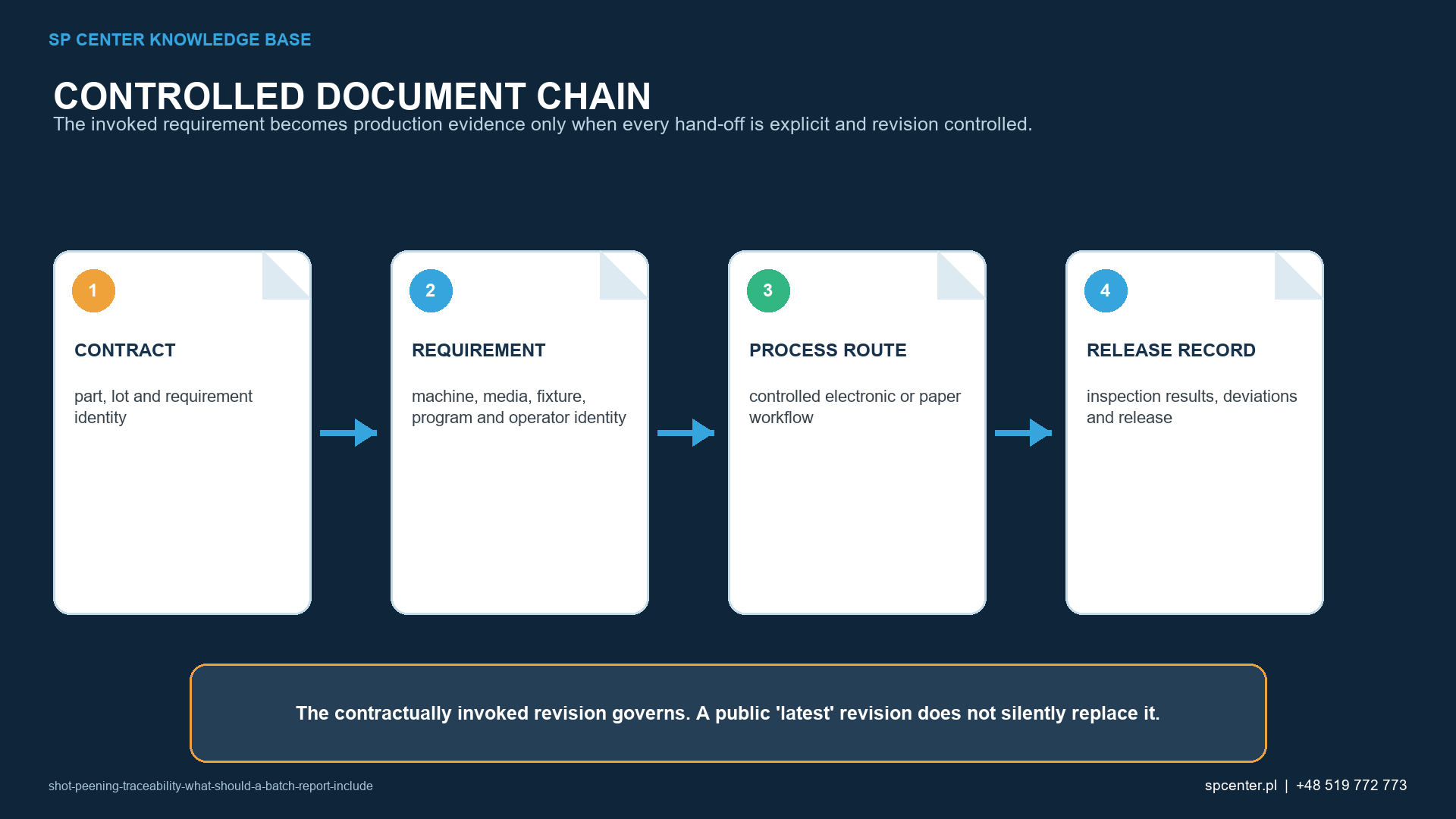
What does traceability mean in shot peening?
Traceability is the maintained relationship between product identity, requirement revision, process route, material and media evidence, equipment and program configuration, inspection results, personnel authorization, deviations and final release. The links must survive lot splitting, partial rejection, rework and data-system changes.
The purpose is reconstruction, not data volume. A short report can be effective when every identifier resolves to a protected underlying record. A long report can still fail when it contains generic values that cannot be tied to the actual parts.
| Record block | Minimum questions | Typical controlled evidence |
|---|---|---|
| Identity and quantity | Which customer, order, part number, revision, serial or lot and quantity were received, processed and released? | Purchase order, traveler, incoming list, split or merge history and final count |
| Invoked requirements | Which drawing, specification, customer addendum, approved source and revision applied? | Contract review and effective-document matrix |
| Qualified configuration | Which site, machine, delivery system, program, fixture, mask and procedure revision were used? | Approved route, equipment and program master records |
| Media and settings | Which media type or class and controlled operating mix were used, and what process settings applied? | Media receipt and inspection, operating-mix checks and job setup or monitored data |
| Verification and results | How were intensity, coverage, surface, dimensions and any special tests accepted? | Almen records, coverage inspection and part inspection results |
| Exceptions and release | Were alarms, interruptions, deviations, rework or concessions present, and who approved disposition and release? | Nonconformance, waiver or concession, rework route and authorized release |
Table 1. Six linked record blocks provide a practical traceability backbone.
How are part, lot and batch identities controlled?
Define what “batch” means for the applicable route: a group processed under one controlled setup, a customer lot, a machine run or another approved unit. Record part number and revision, serial or lot identifiers, received quantity, processed quantity, rejected quantity and released quantity.
When product is split across machines, shifts or rework routes, create controlled child identities linked to the parent. When lots are merged, preserve every source. Timestamps and time zones should be consistent enough to map machine events and inspections to the correct interval.
Which requirements and revisions must be visible?
The report or its linked contract review identifies the drawing, shot peening specification, customer addenda, purchase-order clauses, approved-source status and procedure revision effective for the work. A title without revision or date can be ambiguous.
If requirements conflict or an invoked document is missing, stop and obtain controlled clarification. Internal practice must not silently replace customer or design authority.
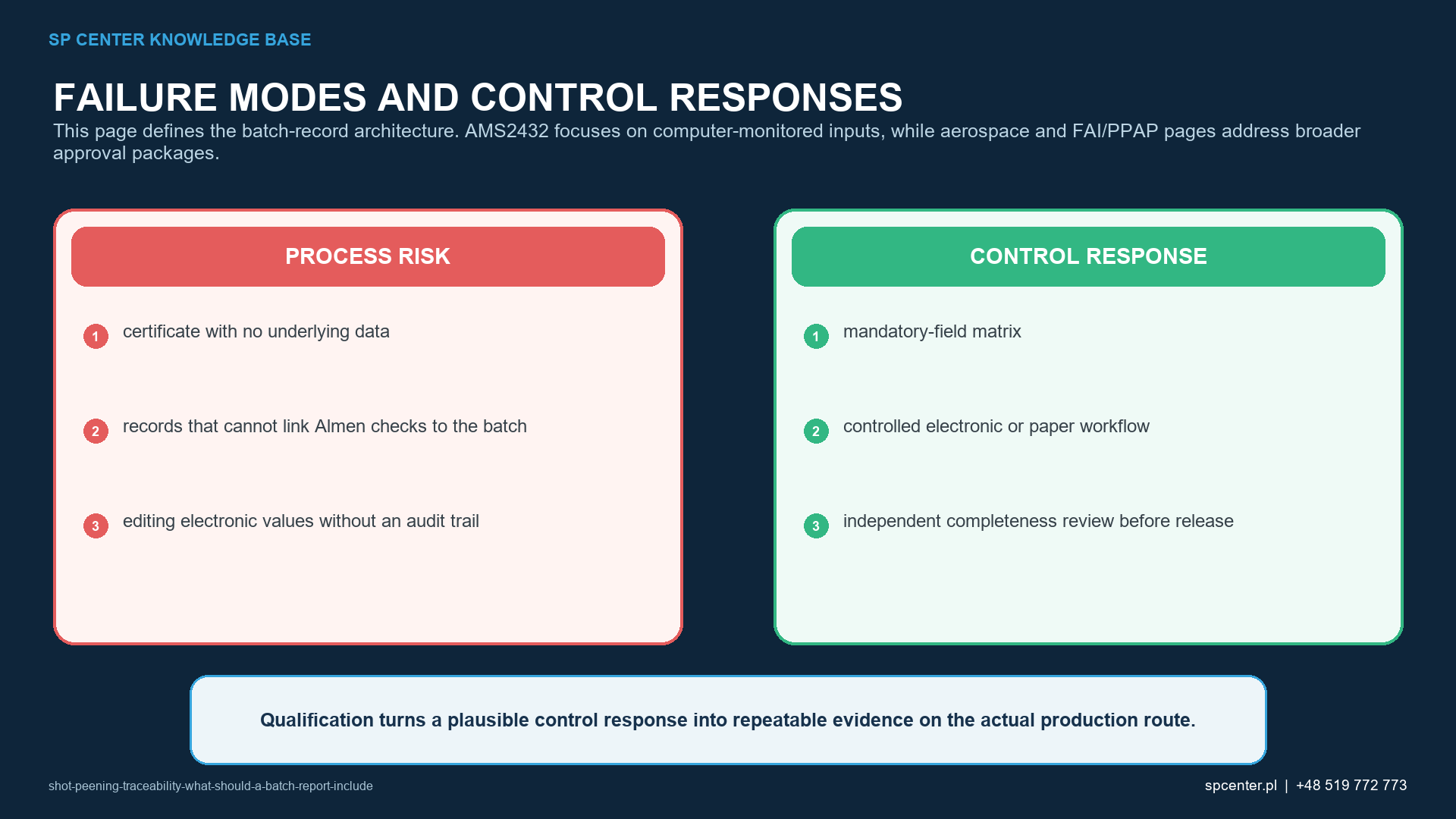
What belongs in the report and what can remain linked?
| Record | Primary purpose | Common mistake |
|---|---|---|
| Certificate of conformity | Formal statement that the supplied work conforms to the invoked order requirements | Treating the certificate as proof of every process detail without supporting records |
| Batch or process report | Human-readable identity, route, results, exceptions and release summary | Copying generic setpoints without linking to actual monitored or inspection data |
| Traveler or router | Chronological execution and sign-off of operations for the identified product | Losing the relationship after a lot is split, merged, partially reworked or short-shipped |
| Machine data file | Time-series or event evidence from monitored equipment | Retaining an unreadable proprietary file with no version, clock, channel or job mapping |
| Qualification record | Defines the approved process baseline and limits | Attaching an old saturation curve without showing that it applies to the production setup |
| Deviation or concession | Documents departure, affected product, technical disposition and approval | Deleting failed results or replacing the original record with corrected data |
Table 2. Each record has a distinct purpose; no single document replaces the complete system.
The customer-facing report should show the information needed for acceptance and stable references to supporting evidence. Detailed qualification files, media microscopy, calibration certificates or time-series data can remain in the controlled record system unless the contract requires them as attachments.
How should machine and process data be identified?
Record site, machine, delivery principle, relevant nozzle or wheel station, program revision, fixture and mask identity, media class, operating-mix status and the controlled job settings. For computer-monitored work, map channels, limits, alarms, overrides and data-file identity to the product interval.
A nominal recipe is not evidence that the process stayed in limits. Conversely, a large data file is not useful if its clock, channels, units, software revision or part relationship cannot be reconstructed.
How are intensity and coverage reported?
Identify the required Almen strip type and intensity range, the applicable saturation-curve or qualification reference, the production verification result, location, holder or fixture identity and acceptance. Do not reduce intensity to pressure or wheel speed.
Record the coverage requirement, method, required surfaces, inspection result and inspector. If an approved indirect method is used, link its qualification and current applicability. Coverage is not an Almen result or a residual-stress value.
How are deviations, alarms and rework retained?
Preserve the original event and result. Record affected product, containment interval, technical assessment, disposition authority, concession or customer approval where required, rework route and reinspection. A corrected report must remain linked to the superseded version.
Do not hide failed trials, alarms or out-of-limit values by exporting only the successful segment. The record must show why the released product remains acceptable.
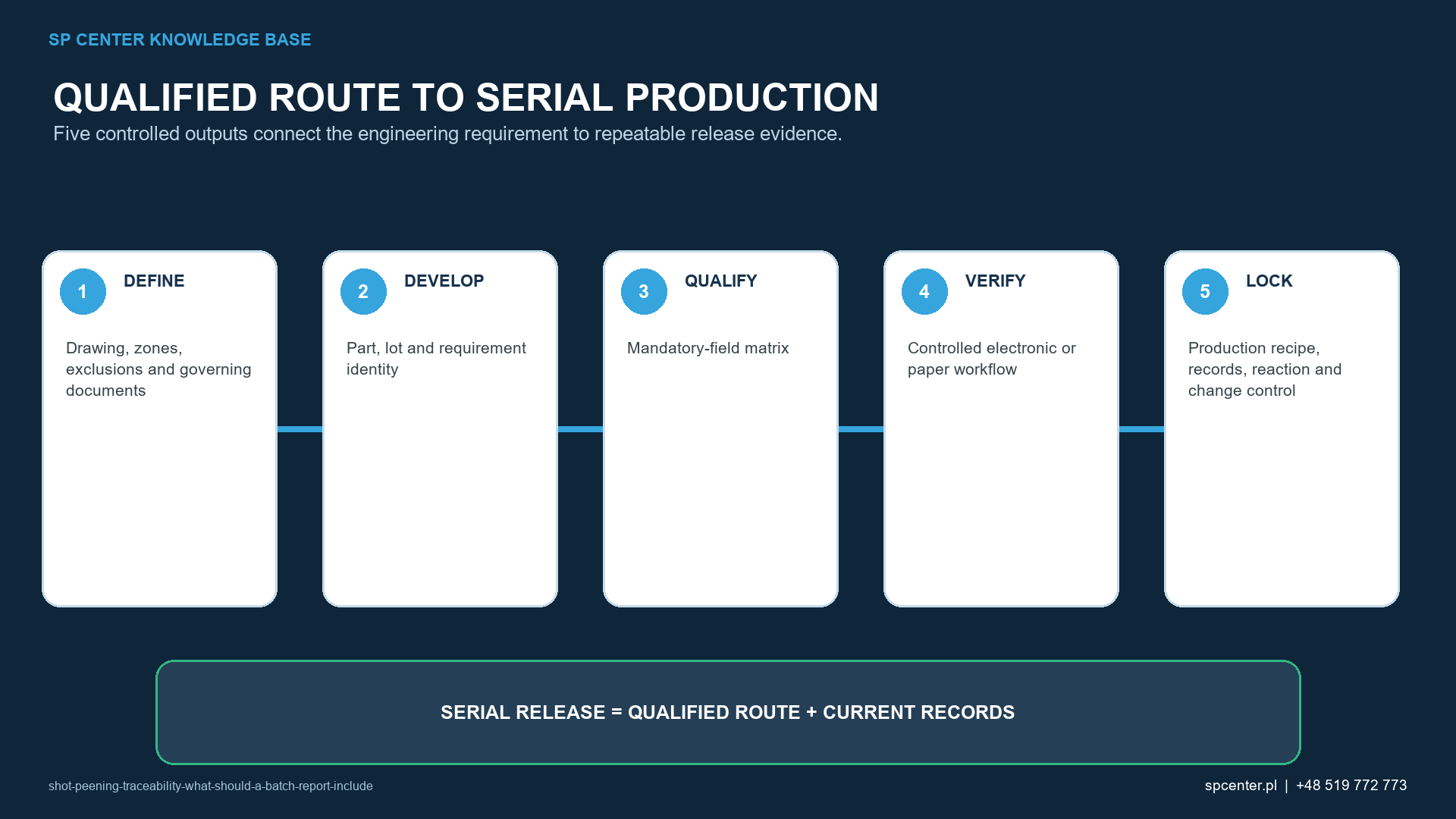
What should be checked before release?
| Release check | Pass condition | Escalation trigger |
|---|---|---|
| Identity reconciliation | Received, processed, rejected and released quantities and identifiers balance | Missing serial, unexplained quantity, ambiguous lot split or mixed revision |
| Requirement validity | All invoked documents and approvals were effective for the work date | Missing customer addendum, obsolete procedure or unclear conflict |
| Configuration status | Machine, program, fixture, media and inspection equipment were approved and within status | Unapproved change, expired calibration or configuration mismatch |
| Process completion | Required steps, intensity, coverage and inspections are complete and acceptable | Alarm, interruption, blank field, out-of-limit result or unexplained manual override |
| Exception closure | Every nonconformance and rework is traceable to authorized disposition and reinspection | Open disposition, unauthorized repair or affected-product interval not established |
| Package completeness | Customer-required documents are present, legible, consistent and signed by authorized personnel | Universal template used instead of the actual contractual deliverable list |
Table 3. Final review is a reconciliation of identity, requirements, configuration, execution, exceptions and deliverables.
Electronic approval should identify the person, role, time and record version. Access control, audit trail, backup, readable retention and migration planning protect the evidence through its required life.
How do customer approval and Nadcap relate to the report?
Nadcap accreditation concerns the supplier and accredited critical-process scope; it is not a product certificate and does not define one universal release package. For Nadcap work, use the current applicable AC7117 criteria and supplements retrieved from PRI EAN and verify the supplier scope in the Qualified Manufacturers List.
Customer source approval, process approval, first-article approval and batch release are separate decisions. State only the approvals actually held and applicable to the job.
Recommended batch-report structure
- Supplier, customer, order and report identity.
- Part, revision, serial or lot and reconciled quantities.
- Invoked drawing, specifications, addenda and procedure revisions.
- Site, machine, program, fixture, mask and media identity.
- Actual process and monitored-data references.
- Intensity, coverage and part-inspection results.
- Interruptions, alarms, deviations, concessions and rework.
- Conformity statement, authorized release and attachment index.
Frequently asked questions
Must every shot peening batch report contain the same fields?
No. A controlled core is useful, but the final fields and attachments follow the drawing, specification, purchase order, customer and quality-system requirements for that job.
Is a certificate of conformity enough?
Only if the contract says so and the supplier retains all supporting evidence required by the governing system. A certificate does not replace missing execution, inspection or deviation records.
Should the saturation curve be attached to every batch report?
Not universally. The report should identify the applicable qualification or curve and production intensity evidence as required. Attachment frequency follows the invoked requirements and customer package.
What if a production lot is split between two machines?
Preserve the parent identity and create traceable sublots linked to each machine, program, time interval, process evidence and release. Do not issue one undifferentiated result.
Should raw computer-monitored data be sent to the customer?
Only when required. It should nevertheless be retained, protected, readable and linked to the job according to the applicable specification, contract and retention rules.
How long must shot peening records be retained?
There is no universal period for every customer. Apply contractual, regulatory, quality-system and specification requirements and record the retention rule used.
Does Nadcap accreditation certify the batch report or product?
No. Nadcap accredits the supplier’s applicable critical-process scope. Product release and the customer document package remain governed by contract, specification and authorized inspection.
How should a failed result be corrected in an electronic record?
Preserve the original result and audit trail, record the reason, authorization and corrected or repeat result, and link the affected-product disposition. Do not silently overwrite evidence.
Key takeaways
- Design the report around reconstruction and authorization, not data volume.
- Reconcile product identity and quantity through every split, merge and rework.
- Record effective requirements and qualified configuration, not generic titles.
- Link actual machine, intensity, coverage and inspection evidence.
- Preserve failed results, alarms, corrections and approval history.
- Build the delivered package from the contract instead of assuming a universal template.
Related SP Center guides
- Aerospace Shot Peening Documentation
- First-Article Shot Peening Qualification
- Nadcap AC7117 for Shot Peening
- Shot Peening Repeatability
Technical references
1. SAE AMS2430U: Shot Peening, revised April 2018
2. SAE AMS2432E: Shot Peening, Computer Monitored, revised October 2022
3. SAE AMS2431E: Peening Media, General Requirements, revised April 2023
4. SAE J442_202602: Tools for Peening Intensity Determination and Verification, revised February 2026
5. SAE J443_202512: Procedures for Determining and Verifying Peening Intensity, revised December 2025
6. SAE J2277_202301: Shot Peening Coverage Determination, revised January 2023
7. PRI, Surface Enhancement Nadcap Audit Criteria Review
8. PRI EAN and Qualified Manufacturers List
Standards note: Required fields, attachments, approvals and retention periods follow the complete applicable contract, specification, regulatory and quality-system requirements.
Author: Paweł Kmieć
Discuss a shot peening traceability or batch-report requirement: +48 519 772 773 | [email protected]