


Build a requirement matrix, choose representative samples, predefine acceptance, approve the production baseline and control requalification
First-article or process qualification for shot peening demonstrates that the proposed production route can meet the applicable drawing, specification, process and component acceptance requirements before routine release. The plan must distinguish the evidence provided by Almen strips, material coupons, representative geometry and actual production parts. It should state every method, limit, sample, record and approval authority before the trial begins; a passing machine setting alone does not qualify a component.
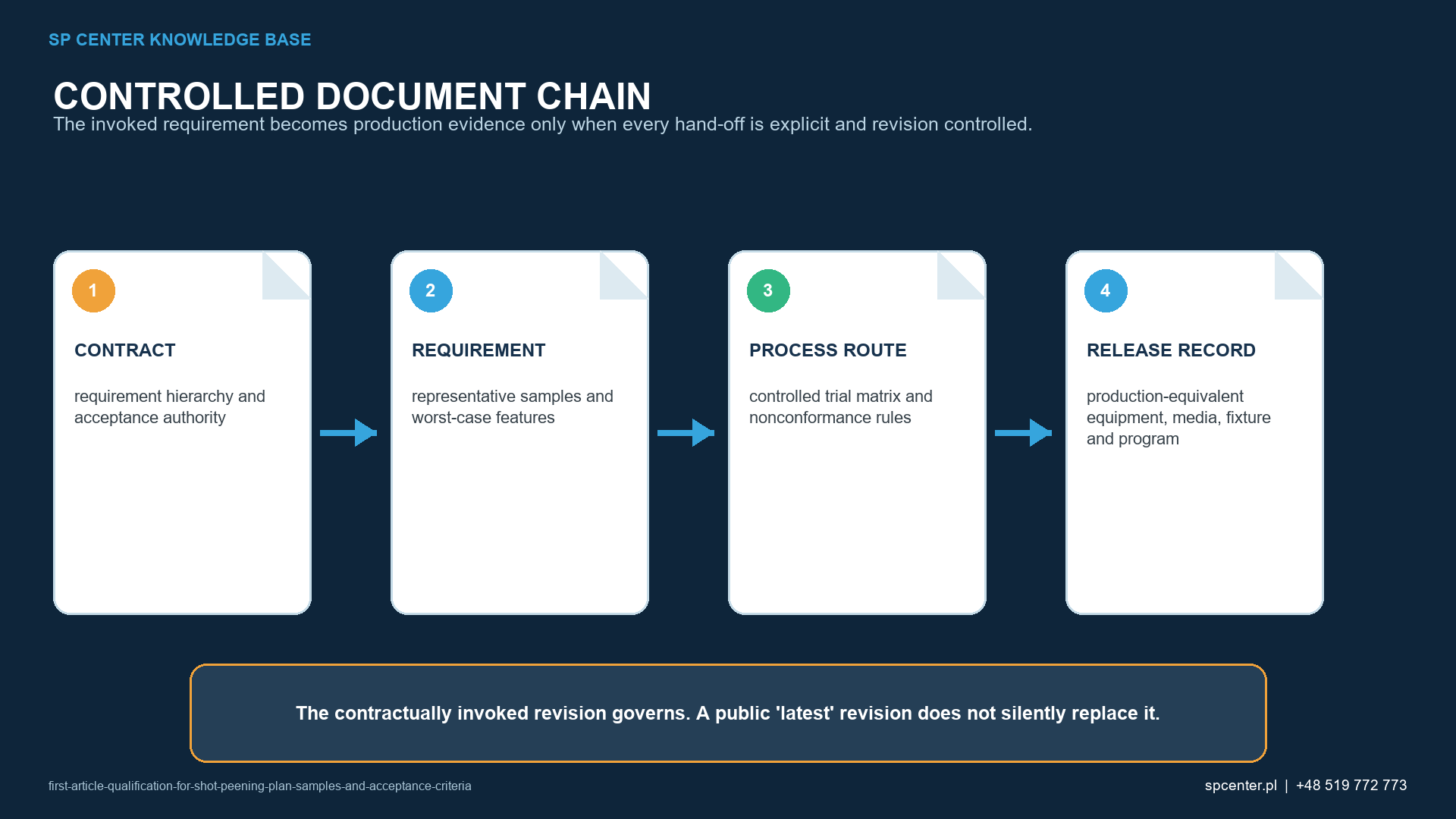
What is being qualified?
Define whether the objective is a new process route, a specific part number, a machine transfer, a changed medium, a new fixture or mask, a revised treatment zone or a formal product first article. These scopes overlap but are not identical.
The qualification boundary should identify material and heat treatment, incoming surface, equipment, air-blast or wheel route, media, fixture, masks, programme, treatment zones, Almen range, coverage, inspection, sequence, records and approved source. Anything outside that boundary needs change assessment.
Which samples answer which questions?
| Evidence article | What it can demonstrate | What it cannot prove alone |
|---|---|---|
| Almen strip and holder | Peening-stream intensity under the defined test arrangement | Coverage, access, dimensions, surface damage, residual-stress depth or fatigue of the component |
| Flat witness coupon | Material-specific surface response, roughness, hardness or residual-stress measurement when representative and approved | Access to a radius, bore, masked boundary or complete production geometry |
| Representative geometry coupon | Worst-case access, shadowing, rebound, mask transition or retained-media behaviour | Every design characteristic of the actual part unless equivalence is documented |
| Production part or first article | Treatment-zone coverage, boundaries, surface, dimensions, cleanliness and traceability under the intended route | Universal performance outside the qualified material and configuration |
| Fatigue or component test specimen | Application response under the defined load, environment and sample plan | Routine batch conformity unless the contract expressly makes it a release test |
Table 1. No single sample is a universal surrogate for stream, surface, geometry and component performance.
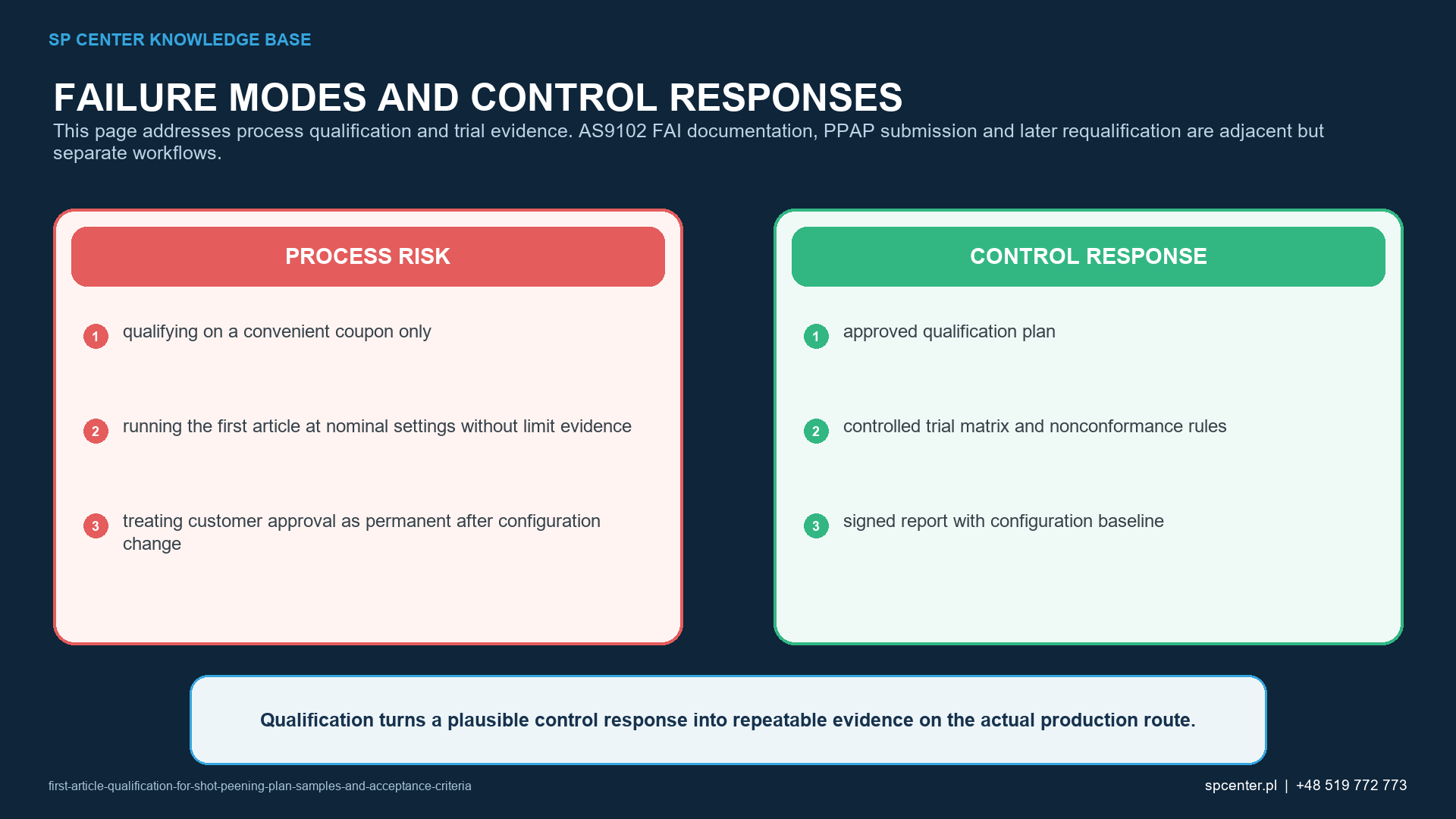
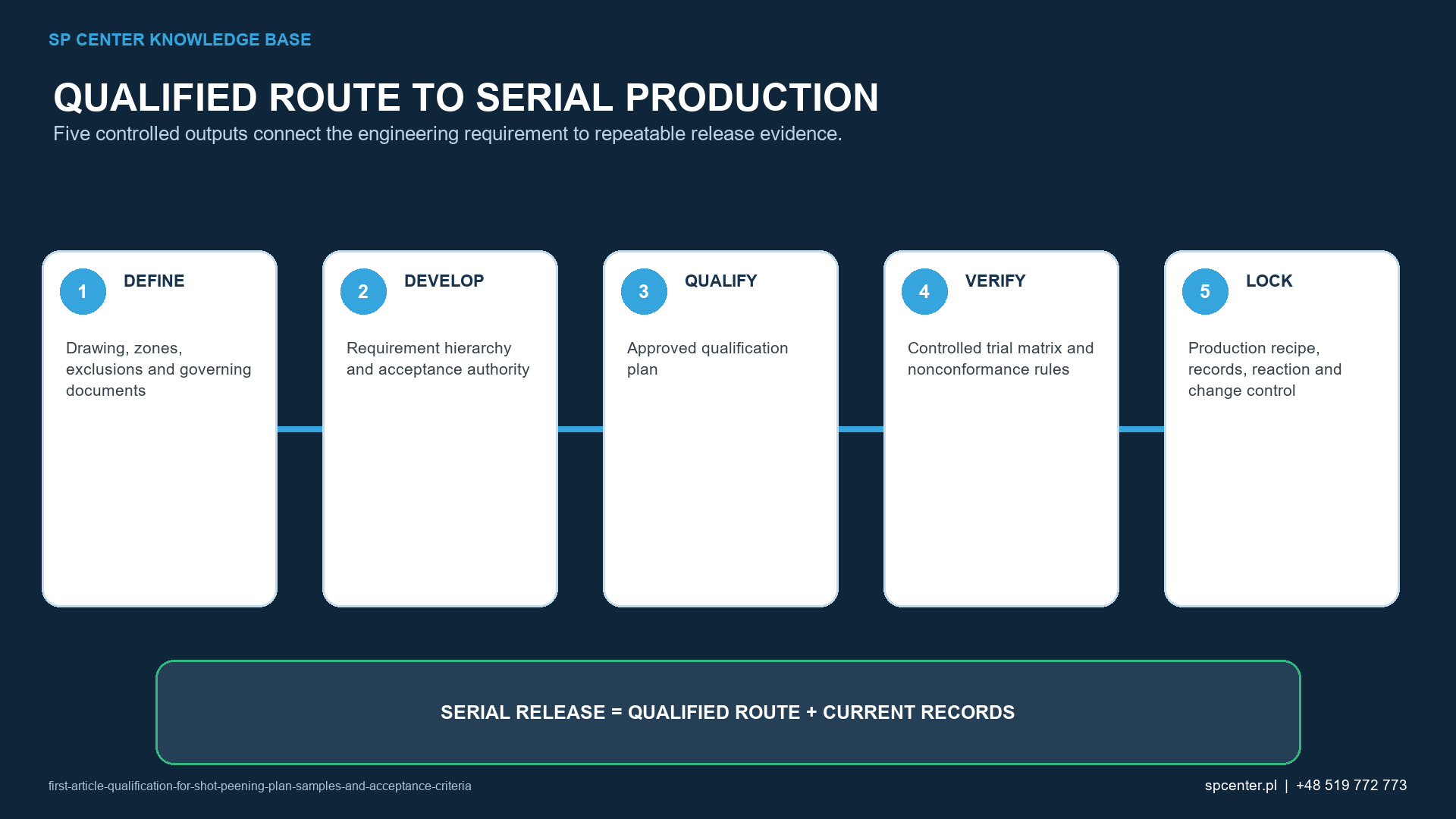
How should a qualification plan be structured?
| Qualification phase | Required output | Approval gate |
|---|---|---|
| Contract review | Current drawing, specification hierarchy, customer supplements, source approval, FAI or PPAP applicability and unresolved conflicts | No processing until authority and revisions are clear |
| Risk and feasibility | Material condition, treatment map, access, edges, masks, fixture, distortion, contamination and media-removal assessment | Worst-case features and stop criteria accepted |
| Process development | Equipment, media, intensity range, coverage route, motion, exposure and preliminary surface or dimensional response | Candidate window selected without crossing damage limits |
| Qualification trial | Production-representative article, loading, operators, monitoring, alarms and planned samples | All predeclared process and part criteria met |
| Documented baseline | Approved programme, fixture and mask revisions, media, intensity, coverage, inspection, reaction plan and records | Authorized signatures and customer approval where invoked |
| Serial handover | Work instructions, training, verification frequency, sampling, maintenance, record retention and change control | Production starts only after the released baseline is available |
Table 2. Each phase produces an approved output before the next one begins.
How are worst-case features selected?
Select features with the most difficult access, smallest radius, deepest bore, strongest shadowing, most sensitive edge, thinnest section, tightest boundary, highest distortion risk or hardest media-removal path. The worst case can differ for coverage, damage, dimensions and cleanliness; one feature need not represent them all.
Use the actual production part where practical. A representative coupon needs documented equivalence in material, geometry, surface, restraint and exposure. Similar appearance or nominal radius alone is not enough.
How should intensity be qualified?
The plan defines the complete Almen range and strip designation, test location or arrangement, saturation-curve method, verification timing and reaction to failure under the governing specification. Pressure, wheel speed, media flow or exposure are inputs and cannot replace the Almen result.
Almen evidence characterizes the stream. It does not prove component coverage or fatigue performance. If several nozzles, wheels, positions or configurations create distinct streams, the plan must justify how each is represented.
How should coverage and boundaries be qualified?
Qualify the production fixture, masks, orientation, part spacing, nozzle or wheel motion and exposure on every treatment zone. Define lighting, magnification, surface condition and the visual or approved indirect method. Fluorescent or tracer techniques require qualification and correlation when used.
Inspect both the treated surface and protected areas. A mask can leak, lift or create rebound. Excessive protection can leave a required transition untreated. Extra exposure cannot repair geometric inaccessibility.
Which surface and dimensional criteria belong in the plan?
Depending on the drawing, inspect impact damage, folding, cracking, roughness, contamination, embedded or retained media, edge condition, bore finish, flatness, roundness, straightness or other critical dimensions. Define incoming and final measurement states, datum and temperature.
Residual-stress depth, hardness, microhardness or fatigue evidence is added only when it answers an invoked design or validation requirement. Destructive tests need dedicated samples and a traceable relationship to the production configuration.
What are defensible acceptance criteria?
| Acceptance layer | Example criterion | Required reaction if failed |
|---|---|---|
| Requirement | Correct part, drawing, process specification, revision, customer supplement and approved source | Hold work and obtain controlled clarification or correct authorization |
| Stream | Required Almen range and strip designation with valid saturation or verification evidence | Contain affected trial or parts and investigate equipment, media and setup |
| Coverage and boundary | Every specified surface accepted by the approved method with protected zones intact | Do not compensate for inaccessible areas with uncontrolled extra exposure |
| Surface integrity | No prohibited damage; roughness, contamination and embedded or retained media within invoked limits | Document nonconformance and use authorized disposition |
| Dimensions and function | Critical dimensions, distortion, fit or functional checks conform after all defined release steps | No informal straightening, machining or re-peening |
| Evidence package | Part and lot linked to configuration, results, deviations, approvals and certificate | Release remains blocked until evidence is complete |
Table 3. Stream, part and document acceptance remain separate and all must pass where invoked.
How does qualification relate to FAI or PPAP?
Process qualification proves the shot peening route. AS9102C FAI, when invoked, documents product accountability and applicable design characteristics. PPAP, when invoked, supports automotive production-part approval. Qualification results can feed either framework but do not complete the whole submission.
Agree who owns the complete submission and who provides the special-process evidence. A processor’s certificate does not automatically close the FAIR or PPAP package.
What must be frozen for serial production?
- Drawing, process specification and customer revision hierarchy.
- Equipment, programme, fixture, mask and treatment-zone configuration.
- Media designation, limits, operating condition and contamination controls.
- Almen and coverage methods, frequencies, limits and reactions.
- Surface, dimensional, cleanliness and retained-media acceptance.
- Loading, part orientation, quantity, motion and exposure.
- Personnel authorization, maintenance, alarms and interruption response.
- Records, retention, deviations, approval authority and change triggers.
Frequently asked questions
Is first-article qualification the same as AS9102 FAI?
Not necessarily. Process or first-article qualification proves the proposed peening route and part acceptance basis. AS9102C FAI is a formal aerospace product-accountability framework when invoked. The contract must define how the two interact.
Can an Almen strip be the first article?
No. It is a standardized stream-intensity tool. It cannot represent component coverage, geometry, dimensions, surface damage or all design characteristics.
Can a witness coupon replace the production part?
Only for the exact property and equivalence approved in the plan. A flat coupon may support residual-stress or roughness measurement but cannot prove access to complex production features.
How many qualification parts are required?
There is no universal number. Geometry variation, destructive tests, process risk, statistical need, customer rules and production variation determine the sample plan.
Must fatigue testing be part of every qualification?
No. Fatigue or component testing applies when the design authority, specification, validation plan or contract invokes it. It is not automatically required for routine qualification or batch release.
Does a successful first article approve every future machine?
No. The approved baseline covers the represented equipment and configuration. Transfer to another machine, fixture, media circuit, programme or site requires formal change assessment and any required requalification.
What happens if one qualification criterion fails?
Preserve the evidence, contain affected articles and investigate. Do not average a failed criterion against passing results or modify the process informally. Repeat work only under an approved revised plan.
When is requalification needed?
Assess every change that can alter stream energy, media, access, treatment boundary, surface response, dimensions, inspection or traceability. The governing drawing, specification and customer rules define the required extent.
Key takeaways
- Define the exact scope and acceptance authority before the trial.
- Use each sample only for the evidence it can represent.
- Qualify worst-case access, damage, dimensions and media removal separately.
- Keep Almen intensity, coverage and component performance distinct.
- Freeze a production-representative configuration and complete evidence package.
- Assess every relevant change for requalification before serial use.
Related SP Center guides
Technical references
1. SAE AMS2430U: Shot Peening, revised April 2018
2. SAE AMS2432E: Shot Peening, Computer Monitored, revised October 2022
3. SAE ARP7488: Peening Design and Process Control Guidelines, issued January 2018
4. SAE J442_202602: Tools for Peening Intensity Determination and Verification, revised February 2026
5. SAE J443_202512: Procedures for Determining and Verifying Peening Intensity, revised December 2025
6. SAE J2277_202301: Shot Peening Coverage Determination, revised January 2023
7. SAE AS9102C, Aerospace Series – First Article Inspection Requirements
Standards note: The complete revisions, drawing, qualification plan and customer-specific requirements invoked by the contract govern.
Author: Paweł Kmieć
Discuss a shot peening qualification plan: +48 519 772 773 | [email protected]