


Verify current AC7117 scope and objective evidence while keeping accreditation, customer approval, process qualification and lot release separate
Nadcap Surface Enhancement is an industry-managed accreditation programme for critical processes. For shot peening, audit preparation must use the current PRI AC7117 audit-criteria series and any applicable supplemental checklists available through PRI EAN. The withdrawn SAE AS7117A document is not the current Nadcap checklist. Accreditation also does not certify a product, approve every customer requirement or release a production lot.
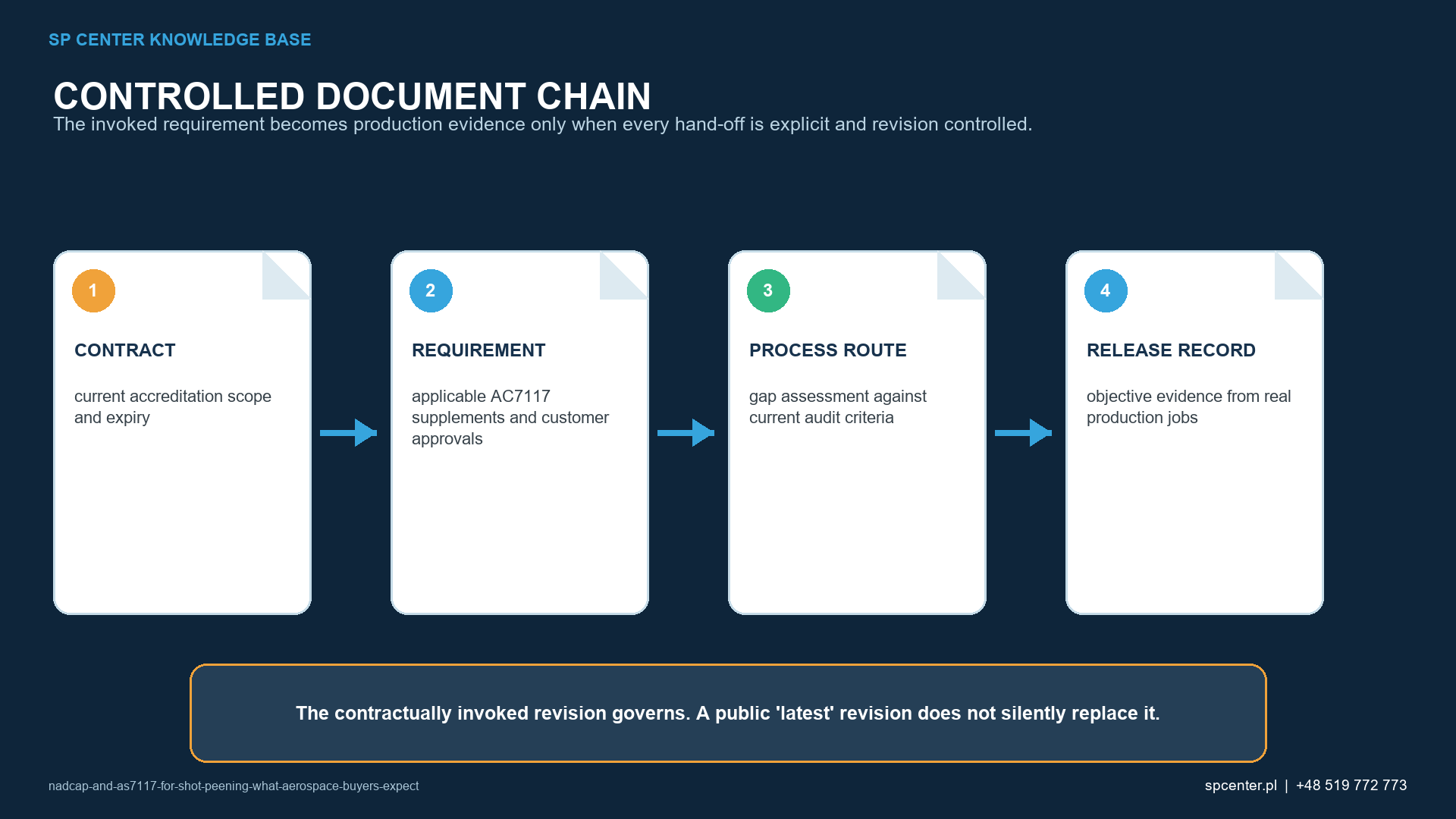
What does Nadcap accreditation establish?
Accreditation establishes that the audited supplier, site, process and stated scope have been assessed under the Nadcap programme. The exact scope matters: a company name, logo or general certificate cannot show that a particular site, technology or customer specification is included.
PRI’s Qualified Manufacturers List in EAN is the appropriate source for current status and detailed scope. Buyers should compare that information with the purchase order, approved-source rules and customer flow-down before accepting the source.
Which approvals must remain separate?
| Decision | What it addresses | What it does not replace |
|---|---|---|
| Nadcap accreditation | Supplier site and critical-process scope accepted through the applicable Nadcap programme | Customer source approval, product certification or lot release |
| Customer supplier approval | Permission to use a source under the customer’s contractual system | Process qualification or compliance of a particular part |
| Process qualification | Evidence that a defined route can meet the invoked requirements | Approval of uncontrolled transfers or changes |
| Part or first-article approval | Evidence for the identified part, revision and production route | Routine release of every later lot |
| Production-lot release | Conformity and records for the actual processed batch | Accreditation or qualification of the supplier |
Table 1. One successful decision cannot be used as automatic evidence for another.
PRI explicitly explains that Nadcap accreditation does not equal customer approval. A buyer can therefore require both current Nadcap scope and separate source approval. Likewise, an accredited process still needs the part-specific qualification and production evidence invoked by the contract.
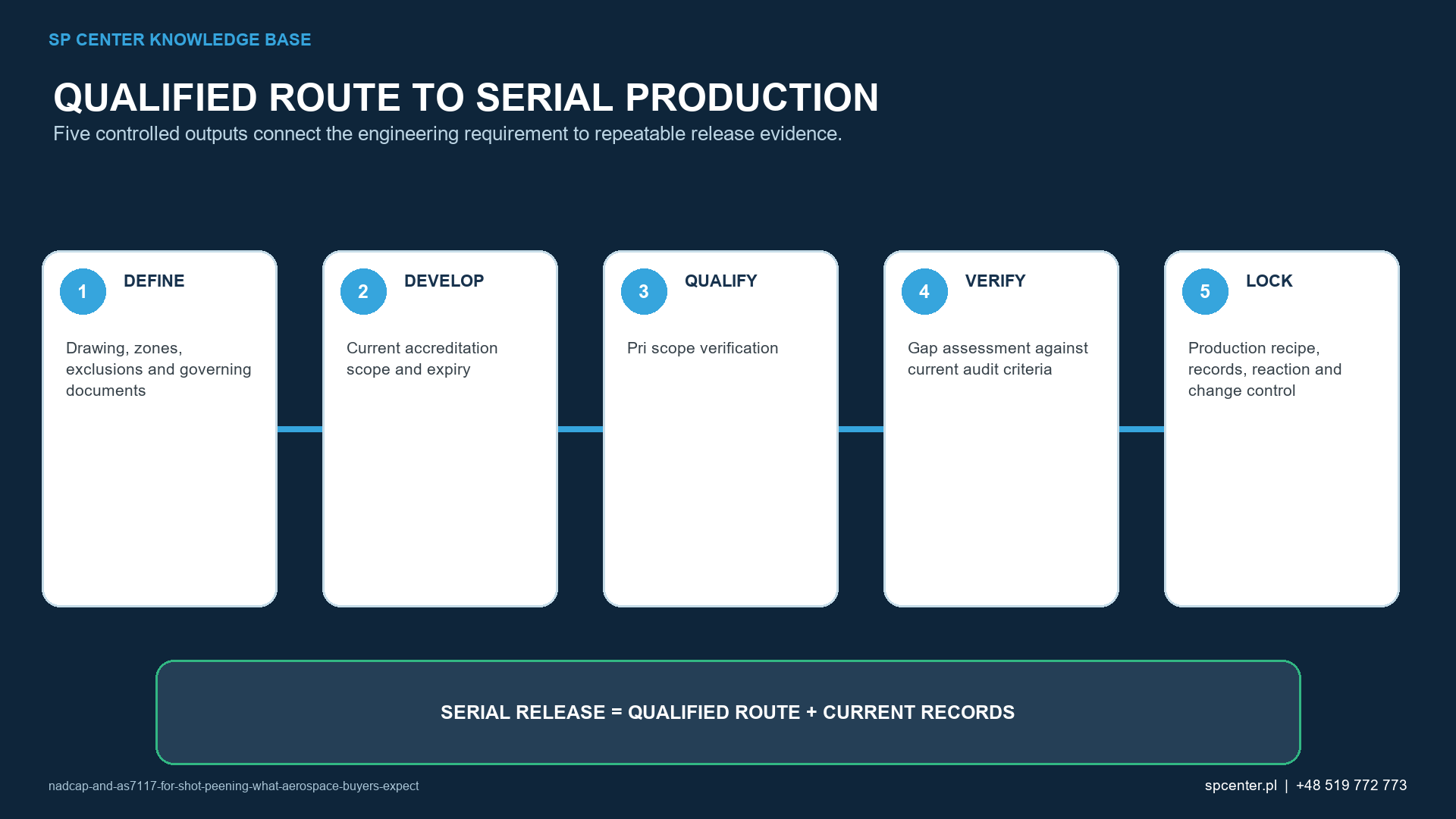
Why must AS7117A not be used as the live checklist?
SAE lists AS7117A as cancelled. PRI training and programme information identify the AC7117 audit-criteria series and supplemental checklists for Surface Enhancement. Audit preparation should therefore begin by retrieving the current applicable documents through PRI EAN and recording the controlled revisions used.
This article does not reproduce proprietary checklist clauses or assign requirements from titles and abstracts. The audited organization must determine the complete current criteria for its requested scope and the contractual specifications for its work.
How should an AC7117 readiness review be structured?
| Readiness area | Controlled question | Typical evidence |
|---|---|---|
| Scope and criteria | Which current AC7117 criteria and supplements apply to the requested activity? | EAN source, requested scope and controlled criteria list |
| Requirement flow-down | How are drawing, purchase order, customer and specification requirements resolved? | Requirement-to-evidence matrix, contract review and controlled clarification |
| Process execution | Can personnel run the qualified route on representative work? | Procedures, training, job records, equipment, tooling and programmes |
| Measurement system | Are media, intensity, coverage and equipment checks valid and traceable? | Inspection plans, calibration or verification status and raw records |
| Change and nonconformity | How are suspect product, changes and NCRs controlled? | Containment, extent review, root cause, corrective action and effectiveness evidence |
| Record integrity | Can the actual lot be reconstructed? | Part, batch, machine, media, programme, operator, results and approvals |
Table 2. A defensible self-audit checks implementation and evidence, not only the presence of procedures.
Start with a controlled requirement-to-evidence matrix. Link each applicable audit, customer and process requirement to the governing procedure, responsible role, production evidence and reaction when a limit is missed. Resolve conflicts before selecting representative work for the self-audit.
Review actual jobs through the complete route. The selected evidence should demonstrate how incoming requirements become programmes, tooling, media controls, measurements, acceptance and traceable release records. The current criteria determine the expected audit sampling; do not invent a universal number of jobs.
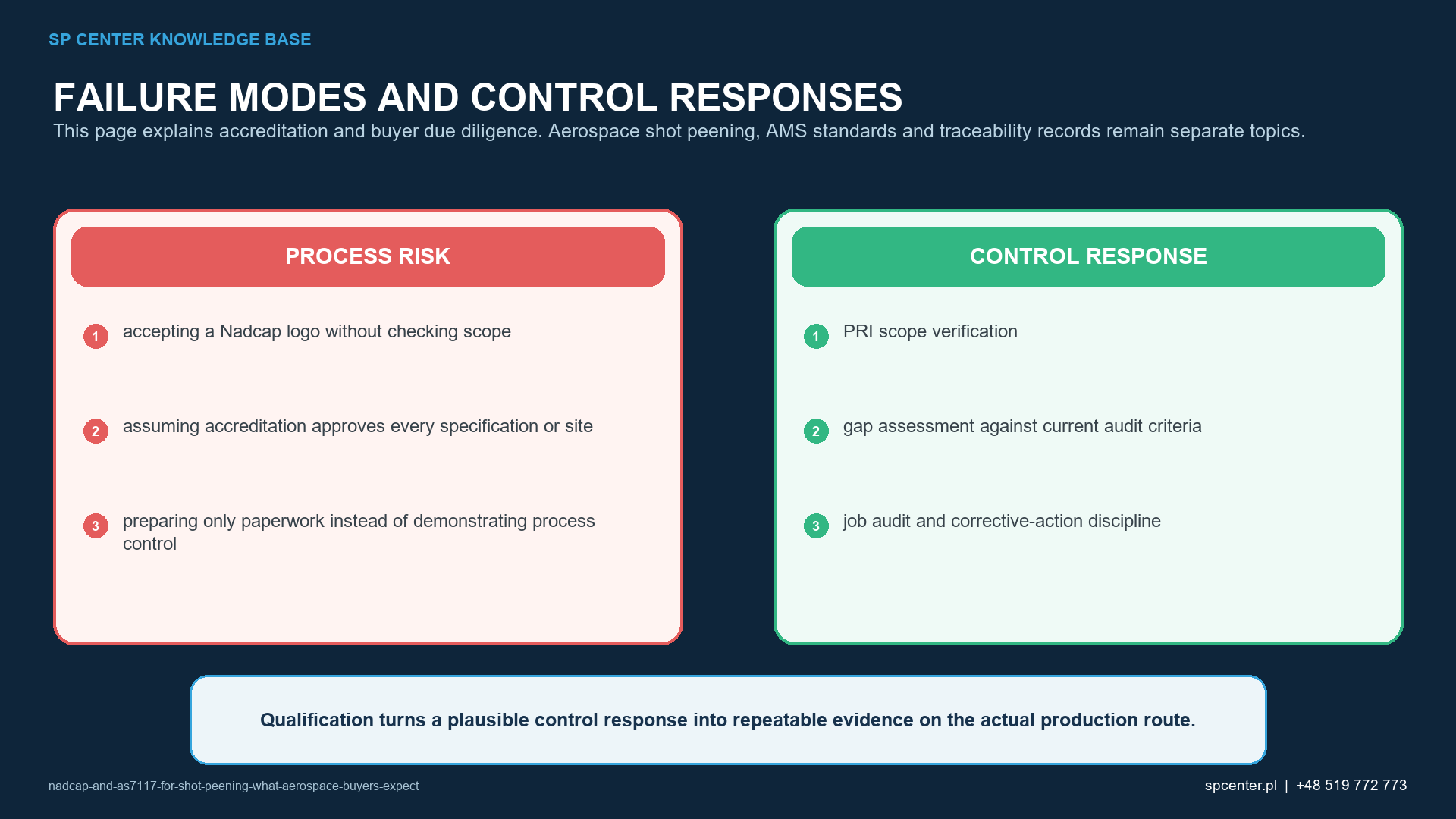
Which technical evidence matters for shot peening?
| Shot-peening evidence | Required connection | Common invalid shortcut |
|---|---|---|
| Media | Identity, condition, operating mix and applicable acceptance evidence | Material name or supplier certificate alone |
| Intensity | Applicable Almen system, locations and valid saturation evidence | Pressure, wheel speed or a single arc-height reading |
| Coverage | Defined surface, approved method and recorded acceptance | Assuming intensity or exposure time proves coverage |
| Equipment and tooling | Qualified configuration, maintenance state and change control | A machine model or recipe name |
| Production lot | Actual component identity, route, results, deviations and release authority | Nadcap certificate alone |
Table 3. Nadcap evidence must remain connected to the component, qualified route and actual batch.
Almen intensity, coverage and component response answer different questions. Intensity characterizes the stream under standardized conditions; coverage concerns impact evidence on the required component surface. Roughness, dimensions, residual stress and fatigue response need separate acceptance evidence when invoked.
For pneumatic equipment, pressure, airflow and media mass flow are separate controlled variables. For wheel equipment, wheel speed, media feed and pattern controls are likewise not interchangeable with measured intensity. The qualified configuration includes equipment, nozzle or wheel, media, fixture, motion, programme and inspection method.
How should nonconformities and changes be handled?
When an audit or production issue is found, protect the product first. Define containment and the affected extent, identify the root cause, implement corrective action and retain objective evidence of effectiveness. An NCR response is not complete merely because a procedure was edited.
Changes to site, machine, media, separator, nozzle or wheel, fixture, programme, geometry, inspection method or customer requirement need a controlled impact review. The result may affect Nadcap scope, customer approval, process qualification, part approval, or more than one of these.
What should aerospace buyers request?
- Current supplier, site and Surface Enhancement accreditation scope verified in PRI EAN.
- Evidence of any separate customer source approval required by contract.
- Identification of the complete drawing, specification and customer requirements.
- Approved process qualification and part-approval status where invoked.
- Batch records linking actual parts to machine, media, tooling, programme and results.
- Controlled deviation, change and requalification evidence where applicable.
If a customer specification, supplement or contractual clause is missing or conflicting, pause the affected work and obtain a controlled clarification. Internal qualification cannot silently substitute for absent customer authority.
Frequently asked questions
Is Nadcap accreditation a product certification?
No. It concerns the accredited supplier, site, process and scope. Product conformity and lot release still depend on the contract, drawing, specifications and actual production records.
Does Nadcap accreditation automatically mean customer approval?
No. PRI states that Nadcap accreditation does not equal customer approval. The buyer must verify its own approved-source and contractual requirements.
Which document is current: AS7117A or AC7117?
AS7117A is withdrawn. Current Nadcap Surface Enhancement audit preparation uses the applicable PRI AC7117 audit-criteria series and supplemental checklists available through PRI EAN.
How should accreditation status be checked?
Verify the current entry and detailed scope in the Nadcap Qualified Manufacturers List in PRI EAN, then confirm customer requirements. Do not rely only on a logo or an old certificate copy.
Does an audit pass release production lots?
No. Lot release remains a separate decision based on the invoked requirements and the evidence from the actual processed batch.
What if a customer specification or contract clause is missing?
Stop the affected review or work and obtain a controlled clarification from the responsible customer or design authority. Internal practice must not silently replace missing contractual requirements.
What should a shot-peening self-audit include?
Use the current criteria applicable to the requested scope and examine real execution: requirements, procedures, personnel, media, equipment, intensity, coverage, records, changes, nonconformities and product traceability.
Can a Nadcap-accredited process be moved to another machine or site?
Not automatically. Accreditation scope, customer approval, process qualification and change-control requirements must all be reviewed before transfer.
Key takeaways
- Use the current AC7117 series and applicable supplements through PRI EAN; AS7117A is withdrawn.
- Verify current site, process and scope in the Qualified Manufacturers List.
- Nadcap accreditation is not product certification and does not equal customer approval.
- Keep accreditation, supplier approval, process qualification, part approval and lot release separate.
- Self-audit actual execution and objective records, not paperwork alone.
- Do not invent checklist requirements or replace missing customer authority with internal practice.
Related SP Center guides
- Aerospace Shot Peening: Components, Documentation and Traceability
- Shot Peening Traceability
- Shot Peening Requalification After Changes
Primary technical sources
1. Performance Review Institute, Nadcap programme
2. Performance Review Institute, Nadcap accreditation
3. Performance Review Institute, Nadcap frequently asked questions
4. Performance Review Institute, Surface Enhancement Nadcap Audit Criteria Review
5. Performance Review Institute, PRI EAN and Qualified Manufacturers List
6. SAE AMS2430U: Shot Peening, revised April 2018
7. SAE J442_202602: Tools for Peening Intensity Determination and Verification, revised February 2026
8. SAE J443_202512: Procedures for Determining and Verifying Peening Intensity, revised December 2025
9. SAE J2277_202301: Shot Peening Coverage Determination, revised January 2023
Standards note: Use the complete current documents invoked by the audit scope, drawing, contract and customer flow-down. This guide does not replace controlled criteria.
Author: Paweł Kmieć
Discuss an aerospace shot peening requirement: +48 519 772 773 | [email protected]