


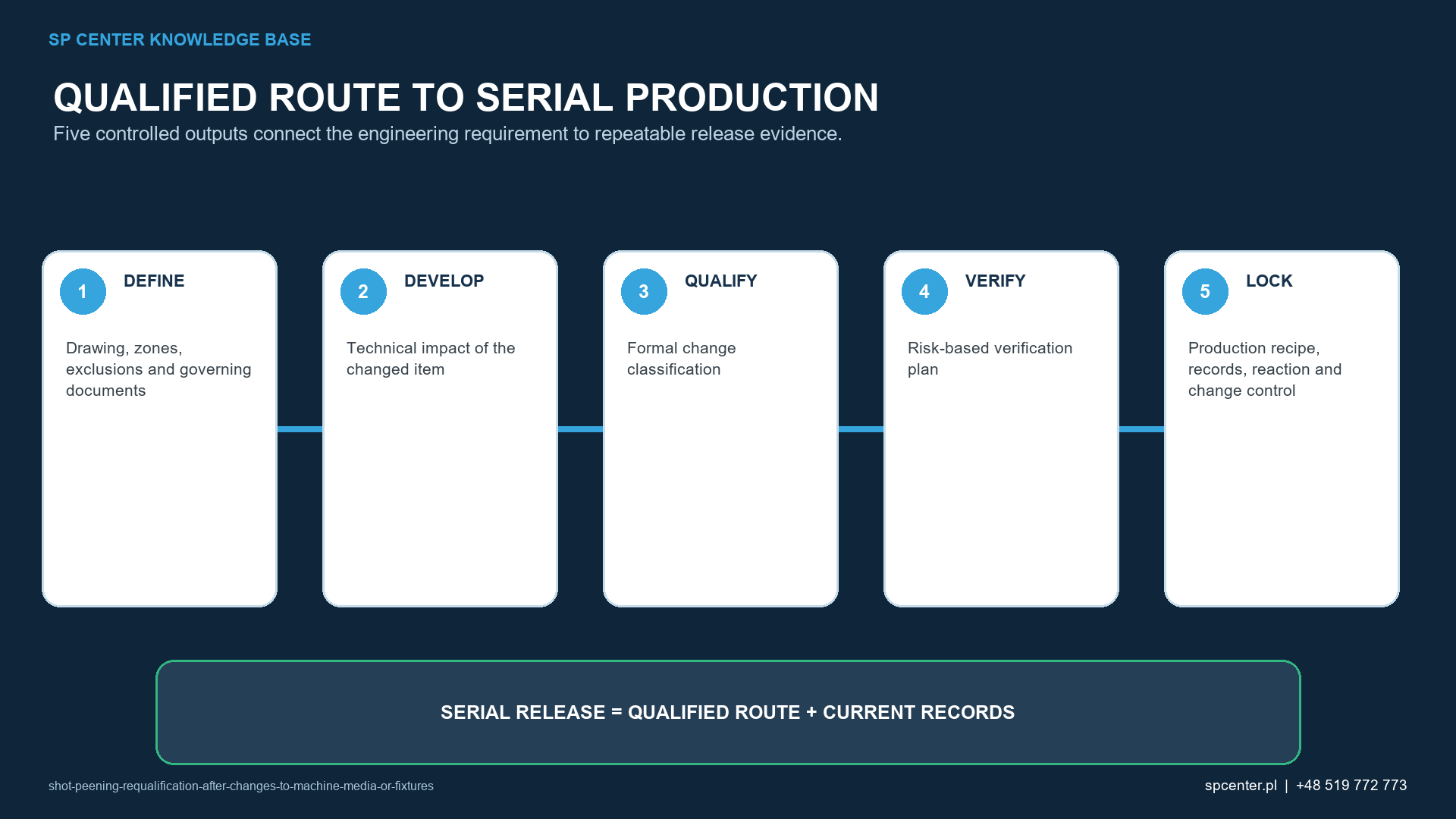
Classify technical impact before use, choose the proportionate qualification level and obtain every required internal, customer and accreditation approval
Shot peening requalification is required when a change can invalidate the evidence linking an approved configuration to its process and component results. The response is not automatically “do nothing” or “repeat the entire qualification.” A controlled technical assessment determines whether documented review, restoration verification, focused confirmation or full requalification is justified under the drawing, specification, customer and quality-system requirements.
What is the qualification baseline?
The baseline is more than a machine model and intensity range. It includes the part and material family, equipment identity and delivery principle, media, operating mix, nozzles or wheels, motion, program, fixture, masking, treatment map, parameter window, monitoring, inspection methods, component limits and application evidence.
A change challenges only the evidence it can affect, but interactions matter. Replacing a flow sensor can affect monitoring and alarm decisions; moving a nozzle bracket can affect stream geometry, coverage and surface response; changing a fixture clamp can affect access and cumulative exposure.
| Change family | Potential impact | Questions for the change review |
|---|---|---|
| Machine or delivery system | Stream profile, particle velocity, flow stability, access, alarms and monitoring | Is the machine, nozzle, wheel, air supply, separator, motion or controller still within the qualified configuration? |
| Media | Impact energy, roughness, transfer, fracture, operating-mix stability and contamination | Did material, size, hardness, shape, class, source or replenishment method change? |
| Program or software | Path, exposure, overlap, data capture, limits, alarms and bypass behaviour | Was logic, revision, scaling, sensor mapping or protected access changed? |
| Fixture or masking | Position, angle, shadowing, contact marks, transition and cumulative exposure | Did location, orientation, clamp, mask material or repositioning route change? |
| Part or material family | Plastic response, damage tolerance, access, distortion and acceptance | Is new geometry, alloy, heat treatment, hardness or surface condition inside the qualified family? |
| Inspection or requirement | Decision threshold, correlation, traceability and contractual acceptance | Did the method, equipment, sampling, coverage assessment, specification or customer approval change? |
Table 1. Change classification begins by mapping the modified item to affected process and component evidence.
How should a change be classified?
Describe the current and proposed state precisely, including manufacturer and part number, drawings, software revision, dimensions, materials, range, tolerances and installation. “Equivalent,” “improved” and “minor” are conclusions that require criteria and evidence, not change descriptions.
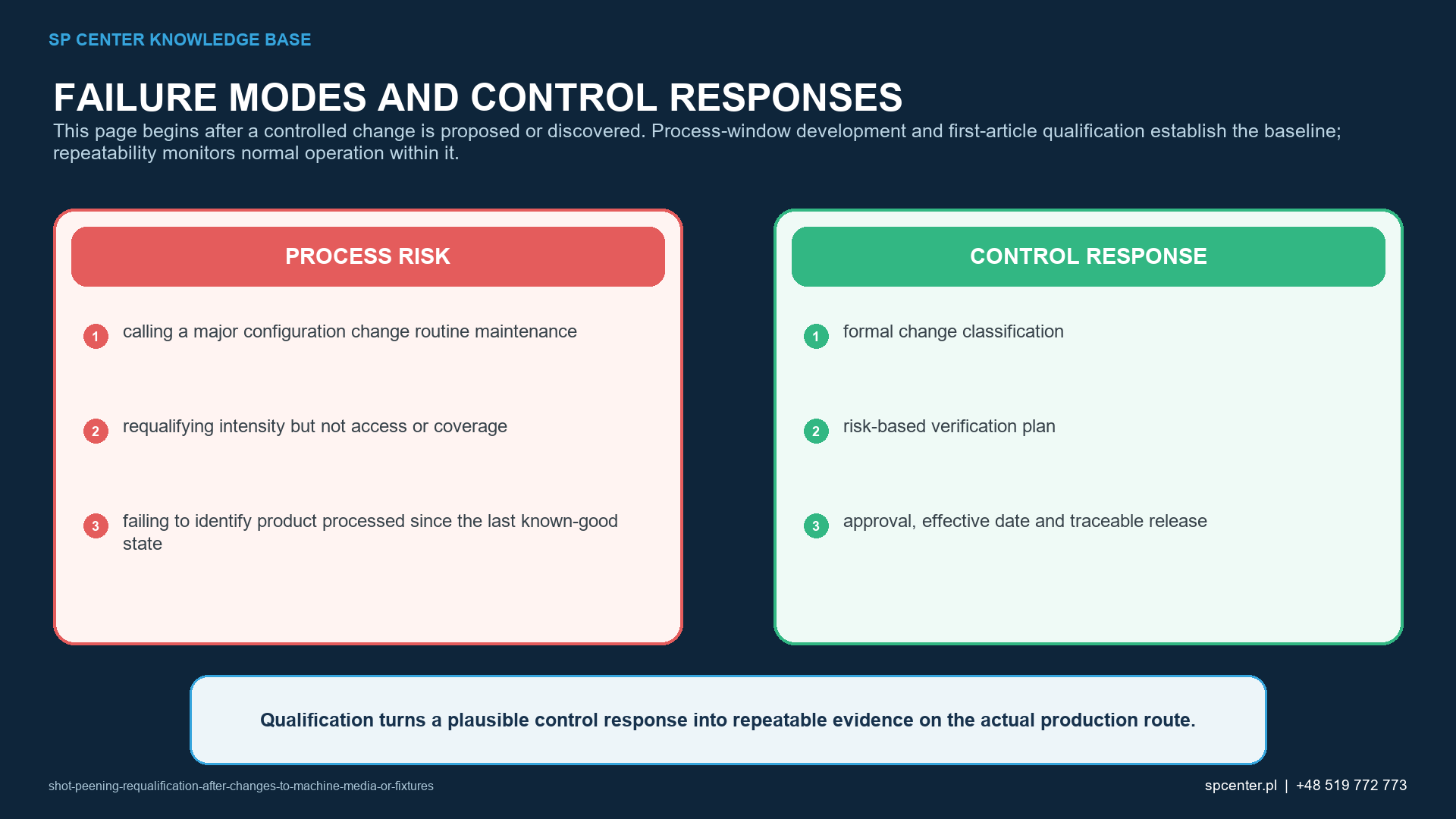
Assess failure modes, affected outputs, interacting variables, prior qualification coverage, detection controls, product already processed and required authorities. If evidence is insufficient, use the more conservative qualification route or obtain controlled clarification.
What levels of requalification are possible?
| Response level | When it may be appropriate | Typical evidence |
|---|---|---|
| Documented review | Administrative revision with no technical change, or an already-approved option within the baseline | Revision comparison, applicability check and authorized approval |
| Restoration verification | Like-for-like replacement or maintenance returning equipment to the defined state | Identity and equivalence, calibration or setup verification, maintenance record and required pre-use checks |
| Focused confirmation | Bounded change with understood affected outputs and unchanged broader application basis | Risk assessment plus selected intensity, coverage, media, surface, dimensional or repeatability comparisons |
| Full requalification | New machine principle, media family, major delivery or fixture geometry, expanded parameter or part family, or insufficient prior evidence | New qualification plan, boundary evidence, representative parts and all required approvals |
| Unplanned-change containment | Change or abnormal condition discovered after production | Stop, identify last verified state, contain affected product, reconstruct records and obtain disposition before resumption |
| Customer or accreditation review | Contract, approved-source, Nadcap scope or specification requires external action | Documented customer approval and current scope verification separate from internal qualification |
Table 2. The qualification level follows technical impact and invoked authority, not the cost or schedule of the change.
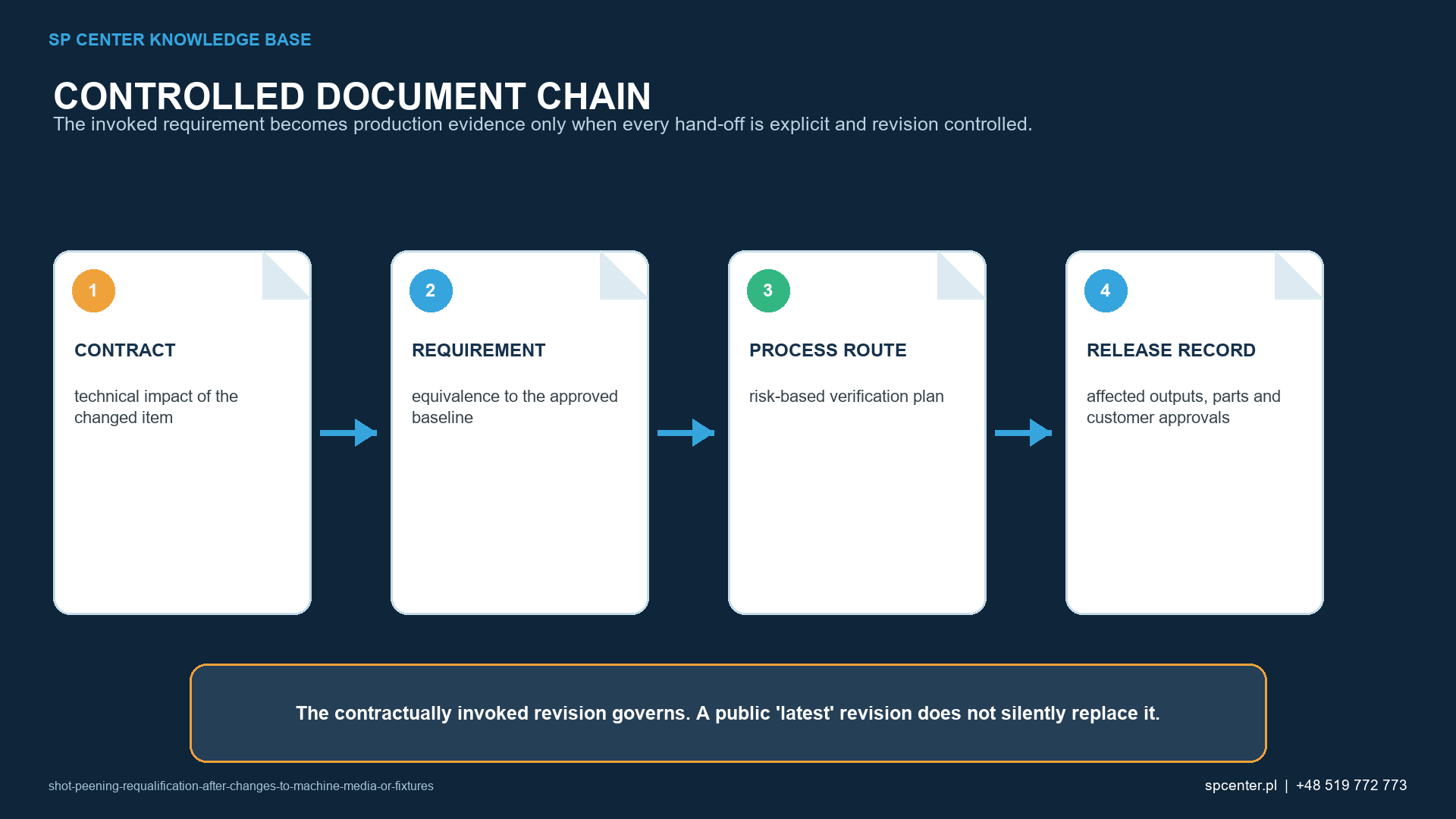
The governing specification or customer can require a specific response even when an internal assessment predicts low risk. Conversely, do not invent a universal requirement for full requalification when the controlled rules explicitly permit verified like-for-like restoration.
How are machine and delivery-system changes evaluated?
Machine relocation, major repair, control-system update, new air supply, hose layout, nozzle, wheel, blade, separator or motion system can alter stream energy, profile, flow, position or monitoring. Compare the installed configuration, not only component certificates.
Relevant checks can include mechanical setup, calibration or verification, flow and pressure stability, wheel or nozzle condition, motion accuracy, alarm functions, valid saturation or intensity results and coverage on representative geometry. Select evidence from the impact assessment and complete job requirements.
How are media changes evaluated?
Media material, specification class, size distribution, hardness, shape, manufacturing route and operating behaviour can influence intensity, roughness, damage and contamination. A supplier certificate establishes declared conformance, not equivalence of the production operating mix.
Review procurement and customer restrictions, incoming inspection, carryover and cleanout, separator settings, replenishment and representative process results. Prevent mixed or unidentified media during the transition.
Why can fixture and program changes be high impact?
A fixture determines part position, contact, shadowing, incidence angle and repeatability. A program determines path, speed, overlap, sequence and exposure. Small dimensional or code changes can produce missed zones or unintended double exposure even when Almen intensity is unchanged.
Use representative parts or surrogates to verify treatment boundaries, coverage, contacts, transitions and component condition. A robot dry run confirms collision clearance and path execution, not particle impact or surface acceptance.
Which evidence closes the change assessment?
| Evidence question | Suitable evidence | Insufficient evidence alone |
|---|---|---|
| Is the stream equivalent? | Comparable valid saturation or intensity results, media flow and profile evidence under controlled setup | One Almen strip or matching nominal setpoints |
| Is access equivalent? | Coverage and exposure evidence on representative geometry, including fixture contacts and transitions | Dry robot path or visual similarity of fixtures |
| Is component integrity retained? | Surface, roughness, dimensional, damage and cleanliness results at relevant boundary conditions | Stream conformity without component inspection |
| Is application performance retained? | Residual-stress depth or representative fatigue and service evidence where the claim depends on it | Surface residual stress at one convenient coupon location |
| Is monitoring equivalent? | Sensor location, range, calibration, scaling, correlation, alarm and data-integrity verification | A calibration certificate without installed-system assessment |
| Is release authorized? | Approved report, procedure and program revisions, customer or design authority approval where required | Successful trials before the required approval is obtained |
Table 3. Stream, access, component, application, monitoring and approval equivalence are distinct questions.
Where fatigue or residual-stress credit is part of the design basis, a change that affects energy, material response, angle or exposure may require residual-stress depth or representative performance confirmation. A convenient flat coupon cannot automatically replace a critical fillet, bore or edge.
How are unplanned changes and affected product controlled?
If a change, wrong component, bypass, maintenance action or abnormal condition is discovered after processing, stop release and preserve the actual state and records. Determine the last verified acceptable configuration and contain the entire potentially affected interval; do not define the interval by convenience.
Retrospective testing can support an authorized disposition but does not turn unauthorized production into a normal approved route. Correct the system, complete the required qualification and approval, and verify readiness before resuming.
How do customer approval and Nadcap scope interact?
Internal requalification, customer source or process approval and Nadcap accreditation scope are separate. A technically successful trial does not grant customer approval. Nadcap accreditation does not certify the product or automatically add a new machine, site or process configuration to the accepted scope.
For Nadcap work, retrieve the current applicable AC7117 criteria and supplements from PRI EAN and verify the Qualified Manufacturers List scope. Apply contractual notification and approval clauses before use.
What should the change package contain?
- Change request, reason, current state and proposed state.
- Requirement and approval matrix, including customer and accreditation actions.
- Technical impact and risk assessment with affected evidence layers.
- Qualification plan, safe boundaries, samples, acceptance and stop criteria.
- Raw and summarized results for stream, coverage and component acceptance.
- Deviations, failed trials, dispositions and corrective actions.
- Approved procedure, program, drawing, control-plan and training revisions.
- Effective date, affected product, release authority and retained records.
Keep failed evidence and exclusions visible. A report that records only the successful final setting cannot demonstrate how the approved boundary was established.
Frequently asked questions
Does every maintenance action require full shot peening requalification?
No universal rule applies. Use the approved change procedure. Like-for-like restoration may need defined verification, while a change that challenges the qualified configuration can require focused or full requalification.
Is a replacement nozzle a like-for-like change?
Only when identity, geometry, material, condition and installed performance meet the approved equivalence definition. Nozzle position and stream response still require the specified pre-use verification.
Does changing the media supplier always require full requalification?
Not automatically, but source, material, class, size, hardness, shape, certification and operating behaviour must be reviewed under the governing specification and customer rules.
Can matching Almen intensity prove two machines are equivalent?
No. It is one stream response. Media flow, profile, access, coverage, surface condition, monitoring and any application evidence must also be assessed.
What if a fixture is modified only to improve loading?
Review clamp location, orientation, shadowing, transition, repeat positioning and damage. A small physical change can alter local exposure.
Does sensor calibration complete requalification after sensor replacement?
Not by itself. Verify range, location, scaling, installed correlation, alarm logic, data capture and the process outputs affected by the sensor.
What happens if an unapproved change is found after production?
Stop release, preserve evidence, identify the last verified acceptable state, contain affected product, assess technical impact and obtain authorized disposition before resuming.
Does Nadcap accreditation approve a machine change?
No. Verify current AC7117 criteria, accreditation scope, customer approval and internal process qualification separately. Accreditation does not release the changed process or product lot.
Key takeaways
- Define the complete qualification baseline before classifying a change.
- Do not use “minor” or “like-for-like” without objective equivalence criteria.
- Choose documented review, restoration verification, focused confirmation or full requalification according to impact.
- Keep stream, access, component, application and monitoring evidence separate.
- Contain unplanned changes from the last verified acceptable state.
- Obtain internal, customer and accreditation approvals independently.
Related SP Center guides
- How Machine Condition Affects Process Quality
- Shot Peening Fixtures
- Shot Peening Process Window
- Shot Peening Repeatability
Technical references
1. SAE AMS2430U: Shot Peening, revised April 2018
2. SAE AMS2432E: Shot Peening, Computer Monitored, revised October 2022
3. SAE J2441_202511: Shot Peening, stabilized November 2025
4. SAE ARP7488: Peening Design and Process Control Guidelines, issued January 2018
5. SAE J442_202602: Tools for Peening Intensity Determination and Verification, revised February 2026
6. SAE J443_202512: Procedures for Determining and Verifying Peening Intensity, revised December 2025
7. SAE J2277_202301: Shot Peening Coverage Determination, revised January 2023
8. Performance Review Institute, Surface Enhancement Nadcap Audit Criteria Review
9. Performance Review Institute, PRI EAN and Qualified Manufacturers List
Standards note: Change classification, notification, approval and qualification extent must follow the complete controlled requirements for the job. This guide does not replace customer authority.
Author: Paweł Kmieć
Discuss a shot peening change and requalification plan: +48 519 772 773 | [email protected]