


Control upper intensity, local exposure, media and cumulative cycles, then judge damage through component-specific surface, dimensional and performance limits
Overpeening is an unacceptable process or component condition in which impact energy, exposure, media or their interaction with the material degrades a required surface, geometry or performance result. It is not defined by one universal cycle time. A condition can satisfy nominal machine settings and still be unacceptable at a sensitive edge, thin wall, fillet or previously treated zone.
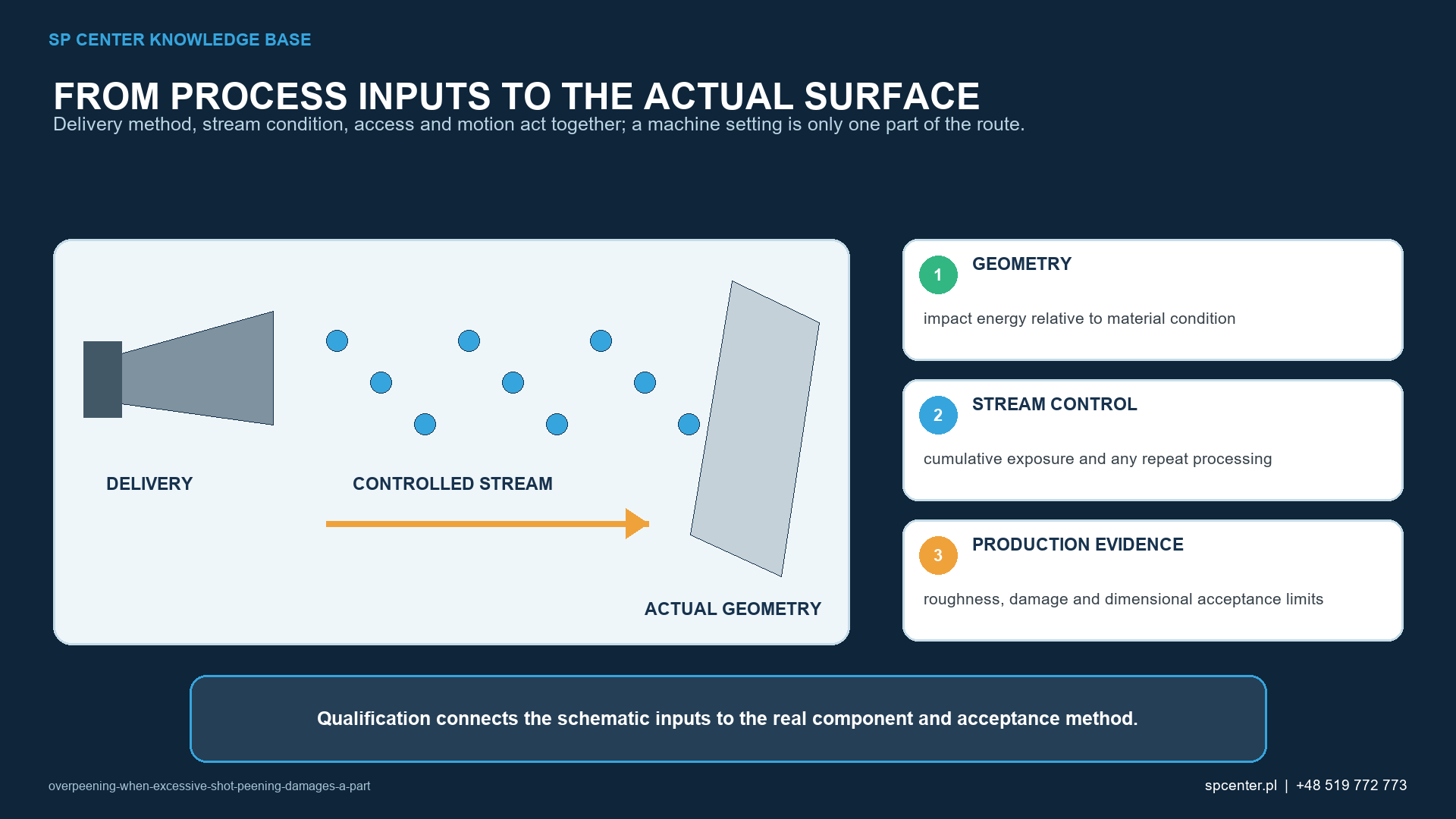
Which conditions can cause overpeening?
| Potential cause | Mechanism or event | Control evidence |
|---|---|---|
| Intensity above the qualified window | Particle impact condition exceeds the approved upper limit | Valid saturation evidence and configuration records |
| Excessive local dwell or overlap | Robot stop, low speed, repeated pass or path error raises local exposure | Programme, motion, footprint and event records |
| Wrong media | Size, hardness, material, shape or contamination changes surface response | Incoming and operating-mix inspection with lot traceability |
| Unexpected component condition | Material, heat treatment, coating, thin wall or incoming roughness differs | Part identity, condition and incoming inspection |
| Uncontrolled repeat processing | A second cycle is added without assessing cumulative exposure | Cycle history and explicit rework authorization |
| Inspection or data error | Coverage convention, programme count or part status is misread | Independent record reconciliation and method verification |
Table 1. The investigation separates the event, the physical mechanism and the evidence that can confirm it.
Excessive exposure can arise from a global cycle setting or a local event. A robot hesitation, overlapping path, wrong index, manual dwell or duplicate programme can concentrate impacts even when the nominal recipe is unchanged. Media contamination or an incorrect component condition can also move the response outside the qualified basis.
Almen intensity, exposure and coverage are different controls. Correct intensity does not prove that the component received the intended dwell and footprint. Conversely, longer exposure can increase coverage without improving the component response indefinitely.
What warning signs should stop release?
| Observed symptom | What it can indicate | What is needed before disposition |
|---|---|---|
| Roughness above limit | Energy, media, exposure or incoming texture mismatch | Defined roughness method, locations and baseline comparison |
| Laps, folds, cracking or severe indentation | Surface damage or unsuitable material-process combination | Qualified inspection and design or repair authority |
| Distortion or dimensional loss | Unbalanced or excessive plastic deformation | Dimensional map, sequence review and allowable limit |
| Uneven texture | Path overlap, dwell, access or mixed-media problem | Coverage mapping, media check and machine-event review |
| No further performance benefit | Response may have saturated or another damage mechanism may dominate | Representative residual-stress or fatigue evidence when required |
Table 2. A symptom identifies a need for investigation; it does not by itself identify the root cause.
Use the inspection methods invoked by the drawing, qualification and contract. Visual examination may reveal obvious damage but cannot replace specified roughness, dimensional, metallographic, residual-stress, customer-specified inspections outside SP Center's service scope or performance evidence.
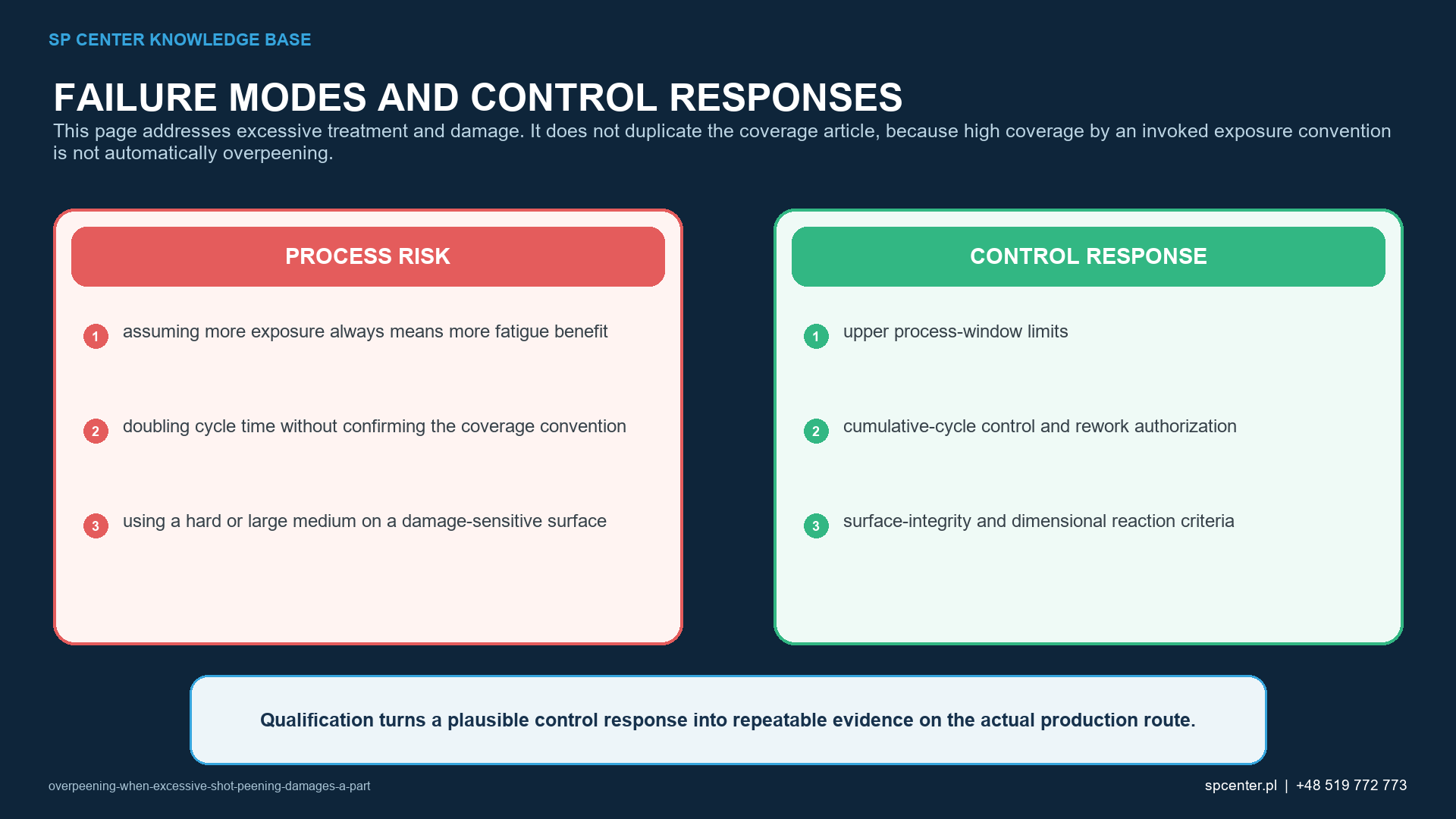
Does high coverage automatically mean overpeening?
No. Coverage and overpeening describe different decisions. Where an applicable requirement defines 200% coverage through total exposure equal to twice the time required for 100%, that is an exposure convention. It does not automatically prove damage, and it does not guarantee additional fatigue benefit.
The specified coverage must remain within the qualified process window for the actual material and geometry. Additional exposure beyond the required convention needs technical and contractual authority, not an assumption that more impacts are beneficial.
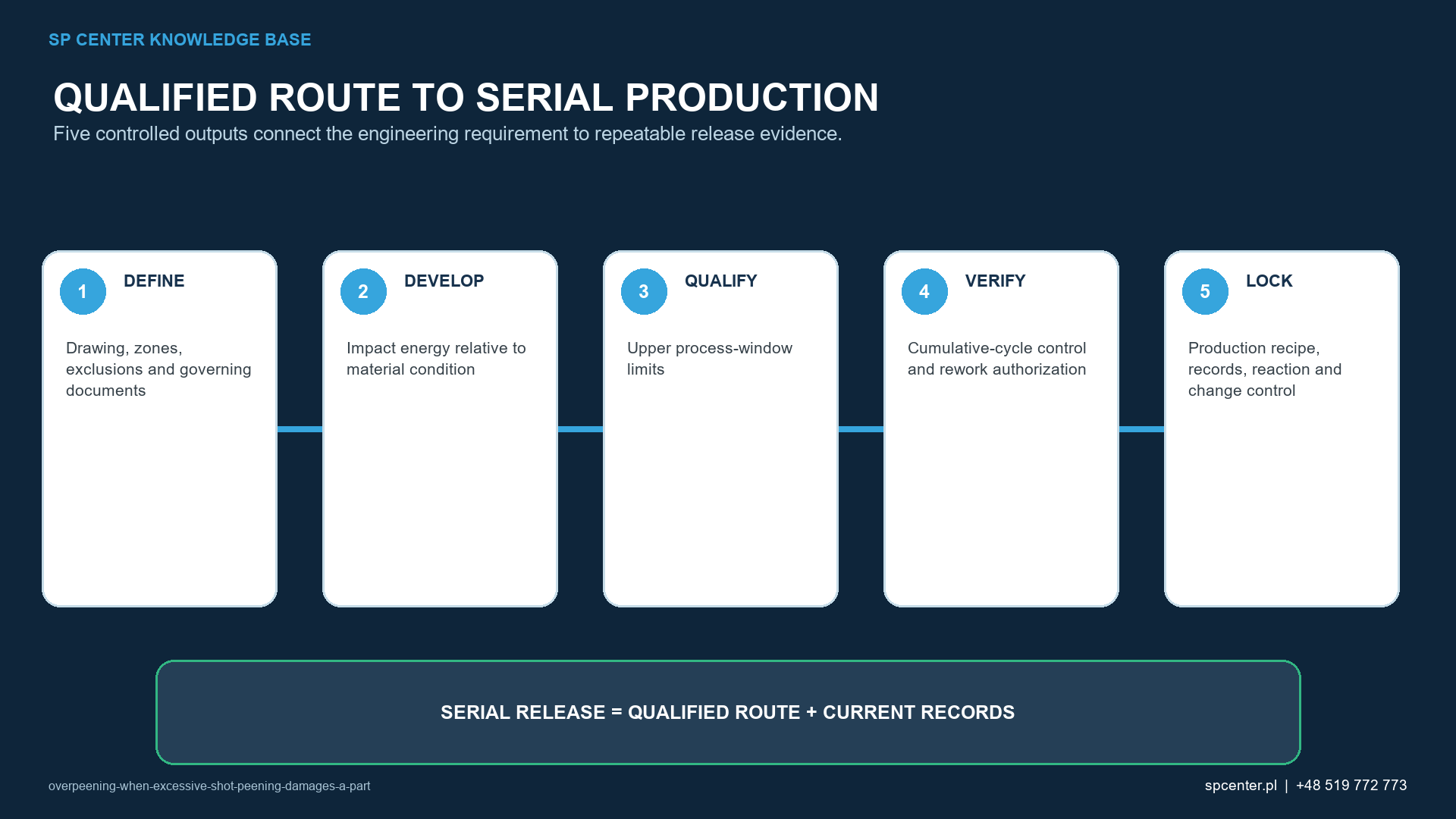
How should the upper process window be qualified?
- Freeze material, heat treatment, incoming surface, geometry, treatment map and governing requirements.
- Define media, equipment, intensity, coverage convention, motion and upper exposure conditions.
- Challenge representative damage-sensitive and worst-overlap locations without exceeding approved stop criteria.
- Measure intensity and coverage independently and inspect invoked surface and dimensional outputs.
- When the design case depends on them, add residual-stress, fatigue or functional evidence on representative material and geometry.
- Approve upper limits, alarms, cumulative-cycle logic, rework authority, records and requalification triggers.
Qualification must include the real sequence. Treatments before or after peening, masking, cleaning, heat exposure, straightening and prior peening can change the result or available margin.
Which evidence proves an acceptable result?
| Evidence layer | What it establishes | What it cannot establish alone |
|---|---|---|
| Intensity | The stream met the specified Almen intensity under defined conditions | Component coverage, roughness or absence of damage |
| Coverage | The required surface has the invoked impact coverage | That further exposure is beneficial or harmless |
| Surface and dimensions | The component meets invoked condition and tolerance limits | Residual-stress depth or fatigue performance |
| Residual stress | The measured profile at defined locations under the stated method | Universal life improvement in service |
| Fatigue or functional test | Performance for the tested material, geometry and loading | Automatic transfer to another component or route |
Table 3. No single surrogate proves the complete component condition.
Residual-stress or fatigue results should not be generalized beyond the tested basis. A useful response may plateau, redistribute or be offset by roughness and damage depending on material and process. The acceptance decision follows the invoked requirement, not a universal assumption about exposure.
How should suspect product be handled?
Stop the process and contain all potentially affected product to the last known acceptable state. Preserve programme, alarm, machine, media, operator, inspection and cycle-history records. Reconcile part identity with every executed pass and identify whether the condition is global or local.
Do not automatically reprocess, polish, blend or accept the surface. Cumulative exposure and material removal can worsen damage or erase evidence. Disposition must come from the applicable design, repair, quality and customer authority.
Frequently asked questions
What is overpeening?
It is an unacceptable process or component condition in which impact energy, exposure, media or their interaction with the part degrades a required surface, geometry or performance result.
Is there a universal overpeening limit?
No. The upper boundary depends on material, heat treatment, geometry, incoming surface, media, equipment and the governing acceptance requirements.
Does 200% coverage mean overpeening?
Not automatically. Where the governing requirement defines 200% as twice the exposure time needed for 100%, it is an exposure convention. It is acceptable only inside the qualified component and process limits.
Can correct Almen intensity rule out overpeening?
No. Intensity characterizes the stream. Local dwell, overlap, component geometry, media condition, roughness, dimensions and surface integrity remain separate questions.
What are warning signs?
Possible signs include excessive roughness, severe indentation, laps or cracking, distortion, dimensional loss and non-uniform surface condition. Each must be assessed by the approved method.
Can an overpeened part be peened again to correct it?
Not automatically. Additional exposure can worsen damage. Stop, contain the part and obtain disposition from the applicable design, repair and contractual authority.
How should duplicate cycles be prevented?
Link part and lot identity to programme execution, cycle count and operator or system confirmation, then define alarms and authorization for any repeat processing.
How is an upper process limit qualified?
Challenge the proposed upper region on representative material and geometry, monitor intensity and coverage, and assess every invoked surface, dimensional, residual-stress or performance limit.
Key takeaways
- Overpeening has no universal time or intensity threshold for every component.
- Local dwell, overlap, wrong media and duplicate cycles can matter as much as the nominal recipe.
- Correct intensity and specified coverage do not alone prove the absence of damage.
- 200% coverage is not automatically overpeening when correctly invoked and qualified.
- Surface, dimensions, residual stress and fatigue remain separate evidence layers.
- Contain suspect product and obtain explicit authority before any reprocessing.
Related SP Center guides
Technical references
1. SAE J2441_202511: Shot Peening, stabilized November 2025
2. SAE AMS2430U: Shot Peening, revised April 2018
3. SAE ARP7488: Peening Design and Process Control Guidelines, issued January 2018
4. SAE J442_202602: Tools for Peening Intensity Determination and Verification, revised February 2026
5. SAE J443_202512: Procedures for Determining and Verifying Peening Intensity, revised December 2025
6. SAE J2277_202301: Shot Peening Coverage Determination, revised January 2023
Standards note: Use the complete documents invoked by drawing and contract. This article does not define a universal damage threshold or authorize rework.
Author: Paweł Kmieć
Discuss a damage-sensitive shot peening project: +48 519 772 773 | [email protected]