


Separate low intensity, incomplete coverage, blocked access, interrupted exposure and weak inspection evidence before deciding how to recover a suspect process
Underpeening is a practical diagnostic term for shot peening that is insufficient or not adequately demonstrated for the specified surface. It is not one universal lower time limit. A process can have correct Almen intensity but miss a recessed fillet, or show full-looking coverage while its intensity evidence is invalid. The first task is therefore to identify exactly which requirement failed and which product may be affected.
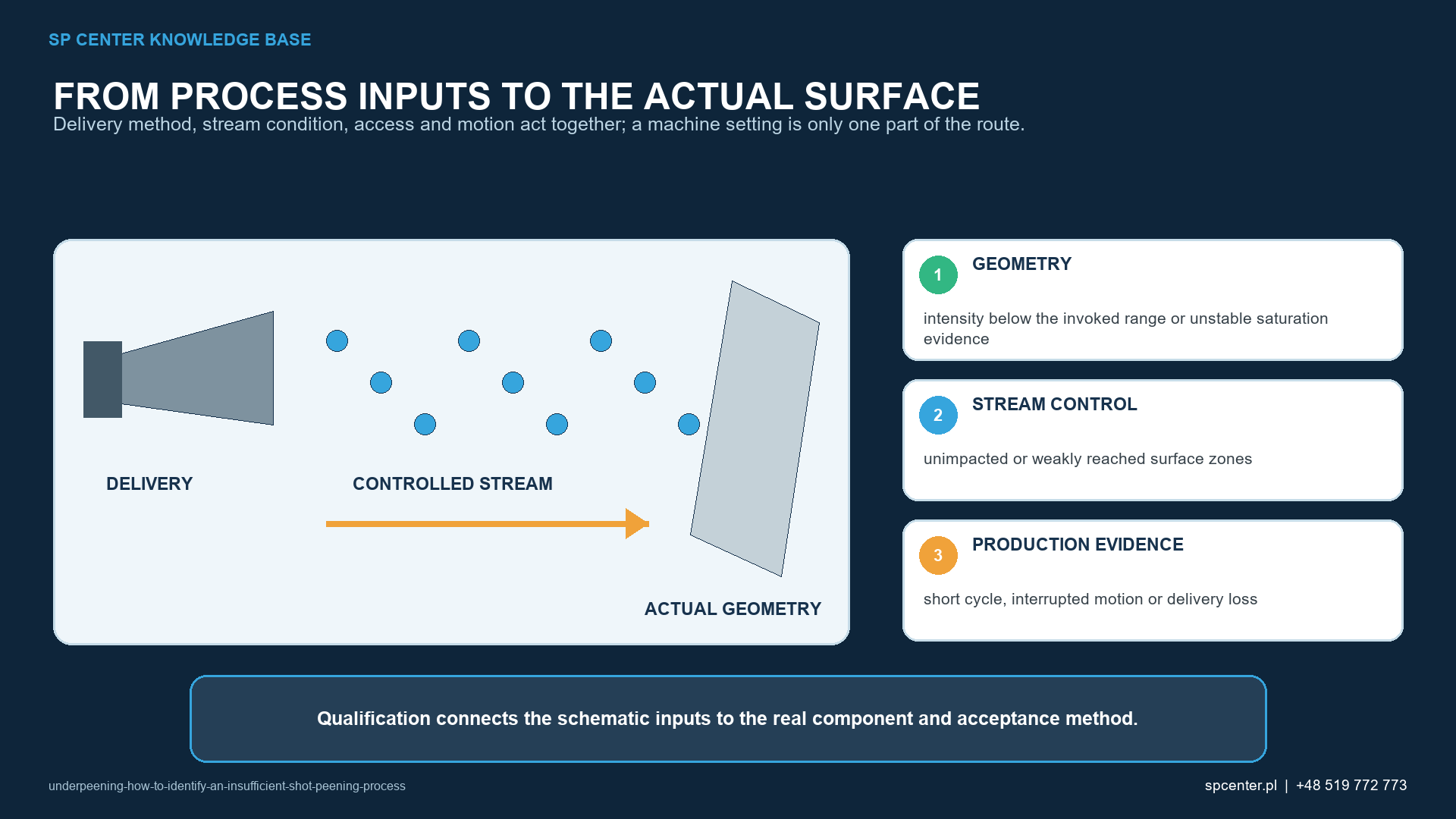
What can “underpeening” mean in practice?
The term can describe intensity below the invoked range, a saturation or verification record that is not valid, incomplete coverage, a feature that the stream did not reach, an interrupted cycle or an inspection method that cannot support the acceptance decision. These conditions are not interchangeable and must not receive the same correction.
Use the formal language of the governing drawing, process specification, purchase order and customer requirements in the nonconformance record. “Underpeening” can help organize the investigation, but it does not replace the actual requirement or the authorized disposition route.
| Observed condition | Possible causes | Evidence to examine before correction |
|---|---|---|
| Intensity below the invoked range | Stream energy, media condition or flow, pressure or wheel speed, nozzle, distance, angle or equipment drift | Valid saturation basis, required verification result, Almen tools, media data and controlled machine records |
| No valid saturation or intensity evidence | Insufficient curve points, invalid fit or criterion, wrong strip or holder, mixed configurations or incomplete traceability | Raw arc-height data, time points, strip identity, holder and gage status, calculation and approved configuration |
| Incomplete coverage on a specified feature | Insufficient exposure, poor access, shadowing, path gap, mask interference, unsuitable inspection or local surface condition | Feature-level coverage evidence, path and fixture review, mask condition, observation method, lighting and magnification |
| Interrupted or shortened cycle | Alarm, media-delivery loss, motion stop, program interruption, loading error or operator intervention | Alarm log, mass-flow or delivery record, position and path history, timestamps, operator record and affected product window |
| Uniform appearance but uncertain treatment | Observation cannot resolve individual impressions, prior texture conceals gaps, tracer is unqualified or accessible area is not representative | Approved direct or qualified indirect coverage method at the actual required area and its correlation basis |
| Acceptable process records but unacceptable component | Edge damage, distortion, contamination, roughness or dimensional change independent of nominal settings | Surface and dimensional acceptance plus any invoked material or performance validation |
Table 1. The same visual symptom can arise from different causes; evidence must be reviewed before changing the process.
Why must intensity and coverage be separated?
Peening intensity characterizes the response of the qualified stream through the Almen system and a valid saturation basis or the verification method invoked for production. Coverage describes the extent to which individual impact impressions cover the required component area under the approved observation method. Neither result substitutes for the other.
Low intensity cannot be corrected by declaring a surface visually uniform. Incomplete coverage cannot be corrected merely by repeating an Almen check. Pressure, wheel speed or nominal cycle time are machine inputs; they are not independent proof of stream intensity or feature-level coverage.
How are blocked access and interrupted delivery detected?
Recesses, bores, roots, undersides, mask boundaries and deep fillets can be shadowed even when an accessible witness area looks acceptable. Review the actual line of sight, nozzle or wheel-stream geometry, fixture, masks, rebound and motion overlap. Development must challenge the least accessible specified location, not only a convenient surface.
For an interrupted cycle, preserve the alarm log, media-flow or delivery record, program revision, position, path history and timestamps. Determine whether the machine resumed at the correct location and whether every component received the required motion and exposure. A completed program flag is not sufficient when the relevant monitoring channel failed or the product position is uncertain.
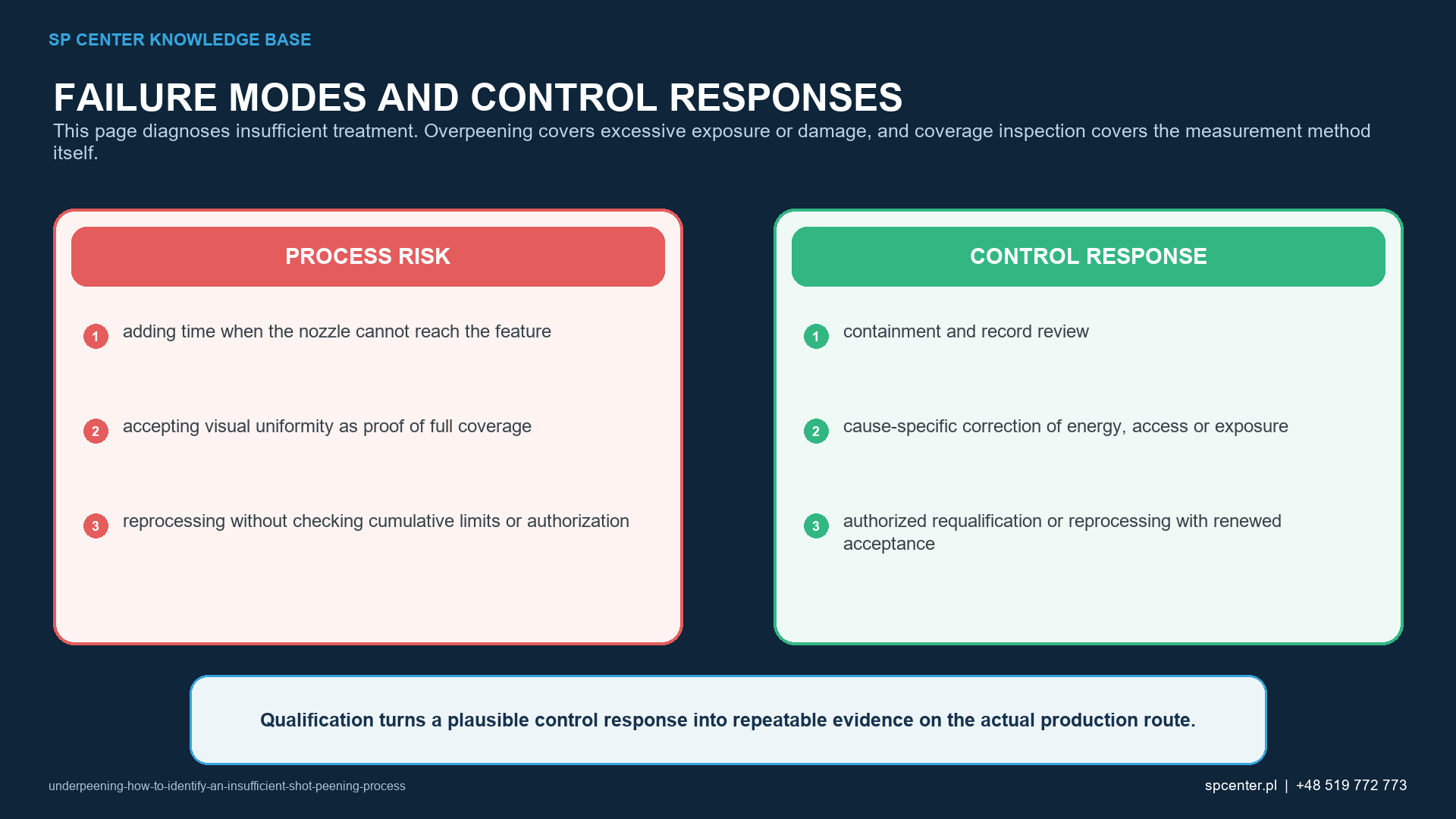
Which evidence belongs to each decision?
| Evidence layer | What it can establish | What it cannot establish alone |
|---|---|---|
| Process verification | The qualified stream and production configuration met the invoked intensity, media, equipment, motion and monitoring requirements | Coverage of every component feature, absence of surface damage or fatigue benefit |
| Component surface acceptance | Required areas meet the approved coverage method, mask boundaries, surface condition, cleanliness and dimensional criteria | The Almen intensity, residual-stress depth profile or service life |
| Component validation | The specified material, geometry and manufacturing route provide the measured residual-stress, fatigue, SCC or other application result | Routine control of every production cycle unless the governing requirement says so |
| Measurement-system evidence | The inspection or measurement method is capable, repeatable and used within its qualified conditions | Acceptance of a particular component without its actual result |
Table 2. Process verification, component acceptance, component validation and measurement-system capability answer different questions.
Residual-stress measurement or fatigue testing can support application validation when invoked, but it is not a routine substitute for an invalid production intensity record. Likewise, repeatability or measurement-system analysis qualifies the inspection system; it does not provide the missing result for a particular component.
What should happen when insufficient treatment is suspected?
Contain the product before experimenting with correction. Establish the last known conforming state using independent records and include every serial number or lot that could share the suspect condition. Do not narrow the affected window from an assumption about nominal program completion.
| Disposition step | Required decision | Release evidence |
|---|---|---|
| Contain | Stop affected processing and identify the last known conforming state and every potentially affected serial or lot identity | Documented product boundary, preserved records and controlled status |
| Classify | Identify whether the failure concerns intensity, saturation evidence, access, coverage, cycle execution, inspection or component condition | Cause-specific review linked to the applicable requirement |
| Restore control | Correct the actual cause and determine whether configuration change or requalification is required | Approved settings, tooling, program, media and verification status |
| Decide product disposition | Obtain the engineering, quality or customer authority required by the governing documents | Recorded use-as-is, reprocess, repair or reject decision without informal substitution |
| Reprocess when authorized | Assess cumulative exposure, material, surface, dimensions and process sequence before another cycle | Authorized route and traceable total exposure |
| Reaccept and release | Repeat every affected process and component check; add validation only when invoked | Complete results tied to the actual product and final release authority |
Table 3. Recovery is a controlled product-disposition process, not an informal extension of cycle time.
When is additional exposure a valid correction?
Additional exposure can be considered only when the cause is known, the required feature is physically accessible, the process route permits another pass and the cumulative component limits remain acceptable. It does not repair an invalid saturation curve, wrong strip type, blocked nozzle path, unsuitable medium, lost traceability or a coverage method that cannot resolve the surface.
Every previous pass contributes to cumulative exposure. Review cold work, roughness, dimensional change, thin-section distortion, edge integrity, coating condition and subsequent heat or finishing operations. Reprocessing requires the authorization defined by the governing documents and renewed acceptance of every affected characteristic.
How should the cause be corrected?
- Intensity failure: restore and verify the qualified stream; review media, flow, energy input, distance, angle, nozzle or wheel condition and Almen-system validity.
- Coverage failure: correct exposure, path, overlap or observation only after confirming that the stream can reach the feature.
- Access failure: revise fixture, orientation, masking or delivery geometry through the required change-control and qualification route.
- Interrupted execution: correct the alarm, delivery or motion failure and establish a traceable recovery point.
- Inspection failure: restore the approved method, lighting, magnification, calibration or correlation; do not infer acceptance from appearance.
- Component damage: stop and use the authorized inspection and disposition route. Shot peening must not conceal a crack, fold, distortion or other rejectable condition.
What should be specified in an RFQ or process requirement?
State the controlled drawing and revision, material and heat treatment, incoming surface, treatment and masking map, invoked specifications and revisions, required Almen intensity and strip designation, coverage definition and observation method, surface and dimensional limits, lot identity and required records. Identify the hardest-to-reach feature and any restriction on reprocessing.
A supplier should explain how equipment, media, fixture, masking, motion, monitoring and acceptance evidence are linked. Avoid a copied pressure, distance or time from another component. A technically comparable quotation defines the required outcome and evidence without forcing an unqualified recipe.
What records support final release?
- Component, serial or lot identity and the exact drawing and specification revisions.
- Qualified machine, media, fixture, masks, program and controlled process settings.
- Saturation or intensity verification data and valid Almen equipment status.
- Media condition, mass-flow or delivery, equipment alarms and motion records as invoked.
- Feature-specific coverage, surface, cleanliness and dimensional acceptance.
- Nonconformance boundary, root-cause evidence, approved changes and disposition authority.
- Total exposure and renewed results for every authorized reprocessing cycle.
- Component-validation evidence only where the qualification or customer requirement invokes it.
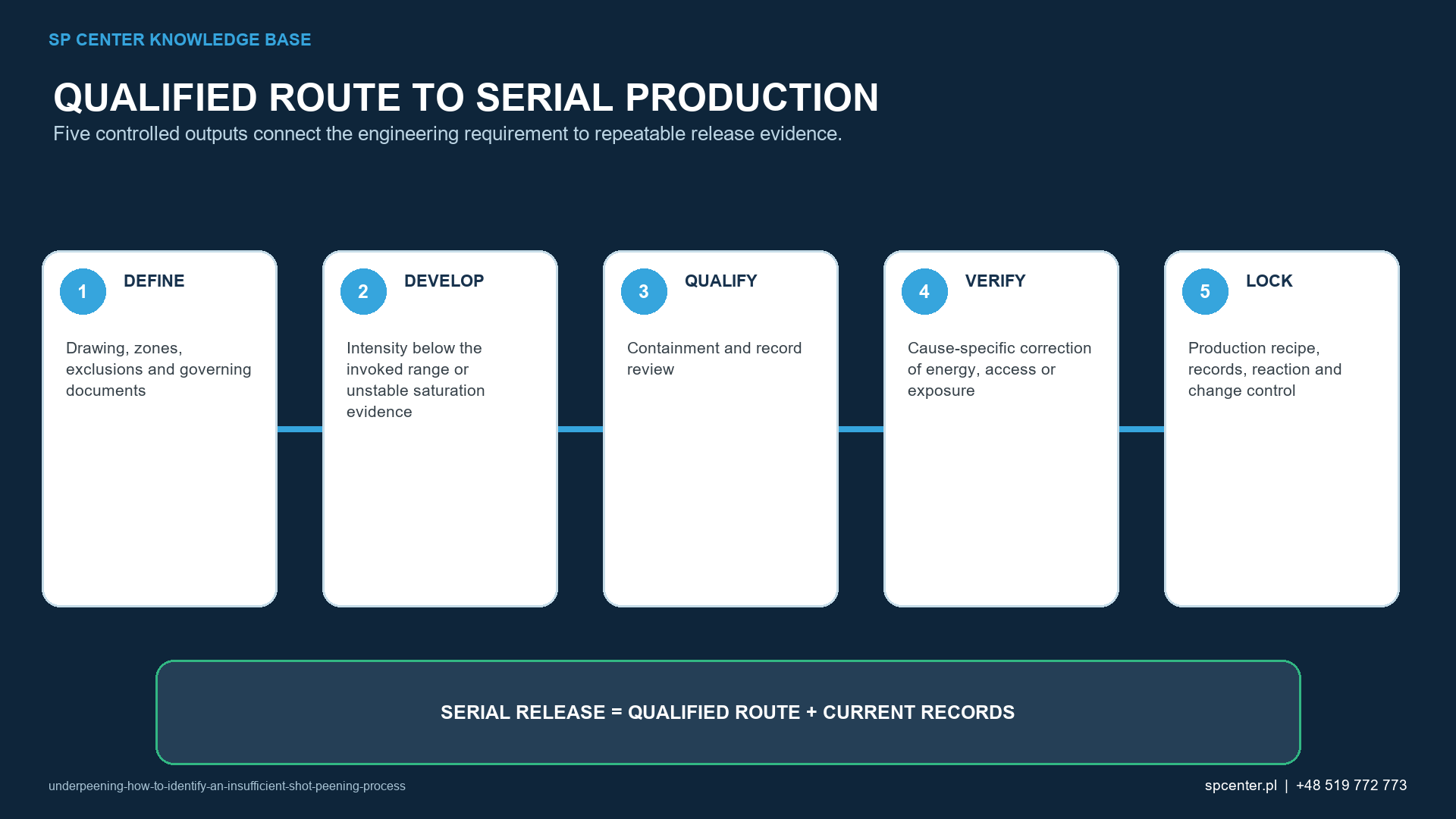
What is underpeening?
Underpeening is a practical diagnostic term for insufficient or unproven shot peening. It can mean intensity outside the invoked range, incomplete coverage, blocked access, interrupted exposure or inadequate evidence for the specified surface. The governing specification determines the formal disposition.
Does low coverage always mean low Almen intensity?
No. Correct stream intensity can coexist with incomplete coverage when exposure, access, path, masking or inspection is inadequate. Conversely, full-looking coverage does not prove that intensity was within the invoked range.
Can extra exposure correct underpeening?
Only when the cause is insufficient exposure, the feature is accessible and an authorized route allows additional processing. More time does not correct blocked access, wrong media, invalid intensity evidence or an unsuitable inspection method.
Does correct Almen intensity prove that a recessed feature was peened?
No. The Almen system characterizes a standardized stream response. Coverage and access at each specified recess, underside, bore or fillet require separate evidence.
Can a fluorescent tracer prove coverage?
It can support inspection only when the method is approved, qualified for the actual surface and correlated with the accepted coverage method. A tracer result alone does not prove surface integrity, dimensions or performance.
May a suspect component be reprocessed automatically?
No. Reprocessing needs the authority required by the drawing, specification and customer system. Cumulative exposure, cold work, roughness, distortion, coatings and prior cycles must be reviewed before another pass.
Is underpeening the opposite of overpeening?
They describe different failure directions, but neither has one universal threshold. Underpeening concerns insufficient or unproven treatment; overpeening concerns excessive exposure, energy or component damage. Both require cause-specific evidence.
Can shot blasting replace a failed shot-peening cycle?
No. Shot blasting is generally used for cleaning or surface preparation and does not replace a qualified controlled shot-peening process or its intensity, coverage and traceability evidence.
Key takeaways
- Underpeening has no universal lower cycle-time threshold.
- Low intensity, incomplete coverage, blocked access and interrupted motion are different failures.
- Machine settings and surface appearance are not sufficient evidence by themselves.
- Contain product and classify the failed requirement before changing the process.
- Extra time helps only when insufficient exposure is the actual cause and reprocessing is authorized.
- Release needs renewed process and component evidence linked to the affected product.
Related SP Center guides
- Overpeening: When Excessive Shot Peening Damages a Component
- Shot Peening Coverage Inspection
- Shot Peening Saturation Curve
- Surface Defects and Shot Peening
Technical sources
1. SAE J442_202602: Tools for Peening Intensity Determination and Verification, revised February 2026
2. SAE J443_202512: Procedures for Determining and Verifying Peening Intensity, revised December 2025
3. SAE J2277_202301: Shot Peening Coverage Determination, revised January 2023
4. SAE AMS2430U: Shot Peening, revised April 2018
5. SAE ARP7488: Peening Design and Process Control Guidelines, issued January 2018
Standards note: Apply the complete revisions invoked by the drawing, contract and customer flow-down. This guide does not create a universal underpeening threshold or authorize product disposition.
Author: Paweł Kmieć
Discuss a controlled shot-peening requirement: +48 519 772 773 | [email protected]