


How machine architecture, process controls and qualification evidence combine to deliver a reproducible peening stream
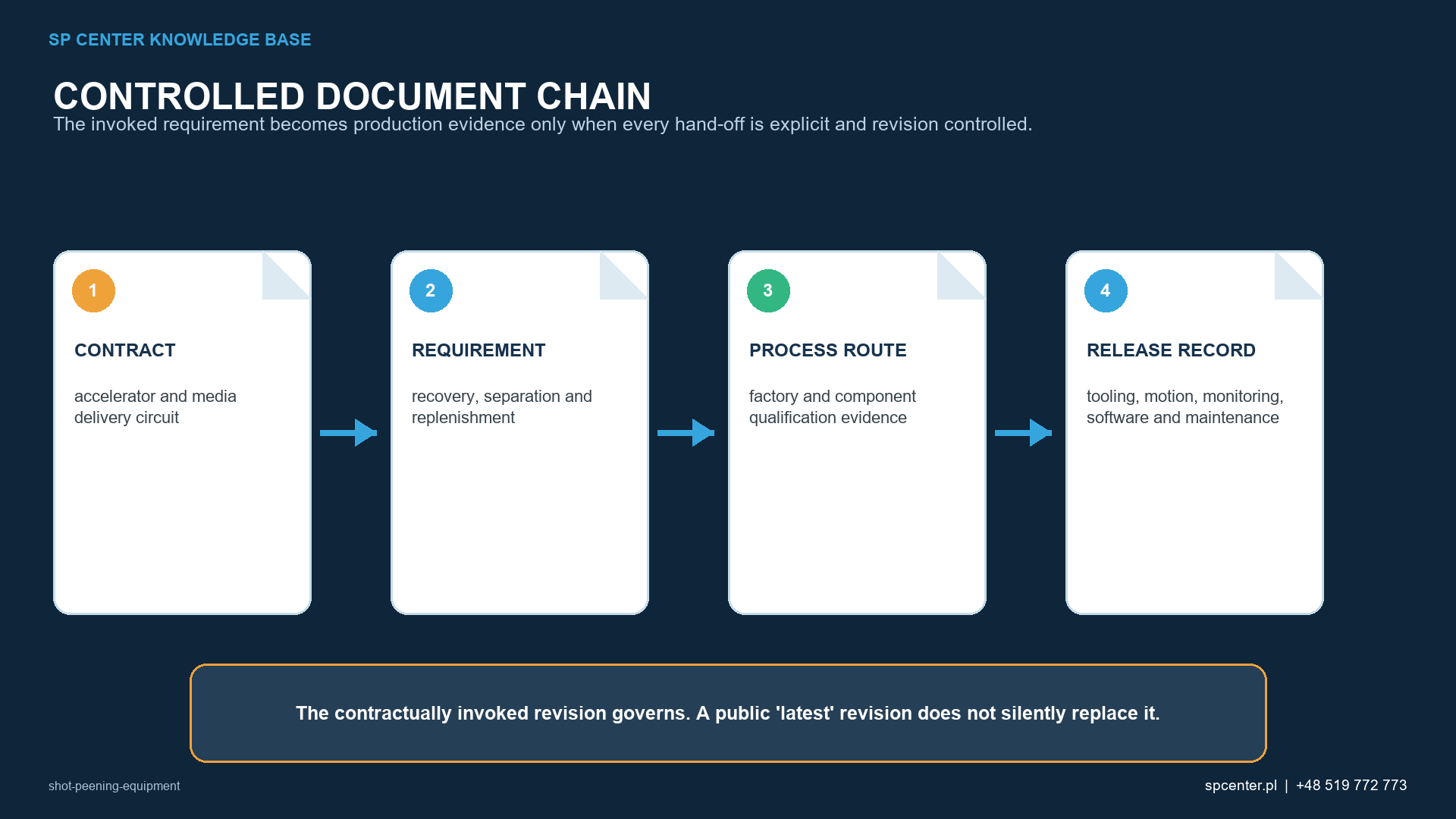
Shot peening equipment is more than a cabinet, pressure vessel or wheel. A controlled system must accelerate and deliver the specified media, maintain media condition, position the component and stream, monitor critical variables and preserve traceable records. Equipment capability is necessary, but the machine is not the product specification: a qualified process still requires Almen intensity control, component coverage acceptance and any engineering validation invoked for the part.
Which functions make up a controlled shot peening system?
| System function | Representative controls | Typical failure effect |
|---|---|---|
| Media acceleration | Air pressure and flow, nozzle condition, wheel speed, blade and control-cage condition | Intensity drift, pattern change or unstable impact energy |
| Media delivery | Media mass flow, feed stability, hopper level and recirculation | Starvation, surging or uneven exposure |
| Media conditioning | Classification, removal of broken or foreign particles, shape and size control | Surface damage, contamination or process-response change |
| Part and stream motion | Fixture, rotation, traverse, nozzle or wheel position, distance and angle | Missed areas, boundary error or nonuniform treatment |
| Monitoring and records | Sensors, alarms, interlocks, recipe control, timestamps and configuration identity | Undetected deviation or an incomplete release record |
Table 1. The controls are interdependent. A stable machine display cannot compensate for an eroded nozzle, worn wheel, contaminated media, loose fixture or incorrect part programme.
How do air-blast and wheel systems differ?
| Feature | Air-blast system | Wheel system |
|---|---|---|
| Primary acceleration route | Compressed air through a nozzle | Mechanical acceleration by a rotating wheel |
| Important stream controls | Working pressure, air flow, media mass flow, nozzle geometry, distance and angle | Wheel speed, media flow, blade and control-cage condition, blast pattern and work position |
| Access | Flexible nozzle placement can support local or complex access | Best suited to geometries that can be presented to the wheel pattern |
| Transfer risk | A pressure value alone does not reproduce a qualified stream | The same wheel speed alone does not reproduce a qualified pattern |
Table 2. Both architectures can support controlled shot peening when appropriately selected and qualified. Neither is universally superior, and a process approved on one architecture should not be transferred to the other by matching a single setting.
In an air-blast system, working pressure, actual air flow and media mass flow are distinct variables. Nozzle design and wear, hose and metering behaviour, distance, angle and motion influence the peening stream. In a wheel system, wheel speed, media delivery, blade wear, control-cage setting, blast-pattern position and work handling are central. The applicable monitoring route must reflect the architecture and its credible failure modes.
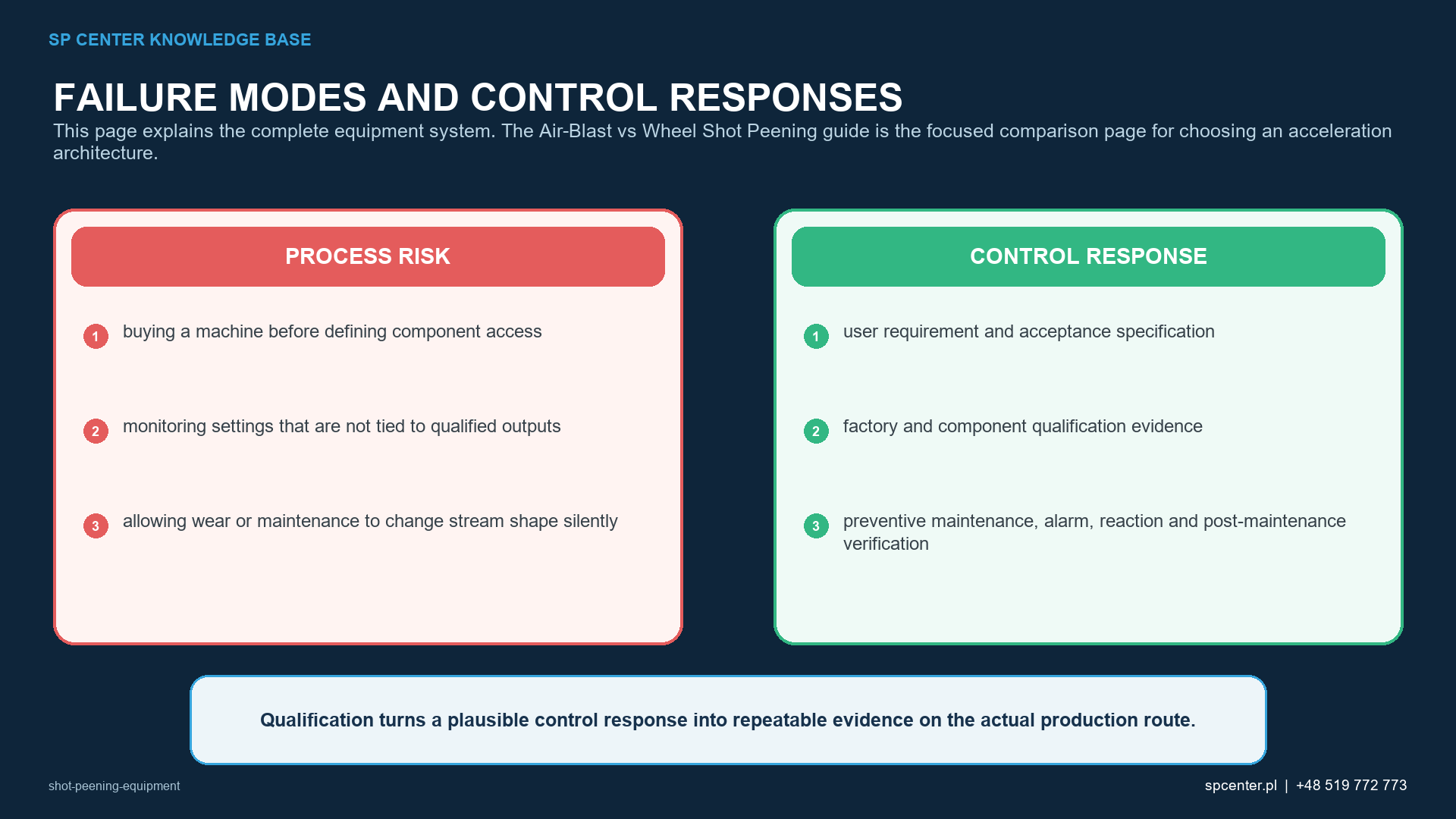
What should the equipment specification define?
- Part envelope, weight, access, treatment zones, exclusions and required production rate.
- Media family, size range, hardness or material requirements and conditioning route.
- Air-blast or wheel architecture, number and placement of nozzles or wheels, fixture and motion axes.
- Required ranges, resolution and control of critical process inputs.
- Measurement locations, sensors, alarms, interlocks, data capture and reaction logic.
- Recipe access, revision control, user permissions, backup and traceability.
- Maintenance access, wear limits, verification after intervention and spare-part configuration.
Numerical requirements should come from the component family and governing process documents, not from a generic machine catalogue. If the future process range is unknown, representative trials and risk-based development are needed before final equipment acceptance.
How should equipment and process qualification be separated?
| Evidence layer | Representative evidence | Not proven by this layer alone |
|---|---|---|
| Equipment readiness | Installation, utilities, safety, calibration or verification status, maintenance and software configuration | Conforming peening intensity or component coverage |
| Process qualification and verification | Qualified machine configuration, Almen intensity, media controls, motion, operating limits and reaction plan | Complete treatment of every component feature |
| Component surface acceptance | Coverage, masking boundaries, surface condition and invoked dimensional or roughness checks | Residual-stress profile or fatigue improvement |
| Component validation | Material-, geometry- and route-representative engineering evidence | Automatic serial release without production controls |
Table 3. Equipment readiness establishes that the system can operate as intended. Process qualification demonstrates that a defined configuration produces the required controlled stream. Component acceptance and validation answer different questions.
Which decisions belong to each qualification stage?
| Qualification stage | Decision | Representative output |
|---|---|---|
| Requirements and design review | Can the proposed architecture control the required component families and evidence? | Approved user requirements, risk review and system specification |
| Equipment readiness | Is the installed hardware, software and measurement chain operating as intended? | Installation and function records, status of utilities, safety, sensors and software |
| Process qualification | Does the defined configuration deliver the specified intensity and component coverage? | Qualified recipe, Almen evidence, coverage evidence and approved operating limits |
| Production release | Are instructions, records, maintenance and reaction plans ready for serial control? | Approved production documentation and release authorization |
Table 4. The names of qualification stages may differ between organisations, but the evidence should still progress from requirements and equipment readiness to a qualified component route and controlled serial release.
What does computer-monitored shot peening add?
SAE AMS2432 addresses computer-monitored shot peening and identifies real-time observation, traceability and response for process input settings as central purposes. Computer monitoring can strengthen evidence by recording the actual cycle, detecting excursions and linking records to the approved recipe. It does not turn Nadcap accreditation into product certification and does not replace the drawing, AMS2430, customer supplements or component inspection.
Monitoring is effective only when sensor selection, calibration or verification, data acquisition, alarm limits, time synchronization, recipe control and software changes are themselves controlled. A recorded value from a failed or mislocated sensor is not objective evidence of the actual process condition.
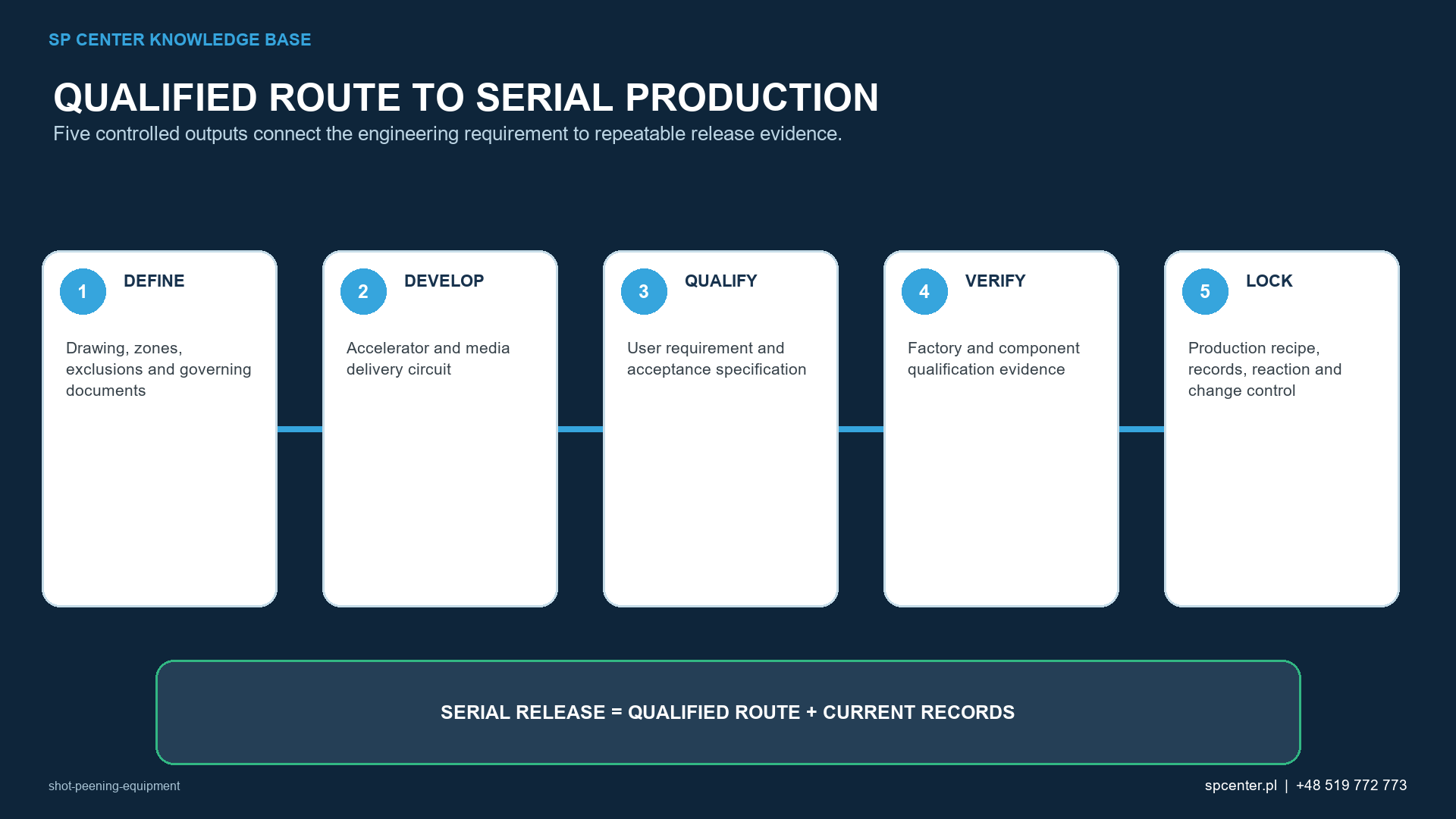
How should a new or modified system be qualified?
- Confirm the controlled technical requirements, component families and contractual document hierarchy.
- Verify installation, utilities, safety functions, software and hardware configuration and measurement-system status.
- Demonstrate operating ranges, media delivery and conditioning, motion accuracy, alarms, interlocks, data integrity and reaction logic.
- Develop and qualify the actual peening configuration for representative components, including intensity and coverage.
- Validate component response where required by engineering or customer qualification.
- Approve work instructions, recipes, operating limits, maintenance, records, deviation control and requalification triggers before serial release.
Which changes require formal review?
Machine relocation, utility change, nozzle or wheel replacement with a different configuration, fixture or programme change, altered media system, sensor or software change, expanded parameter range and major maintenance can affect the qualified state. The governing quality system should classify the change, define required approval and determine whether verification, partial requalification or full requalification is necessary.
| Change or event | Immediate review | Possible evidence before restart |
|---|---|---|
| Nozzle, wheel, blade or control-cage replacement | Confirm replacement configuration and wear condition | Inspection, setup verification and intensity or pattern verification as required |
| Fixture, programme or motion change | Assess access, exposure distribution and masking boundaries | Dry run, motion verification, coverage and intensity evidence |
| Sensor, controller or software change | Assess measurement integrity, alarms, records and recipe control | Functional challenge, data-integrity check and approved software configuration |
| Major maintenance, relocation or utility change | Assess all affected qualified characteristics | Documented restoration, verification and requalification defined by change control |
Table 5. The required action depends on the governing procedure and the technical effect of the change; replacement with a nominally similar item is not automatically evidence that the qualified state is unchanged.
Frequently asked questions
Is a shot peening machine qualified by achieving one correct Almen result?
No. One result is only part of the evidence. Qualification must address the defined configuration, measurement route, media system, motion, operating limits, monitoring, records and applicable customer requirements.
Does computer monitoring guarantee a conforming component?
No. It can provide real-time observation, traceability and reaction to process-input settings, but component coverage, surface acceptance and any performance validation remain separate requirements.
Can air pressure be used as the intensity value?
No. Pressure is an input variable in an air-blast system. Peening intensity must be determined or verified through the applicable Almen-system procedure under the qualified configuration.
Are air-blast and wheel peening interchangeable?
Not automatically. They differ in stream formation, access, pattern, monitored variables and failure modes. Substitution requires technical review and qualification against the component and governing requirements.
Which equipment changes may require requalification?
Changes to the machine, nozzle or wheel, fixture, motion, media system, monitoring software, parameter ranges or maintenance condition may affect the qualified state. The approved change-control procedure determines the required action.
What information should be provided when sourcing a process?
Provide the controlled drawing, material and heat treatment, treatment and exclusion zones, specifications, intensity and coverage requirements, surface constraints, production volume, validation needs and required records.
Key takeaways
- A controlled peening system integrates media acceleration, delivery and conditioning with motion, monitoring and records.
- Air-blast and wheel systems use different control variables and are not automatically interchangeable.
- Equipment readiness, process qualification, component surface acceptance and component validation are separate evidence layers.
- Computer monitoring strengthens observation and traceability but does not guarantee component conformance by itself.
- Configuration and change control determine whether a previously qualified process remains representative.
Related SP Center guides
Technical references
1. SAE AMS2432E: Shot Peening, Computer Monitored, revised October 2022
2. SAE AMS2430U: Shot Peening, revised April 2018
3. SAE AMS2431E: Peening Media, General Requirements, revised April 2023
4. SAE ARP7488: Peening Design and Process Control Guidelines, issued January 2018
Standards note: The drawing, contract, customer requirements and revisions invoked for the programme remain authoritative.
Author: Paweł Kmieć
Discuss your shot peening requirement: +48 519 772 773 | [email protected]