


Connect the current contract and drawing to approved-source status, process qualification, component evidence, traceable release and authorised data handling
Defence-component shot peening uses the same core process controls as other fatigue-critical work, with additional emphasis on contract hierarchy, configuration, approved sources, deviations, record retention and information security. No universal “military” process exists: the current purchase order, drawing and complete customer flow-down define the treatment and acceptance authority.
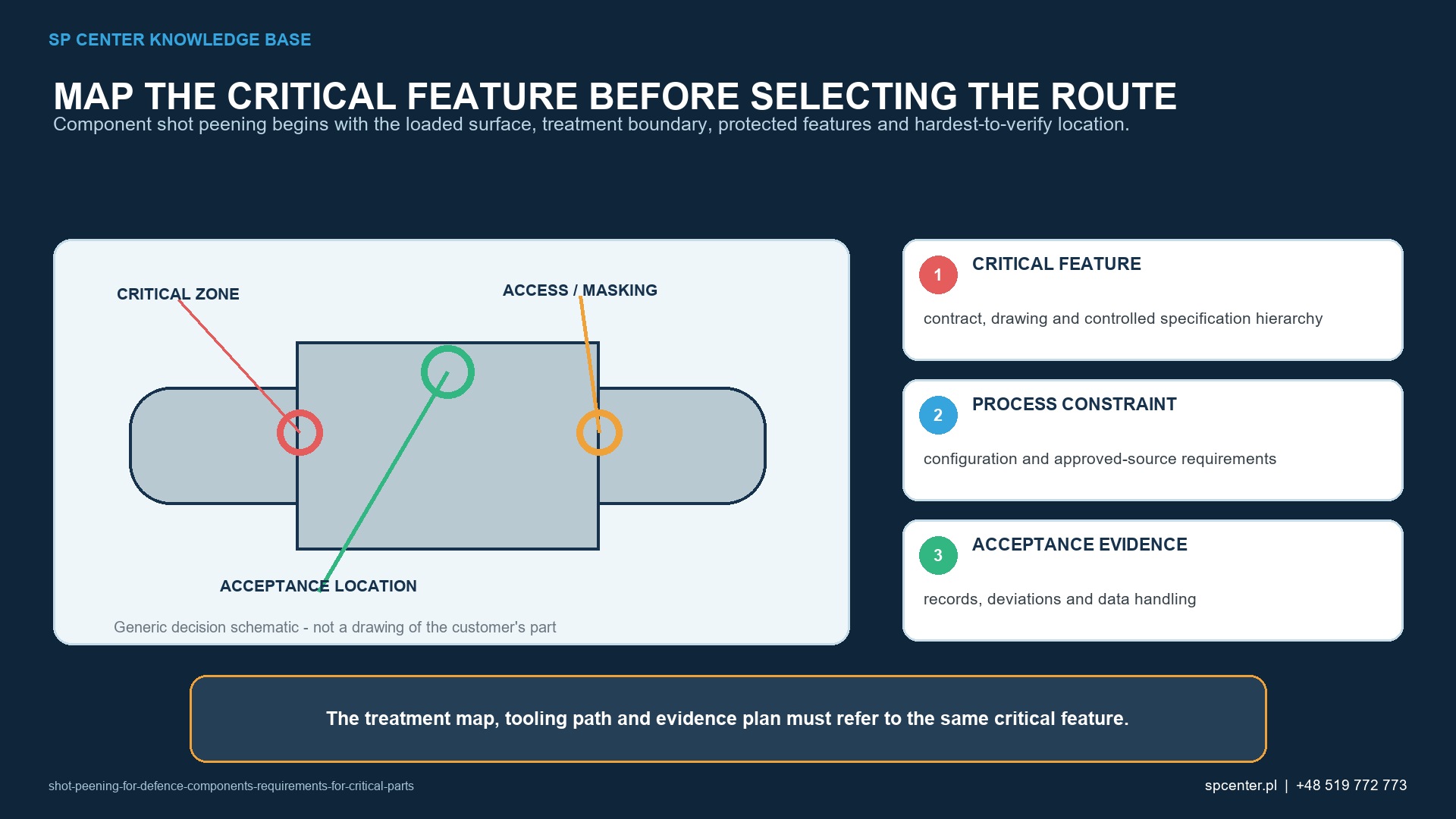
What must contract review resolve before processing?
| Requirement layer | Review question | Stop condition |
|---|---|---|
| Contract and purchase order | Which clauses, approved sources, deliverables, retention and data restrictions apply? | Missing clause, uncontrolled amendment or unresolved conflict |
| Drawing and part configuration | Which part number, revision, zones, exclusions, material condition and acceptance notes control? | Unknown revision, ambiguous treatment boundary or mismatched part identity |
| Process and media specifications | Which complete revisions govern media, intensity, coverage, equipment and records? | Obsolete or incomplete document used without authorised disposition |
| Customer/OEM flow-down | Which supplements, source approvals, deviations, first-article or notification rules apply? | Required approval or supplement unavailable |
| Security and data handling | How are information classification, access, storage, transfer and destruction controlled? | No authorised channel or recipient for controlled information |
Table 1. Production should stop when the controlling requirement or authorised information route is unresolved.
A controlled requirement matrix should link every applicable clause to an operational control and record. If documents conflict, a specification is unavailable or an obsolete military document appears in the route, do not replace the missing requirement with an internal assumption. Obtain controlled clarification from the contract/design authority before work proceeds.
How are accreditation, source approval and part release separated?
| Decision | What it means | What it does not mean |
|---|---|---|
| Nadcap accreditation | The named site/process scope has passed the applicable PRI accreditation route | Automatic customer source approval, product certification or acceptance of every defence contract |
| Customer-approved source | The customer permits the named source for the stated scope/configuration | That every part or process change is automatically approved |
| Process qualification | The defined equipment, media, tooling, motion and evidence establish an authorised baseline | Universal transfer to another machine, site, part or requirement |
| First-article/representative validation | The selected component or surrogate demonstrates the planned route under stated criteria | Release of all future lots without production controls |
| Production-batch release | The actual batch meets invoked process, component and documentation requirements | Independent proof of fatigue life or residual-stress profile unless specifically required |
Table 2. Each approval applies to a stated organisation, process, configuration or product decision.
Nadcap accreditation is not product certification and does not by itself authorise a supplier for every defence customer. Where Nadcap is contractually invoked, verify the facility, process scope and validity together with customer approval. PRI describes current Surface Enhancement audits through the AC7117 series and supplemental checklists; cancelled AS7117A must not be presented as the current audit criterion.
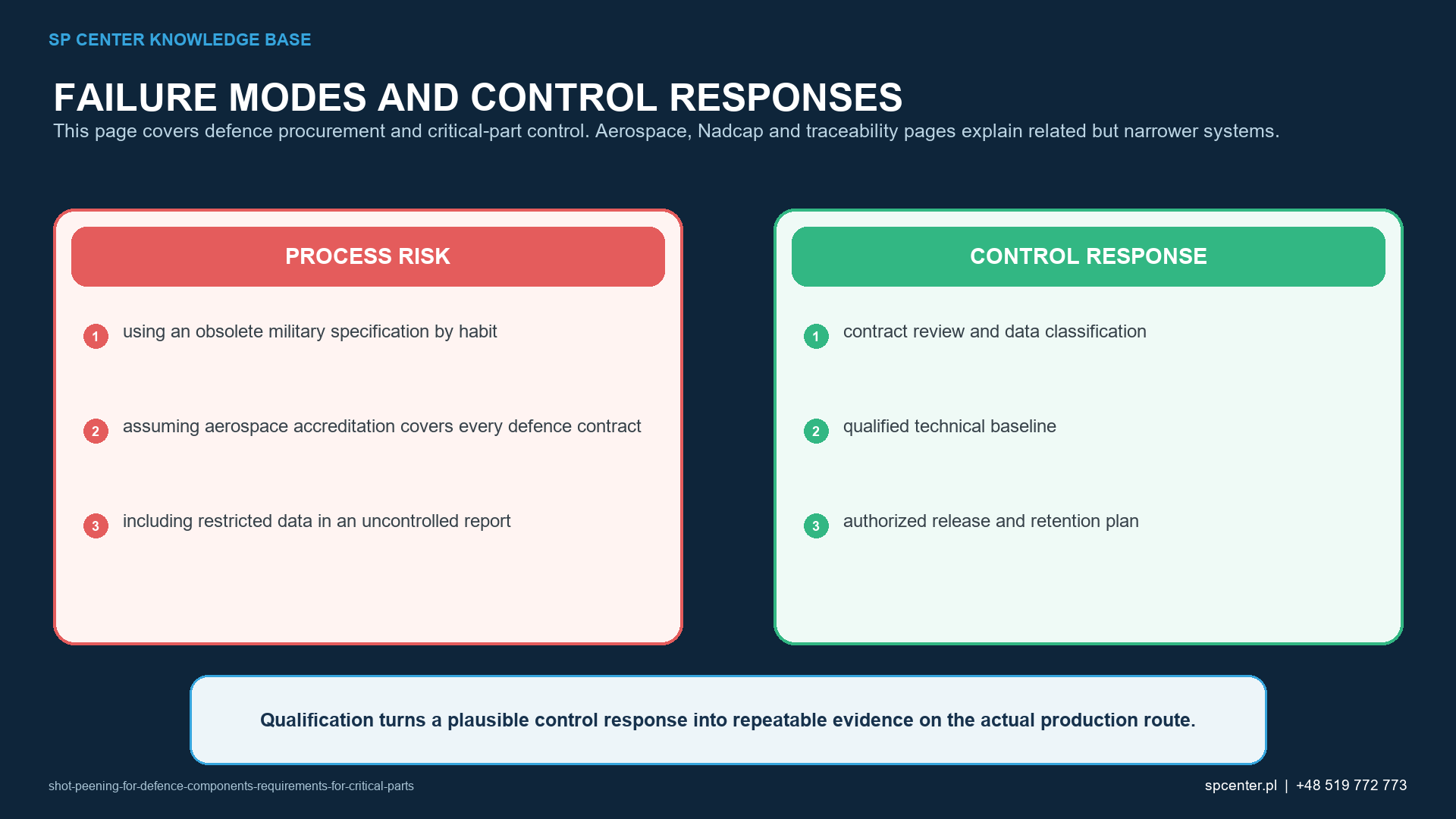
What technical baseline must be qualified?
The baseline links actual site and machine, air-blast or wheel configuration, media specification and operating mix, separator, nozzle/tooling, fixture, masks, program/recipe, part orientation, motion, treatment boundaries and inspection route. The hardest-to-reach and most damage-sensitive prescribed features should be represented.
Almen intensity, component coverage and component acceptance remain independent evidence layers. Intensity verifies a standardised stream response. Coverage addresses impact evidence on the specified surface. Roughness, dimensions, residual stress, fatigue, corrosion or cleanliness require the separate evidence invoked by the drawing or qualification plan.
Which records make the result defensible?
| Evidence package | Minimum linkage | Common failure |
|---|---|---|
| Requirement matrix | Contract, drawing, specification, supplement and approved deviation revisions | Old military or customer document used by habit |
| Configuration record | Site, machine, nozzle/wheel, media, fixture, program/recipe and inspection route | Accreditation certificate cited without matching scope or configuration |
| Process verification | Current Almen setup/strip, saturation or verification record and applicable monitored inputs | Correct intensity treated as proof of component coverage |
| Component acceptance | Treatment zones, coverage, masking boundaries, surface/dimensional checks and required first-article evidence | Generic visual statement without location, method or acceptance authority |
| Batch and custody records | Part/lot/serial identity, dates, operators, exceptions, approvals and required retention/access controls | Restricted data copied into an uncontrolled report or email |
Table 3. Records must link the governing requirement and qualified configuration to the actual batch.
The record package should state identity, revision, method, location, instrument or verification status, sampling, results and acceptance authority. A customer may require a specific release pack, but there is no single universal document set for every defence contract. Retention, access, reproduction and destruction follow the applicable contractual and security rules.
How are deviations and controlled data handled?
A deviation is not an informal recipe adjustment. Identify the affected requirement, product and configuration; contain the affected serials/lots; obtain approval from the authorised party; and retain the decision with the batch. Do not place classified, export-controlled or otherwise restricted technical data in an uncontrolled report, ordinary email or public support channel when the governing rules prohibit it.
Before exchanging controlled information, agree the permitted recipient, classification/marking, transfer channel, storage, access and retention route. This article does not determine legal classification; the contract owner and applicable authority do.
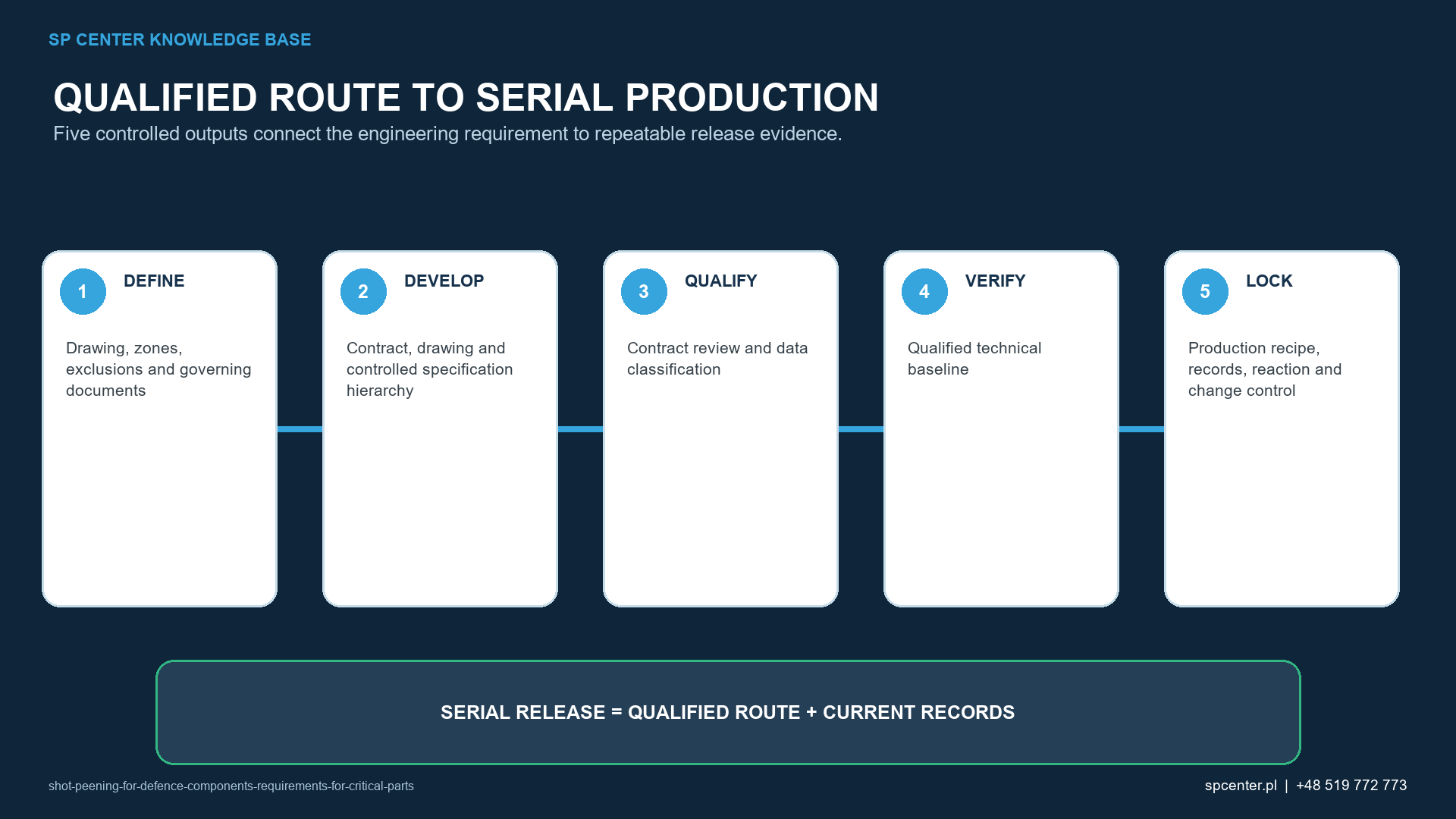
When is requalification or product containment required?
| Change or event | Required review | Possible response |
|---|---|---|
| Drawing, contract or specification revision | Requirement hierarchy and affected qualification/records | Hold work until conflict is resolved and baseline is re-authorised |
| Machine, nozzle/wheel, media, separator, fixture or program change | Effect on intensity, coverage, geometry, contamination and monitoring | Risk-based verification, representative trial or requalification |
| Source, site or subcontractor change | Customer approval, accreditation scope and full flow-down | Obtain approval before transfer; repeat required qualification |
| Process excursion or interrupted cycle | Affected serial/lot, cumulative exposure, surface/dimensional risk and recovery authority | Contain, investigate and obtain authorised disposition; do not reprocess automatically |
| Security or custody breach | Information/product exposure, contractual notification and record integrity | Use the authorised incident route; preserve evidence and restrict further access |
Table 4. The response depends on possible effect on requirement, process capability, component acceptance and record integrity.
Reprocessing is not an automatic correction. Another cycle can change cumulative exposure, roughness, dimensions, distortion, coating or heat-treatment sequence. It requires explicit engineering/quality authority and renewed evidence appropriate to the affected condition.
Does a defence part require a special universal shot peening specification?
No. The governing requirement comes from the current contract, drawing, invoked specifications and customer flow-down. A generic defence or military label does not define media, intensity, coverage or records.
Does Nadcap accreditation automatically approve a supplier for every defence contract?
No. Nadcap is a process/site accreditation within its stated scope. Customer source approval, contract flow-down, process qualification, part approval and batch release remain separate decisions.
Can AS7117A be used as the current Nadcap audit criterion?
No. AS7117A is cancelled. PRI identifies the current Surface Enhancement audit route through the AC7117 series and applicable supplemental checklists; the exact current documents must be obtained through the authorised PRI/EAN route.
Can a qualified process be transferred to another machine or site?
Not automatically. Equipment, media, separator, tooling, geometry, motion, monitoring, accreditation/source-approval scope and customer requirements must be reviewed and the required verification or requalification completed.
Does correct Almen intensity release a defence component?
No. It verifies standardised stream response. Component coverage, boundaries, surface/dimensions, configuration, approved-source status and required records need separate evidence.
Can shot blasting replace shot peening on a defence drawing?
Not without design and contractual authority. Shot blasting commonly cleans or prepares a surface; controlled shot peening requires specified media, intensity, coverage, exposure and traceability.
Can an interrupted or nonconforming part simply be peened again?
No. Cumulative exposure, surface condition, dimensions and prior processing must be assessed. Reprocessing requires an authorised route, product containment and renewed acceptance evidence.
What should be sent for a defence shot peening quotation?
Provide only information authorised for the agreed channel: part/drawing revision, material/condition, zones, specifications and customer flow-down, source/accreditation rules, quantities, acceptance, records and delivery requirements. Do not send controlled data through an unapproved channel.
Key takeaways
- Freeze the current contract, drawing, specifications, customer flow-down and approved deviations before processing.
- Do not treat a generic defence label or obsolete military specification as the process authority.
- Separate Nadcap accreditation, customer source approval, process qualification, part approval and batch release.
- Link intensity, coverage, component checks and configuration records to the actual lot/serial identity.
- Contain conflicts, excursions and interrupted cycles; do not reprocess automatically.
- Use only authorised channels for controlled technical information.
- Assess machine, media, tooling, program, source and document changes for requalification.
Related SP Center guides
Technical sources
1. SAE J2441_202511: Shot Peening, stabilized November 2025
2. SAE AMS2430U: Shot Peening, revised April 2018
3. SAE AMS2432E: Shot Peening, Computer Monitored, revised October 2022
4. SAE J443_202512: Procedures for Determining and Verifying Peening Intensity, revised December 2025
5. SAE J2277_202301: Shot Peening Coverage Determination, revised January 2023
6. PRI, Surface Enhancement Nadcap Audit Criteria Review — AC7117 series and supplemental checklists
Standards note: The complete contract, drawing, customer flow-down and authorised current documents control. This guide neither creates security classification nor replaces customer source approval, legal/export-control review or the current PRI/EAN audit package.
Author: Paweł Kmieć
Discuss an authorised defence shot peening requirement: +48 519 772 773 | [email protected]