


How size distribution, hardness and durability determine whether recirculating cast steel shot remains suitable for a qualified process
Cast steel shot used for controlled shot peening is not defined by a trade name or nominal size alone. Size distribution, hardness, shape, material condition and durability determine how the particle population reaches the component, transfers impact and changes in service. The selected shot must be authorized by the governing requirements and remain controlled as an operating mix throughout production.
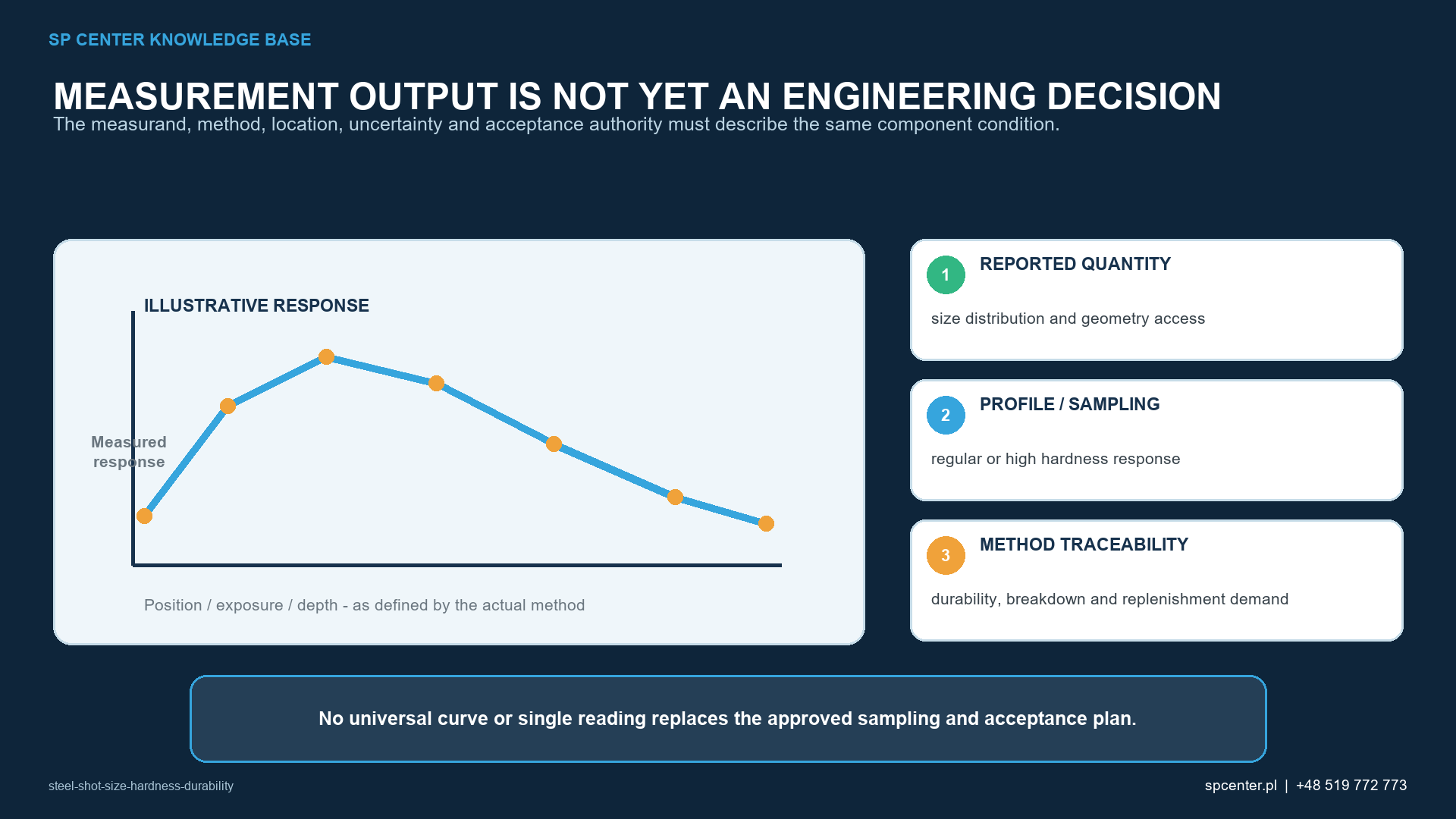
Why is cast steel shot a dynamic process input?
Each particle repeatedly contacts components, tooling and other media. It can wear, round, flatten, fracture, become undersize or leave the recovery system. Fresh media are added while older particles remain. The machine therefore contains a changing operating mix rather than a permanent copy of the supplier lot.
| Characteristic | Primary influence | Required evidence |
|---|---|---|
| Size distribution | Particle mass, impact population, access and coverage development | Applicable sieve limits and representative sampling |
| Hardness | Plastic deformation, shape retention, fracture and interaction with the component | Invoked hardness range, method and lot verification |
| Shape and integrity | Contact geometry, roughness and risk from angular or fractured particles | Approved shape classification and rejection criteria |
| Durability | Wear, breakdown, replenishment and operating-mix drift | Qualified media route plus monitored in-use condition |
Table 1. Steel-shot control combines delivered properties with evidence from the active operating population.
How does size distribution affect the process?
A shot designation represents a distribution under the invoked media requirement, not one exact particle diameter. For comparable material, a coarser population contains greater mass per particle but fewer particles at a given mass flow. A finer population provides more impacts per unit mass and may reach restricted geometry more readily, but it has a different acceleration and intensity response.
| Observed population | Potential process effect | Engineering response |
|---|---|---|
| Coarser distribution | Greater mass per particle but fewer impacts for a given mass flow; access and roughness may change | Verify access, intensity development, coverage and surface limits |
| Finer distribution | More particles per unit mass but lower individual particle mass | Establish the required acceleration, mass flow and exposure on the actual equipment |
| Excess oversize | Local indentation, poor access or surface departure | Contain the mix and investigate classifier, replenishment and sampling |
| Excess undersize | Reduced individual impact and altered stream response | Remove as specified and verify intensity and component acceptance after correction |
Table 2. Particle size is selected against access, peening-stream response and surface limits, not by a universal larger-or-smaller rule.
Why can geometry set the practical upper size?
Gear roots, small fillets, grooves, splines, holes and internal corners may restrict larger particles or shield the stream. A flat Almen strip can meet the required intensity while the worst-access component feature receives inadequate coverage. Representative component evidence is therefore required at the locations and by the method specified for the part.
No universal fillet-to-particle ratio should be invented. The drawing, applicable specification, access assessment, fixture, motion and representative trials govern the decision.
How should hardness be evaluated?
Hardness influences whether steel shot retains its shape, deforms or fractures during the actual impact cycle. The objective is not the hardest available media. Component material and hardness, required intensity, equipment, media detail specification and observed breakdown must be evaluated as one route.
| Media/component condition | Risk to assess | Evidence to retain |
|---|---|---|
| Media too soft for the duty | Flattening, deformation and changing energy transfer | Shape trend, intensity stability and classifier performance |
| Media unnecessarily hard or brittle | Breakdown and angular fragments | Fracture trend, shape rejection and component surface condition |
| Relatively soft or thin component | Indentation, roughness or distortion | Surface and dimensional acceptance on representative geometry |
| Relatively hard component | Insufficient response from the selected complete stream | Qualified intensity range and application-specific component evidence |
Table 3. A hardness class is an approved media characteristic, not a general ranking of quality.
Where AMS2431 is contractually invoked, the current official detail specifications distinguish regular-hardness cast steel shot under AMS2431/1G from high-hardness cast steel shot under AMS2431/2G. Their stated hardness ranges are 45–52 HRC and 55–62 HRC respectively. The drawing, contract and invoked revision determine whether either route is permitted.
Why does durability affect process stability?
Durability is the ability of the media population to withstand repeated circulation while retaining acceptable size and shape. It affects replenishment, separator loading, fragment generation, maintenance and the rate at which the operating mix changes. Purchase price per kilogram is therefore not the same as cost per accepted component.
| Durability behaviour | Production consequence | Control implication |
|---|---|---|
| Stable wear and rounding | The operating mix evolves predictably | Replenishment and classification can maintain the qualified population |
| Rapid fracture | Undersize and irregular particles accumulate | Sampling, removal and inspection may need a tighter response route |
| Flattening or elongation | Particles remain in the machine but contact geometry changes | Shape inspection is needed in addition to sieving |
| Unusual carry-out or loss | Population balance and consumption change | Record additions and investigate recovery, leakage and separator performance |
Table 4. Remaining inside the machine does not mean that a steel-shot particle remains acceptable.
How do cast steel shot and conditioned cut wire differ?
They have different manufacturing routes, initial structure, conditioning, wear behaviour, available hardness classes and detail specifications. Neither is universally superior or interchangeable with the other. Equivalent nominal size or a similar Almen result does not prove equivalent surface response, operating life or contamination behaviour.
Which inspections are complementary?
| Evidence layer | What it establishes | What remains separate |
|---|---|---|
| Supplier-lot acceptance | Identity and delivered conformance to invoked requirements | Condition after recirculation |
| Sieve analysis | Sampled size distribution | Shape, hardness and cleanliness |
| Shape and condition inspection | Control of unacceptable irregular or damaged particles | Exact size distribution and peening-stream response |
| Almen intensity verification | Standardized response of the qualified stream configuration | Component coverage and surface integrity |
| Component surface acceptance | Coverage, boundaries and specified surface or dimensional criteria | Media conformance unless separately recorded |
Table 5. No single test establishes media condition, peening-stream verification and component acceptance at the same time.
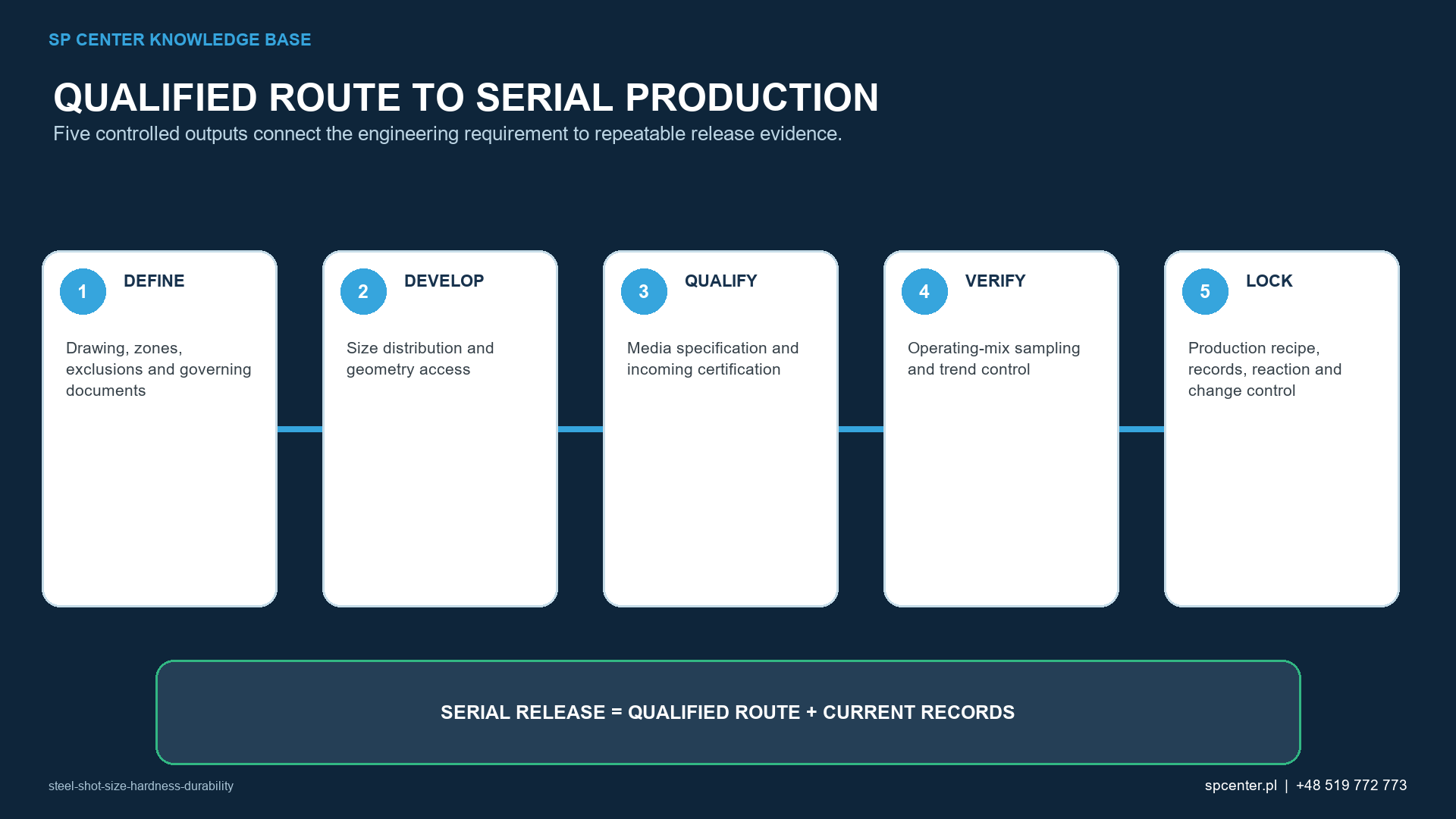
How should steel shot be qualified and controlled?
- Confirm the drawing, contract, approved media family and applicable specifications and revisions.
- Review component material, hardness, heat treatment, geometry, access and surface limits.
- Qualify the actual machine, delivery, recovery, classifier, fixture and motion.
- Accept the supplier lot and establish representative operating-mix sampling.
- Determine or verify intensity and establish component coverage and surface acceptance.
- Define replenishment, removal, reaction limits, records and controlled approval of changes.
Steel shot may also be supplied for blast cleaning, but a product suitable for cleaning is not automatically acceptable for controlled shot peening. The procurement and operating controls must match the invoked peening requirements.
Frequently asked questions
Which matters most: steel-shot size, hardness or durability?
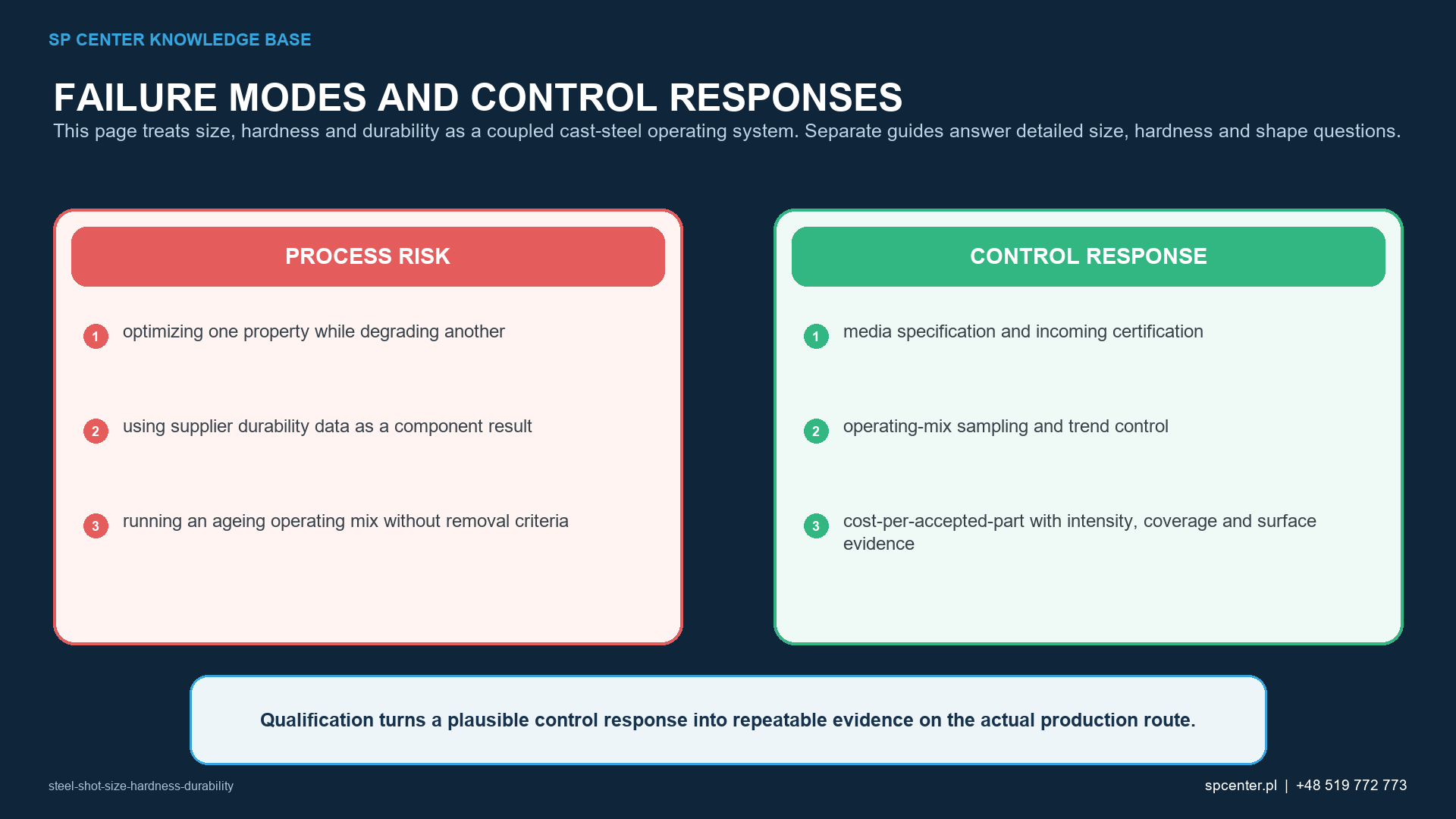
None can be selected independently. The qualified combination must provide access, the required peening-stream response, acceptable coverage and surface condition, and a controllable operating mix.
Are regular-hardness and high-hardness cast steel shot interchangeable?
No. They are different media routes under the relevant detail specifications. A change requires specification review, equipment and component assessment, and the prescribed approval and qualification.
Does correct Almen intensity prove that steel shot is acceptable?
No. Almen intensity verifies a standardized peening-stream response. Media conformance, operating-mix condition, component coverage and surface acceptance require complementary evidence.
Does longer steel-shot life always reduce process cost?
Not necessarily. Cost per accepted part also depends on classification, machine wear, replenishment, cycle time, downtime and rejection risk within the qualified process window.
Can sieving alone control recirculating steel shot?
No. Sieving measures size distribution but does not fully identify flattened, elongated, angular or fractured particles. The invoked control plan must address both size and condition.
What information should an RFQ include?
Provide the controlled drawing and revision, material and heat treatment, treatment and exclusion zones, governing specifications, intensity, coverage, surface limits, quantities and required records.
Key takeaways
- Control cast steel shot as a changing distribution, not a single diameter.
- Select size for the qualified stream and worst-access component geometry.
- Select hardness for stable interaction with the component, not maximum hardness.
- Treat durability as both a process-control and total-cost variable.
- Keep supplier-lot acceptance, operating-mix control, Almen verification and component acceptance separate.
Related SP Center guides
Technical references
1. SAE AMS2431E: Peening Media, General Requirements, revised April 2023
2. SAE AMS2431/1G, Peening Media (ASR) Cast Steel Shot, Regular Hardness (45 to 52 HRC)
3. SAE AMS2431/2G, Peening Media (ASH) Cast Steel Shot, High Hardness (55 to 62 HRC)
4. SAE J444_202306, Cast Shot and Grit Size Specifications for Cleaning and Peening
5. SAE J827_201910, High-Carbon Cast-Steel Shot
6. SAE J2175_202608, Specifications for Low Carbon Cast Steel Shot
Standards note: These documents have different scopes. Use only the specifications and revisions invoked by the drawing, contract and customer requirements.
Author: Paweł Kmieć
Discuss your shot peening requirement: +48 519 772 773 | [email protected]