


Match the process to spring-steel condition, component geometry and service loading—and validate the balance between compressive stress, roughness, damage and stability
Shot peening spring steel is not a single recipe. Valve springs, suspension coils, leaf springs and torsion bars combine high material strength with severe cyclic loading and surface-sensitive failure. The process can introduce useful compressive residual stress and cold work, but fatigue performance depends on the complete route: steel cleanliness, heat treatment, decarburization, forming and machining, critical geometry, peening, coating or baking and service loading.
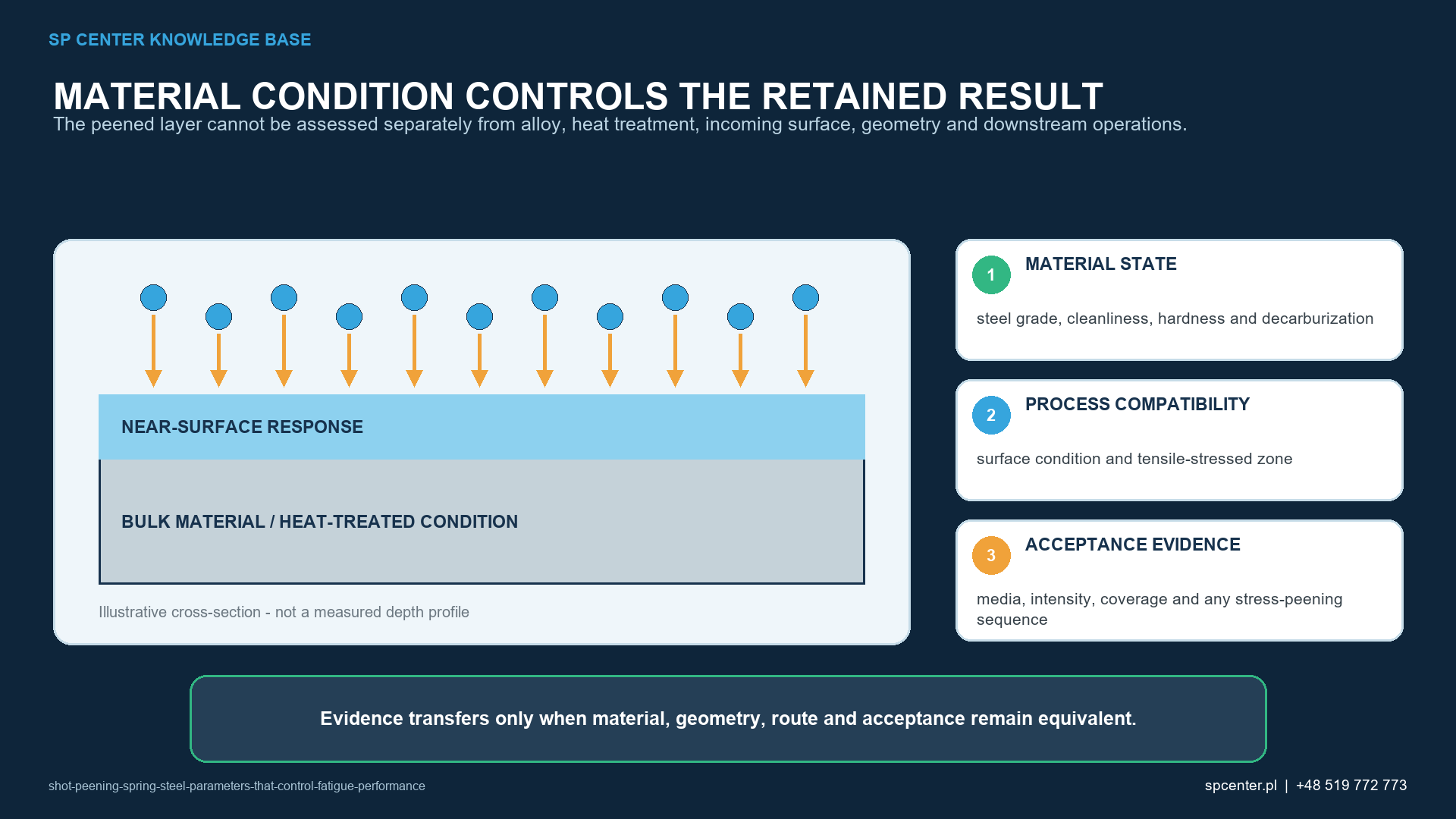
Why are spring steels demanding shot peening applications?
High-strength spring steels can be sensitive to small surface laps, seams, pits, grinding marks, decarburized zones and nonmetallic inclusions. Shot peening changes the crack-driving stress near the surface; it does not erase the underlying defect population or guarantee that fatigue initiation remains at the surface.
At very long lives, cracks may initiate below the compressive layer at an inclusion or in a region of tensile residual stress. Residual stress can also relax during cyclic or thermal loading. Qualification must therefore address the relevant failure mechanism and life regime, not only the as-peened surface value.
| Spring family | Typical critical locations | Qualification questions |
|---|---|---|
| Helical compression or valve spring | Wire surface, inside coil, transition to end coil, ground end and contact marks | Can the stream reach the full circumference and coil spacing without collision, shadowing or untreated bands? |
| Extension or torsion spring | Hooks, bends, inside radii, legs and forming marks | Are highly strained forming zones included, protected or separately qualified? |
| Leaf spring | Tension face, edges, eye transitions, center region, clamp and interleaf contact zones | Are scale, decarburization, edge condition, fixture support and distortion controlled? |
| Torsion bar or stabilizer | Fillets, splines, transitions, bends and locally machined zones | Does the treatment map match the calculated stress concentration and subsequent joining or coating sequence? |
Table 1. Geometry and service stress determine which zones require treatment and representative validation.
What must be known before selecting parameters?
Record the material grade and cleanliness basis, heat treatment, hardness range, microstructure, section thickness, decarburization limit, existing residual stress and surface condition. Separate scale removal or cleaning by shot blasting from controlled shot peening for fatigue enhancement.
Define the critical surfaces, no-peen areas, transition rules, dimensional limits and subsequent operations. A process qualified on polished flat specimens cannot automatically be transferred to drawn wire, rolled leaf edges, a formed hook or a ground end.
How do intensity, media and exposure interact?
| Variable | Potential benefit | Failure mode if misapplied |
|---|---|---|
| Impact velocity and Almen intensity | Changes plastic-zone depth and process response | Excessive roughness, folding, microcracking or distortion; nominal pressure or wheel speed is not intensity |
| Media size | Larger media can increase affected depth under suitable conditions; smaller media can improve access and surface finish | Poor access, bridging, shallow response or excessive indentation depending on geometry and energy |
| Media hardness and condition | Supports plastic deformation of high-hardness spring steel when specification permits | Media flattening or fracture, contamination and aggressive surface damage |
| Coverage and exposure | Closes untreated surface gaps and can deepen cumulative cold work | Unintended overexposure, roughness and damage; increased coverage does not guarantee better fatigue |
| Angle, distance and fixture | Controls local energy, access and repeatability | Shadowing, nonuniform treatment, contact marks and spring movement |
| Stress peening or multi-stage peening | Can tailor residual stress when the loaded state and sequence are qualified | Wrong preload, loss of control, geometric change or unapproved substitution for conventional peening |
Table 2. Each parameter changes several outputs; no variable should be optimized in isolation.
Intensity is established from a valid saturation curve using the required Almen system. It is not identical to air pressure, wheel speed or impact velocity. Coverage is the proportion of the specified surface showing impact impressions under the approved method; it is not residual stress, and “more coverage” is not a universal fatigue rule.
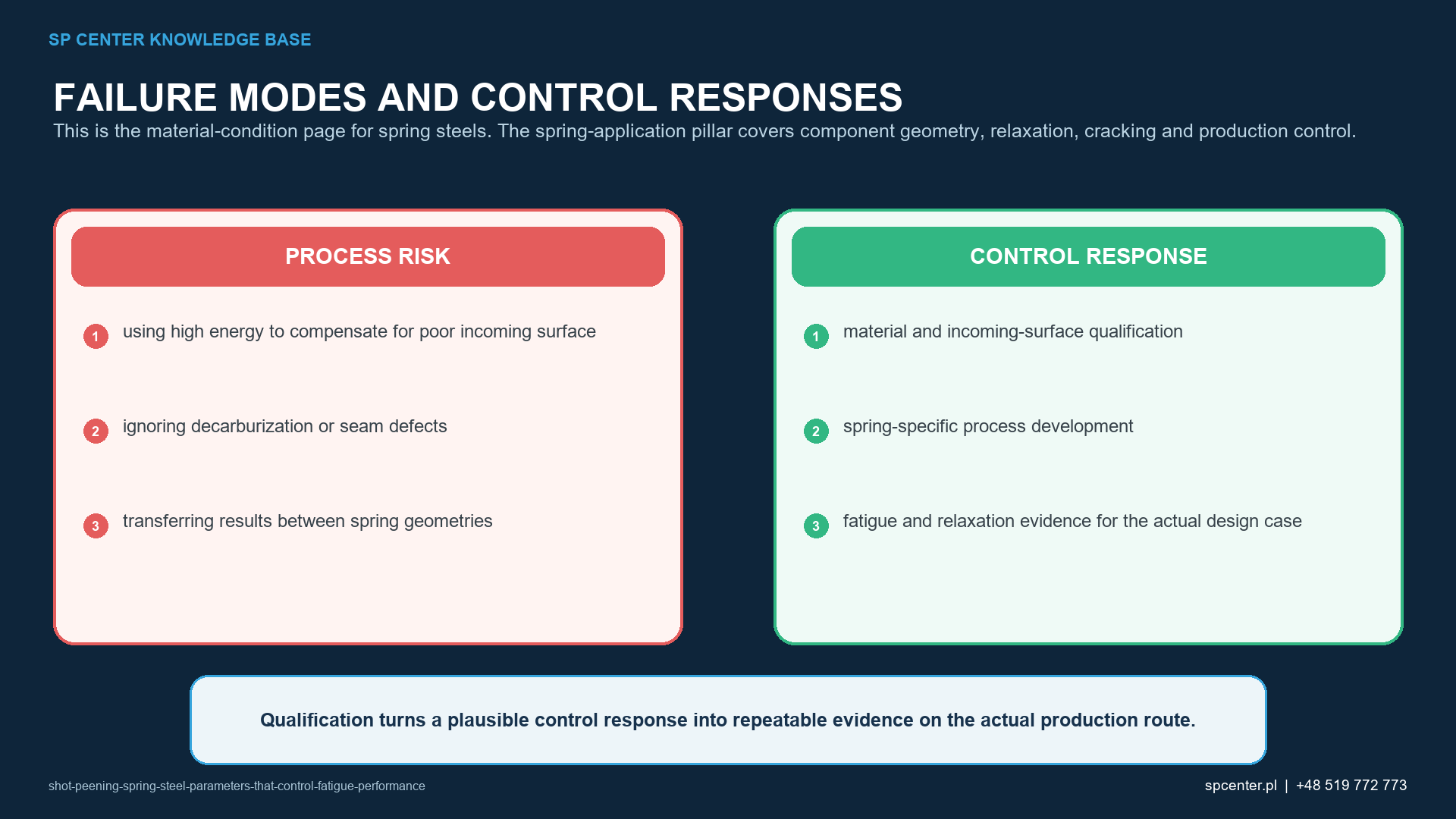
How are hard spring steels treated without surface damage?
High target hardness may require media and impact conditions capable of producing the intended plastic response. At the same time, brittle or damaged surface conditions can be intolerant of aggressive impacts. Media hardness, size, shape, broken-particle control, velocity, angle and exposure must be considered together.
Inspect relevant boundary conditions for laps, folds, sharp indentation, cracking, excessive roughness and dimensional change. A conforming Almen result does not overrule unacceptable part damage.
Why are decarburization and surface defects decisive?
Decarburization reduces near-surface hardness and changes plastic response and fatigue resistance. Shot peening may modify the residual-stress field of a decarburized surface, but it does not restore lost carbon or automatically remove the affected depth. Prevention, measurement and an authorized acceptance or removal route remain necessary.
Peening can close the visual appearance of a seam or lap without removing the defect. Incoming surface inspection and fracture analysis should distinguish defect-driven failures from inadequate peening.
When should stress peening or dual peening be considered?
Stress peening applies an elastic preload during impact, then releases the part to create a different residual-stress field. Dual peening applies two controlled stages, usually with different media or energy. Both can be effective in a qualified system; neither is simply “200% coverage.”
Control preload magnitude and direction, fixture stiffness, part position, spring deflection, safety, exposure sequence and unloading. Confirm that the residual-stress and fatigue benefit is repeatable on the actual component family.
How does process sequence affect the result?
Heat treatment, descaling, forming, grinding, peening, coating, baking, setting and assembly can alter surface condition or residual stress. Peening before a material-removal operation can lose part of the treated layer. Heating after peening can relax or redistribute stress; the effect depends on time, temperature, material and prior cold work.
Qualify the complete manufacturing route and control changes to coating cure, stress relief or cleaning. Do not infer thermal stability from room-temperature measurements alone.
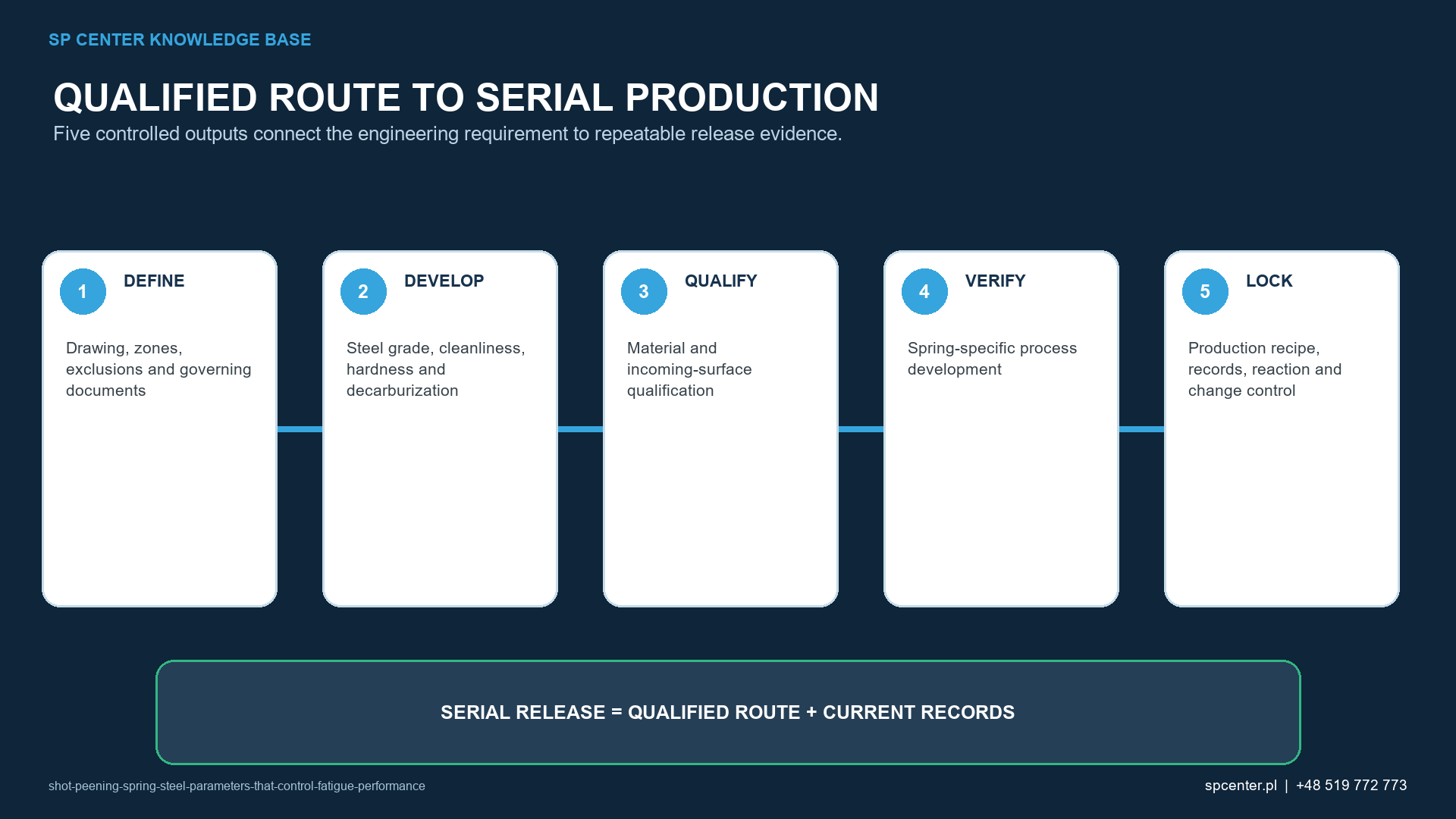
Which evidence supports fatigue performance?
| Evidence layer | Suitable checks | Decision supported |
|---|---|---|
| Incoming spring steel | Material identity, heat treatment, hardness, microstructure, cleanliness and decarburization evidence | Whether the part belongs to the qualified material and surface family |
| Process execution | Valid saturation curve and intensity verification, media inspection, flow, program, fixture, masking and coverage | Whether the approved shot peening process was performed |
| Surface integrity | Visual or microscopic damage inspection, roughness, topography, dimensional and cleanliness checks | Whether the process avoided unacceptable surface or geometric degradation |
| Residual-stress and cold-work profile | Qualified X-ray or other suitable depth method, hardness or diffraction-line metrics where justified | Whether the intended near-surface state was produced and retained |
| Application performance | Representative fatigue tests with correct geometry, load ratio, environment and failure analysis | Whether the full process route supports the claimed spring duty |
Table 3. Process conformity and application performance are related but distinct evidence layers.
Fatigue tests should reproduce the governing stress state and likely initiation site. Record runouts, failures, fracture origin and statistical treatment. A life increase reported for one steel, hardness, specimen and load ratio is not a universal design factor.
What should the production control plan include?
- Material, heat-treatment, hardness and surface-family traceability.
- Approved drawing zones, masking, fixture and program revision.
- Current saturation curve, intensity verification and Almen setup.
- Media specification, operating-mix size, shape, hardness and contamination control.
- Flow, pressure or wheel parameters and equipment monitoring defined by the procedure.
- Coverage method, acceptance, lighting or magnification and inaccessible-zone rule.
- Surface, dimensional, cleanliness and post-peening thermal-cycle checks.
- Batch identification, deviations, approvals and retained results.
Frequently asked questions
Does shot peening always increase spring fatigue life?
No. Benefit depends on steel, heat treatment, defects, decarburization, geometry, surface damage, residual-stress stability and service loading. An unsuitable process can provide little benefit or reduce life.
Should the media be harder than the spring steel?
Media hardness must follow the applicable specification and qualified process. Sufficient hardness and shape stability may be important for hard spring steel, but a simple universal hardness ratio is not a safe selection rule.
Can shot peening remove a decarburized layer?
Do not use controlled shot peening as an assumed machining or cleaning operation. Decarburization must be prevented, measured and dispositioned; any material-removal step requires its own controlled basis.
Is higher Almen intensity always better for a spring?
No. Higher intensity changes the process response but can increase roughness, damage and distortion. Select a qualified window from fatigue-relevant evidence rather than maximizing one value.
What is stress peening?
The spring or specimen is elastically preloaded during peening so the unloaded residual-stress state changes. Load magnitude, direction, fixture, sequence and safety require separate qualification and approval.
Can 200% coverage be substituted for stress peening or dual peening?
No. Increased exposure, peening under preload and a second media or intensity stage are different process changes. One must not be substituted for another without authorization and evidence.
Does a paint-curing bake affect the peened state?
It can. Temperature, time, material and loading can relax or redistribute residual stress. Validate the complete post-peening thermal cycle and sequence for the application.
Which fatigue test should qualify a spring process?
Use a test representative of component geometry, stress state, load ratio, cycle regime, environment and failure location. Coupon data alone may not represent a coil, eye, hook, fillet or contact zone.
Key takeaways
- Start with steel condition, defect population, geometry and service loading.
- Balance residual-stress depth against roughness, damage and distortion.
- Do not treat intensity, coverage or media hardness as independent optimization targets.
- Control decarburization and defects rather than expecting peening to repair them.
- Qualify stress peening, dual peening and post-peening heating as distinct changes.
- Use representative fatigue and fracture evidence for application claims.
Related SP Center guides
- Residual-Stress Depth Profile
- 100% vs 200% Coverage
- Overpeening: When Excessive Peening Damages a Part
- Hardness and Microhardness
Technical references
1. SAE J2441_202511: Shot Peening, stabilized November 2025
2. SAE AMS2431E: Peening Media, General Requirements, revised April 2023
3. SAE J442_202602: Tools for Peening Intensity Determination and Verification, revised February 2026
4. SAE J443_202512: Procedures for Determining and Verifying Peening Intensity, revised December 2025
5. SAE J2277_202301: Shot Peening Coverage Determination, revised January 2023
6. Farrahi et al., shot peening, residual stress and fatigue life of spring steel, 1995
7. Experimental residual-stress data for SAE 5160 and DIN 51CrV4 spring steels, 2026
8. Shot peening and fatigue strength of SAE 9245 spring steel, 2002
Standards note: Material limits, process parameters, stress peening, coverage, thermal sequence and acceptance follow the complete controlled requirements for the part.
Author: Paweł Kmieć
Discuss a controlled shot peening process for spring steel: +48 519 772 773 | [email protected]