


Control the fatigue-critical spring surface, material condition, access, manufacturing sequence and evidence for fatigue, relaxation and cracking claims
Spring shot peening is a controlled surface treatment used to delay surface-initiated fatigue cracking and, for qualified spring systems, support resistance to stress-corrosion cracking. It does not create a universal fatigue-life multiplier and it cannot repair an existing crack. The result depends on the spring type, material and heat treatment, incoming surface, applied stress state, media, intensity, coverage, motion and complete manufacturing sequence.
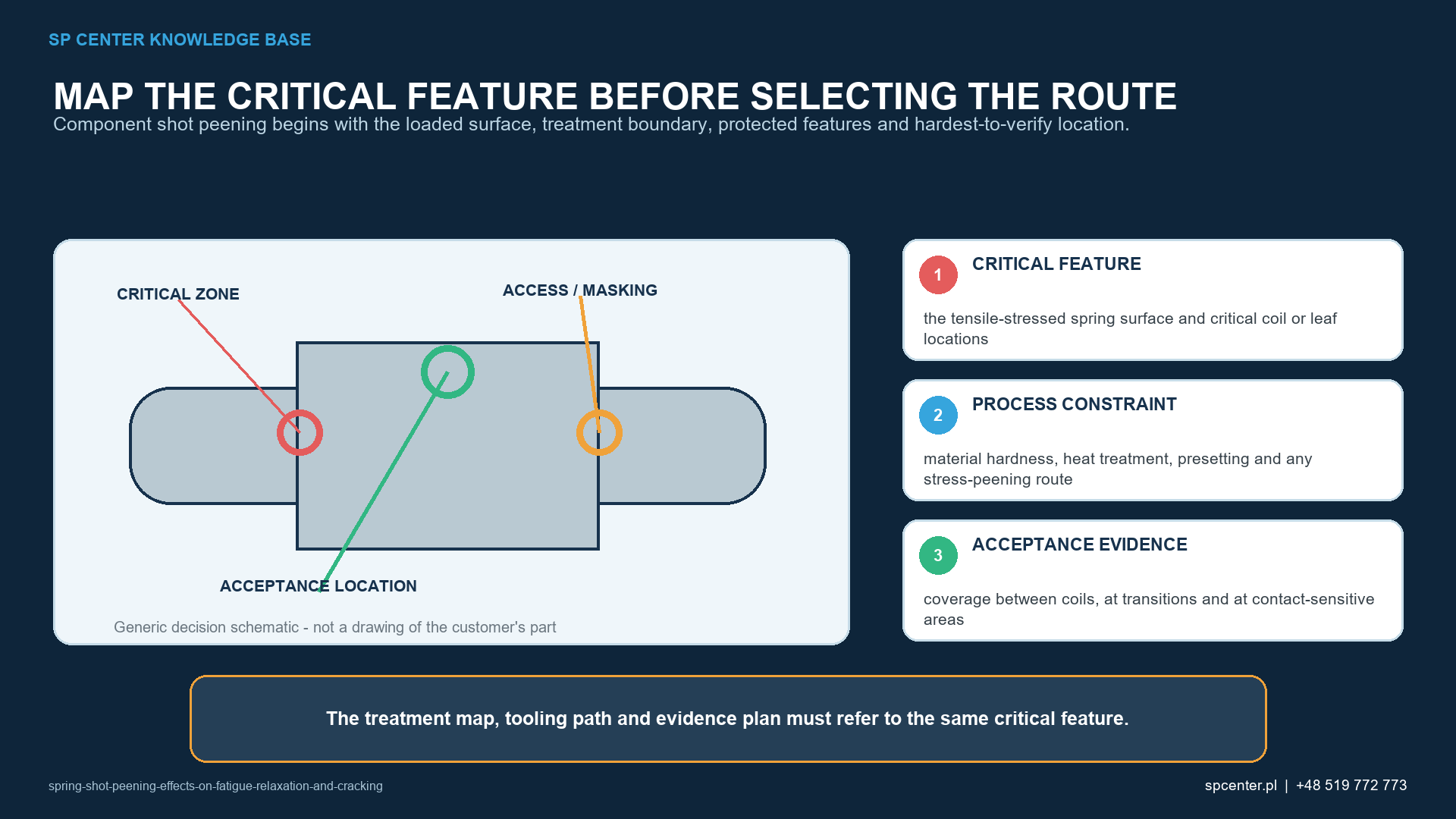
Where does spring shot peening need to act?
The required zone is the surface that governs the approved fatigue assessment, not simply the area that is easiest to expose. On a helical spring, curvature, coil spacing, end geometry and contact can change local stress and shadowing. On a leaf spring, eyes, edges, transitions, centre regions and interleaf contact can create different crack origins. Extension and torsion springs add hooks, legs and bends.
Use the drawing, stress analysis, service history and authorized design basis to define treatment and exclusion zones. If a surface becomes inaccessible after assembly, the approved route must establish whether it is treated earlier, protected or excluded.
| Spring feature | Engineering concern | Control and evidence |
|---|---|---|
| Helical compression or valve spring | Curvature, coil spacing, end coils and local contact can change stress and access | Identify the fatigue-critical wire surface from the approved design basis; qualify gun or nozzle access, rotation, axial motion and coverage at the worst location |
| Extension or torsion spring | Hooks, bends, legs and transitions can govern instead of the regular coil body | Map the stressed features and exclusions explicitly; do not infer treatment from coverage on an easy straight or coil section |
| Leaf or parabolic spring | Edges, eyes, thickness transitions, centre region and interleaf contact can introduce different crack origins | Control each required face and edge, treatment sequence, masking and access before assembly where interfaces become inaccessible |
| Nitrided, decarburized or surface-damaged spring | The incoming layer can dominate roughness, cracking or residual-stress response | Accept material, heat treatment and incoming surface first; qualify media, intensity and surface-integrity limits for that condition |
| Previously preset, coated or repaired spring | Sequence can change geometry, access, surface state and residual-stress stability | Use only the approved manufacturing route and evaluate any deviation before processing |
Table 1. Spring geometry, material condition and access determine what must be qualified.
How can shot peening influence fatigue and cracking?
Controlled impacts plastically deform the near-surface layer and can introduce compressive residual stress. That state can reduce the effective tensile driving force for a crack initiating at the treated surface. The outcome also includes cold work and topography changes; excessive roughness, folds, sharp impressions or microcracking can offset the intended benefit.
Shot peening does not remove internal inclusions, decarburization, corrosion pits, grinding damage or unacceptable heat treatment. Those conditions require their own acceptance and corrective route before peening.
What is the difference between fatigue improvement and relaxation?
Three effects must not be merged. Fatigue life concerns cyclic crack initiation and propagation. Spring relaxation or load loss is a macroscopic change in force or geometry under time, stress and temperature. Residual-stress relaxation is a change in the peening-induced stress field during later thermal or cyclic exposure.
A process can improve fatigue performance without reducing spring load loss under every service condition. Later heating, coating cure or high cyclic stress can also reduce beneficial compressive residual stress. Each claim therefore needs its own test and acceptance criterion.
How are conventional peening, stress peening and presetting separated?
| Operation | Purpose | Why it is not interchangeable |
|---|---|---|
| Conventional spring shot peening | Create a controlled near-surface state on the unloaded or procedure-defined spring | Requires its own intensity, media, coverage, motion, surface and part acceptance |
| Stress peening | Peen while the spring is deliberately loaded to alter the residual-stress result after unloading | Applied load, fixture stiffness, direction, safety, sequence and release are part of the qualified process |
| Presetting or scragging | Mechanically stabilize spring geometry or load by controlled overloading | It is not shot peening and does not prove peening coverage, intensity or surface integrity |
| Double or multiple peening | Apply two or more controlled peening stages for a qualified surface and residual-stress response | The stages, order, media, exposure and acceptance are one approved route—not permission for an extra pass |
| Blast cleaning | Remove scale or contamination or prepare a surface | Cleanliness evidence does not establish a qualified shot-peening process |
Table 2. Similar manufacturing objectives do not make these operations equivalent.
Stress peening is not ordinary peening performed on a spring that happens to be restrained. The applied load and fixture are controlled process variables. Likewise, presetting before or after peening can change geometry and residual stress and must follow the qualified sequence.
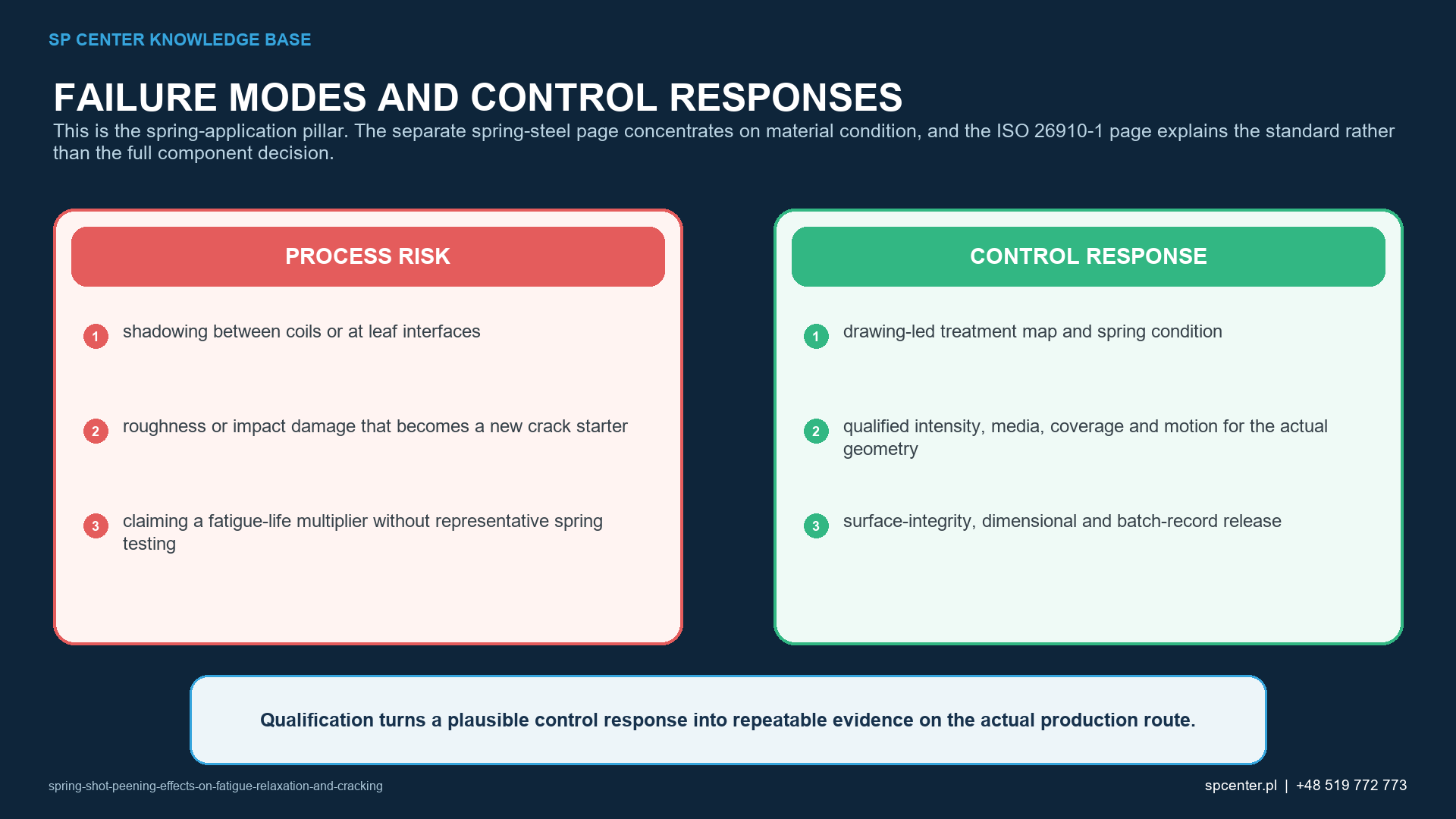
Which process variables require control?
Control the approved media material, size, hardness, shape and operating mix; intensity from a valid saturation curve; media mass flow; pressure or wheel settings; nozzle or wheel geometry; angle, distance, spring rotation, axial travel, overlap and exposure. For stress peening, also control the applied load or deflection, fixture stiffness, orientation and unloading sequence.
Media hardness and impact conditions must be suitable for the actual spring hardness and surface condition. A program qualified on one wire diameter, coil pitch, leaf thickness or heat-treatment state is not automatically transferable to another.
How are intensity and coverage verified on a spring?
Almen intensity is derived from a valid saturation curve and describes a standardized response of the peening stream. It does not measure residual stress in the spring. Coverage is the observed proportion of the specified surface covered by impact impressions under the approved method; it is not exposure time.
Coverage development must challenge the worst-access location: for example, an inner coil surface, hook transition, spring eye, leaf edge or masked boundary. Robot motion, turn count or nominal dwell does not by itself prove local impact.
How is surface integrity protected?
Before peening, verify material identity, heat treatment, hardness when required, decarburization or nitrided-layer condition, incoming damage and cleanliness. After peening, inspect the invoked zones for cracks, folds, sharp impressions, contamination, roughness, dimensional change and masked-boundary condition.
If access is poor or the surface is unacceptable, do not compensate automatically with more exposure. Contain affected product, identify the last known conforming condition and separate media, equipment, access and incoming-surface causes. Reprocessing requires explicit authority and cumulative-exposure review.
What evidence supports release and a performance claim?
| Claim or release question | Suitable evidence | Important limit |
|---|---|---|
| Was the peening stream controlled? | Valid saturation curve and intensity verification, approved media, equipment, fixture and program records | Almen intensity is a standardized stream response, not spring residual stress or fatigue life |
| Were critical surfaces reached? | Approved coverage method at the hardest-to-reach coil, hook, eye, transition, edge or face | Coverage at an accessible witness area does not prove a shadowed feature |
| Is the surface acceptable? | Defined inspection for cracks, folds, sharp impressions, roughness, contamination and dimensions | Additional exposure can worsen a damaged surface |
| Was the intended residual-stress state produced? | Qualified measurement plan with location, direction, depth method and uncertainty when required | One surface value is not the complete profile and can relax in later service or processing |
| Did fatigue performance improve? | Representative spring or justified specimen testing with load ratio, environment and fracture-origin analysis | No literature result supplies a universal life multiplier |
| Was relaxation or cracking resistance improved? | A test that measures the specified load loss, stress relaxation or environment-assisted cracking outcome | Spring load relaxation and relaxation of peening residual stress are different phenomena |
Table 3. Process verification, component acceptance and performance validation answer different questions.
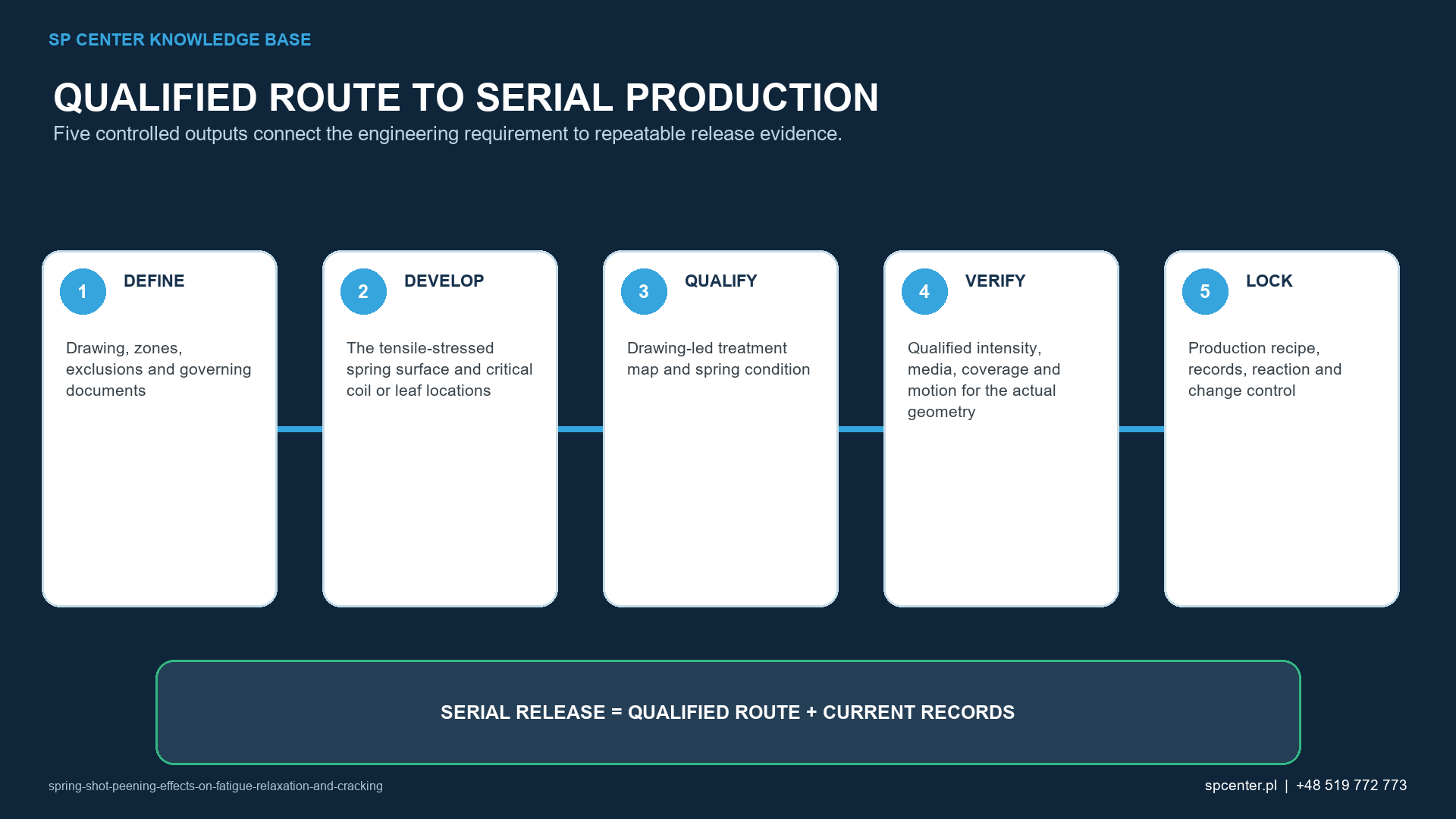
Fatigue tests should represent the actual spring family, critical location, load ratio or load-deflection cycle, environment and manufacturing route. Record run-outs, failures and fracture origins. Published studies can support a qualification plan, but their numerical gains do not transfer automatically to another spring.
How does the manufacturing sequence affect the result?
Heat treatment, nitriding, grinding, presetting, stress peening, conventional or multiple peening, cleaning, coating and thermal curing can interact. Material removal after peening can remove the treated layer; heating can relax residual stress; coating preparation can change the surface; handling or interleaf assembly can damage treated areas.
Freeze the approved sequence and review changes before production. If the drawing, purchase order or customer flow-down is incomplete or contradictory, pause and obtain controlled clarification rather than inventing a local substitute requirement.
What belongs in the production control plan?
- Part, batch, material, heat-treatment and incoming-surface traceability.
- Approved treatment, exclusion and transition map for every critical spring feature.
- Qualified equipment, media, fixture, program and any stress-peening load.
- Current saturation and intensity evidence plus media-condition records.
- Coverage and surface-integrity checks at feature-specific locations.
- Dimensional, load-deflection and performance checks required by the governing plan.
- Reaction plan for alarms, missed access, damage, change and reprocessing.
- Traceable release, deviation and customer-approval records.
Frequently asked questions
Does shot peening prevent every spring fatigue failure?
No. It mainly changes the near-surface condition. Internal defects, overload, corrosion, fretting, decarburization, unsuitable heat treatment, inaccessible features or an inadequate design can still govern failure.
Is stress peening the same as presetting a spring?
No. Stress peening treats a deliberately loaded spring with controlled media impacts. Presetting or scragging mechanically overloads the spring to stabilize geometry or load. If both are used, their sequence and controls must be approved.
Does shot peening reduce spring load relaxation?
Not automatically. Load loss depends on material, stress, time and temperature, while peening residual stresses can also relax thermally or cyclically. A relaxation claim needs a defined spring-level test.
Can shot peening improve resistance to stress-corrosion cracking?
It can support resistance in a qualified material, surface and environment by reducing detrimental near-surface tensile stress, but it does not replace material selection, corrosion protection, cleanliness or crack acceptance.
Does correct Almen intensity prove that inner coil surfaces are treated?
No. Intensity verifies a standardized stream response. Component access and coverage at the specified critical locations need separate evidence.
Can an existing spring crack be repaired by peening?
No. Stop and disposition the crack under the applicable design, material and customer authority. Peening must not be used to conceal a rejectable indication.
When does a spring peening route need change review?
Review changes to material or hardness, heat treatment, spring geometry, incoming surface, equipment, media, fixture, motion, stress-peening load, inspection method and subsequent thermal or coating operations before use.
What should a spring shot peening RFQ include?
Provide the controlled drawing and revision, spring type, material and heat treatment, manufacturing condition, treatment and exclusion zones, governing specifications, intensity and strip type, coverage method, surface and dimensional limits, quantity and required records.
Key takeaways
- Define the fatigue-critical spring surface before selecting the peening route.
- Separate conventional peening, stress peening, presetting, multiple peening and cleaning.
- Do not confuse spring load relaxation with residual-stress relaxation.
- Qualify intensity, access, coverage and surface integrity on the actual geometry.
- Use representative evidence for fatigue, relaxation or cracking claims.
- Control the complete manufacturing sequence and any reprocessing.
Related SP Center guides
- Shot Peening Spring Steel
- ISO 26910-1:2023 for Spring Shot Peening
- How Shot Peening Improves Fatigue Life
- Shot Peening Coverage
Technical sources
1. ISO 26910-1:2023, Springs — Shot peening — Part 1: General procedures
2. SAE J2441_202511: Shot Peening, stabilized November 2025
3. SAE J442_202602: Tools for Peening Intensity Determination and Verification, revised February 2026
4. SAE J443_202512: Procedures for Determining and Verifying Peening Intensity, revised December 2025
5. SAE J2277_202301: Shot Peening Coverage Determination, revised January 2023
8. Tange, Study on Optimizing a Shot-Peening Process, SAE 2005-32-0087
Standards note: Apply the complete revisions invoked by the drawing, contract and customer flow-down. This guide provides engineering context and does not replace controlled requirements.
Author: Paweł Kmieć
Discuss controlled spring shot peening: +48 519 772 773 | [email protected]