


What complete coverage means, how it is determined and how a qualified exposure route is controlled
Shot peening coverage is the degree to which the required component surface shows impact evidence from the peening media when assessed by an approved method. Complete or 100% coverage means that no visible unpeened areas remain within the specified zone under the defined inspection conditions. Coverage is a component surface-acceptance characteristic; it is not Almen intensity, exposure time, a coating or proof of fatigue performance.
How is coverage different from intensity, exposure and validation?
| Term | Question answered | Evidence boundary |
|---|---|---|
| Almen intensity | Does the qualified stream deliver the specified intensity under the applicable Almen arrangement? | Process verification; it does not accept the component surface |
| Coverage | Has the required component area received the specified degree of impact evidence? | Component surface acceptance; it does not prove intensity |
| Exposure | How long or how many passes is the area subjected to the qualified stream? | Process input used to achieve coverage; not an acceptance result by itself |
| Surface-condition acceptance | Is the treated surface free from prohibited damage, contamination or other specified defects? | Separate component acceptance criteria |
| Component validation | Does the qualified route provide the required residual-stress, fatigue or functional result? | Part- or specimen-based evidence when explicitly required |
Table 1. Intensity, coverage, exposure, surface condition and validation support different decisions and must not substitute for one another.
What does 100% coverage mean?
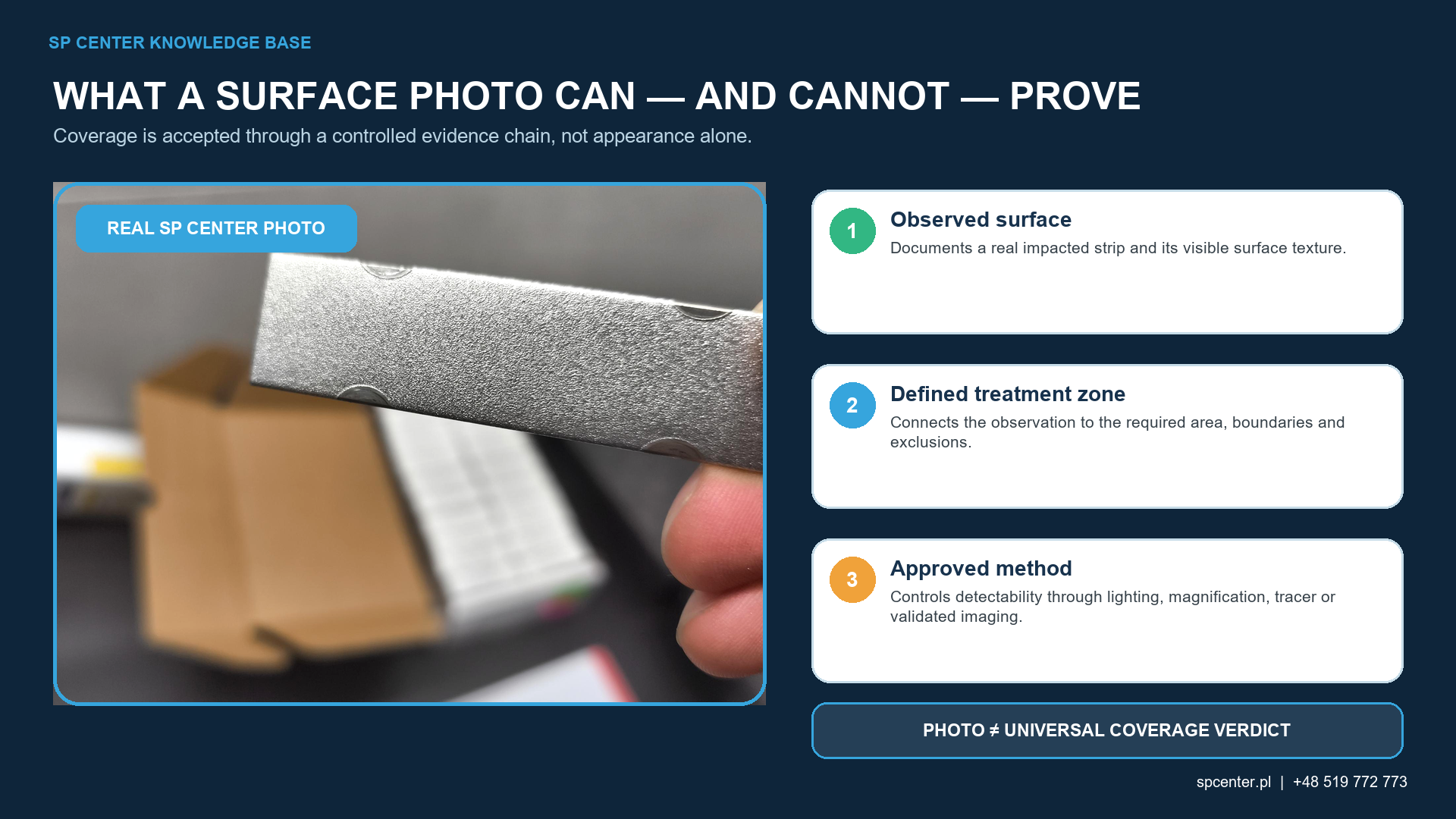
One hundred percent coverage means complete coverage of the required surface with no visible unpeened areas when evaluated by the approved method. The statement is incomplete unless the inspected zone, surface condition, cleaning, lighting, viewing angle, magnification, sampling or full-area rule and acceptance authority are known.
Coverage is method-dependent because sensitivity changes with surface finish, media impression size, contrast, illumination, magnification and geometry. A result obtained at one magnification or on an open witness surface cannot automatically be transferred to every area of the component.
How does coverage develop?
Individual impacts initially create separate impressions. As exposure continues, new impressions fill previously untouched areas and increasingly overlap earlier ones. The rate of visible coverage growth therefore slows as the remaining unpeened areas become smaller and less frequent.
This statistical behaviour does not remove the acceptance requirement. Production must follow a qualified route that reliably treats the complete specified geometry. It should not stop merely because one convenient field first appears complete.
What do 150% and 200% coverage mean?
Where a governing requirement uses percentage values above 100%, they normally express additional exposure relative to the qualified time needed to reach complete coverage under unchanged conditions. In this article, T100 is only a convenient local notation for that qualified time; it is not presented as a universal standards symbol.
| Requirement | Practical meaning | Control condition |
|---|---|---|
| 100% coverage | Complete coverage of the required surface with no visible unpeened areas when assessed by the approved method | Method, lighting, magnification, area and acceptance rule are defined |
| 150% coverage | Total exposure equal to 1.5 times the qualified time to 100%, when the governing requirement uses this convention | Qualified conditions remain unchanged |
| 200% coverage | Total exposure equal to twice the qualified time to 100%, when invoked | It is an exposure multiplier, not physical coverage of 200% of the area |
Table 2. Values above 100% describe exposure multipliers when invoked, not physical coverage of more than the available surface.
Additional exposure does not automatically improve fatigue performance. Depending on material, geometry, media and process severity, excessive treatment can increase roughness, damage edges, distort thin sections or create another nonconforming surface condition.
How is coverage determined?
| Assessment method | Useful role | Qualification need or limitation |
|---|---|---|
| Direct visual examination | Identifies remaining unpeened areas on accessible surfaces | Lighting, cleanliness, angle, magnification and inspector competence affect sensitivity |
| Magnified visual examination | Improves observation of small remaining areas and fine media impressions | Field of view, depth of field and complete-area scanning must be controlled |
| Photographic record | Documents location and supports review or traceability | A photograph records only the captured field and conditions; it does not replace the approved decision method |
| Fluorescent or tracer method | Provides indirect evidence of stream access and removal of a qualified coating | Must be approved, qualified and correlated to the governing coverage method for the route |
| Digital image analysis | Can support repeatable quantification in a defined setup | Thresholds, resolution, sampling, algorithm and measurement-system performance require qualification |
Table 3. The selected method must be appropriate for the surface and linked to a defined acceptance decision.
Fluorescent or tracer methods are indirect. They can help demonstrate stream access or reveal residual coating, but the coating system, application, cure, inspection conditions, removal mechanism, acceptance threshold and correlation must be qualified for the route. A tracer result must not be presented as universal direct proof of media impressions.
Why is complex geometry difficult?
| Geometry risk | Why incomplete coverage can remain | Typical engineering response |
|---|---|---|
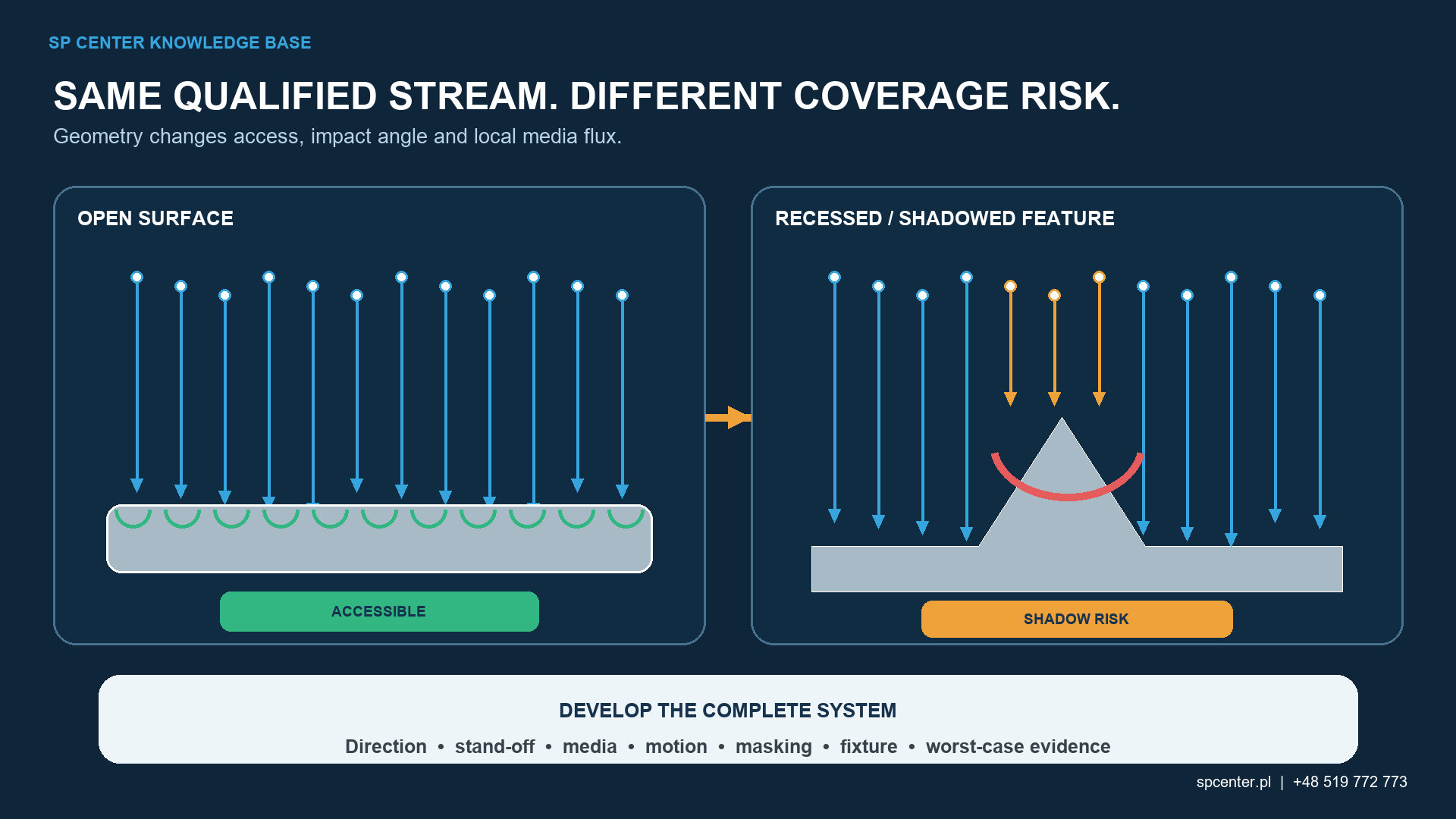
| Fillet or notch root | Impact angle and adjacent surfaces can shield the critical radius | Dedicated orientation, nozzle or wheel presentation, fixture and local verification |
| Bore or deep recess | Limited line of sight and media escape change the stream | Suitable lance or nozzle, defined travel, media removal and representative validation |
| Gear or spline | Tooth flanks and roots receive different access and dwell | Controlled indexing, orientation and inspection of critical zones |
| Masked boundary | Mask position and rebound can create a transition or shadow | Qualified mask, boundary tolerance and complete transition review |
| Thin or flexible section | Longer exposure can distort the part before access is solved | Balanced presentation, support, dimensional checks and route redesign |
Table 4. Access problems require changes to presentation, tooling or verification; additional time alone may overwork accessible areas without treating the shadowed surface.
Coverage evidence must address the actual critical location. A result on an open adjacent face, Almen holder or conveniently photographed field cannot prove treatment in a bore, root, recess or masked transition.
Why can increasing exposure fail to correct incomplete coverage?
If the stream cannot reach the surface, more exposure reproduces the same shadow. The accessible area receives additional impacts while the inaccessible area remains untreated. The correct response may be a different nozzle, wheel presentation, part orientation, fixture, motion path, media delivery strategy or approved local method.
Before changing the route, evaluate effects on Almen intensity, media behaviour, boundaries, distortion, surface condition and qualification. Production personnel should not improvise extra passes outside the controlled instruction.
Why is complete coverage necessary but not sufficient?
Complete coverage confirms only the specified surface evidence under the approved method. It does not show that the stream met the Almen-intensity requirement, the media remained within condition limits, the component is free from prohibited damage, or the route produced a particular residual-stress or fatigue result.
| Evidence layer | Representative evidence | Decision supported |
|---|---|---|
| Process verification | Almen setup and result, media condition, equipment, program, motion, flow, pressure or wheel speed and monitoring | The qualified stream and configuration were maintained |
| Surface acceptance | Coverage method, complete required area, boundaries, surface condition, inspector and decision | The component surface meets the invoked acceptance criteria |
| Component validation | Residual-stress profile, fatigue, distortion, roughness or functional testing where required | The route produces the specified part-level result for the qualified basis |
Table 5. Process verification, component surface acceptance and component validation form separate evidence layers.
How should coverage be qualified and controlled in serial production?
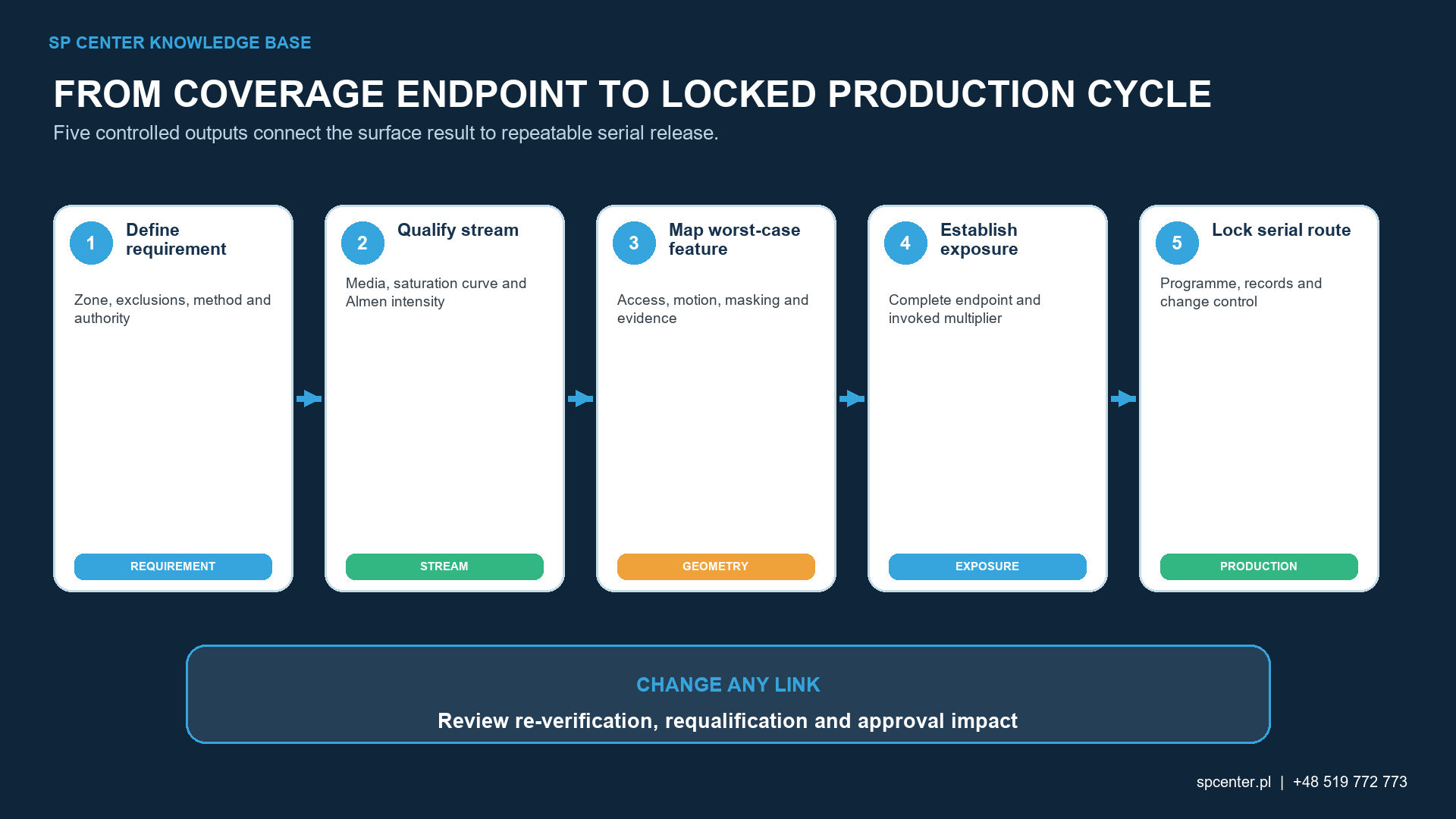
- Define the exact required and excluded areas, boundaries and inspection method.
- Establish access, tooling, part motion, stream presentation and a qualified exposure route on representative geometry.
- Determine the time to complete coverage under controlled conditions and apply any invoked exposure multiplier.
- Document machine, program, fixture, media, nozzle or wheel, motion, flow and inspection conditions.
- Verify the process stream as required and accept the actual component surface separately.
- Control changes to equipment, tooling, media, geometry, program, motion, masking and method.
- Retain records that connect the batch, route, inspector and decision.
What should a coverage requirement include?
- Required surface, zone identifiers, boundaries, exclusions and transitions.
- Target coverage and any permitted exposure convention above 100%.
- Direct or indirect assessment method and its qualification status.
- Cleaning, lighting, viewing angle, magnification and surface-condition prerequisites.
- Full-area or sampling rule, representative locations and difficult-geometry controls.
- Acceptance authority, records, traceability and response to an indeterminate result.
- Change, requalification and customer-notification requirements.
Common specification mistakes
- Using coverage and Almen intensity as synonyms.
- Writing “200% coverage” without defining the exposure convention.
- Specifying complete coverage without an inspection method or area.
- Using a tracer method without route-specific approval and correlation.
- Assuming that longer exposure corrects access or shadowing.
- Accepting an open surface while ignoring roots, bores or masked boundaries.
- Treating coverage as proof of residual stress, fatigue life or absence of surface damage.
Frequently asked questions
What is shot peening coverage?
Coverage is the degree to which the required component surface shows impact evidence from the peening media, assessed by an approved method. It is a surface-acceptance characteristic, not Almen intensity or a coating thickness.
What does 100% coverage mean?
It means complete coverage of the required surface with no visible unpeened areas under the specified inspection method, lighting, magnification and acceptance rule. The exact method and area must be defined.
Is coverage the same as Almen intensity?
No. Almen intensity verifies the qualified stream under the applicable Almen arrangement. Coverage assesses the component surface. A conforming result for one does not prove the other.
What is the difference between coverage and exposure?
Coverage is the observed surface result. Exposure is the controlled treatment time or number of passes used to obtain it. Exposure is an input; coverage is an acceptance characteristic.
How is coverage inspected?
Use the method invoked by the drawing or process specification. Direct or magnified visual examination is common; tracer or digital methods require approval, qualification and correlation where used.
What do 150% or 200% coverage mean?
When the governing requirement uses this convention, they refer to exposure multipliers relative to the qualified time to 100% coverage. They do not mean that more than the physical surface area is covered.
How is coverage verified on complex geometry?
Qualify access, orientation, motion, tooling and inspection on representative geometry. Use local methods or indirect aids only when approved and correlated, and do not compensate for shadowing by extending exposure indiscriminately.
Key takeaways
- Coverage is surface impact evidence on the specified component area.
- Complete coverage is method- and area-dependent.
- Intensity, coverage and exposure answer different questions.
- Percentages above 100% are exposure multipliers when invoked.
- Complex geometry requires qualified access, motion and local verification.
- Complete coverage does not replace surface-condition acceptance or component validation.
Related SP Center guides
- 100% vs. 200% Shot Peening Coverage
- Shot Peening Coverage Inspection
- Almen Intensity in Shot Peening
Technical references
1. SAE J2277_202301: Shot Peening Coverage Determination, revised January 2023
2. SAE J2441_202511: Shot Peening, stabilized November 2025
3. SAE AMS2430U: Shot Peening, revised April 2018
4. SAE J442_202602: Tools for Peening Intensity Determination and Verification, revised February 2026
5. SAE J443_202512: Procedures for Determining and Verifying Peening Intensity, revised December 2025
Standards note: Use the method, acceptance rule and revisions invoked by the drawing, contract and customer requirements.
Author: Paweł Kmieć
Discuss a coverage requirement: +48 519 772 773 | [email protected]