


How to select and control a particle-size distribution without treating nominal designation as proof of intensity, coverage or component performance
Shot size in shot peening is a controlled particle-size distribution, not one exact diameter. The distribution influences particle population, acceleration, access to component features, surface texture, intensity response and coverage development. Selection must therefore connect the media material and size range with the actual equipment, geometry, component material and required evidence. A nominal media designation alone does not qualify the process.
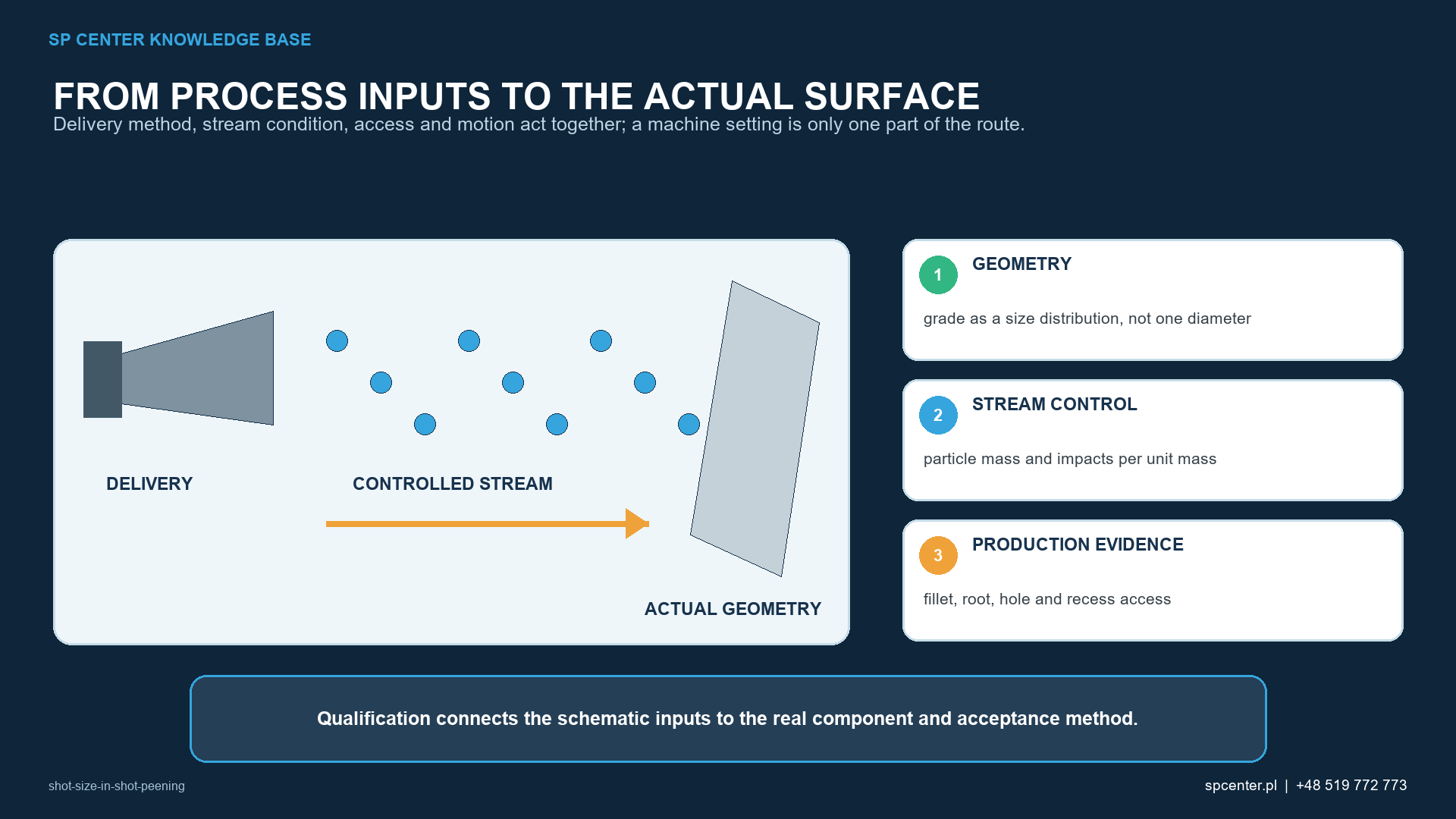
How does shot size influence the peening process?
| Size-related effect | Why it changes | Required engineering check |
|---|---|---|
| Particle mass and impact response | For the same material, particle mass changes strongly with characteristic diameter, while actual velocity also depends on the equipment | Qualify the resulting stream through the required intensity and component evidence |
| Number of impacts | A given media mass contains a different particle population as size changes | Establish coverage exposure on representative geometry |
| Access and shadowing | Large particles may not reach narrow radii, grooves, holes or shielded features in the same way | Verify physical access and feature-specific coverage |
| Surface texture and local deformation | Contact size, material, hardness, velocity and angle act together | Confirm roughness, damage and dimensional limits on the actual material |
| Depth of component response | Stress and plastic-strain distributions depend on the complete impact condition | Use component-specific validation when depth or performance is specified |
Table 1. These are interacting effects, not one-direction rules. A size change cannot be evaluated without the actual media material, equipment, velocity or wheel condition, flow, angle, exposure and component geometry.
How should shot size be selected?
| Selection input | Question | Evidence |
|---|---|---|
| Governing requirements | Is a media designation, material or size distribution already invoked? | Drawing, process specification, customer supplement and approved source list |
| Component geometry | Can the selected population reach every required feature without unacceptable boundary effects? | Access study, fixture and stream geometry, representative coverage |
| Component material and surface | Is the resulting roughness and deformation acceptable for the alloy, hardness and starting condition? | Representative surface inspection and material-specific qualification |
| Required intensity and coverage | Can the selected media produce the specified process outputs within a stable operating range? | Saturation-curve or verification evidence and coverage development |
| Downstream route and service | Can embedded media, surface texture or material removal affect cleaning, coating, dimensions or performance? | Downstream-process and component-validation evidence where required |
Table 2. If the drawing or specification already invokes a media designation, substitution requires the prescribed technical approval. If selection remains open, development must be based on representative parts and measurable acceptance criteria.
Why is access as important as intensity?
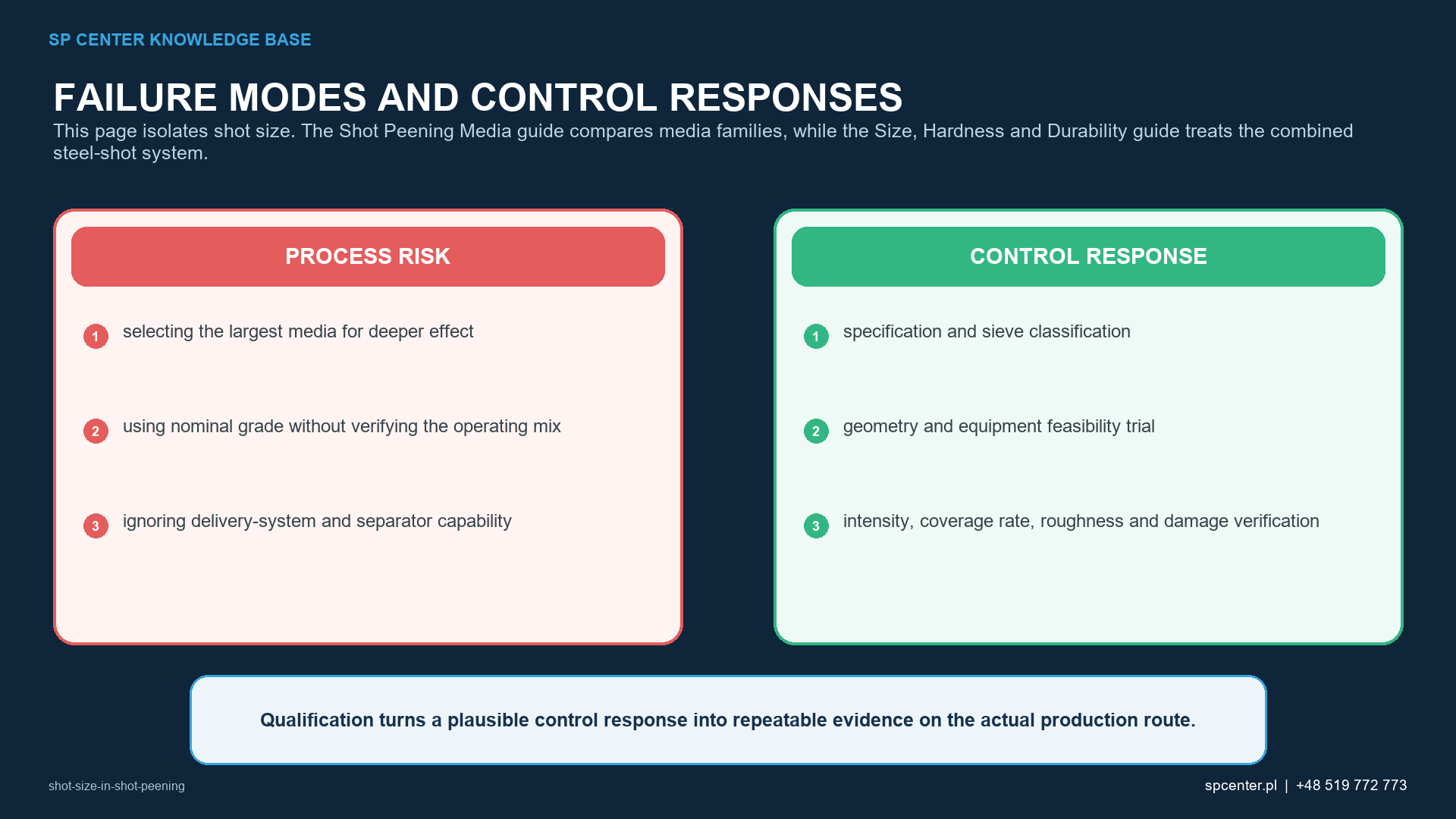
A media population can generate the required Almen intensity at a holder and still fail to reach a narrow fillet, groove, hole or masked transition. Physical access, stream shadowing, rebound and local impact angle must be reviewed on the component. Coverage evidence on an easy flat surface cannot automatically release a difficult feature.
Conversely, selecting smaller media only for access can change roughness, exposure required for coverage, media breakdown and the depth of the component response. The qualification route should establish a stable operating window rather than optimize a single output.
How do incoming-lot and operating-mix controls differ?
| Control stage | Primary purpose | Typical record |
|---|---|---|
| Supplier lot | Confirm identity and the invoked delivered size distribution | Certificate, lot, receiving sample and acceptance result |
| Machine charge | Prevent wrong designation, mixing and unapproved substitution | Issue, line-clearance and charge record |
| Operating mix | Detect wear, breakage, classifier drift and replenishment imbalance | Representative in-process sample, sieve result and trend |
| Process verification | Confirm the qualified peening stream after size-related changes | Almen and monitored-parameter evidence required by the process plan |
| Component acceptance | Confirm treatment of actual drawing-defined surfaces | Coverage, boundaries, surface condition and invoked dimensions |
Table 3. Receiving acceptance proves the delivered sample at the time of receipt. It does not prove the size distribution after the media has circulated, worn, broken, been replenished and passed through the classifier.
How should the size distribution be measured?
| Measurement element | Control | Failure mode |
|---|---|---|
| Sampling | Defined location, timing, quantity and clean equipment | Segregated or convenient sample does not represent the population |
| Sample reduction | Approved splitting route preserving the distribution | Fine or coarse particles are preferentially lost |
| Sieve or analytical equipment | Applicable mesh or measurement system, status, cleanliness and method | Damaged sieve, blocked opening, wrong unit or unverified instrument |
| Test execution | Defined charge, duration or analysis settings and complete mass balance where required | Overloading, loss of particles or selective re-test changes the result |
| Reporting | Raw fractions, units, calculation, acceptance and sample identity | Only a nominal designation is reported without the measured distribution |
Table 4. For cast shot, the applicable SAE J444 route may be relevant when invoked; other media families use their applicable detail specifications. The controlled method and contractual hierarchy determine the required equipment, fractions and limits.
Sampling is the first measurement. A representative operating-mix sample should be linked to the actual stream, machine and time window. Sample reduction must preserve the population before sieving or other approved analysis. Raw fractions and mass balance should remain available where required so that an acceptance value can be reconstructed.
What changes can invalidate an approved size route?
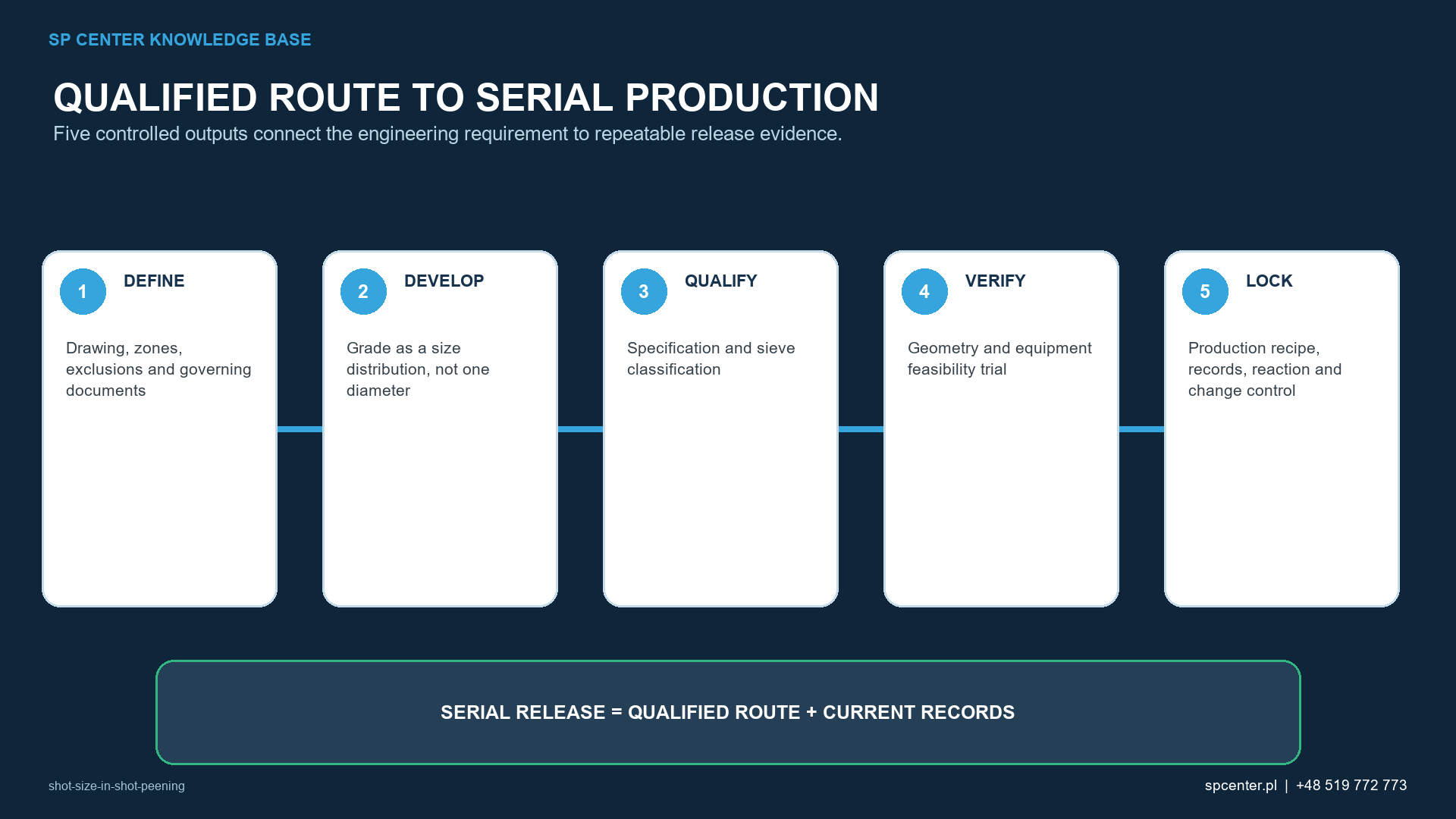
A different media designation or supplier route, material or density change, classifier or sieve change, replenishment strategy, machine or nozzle or wheel configuration, fixture, access or component material can affect representativeness. Change control should determine the required receiving tests, intensity verification, coverage development, surface inspection and requalification.
Which findings require containment?
| Finding | Possible cause | Required response |
|---|---|---|
| Excess undersize | Wear, breakage, classifier or replenishment problem | Contain, confirm, assess intensity and surface effects, restore the operating mix |
| Excess oversize | Wrong addition, damaged screen, supplier or segregation error | Stop use, verify identity and access or damage risk, contain product |
| Mixed media designation | Handling or changeover failure | Open contamination and traceability investigation |
| Correct size result but intensity drift | Velocity, flow, equipment or media material changed | Investigate the complete peening-stream configuration |
| Correct intensity but size result outside limit | Different population still produces similar standardized response | Do not release on intensity alone; follow media and product disposition |
Table 5. Correcting the operating mix does not automatically dispose of components processed since the last acceptable size evidence. The product assessment must consider intensity history, coverage, surface condition, material and customer requirements.
What records demonstrate size control?
- Applicable media general and detail specifications, drawing and customer revisions.
- Supplier, designation, material, lot, certificate and receiving acceptance.
- Storage, issue, machine charge, replenishment, classification and disposal.
- Sampling location, timing, quantity, reduction and sample identity.
- Raw sieve or analytical fractions, units, calculations, equipment status and acceptance.
- Trends, deviations, containment, restoration, re-verification and product disposition.
Frequently asked questions
Is shot size one exact particle diameter?
No. Production media are controlled as a distribution defined by the invoked media specification and test method. The commercial designation does not mean every particle has one diameter.
Does larger shot always create higher intensity?
No universal rule applies. Particle mass, actual velocity, material, hardness, equipment and stream settings act together. Intensity must be determined or verified for the qualified configuration.
Does smaller shot always improve coverage?
Smaller media may increase impact population and access some features, but coverage also depends on flow, velocity, angle, motion, exposure and geometry. It must be established on representative component surfaces.
Can the same media size be transferred to a different material or geometry?
Not on designation alone. Access, roughness, intensity, coverage, surface damage and component response must remain representative under the governing qualification route.
Why must the operating mix be tested after receiving acceptance?
Wear, breakage, replenishment and classification change the recirculating distribution. The machine population can therefore differ from the original supplier lot.
What happens after an out-of-limit size result?
The affected process and product window should be contained as required, the result confirmed, the cause investigated, the media system restored and product disposition completed before release.
Key takeaways
- Shot size is a controlled distribution, not one particle diameter.
- Size selection must connect geometry, access, material, surface limits, intensity and coverage.
- Receiving-lot and operating-mix controls are different evidence layers.
- Correct intensity does not prove a conforming size distribution; a conforming distribution does not prove component coverage.
- Out-of-limit results require both media-system restoration and product-window disposition.
Related SP Center guides
Technical references
1. SAE AMS2431E: Peening Media, General Requirements, revised April 2023
2. SAE J444_202306, Cast Shot and Grit Size Specifications for Cleaning and Peening
3. SAE AMS2430U: Shot Peening, revised April 2018
4. SAE ARP7488: Peening Design and Process Control Guidelines, issued January 2018
Standards note: The applicable media detail specification, drawing, contract, customer requirements and invoked revisions remain authoritative.
Author: Paweł Kmieć
Discuss your shot peening requirement: +48 519 772 773 | [email protected]