


Use process physics, capable measurements and structured trials to reveal interactions, then confirm a technically safe production window
Design of experiments (DOE) can reveal interactions among shot-peening variables more efficiently than changing one setting at a time. It is not an automatic recipe generator. A defensible study begins with a precise engineering decision, measurable responses, safe factor ranges and a design compatible with the way the production process can actually be run.
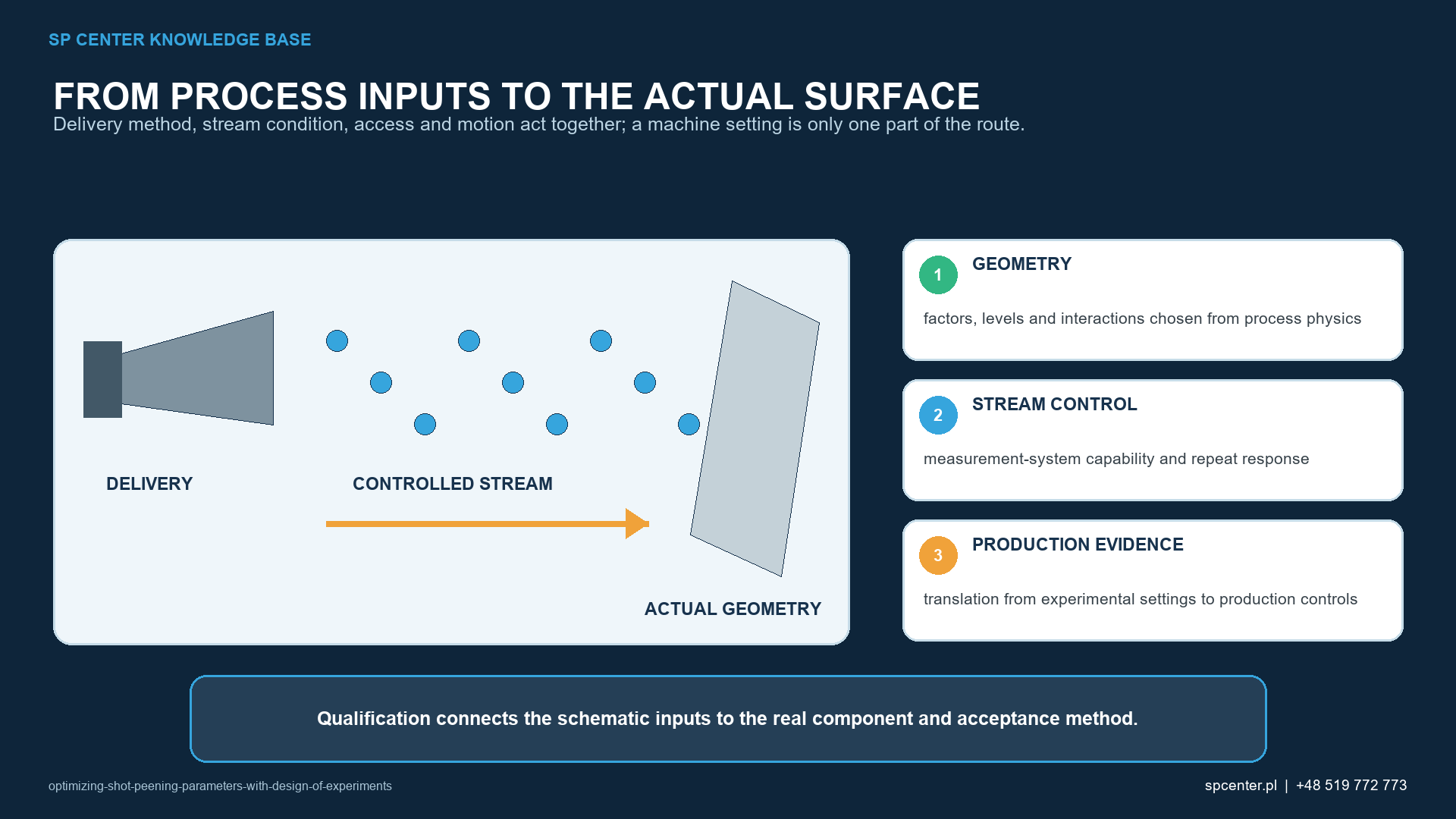
What should be defined before selecting a DOE design?
| Element | Shot-peening example | Design question |
|---|---|---|
| Controllable factor | Media mass flow, pressure, wheel speed, traverse speed, nozzle distance or angle | Can the production system set and verify the selected levels? |
| Categorical factor | Machine, nozzle type, media material or fixture concept | Does the design need a comparison, a block or a separate qualification? |
| Response | Intensity, time to coverage, roughness, distortion or residual-stress feature | Does this measurement represent the engineering claim? |
| Nuisance variable | Media lot, day, operator, part position or measurement session | Should it be randomized, blocked or deliberately studied? |
| Constraint | Damage, roughness, dimensions, coverage, equipment or specification limit | Which condition stops a run or excludes a region? |
| Confirmation | Independent run at proposed nominal and relevant limits | Does the predicted result repeat on representative geometry? |
Table 1. Factors, responses, nuisance variables, constraints and confirmation belong to one experimental strategy.
Start from the component requirement. If the design concern is surface roughness or distortion, optimizing only Almen intensity answers a different question. If fatigue benefit is claimed, representative material and geometry may be necessary; a stream surrogate cannot create that evidence by itself.
Factor levels must remain inside the feasible and authorized region. Do not use statistical completeness as a reason to run conditions that can damage the part, exceed equipment capability or conflict with the governing specification.
Which shot-peening factors can interact?
Air pressure, airflow and media mass flow are distinct on pneumatic equipment. Nozzle bore, distance, angle and traverse influence velocity and footprint. Media size, density, hardness, shape and operating-mix condition influence individual impacts and stream behaviour. On wheel equipment, wheel speed, feed, pattern controls and part motion create a different factor structure.
Interactions are technically plausible: a pressure change can have a different effect at another media flow; traverse speed can change the consequence of footprint overlap; media size can alter both intensity and roughness. One-factor-at-a-time trials cannot estimate these interactions efficiently.
How should the experimental sequence be built?
| Experimental stage | Purpose | Typical failure |
|---|---|---|
| Measurement readiness | Demonstrate method resolution, repeatability and traceability | Noise is mistaken for a factor effect |
| Screening | Identify influential factors and important interactions | A fractional design hides a critical confounded effect |
| Focused modelling | Estimate curvature and a useful local response surface | The model is extrapolated outside the tested region |
| Multiple-response decision | Balance intensity, coverage, roughness, dimensions and performance | One convenient surrogate is optimized while another limit fails |
| Confirmation | Challenge prediction at nominal and boundary conditions | The same data used to fit the model are presented as validation |
| Production translation | Define settings, limits, checks and reactions | A mathematical optimum becomes an unjustifiably narrow recipe |
Table 2. Screening, modelling, confirmation and production translation require separate decisions.
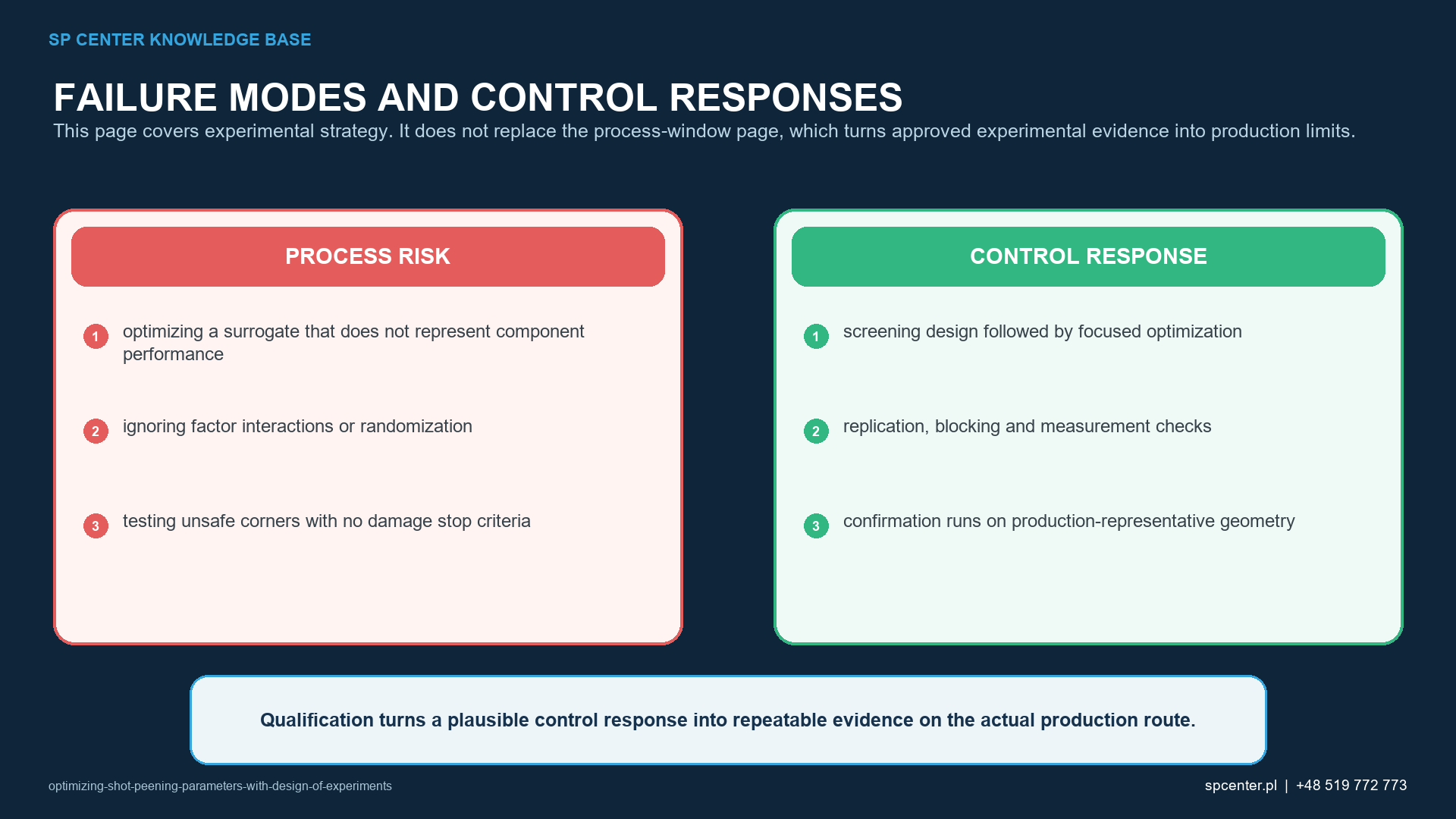
A screening design narrows the field of plausible factors. A focused design can then estimate curvature and interactions in the useful region. Centre points, replication, blocking and randomization are selected for the actual question; they are not decorative additions.
Hard-to-change factors such as media material or machine configuration may prevent complete randomization. A blocked or split-plot design can be appropriate, but its error structure must be analysed accordingly. Recording an unrestricted random design while running grouped settings creates misleading uncertainty.
Why must the measurement system be studied first?
A DOE cannot separate a small process effect from measurement noise when the method lacks resolution or repeatability. Define location, direction, instrument, calibration or verification status, operator method, repeated-measurement logic and raw-data retention for every response.
Replicate process runs to estimate independent process variation. Repeated readings on the same strip or component answer a measurement question and must not be counted as independent process replicates.
How should statistical and engineering significance be separated?
| Evidence question | Required treatment | Invalid shortcut |
|---|---|---|
| Is the effect statistically credible? | Model terms, residuals, uncertainty and design structure | A small p-value without residual review |
| Is the effect technically important? | Compare magnitude with specification, risk and measurement capability | Equating statistical significance with engineering value |
| Are interactions visible? | Retain hierarchy and interpret factors jointly | Changing one factor at a time |
| Is the process robust? | Confirmation with nuisance variation and relevant limits | One run at the predicted optimum |
| Is transfer justified? | Review machine, media, geometry, tooling and measurement equivalence | Copying coded factor settings to another route |
Table 3. The model supports an engineering decision; it does not replace specification limits or technical judgement.
Review residuals, influential observations, hierarchy, uncertainty and lack of fit where applicable. A statistically detectable change may be too small to matter technically, while an uncertain effect near a damage boundary can remain important for risk control.
For several responses, do not hide trade-offs in one unexplained score. Show how intensity, coverage, roughness, dimensions and any performance response behave across the proposed region and which requirement sets each boundary.
How does a DOE become a qualified process window?
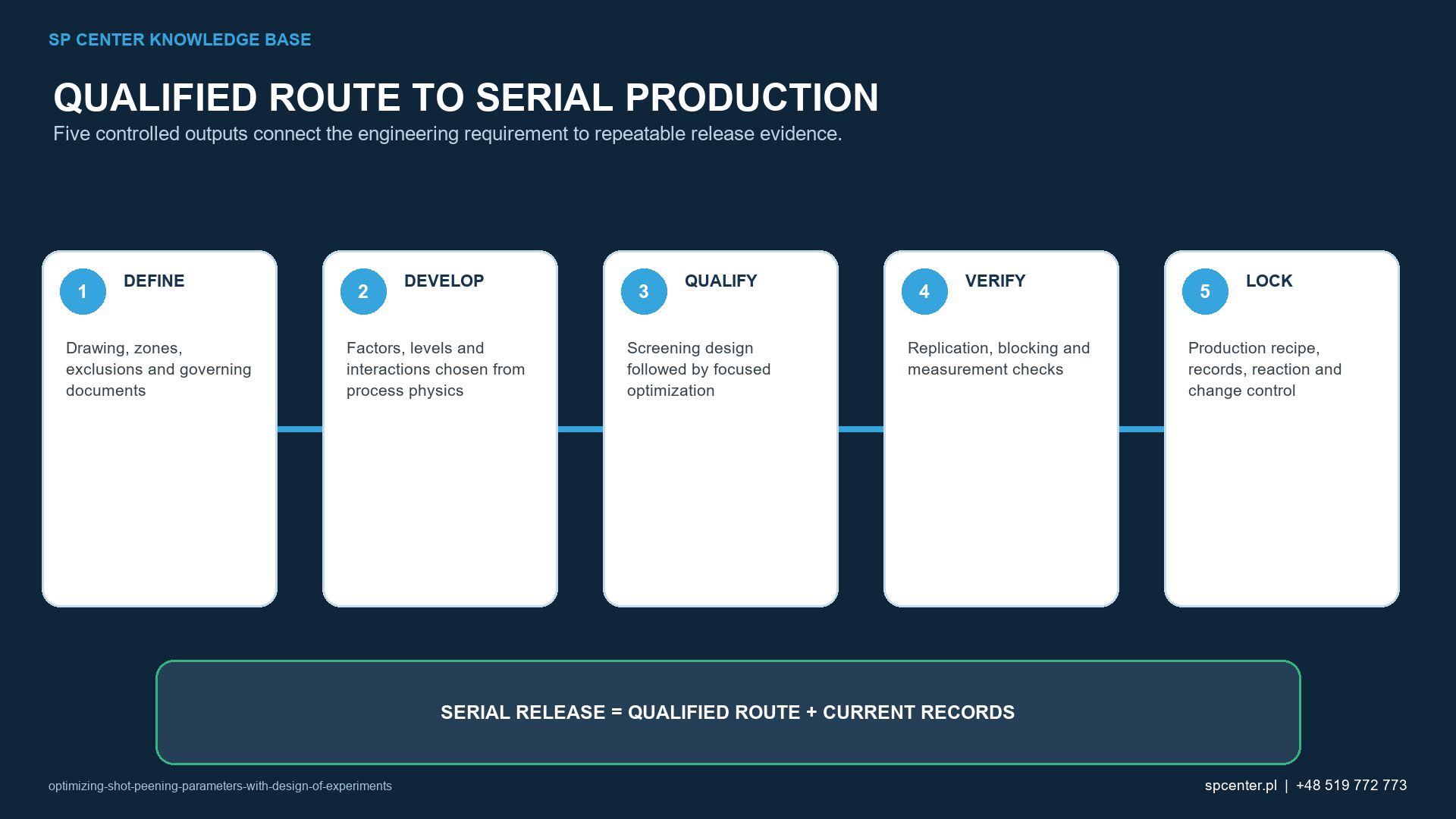
- Run independent confirmation trials at the proposed nominal and technically relevant limits.
- Use production-representative machine, media, fixture, geometry, motion and measurement methods.
- Compare prediction and observed results with uncertainty and all invoked acceptance limits.
- Choose a practical nominal with margin rather than the most extreme mathematical optimum.
- Translate factors into production settings, verification checks, action limits and reaction plans.
- Document transfer limits and requalification triggers for changes to equipment, media, geometry or inspection.
Do not extrapolate beyond the studied region. A DOE model describes evidence from its design space and assumptions; it does not prove conditions that were never tested.
Which failures invalidate the conclusion?
- The response does not represent the component requirement.
- The measurement system cannot resolve the studied effects.
- Run order, blocking or deviations are missing from the data set.
- Critical interactions are aliased, removed without basis or interpreted as isolated main effects.
- Unsafe or non-compliant conditions were tested without defined stop criteria.
- Model-fitting data are presented as independent confirmation.
- The optimum is transferred to another machine, medium or geometry without review.
Frequently asked questions
Why use DOE for shot peening?
DOE can estimate several factor effects and interactions within a structured set of trials, reducing the blind spots of changing one setting at a time.
Which response should be optimized?
Select the response that represents the engineering decision. Intensity, coverage, roughness, distortion, residual stress and fatigue are different outcomes and may require a multi-response decision.
Can Almen intensity be the only DOE response?
Only if the objective is limited to stream intensity. It cannot alone demonstrate component coverage, surface integrity, residual-stress profile or fatigue performance.
What is the difference between replication and repeated measurement?
Replication repeats an experimental condition with independent process variation. Repeated measurement estimates measurement variation on the same experimental unit; the two are not interchangeable.
Must every run be randomized?
Randomization protects against time-related bias, but practical hard-to-change factors may require blocking or a split-plot structure. The restriction must be designed and analysed explicitly.
Can DOE test the corners of any factor range?
No. Factor ranges must remain physically feasible, specification-compliant and safe for the component and equipment. Define stop criteria before running trials.
Does the statistical optimum become the production nominal?
Not automatically. Confirm the prediction independently, assess uncertainty and robustness, then define a practical nominal and allowable window under the governing requirements.
What should be retained from a DOE?
Retain objectives, factors and coding, run order, blocks, raw measurements, deviations, model and residual review, confirmation results, approved conclusions and the resulting control plan.
Key takeaways
- Begin with the engineering decision and response, not with convenient machine settings.
- Use DOE to estimate interactions that one-factor trials miss.
- Study measurement capability before interpreting small effects.
- Distinguish replication, repeated measurement, randomization and blocking.
- Keep every run within safe, feasible and authorized limits.
- Confirm independently and convert the model into a robust production window.
Related SP Center guides
Technical references
1. NIST/SEMATECH e-Handbook of Statistical Methods, Process Improvement through Designed Experiments
2. SAE J2441_202511: Shot Peening, stabilized November 2025
3. SAE ARP7488: Peening Design and Process Control Guidelines, issued January 2018
4. SAE J442_202602: Tools for Peening Intensity Determination and Verification, revised February 2026
5. SAE J443_202512: Procedures for Determining and Verifying Peening Intensity, revised December 2025
6. SAE J2277_202301: Shot Peening Coverage Determination, revised January 2023
Standards note: Use the complete controlled documents invoked by drawing and contract. The experimental design must remain inside those requirements and the approved safety limits.
Author: Paweł Kmieć
Discuss a shot peening development project: +48 519 772 773 | [email protected]