


A practical contract-review and implementation guide for buyers, engineers and shot peening suppliers
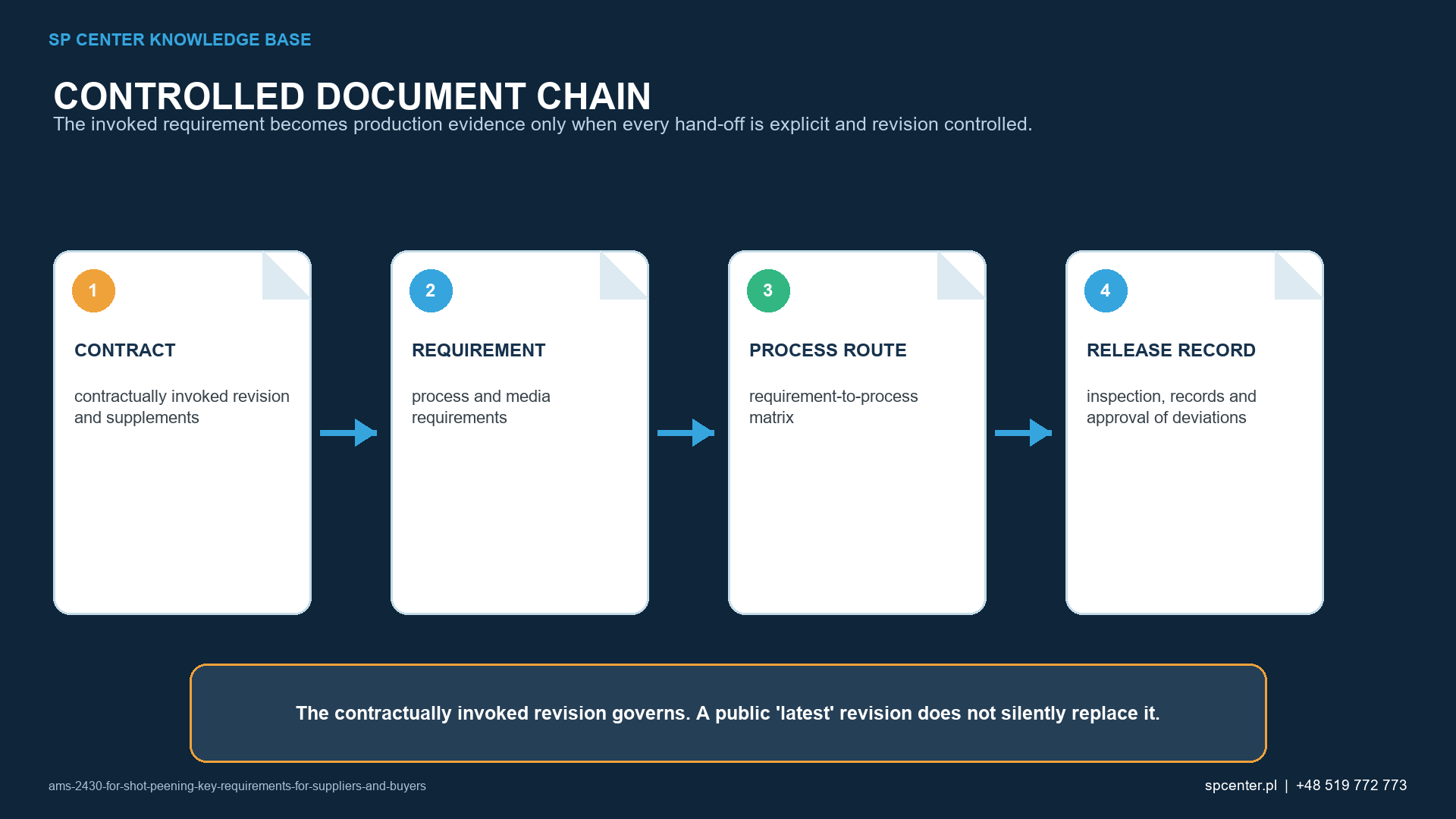
AMS2430 is an SAE Aerospace Material Specification for shot peening part surfaces with metallic, glass or ceramic media. It is not a stand-alone part drawing, supplier approval or product certificate. Buyers and processors must use the complete revision invoked by the contract together with the drawing, purchase order, customer supplements, referenced documents and released part-specific procedure. If any requirement conflicts or is missing, the affected decision must be stopped and formally clarified.
What does AMS2430 cover?
SAE’s public record describes the document as establishing requirements for shot peening part surfaces by impingement of metallic, glass or ceramic media. The full normative detail is contained in the licensed standard. A public abstract or article is not sufficient to determine every clause, acceptance limit, sampling rule or record requirement.
Before use, verify the official SAE record, obtain the complete contractually invoked revision and review all customer flow-down. Do not infer a detailed normative requirement from a document title, an old checklist, a supplier presentation or another programme.
Which documents govern an AMS2430 order?
| Controlled source | Typical role | Contract-review question |
|---|---|---|
| Purchase order and quality clauses | Commercial scope, flow-down, approved-source, records, notification and delivery requirements | Which clauses apply to the exact site and order? |
| Engineering drawing and revision | Part identity, treatment and exclusion zones, dimensions, notes and design authority | Are every zone and boundary unambiguous? |
| AMS2430 revision invoked | General shot peening process requirements within its published scope | Which complete revision is contractually applicable? |
| Customer or OEM supplement | Programme-specific additions, deviations, forms, approvals and source restrictions | Does it modify or add to the base specification? |
| Referenced SAE documents | Media, Almen tools and procedures, coverage or design guidance according to the invoked route | Are the correct documents and revisions available? |
| Released supplier procedure | Translates the controlled requirements into equipment, media, tooling, movement, inspection, records and reaction plans | Is it approved and matched to the actual part configuration? |
Table 1. Conformity comes from the complete controlled document hierarchy.
The drawing or design authority defines where the process applies and which surfaces remain excluded. The purchase order can invoke source approval, records, notifications and delivery clauses. Customer supplements can modify or add programme-specific controls. The supplier procedure turns this hierarchy into an executable route but cannot replace missing design authority.
What must the buyer define?
A useful RFQ and order identify the exact part, drawing and revision; material and heat-treatment condition; marked treatment, exclusion and transition zones; AMS2430 revision; customer supplements; complete Almen intensity requirement and strip designation; coverage or exposure; permitted or prohibited media; masking and cleaning; required qualification, inspection, records, packaging and delivery milestones.
If the buyer expects the supplier to propose intensity, media, coverage route or another technical element, the proposal authority and approval path must be explicit. “Process per AMS2430” alone may not close every part-specific decision.
What must the supplier confirm before quotation?
- All controlled documents and revisions are available and their precedence is understood.
- Every treatment and exclusion zone is reachable, maskable and inspectable.
- The material condition, incoming surface and manufacturing sequence are known.
- The available equipment, media, fixture and motion can support the required range and geometry.
- Qualification, customer approval, source surveillance and documentation are defined.
- Open conflicts and assumptions are recorded and routed to the responsible authority.
How are buyer and supplier responsibilities divided?
| Responsibility | Buyer or design authority | Processor or supplier |
|---|---|---|
| Requirement definition | Issue current drawing, hierarchy, treatment boundary and all applicable flow-down | Review for completeness, conflict and feasibility before commitment |
| Intensity and media | Define the complete requirement or authorize a controlled proposal | Select and control the route only within the governing requirements |
| Coverage and exposure | State the required coverage or additional exposure and acceptance basis | Develop a qualified route and inspect the actual specified area |
| Qualification | Define approval authority and part-level evidence when required | Generate objective evidence with representative equipment, tooling, media and geometry |
| Production and records | State required certificate, forms, traceability and source-surveillance route | Execute the released procedure and retain the invoked records |
| Change or nonconformance | Define notification and disposition authority | Stop the affected decision, contain status and obtain authorization before proceeding |
Table 2. Responsibility can be delegated only through an explicit and controlled authority route.
How should Almen intensity be handled?
Use the complete intensity range, strip designation, notation and locations invoked by the controlled requirement. Intensity is determined or verified with the applicable Almen strip, holder, gage and procedure. Pressure, air flow, wheel speed, media flow or exposure time may be process inputs, but none is a substitute for the standardized Almen evidence required by the governing route.
The Almen result verifies the peening stream at the test arrangement. It does not directly measure residual stress, roughness, dimensions, fatigue life or component coverage. The selected media and configuration remain part of the qualification basis even when nominal intensity is unchanged.
How should coverage and exposure be handled?
Coverage is the degree to which the specified component surface shows impact evidence under the approved inspection method. Complete coverage means that no visible unpeened area remains within the required zone under the defined conditions. The qualification route must account for access, impact angle, shadowing, transition boundaries, lighting, magnification and surface condition.
Where additional exposure such as 150% or 200% is invoked, apply the definition in the governing requirement. It commonly describes a time multiplier relative to the qualified time for complete coverage under unchanged conditions. Additional time does not repair shadowing and does not automatically improve fatigue performance.
How are peening media controlled?
The exact media family, size, hardness, shape, cleanliness and condition must satisfy the contractually invoked specifications and part restrictions. The supplier route should address receipt, identification, segregation, screening or classification, replenishment, working mix, contamination, breakdown and reaction to nonconforming media.
AMS2431 provides general requirements for peening media within its published scope, while detailed media designations or customer restrictions can come from other documents. A generic phrase such as “steel shot” or “ceramic media” is not enough when the controlled route requires a specific grade or condition.
What is the relationship to SAE J442, J443, J2277 and ARP7488?
SAE’s public records identify J442 with tools for peening-intensity determination and verification, J443 with procedures for determining and verifying peening intensity, J2277 with coverage determination and ARP7488 with peening design and process-control guidance. Their roles are complementary and their complete invoked revisions must be read in context.
An Almen-tool document does not define the component treatment boundary. A coverage document does not select the design intensity. Guidance does not override the controlled drawing or customer supplement. The contract-review matrix should show which decision and record each document supports.
When does AMS2432 apply?
SAE describes AMS2432 as computer-monitored shot peening intended to provide real-time observation, traceability and response for process input settings, and states that AMS2430 forms an integral part of it. This does not mean that every AMS2430 order automatically becomes an AMS2432 order. Use AMS2432 only when the contract invokes the applicable document set and requirements.
Computer monitoring does not replace the Almen system, media control, coverage inspection, part acceptance or required qualification. It adds a defined monitoring and traceability layer within the invoked route.
Does AMS2430 automatically require Nadcap?
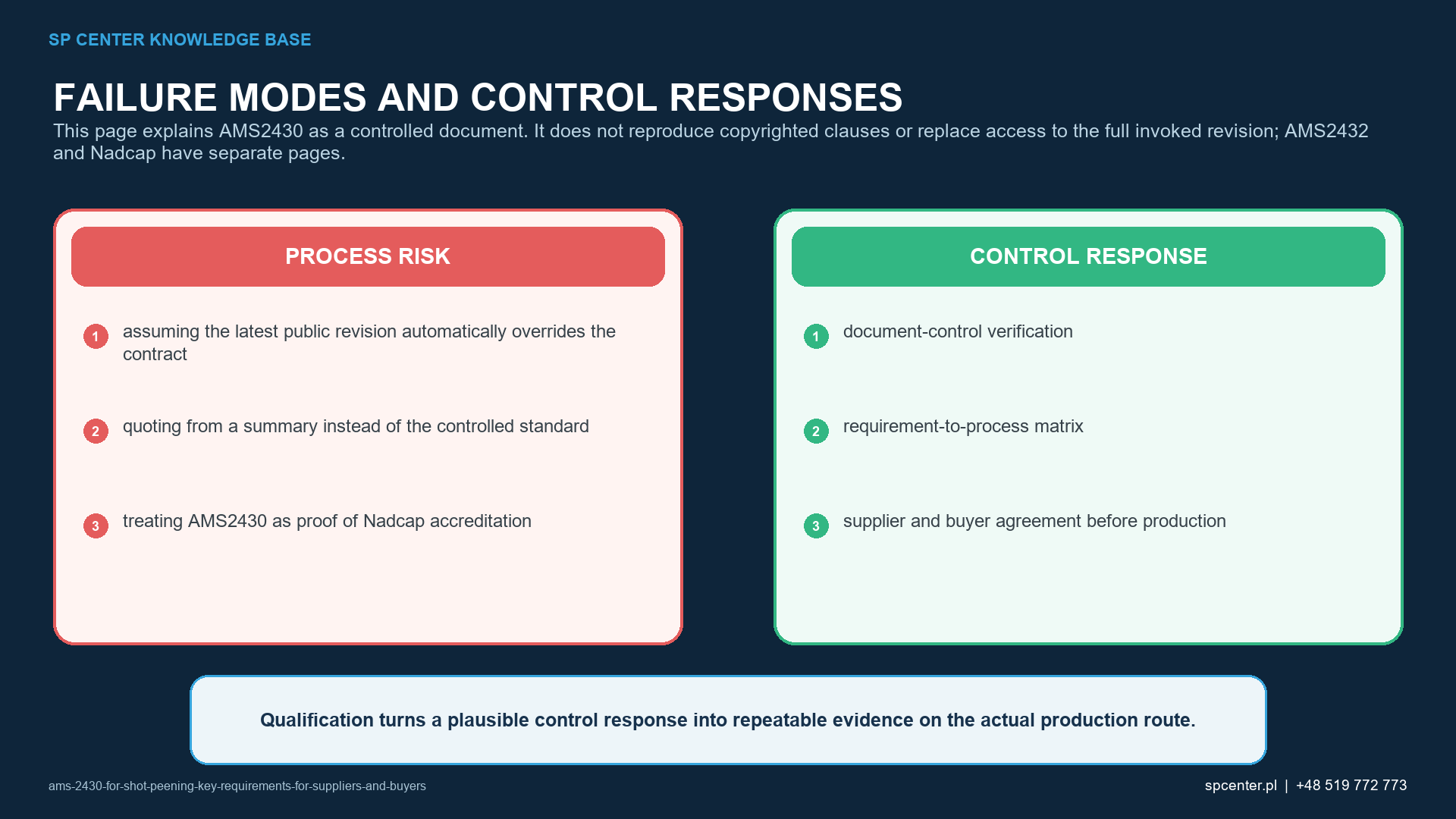
No. Nadcap accreditation is a separate industry-managed accreditation route administered by PRI. It is required only when invoked by the customer, contract or programme. Verify the exact processing site’s current Surface Enhancement scope in PRI records and confirm any customer approved-source status separately.
Nadcap is not certification of the processed product. A conforming batch still requires the applicable drawing, specification, qualified procedure, production evidence, inspection and authorized release.
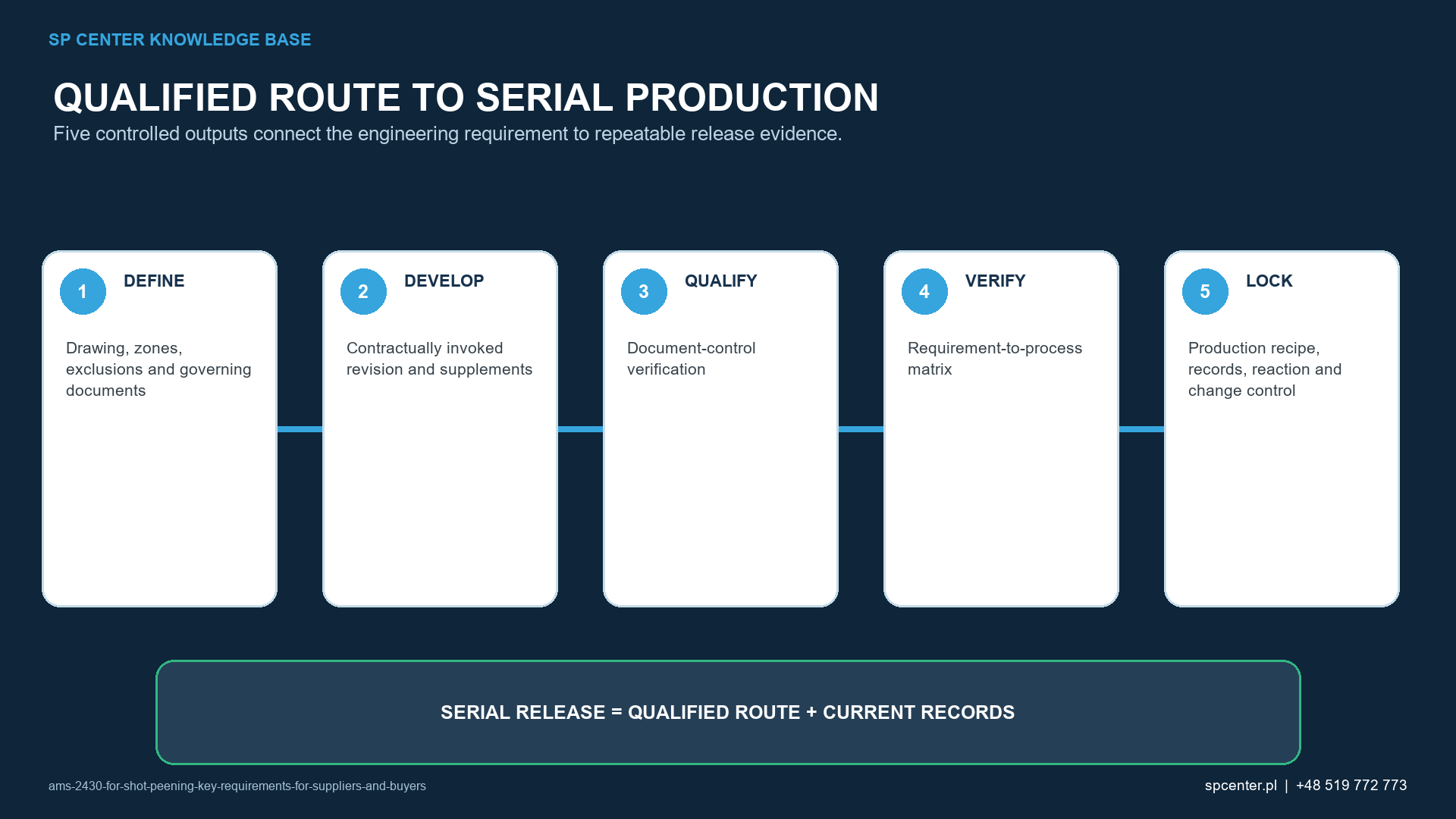
How should an AMS2430 process be qualified and released?
- Complete contract and feasibility review against the entire document hierarchy.
- Develop the equipment, media, tooling, masking, movement, intensity, coverage and inspection route within authorized requirements.
- Generate the invoked Almen saturation or verification and representative coverage evidence.
- Complete part-level surface, dimensional, residual-stress or performance validation only when required.
- Release controlled work instructions, records, reaction plans and change triggers.
- Run production, review deviations and approve the batch only after all required evidence is complete.
| Evidence layer | Representative content | What it does not prove by itself |
|---|---|---|
| Peening-stream verification | Almen determination or verification, media condition, equipment configuration and monitored inputs | Complete coverage or part performance |
| Component-surface acceptance | Coverage, boundaries, prohibited damage, cleanliness, roughness and dimensions when invoked | Qualified intensity or fatigue-life improvement |
| Configuration and traceability | Part and revision, order, lot, procedure, machine, programme, tooling, operator and inspection records | Technical adequacy of an unqualified route |
| Part-level validation | Residual-stress profile, fatigue, distortion or other functional evidence when required | Routine execution of every serial batch unless separately recorded |
| Release package | Certificate and customer-required records linked to conforming part and batch status | Requirements or tests not actually invoked or performed |
Table 3. Each evidence layer supports a different release decision.
Which changes require review?
Use the notification and requalification rules in the invoked standard, customer supplement and approved procedure. Potential triggers can include processing site, machine, control system, media, fixture, nozzle or wheel arrangement, programme, movement, treatment boundary, intensity range, inspection method, material condition, repair route or subcontracted operation. Do not decide from a generic list alone; assess the controlled qualification basis.
Common implementation mistakes
- Using the latest publisher revision without contractual approval.
- Quoting only “AMS2430” while treatment zones, intensity or coverage remain undefined.
- Treating machine settings as Almen intensity.
- Using a conforming Almen result as proof of component coverage or performance.
- Assuming a certificate, Nadcap scope or approval applies to another site or part.
- Changing media, fixture, programme or machine without review against the qualification basis.
- Issuing a release certificate before deviations and required records are complete.
Frequently asked questions
What is AMS2430?
It is an SAE Aerospace Material Specification whose public scope covers shot peening of part surfaces using metallic, glass or ceramic media. The complete purchased revision and contract flow-down are required for implementation.
Should the newest AMS2430 revision always replace the one on the drawing?
No. Production follows the revision contractually invoked unless an authorized change approves another revision. Current publisher status should be reviewed, but it does not silently rewrite an existing qualification or order.
Does AMS2430 define the whole component requirement?
Not by itself. The drawing, purchase order, customer supplements, referenced specifications, approved procedures and part-specific qualification can add or control treatment zones, limits, evidence and approvals.
Is AMS2430 the same as AMS2432?
No. SAE describes AMS2432 as computer-monitored shot peening and states that AMS2430 forms an integral part of that specification. Use the document set and revision invoked by the contract.
Does an AMS2430 order automatically require Nadcap?
No. Nadcap accreditation is required only when the customer, contract or programme invokes it. Verify the exact site’s current Surface Enhancement scope in PRI records and any separate customer source approval.
Does Almen intensity prove component coverage?
No. Almen evidence characterizes the peening stream under the applicable test arrangement. Coverage is accepted on the specified component surface by the approved method.
Can the supplier choose missing intensity or coverage requirements?
Only when the design or contract authority explicitly authorizes a supplier proposal and accepts it through a controlled route. Otherwise the affected work must wait for formal clarification.
What should be reviewed before releasing a batch?
Confirm part and revision, released procedure, required Almen and coverage evidence, media and configuration traceability, inspections, deviations and approved dispositions, customer forms and authorized release status.
Key takeaways
- Use the complete contractually invoked AMS2430 revision and full document hierarchy.
- Keep design authority, supplier proposal authority and approval routes explicit.
- Separate Almen intensity, coverage, surface acceptance and component validation.
- Control media, equipment, geometry, movement and changes as one qualified route.
- Do not treat AMS2430, AMS2432, Nadcap or customer approval as interchangeable.
- Release only a traceable, complete and authorized batch record.
Related SP Center guides
Primary sources
1. SAE AMS2430U: Shot Peening, revised April 2018
2. SAE AMS2432E: Shot Peening, Computer Monitored, revised October 2022
3. SAE AMS2431E: Peening Media, General Requirements, revised April 2023
4. SAE J442_202602: Tools for Peening Intensity Determination and Verification, revised February 2026
5. SAE J443_202512: Procedures for Determining and Verifying Peening Intensity, revised December 2025
6. SAE J2277_202301: Shot Peening Coverage Determination, revised January 2023
7. SAE ARP7488: Peening Design and Process Control Guidelines, issued January 2018
8. Performance Review Institute, Nadcap accreditation
Standards note: This guide does not reproduce the standard. The complete revisions and customer-specific requirements invoked by the contract govern.
Author: Paweł Kmieć
Discuss an AMS2430 requirement: +48 519 772 773 | [email protected]