


How dwell, traverse, rotation, passes and recovery rules create a controlled local treatment history
Exposure time in shot peening is the controlled local history through which a specified component area receives the qualified peening stream. It may be created by dwell time, nozzle traverse, component rotation, repeated passes or indexed positions. Exposure affects coverage, but it is not Almen intensity; the exposure used in an Almen saturation study is also not automatically the production time for a component.
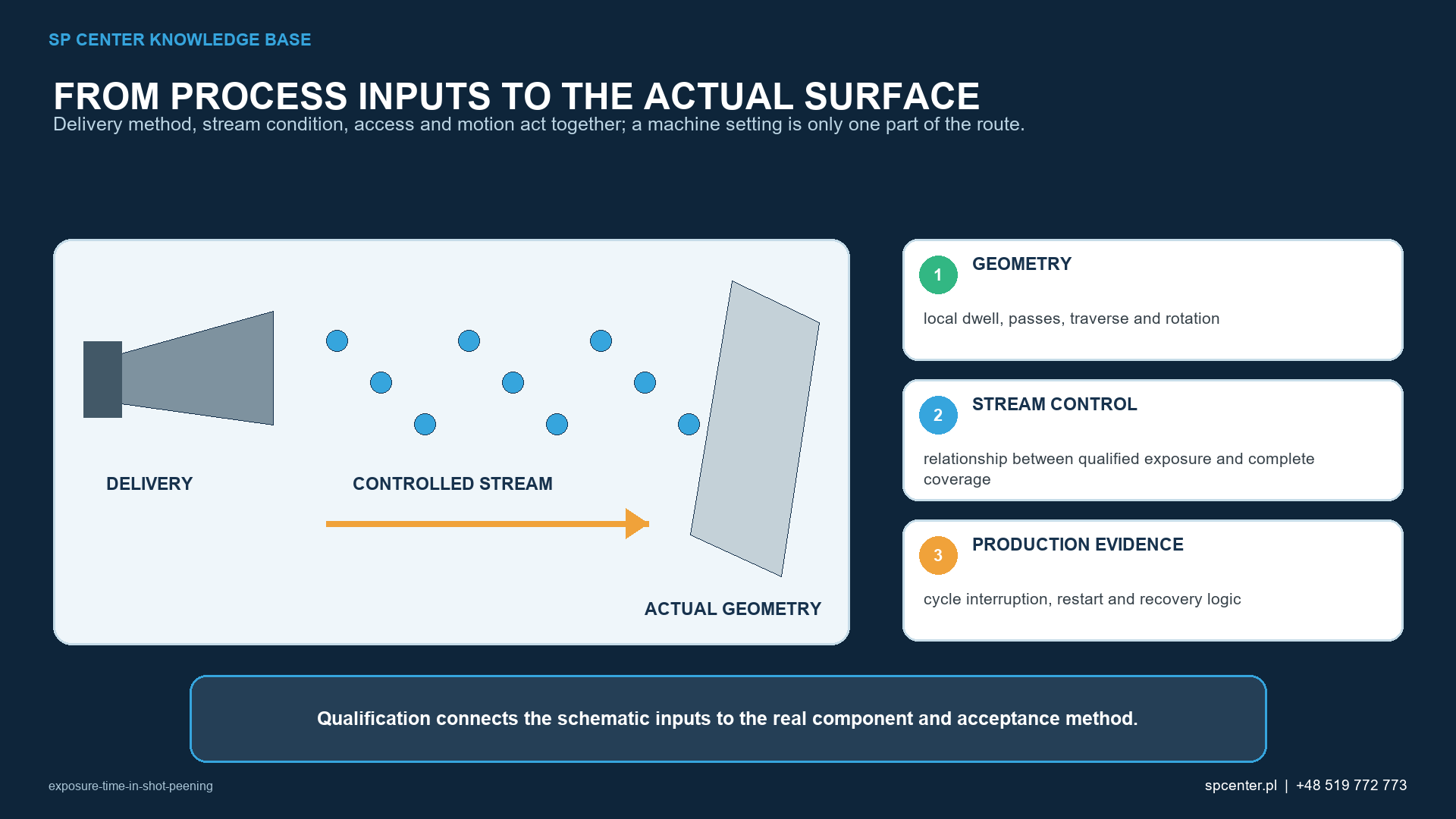
Why is exposure a local treatment history?
A machine timer records elapsed cycle time. It does not by itself show how long each surface point remained in the effective stream. A fillet may receive repeated passes, an exposed face may cross the centre of the stream and a recessed feature may receive only the edge of the particle plume. A defensible recipe therefore links time to the actual fixture, path, orientation and specified treatment area.
| Production variable | How local exposure is created | Typical control evidence |
|---|---|---|
| Fixed dwell | A stationary nozzle or component treats one defined area for a set duration | Recipe time, position confirmation and cycle record |
| Nozzle traverse | Local exposure depends on speed, stand-off, stream width and pass overlap | Program revision, path and speed verification |
| Component rotation | Circumferential exposure depends on speed, stream width and completed revolutions | Speed or encoder record and cycle count |
| Repeated passes | Exposure is added only where the qualified path is repeated | Pass count and complete-cycle confirmation |
| Indexed positions | Local dwell accumulates at controlled orientations or locations | Index sequence, position confirmation and dwell record |
Table 1. Exposure must be controlled at the required surface, not inferred from total machine time alone.
How does exposure differ from intensity, saturation and coverage?
| Term | What it describes | What it does not prove |
|---|---|---|
| Almen intensity | Standardized stream response determined or verified under the invoked procedure | Coverage on the production component |
| Saturation time | Exposure coordinate associated with the evaluated saturation point | A universal component cycle time |
| Component exposure | Qualified local time, passes or motion history applied to a specified area | Stream intensity unless verified separately |
| Coverage | Extent of the specified surface showing peening impressions under the approved method | Residual-stress depth or fatigue performance |
Table 2. Four related quantities describe different parts of process control and acceptance.
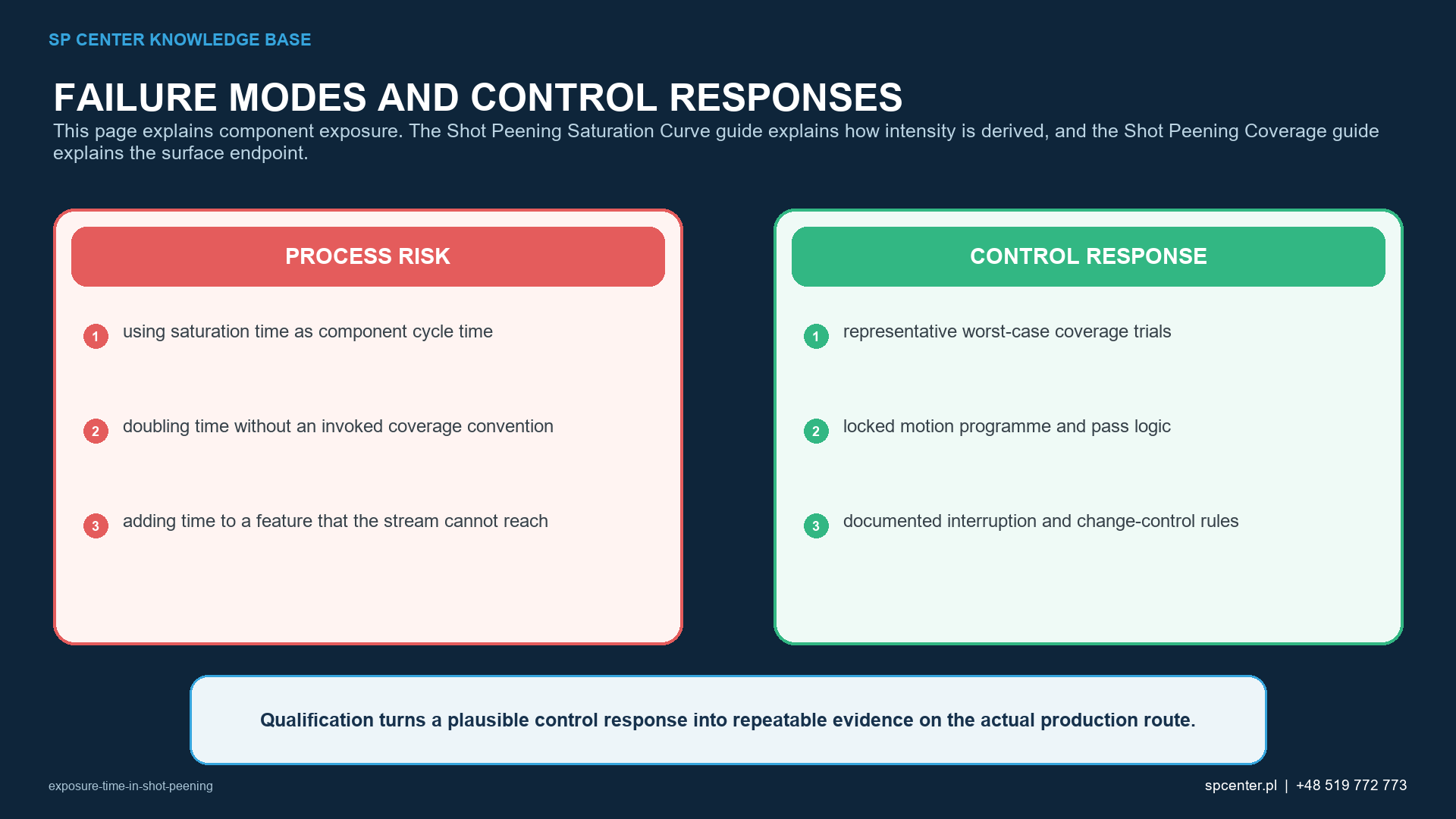
Changing exposure during saturation-curve development changes the measured arc height, but Almen intensity is determined from the evaluated curve under the invoked procedure. Conversely, a machine can reproduce the qualified intensity while the component remains underexposed because access, motion or orientation is wrong.
Engineering note: Do not prescribe “increase intensity” as a generic correction for incomplete coverage. More particle energy along an ineffective path does not correct a shadowed or inaccessible surface.
How is component exposure established?
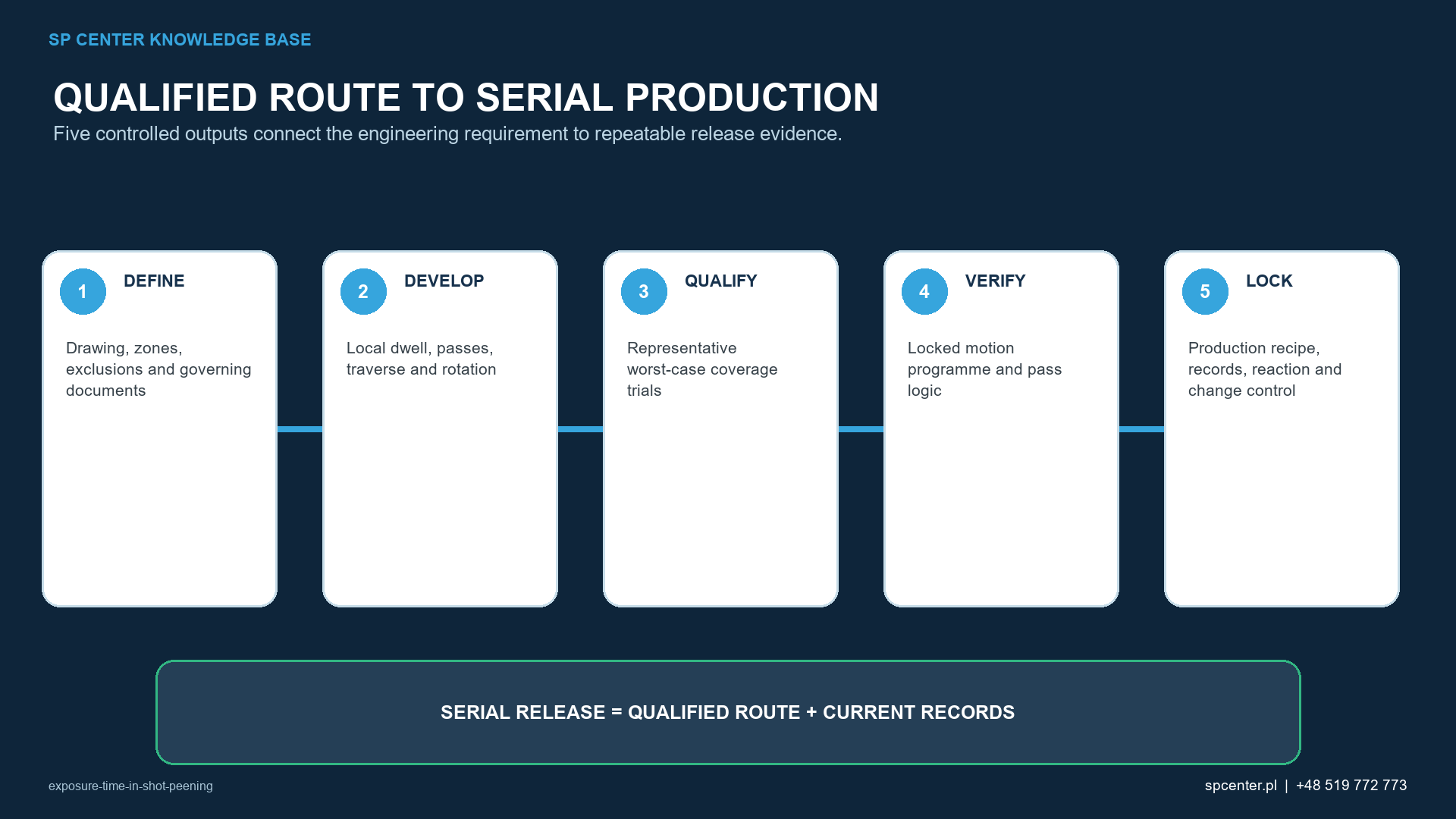
Development starts with the qualified stream and representative component geometry. The fixture, nozzle or wheel relationship, path, rotation, indexing, overlap and pass count are then developed so every specified area reaches the required coverage by the approved inspection method. Any required exposure multiplier is applied only after the complete-coverage baseline has been established for that controlled configuration.
- Define treatment zones, boundaries, exclusions, masking and acceptance criteria.
- Verify the stream and determine or verify Almen intensity under the invoked procedure.
- Develop access and motion on representative geometry, including the most difficult required areas.
- Establish the exposure associated with complete coverage using the approved method.
- Apply the multiplier or margin required by the governing specification or approved process plan.
- Freeze the recipe revision and define monitoring, interruption and change-control records.
What do underexposure and excessive exposure mean?
Underexposure means that a required area did not receive the qualified treatment history needed by the process requirement. The cause can be insufficient time, poor access, incorrect orientation, missing passes or an interrupted cycle. There is no universal time at which every material becomes overprocessed. Exposure beyond the authorized route is nevertheless a process deviation and can change roughness, cold work, distortion risk, media consumption and tooling or masking wear.
| Observation | Engineering interpretation | Required control response |
|---|---|---|
| Coverage is incomplete | Exposure, access, orientation or motion is insufficient at a required area | Correct the cause; reprocess only under an authorized route |
| Coverage is complete before cycle end | The approved production exposure may contain deliberate margin | Do not shorten the cycle without validation and authorization |
| The recipe exposure was exceeded | Conformity is uncertain even if appearance is acceptable | Record the deviation and obtain the required disposition |
| Roughness changes after full coverage | Surface response can continue after coverage is achieved | Assess the invoked surface and component requirements separately |
Table 3. Surface appearance alone cannot approve exposure outside the authorized production route.
How are 100% and 200% coverage related to exposure?
Complete coverage means that the required surface has no visible unpeened areas when assessed by the approved method. When the governing requirement defines 200% coverage through exposure, it is commonly implemented by applying twice the exposure required to establish complete coverage under unchanged conditions. It is not 200% physical area and does not imply twice the intensity, residual stress or fatigue life.
Which motion and stream variables control effective exposure?
| Variable | Effect of an uncontrolled change | Control principle |
|---|---|---|
| Traverse speed | Local dwell and pass overlap change | Lock and verify the qualified speed and path revision |
| Rotation speed | Revolutions in the stream and circumferential overlap change | Monitor speed and completed revolutions |
| Nozzle angle or stand-off | Footprint, incidence and accessible area change | Use verified tooling, positions and program coordinates |
| Pass count or index sequence | Accumulated exposure becomes incomplete or excessive | Record cycle completion and recipe identity |
| Media flow, pressure or wheel speed | The qualified stream condition can change, not only exposure | Control stream variables independently of cycle time |
Table 4. Time cannot silently compensate for changes to other qualified process variables.
How should an interrupted cycle be controlled?
An interruption creates a traceability problem when the controller cannot identify the last completed path, pass or index. The approved recovery route should define what is recorded, how the part is repositioned, the permitted restart point, whether accumulated exposure is retained and when full reprocessing or formal disposition is required. Operators should not reconstruct the treatment history from memory.
Which evidence proves a controlled result?
| Evidence layer | Required evidence for exposure control | Separate decision |
|---|---|---|
| Process verification | Qualified stream, machine and recipe identity, media, delivery settings, fixture, motion and monitoring | Component surface acceptance |
| Component surface acceptance | Specified area, coverage, boundaries, surface condition and any invoked dimensional or roughness criteria | Application-specific validation |
| Component validation | Residual-stress, fatigue, distortion or other engineering evidence when required | Routine stream verification |
Table 5. Exposure control remains defensible only when process verification, component surface acceptance and component validation are kept separate.
What information should an RFQ include?
Provide the controlled drawing and revision, material and heat treatment, treatment and exclusion zones, governing specifications, intensity and coverage requirements, component geometry, quantity, surface and dimensional limits, required records and customer-specific approvals. SP Center can then review feasibility and define the evidence needed within its confirmed capability and approval scope.
Frequently asked questions
What is exposure time in shot peening?
It is the controlled local time, passes or motion history through which a specified component area receives the qualified peening stream. Total machine cycle time is adequate evidence only when the qualified motion maps it to every required area.
Is component exposure the same as Almen saturation time?
No. Saturation time belongs to the standardized Almen-strip study used for intensity. Component exposure is developed for the actual geometry, access, motion and coverage requirement.
Does twice the exposure always mean 200% coverage?
No. Doubling the exposure established for complete coverage represents 200% coverage only when the governing requirement uses that convention and the controlled setup remains unchanged.
Does correct Almen intensity prove that component exposure is acceptable?
No. Correct intensity verifies the standardized stream response. Component coverage, boundaries, surface condition and any additional acceptance criteria require separate evidence.
Can extra time compensate for poor access?
Not reliably. A stream that does not reach a feature at an effective angle cannot be corrected merely by extending the same ineffective path. Access, orientation, tooling or motion must be addressed.
How should an interrupted cycle be recovered?
Use the approved recovery instruction. It must define the recorded completed state, repositioning, permitted restart point and whether partial completion or full reprocessing is authorized.
Key takeaways
- Define exposure at the local surface, not only at the machine timer.
- Keep Almen intensity, saturation time, component exposure and coverage separate.
- Develop coverage on representative geometry with the qualified setup.
- Control traverse, rotation, passes, indexing and interruption recovery.
- Treat exposure outside the authorized recipe as a deviation requiring disposition.
Related SP Center guides
- Shot Peening Saturation Curve
- Shot Peening Coverage
- Impact Angle in Shot Peening
- Masking for Shot Peening
Technical references
1. SAE J443_202512: Procedures for Determining and Verifying Peening Intensity, revised December 2025
2. SAE J2277_202301: Shot Peening Coverage Determination, revised January 2023
3. SAE J2441_202511: Shot Peening, stabilized November 2025
Standards note: The complete revisions invoked by the drawing, contract and customer requirements remain authoritative.
Author: Paweł Kmieć
Discuss your shot peening requirement: +48 519 772 773 | [email protected]