


How manufacturers can compare capability ownership, lifecycle cost, qualification, capacity and continuity
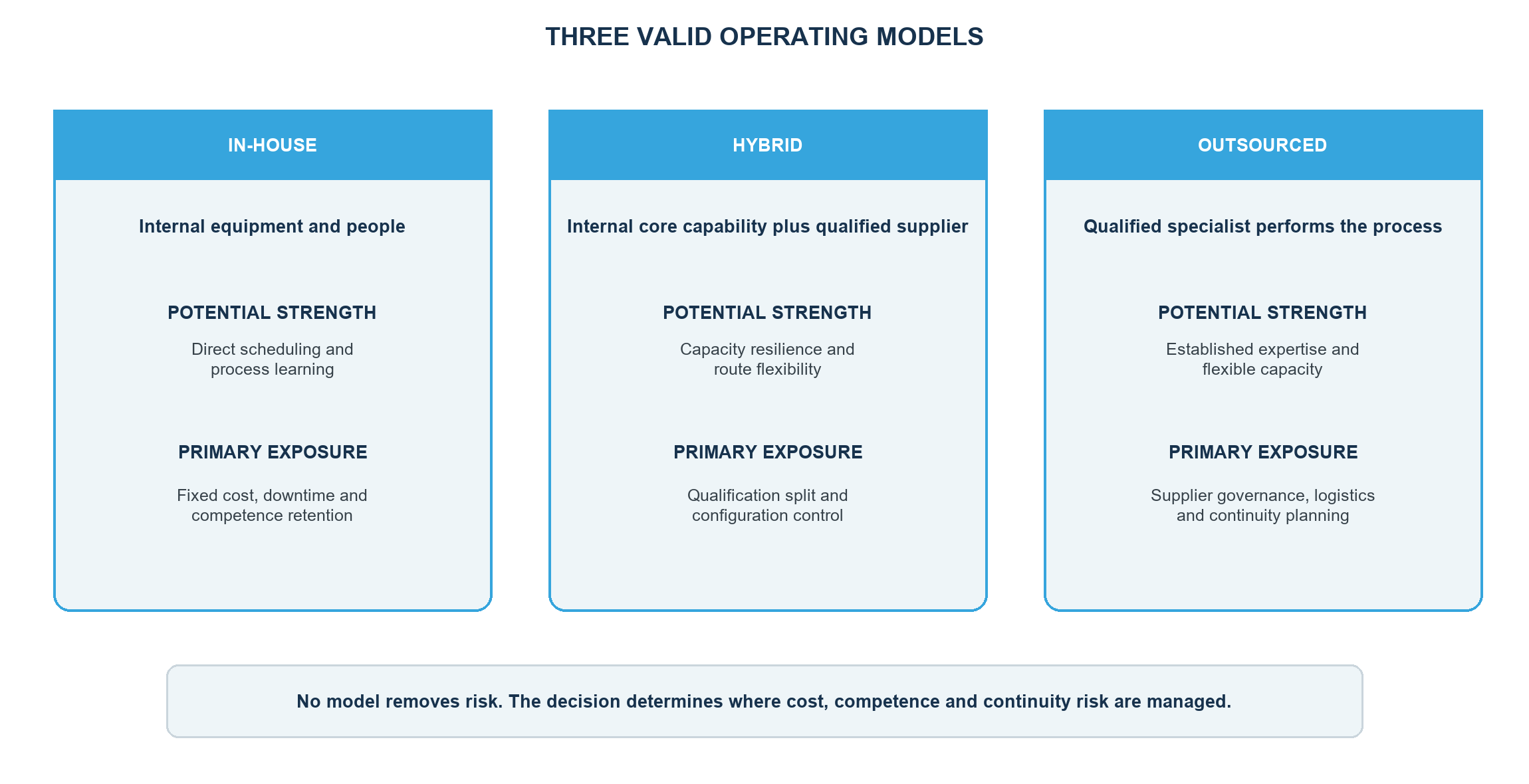
The decision is not simply whether to buy a machine or a service. It is where to place responsibility for equipment, process development, competent personnel, media and Almen control, coverage acceptance, maintenance, records, qualification, capacity and continuity. In-house, hybrid and outsourced models can all be valid when assessed against the same component scope, demand pattern, approval route and lifecycle risk.
Why does shot peening require more than a machine?
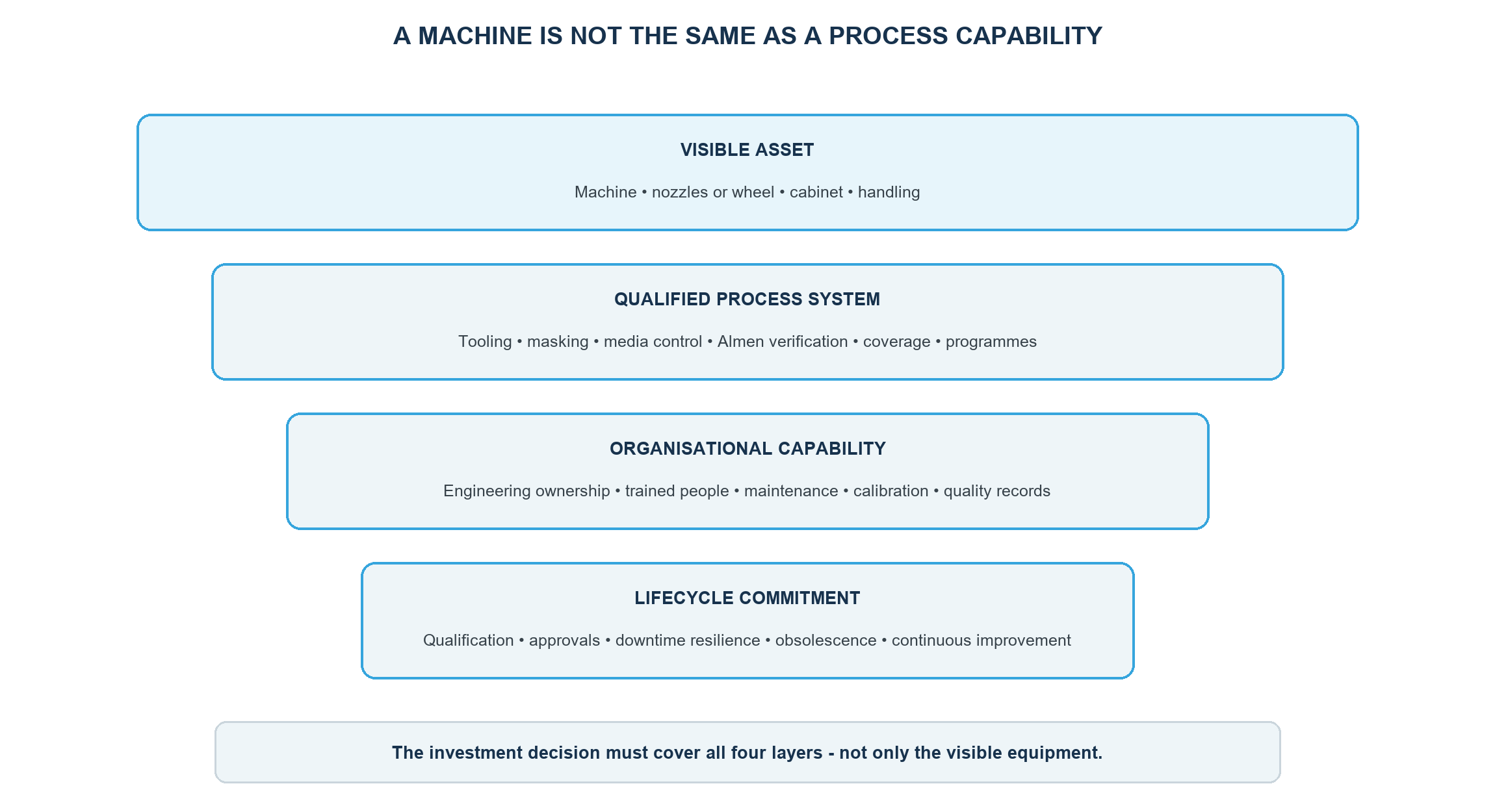
A capable installation is only one element of controlled shot peening. The organization also needs released requirements, qualified tooling and programs, controlled media, Almen-intensity verification, coverage assessment, competent operators and inspectors, calibration, maintenance, traceability, nonconformance control and change governance.
Computer monitoring can strengthen observation and traceability of defined inputs, but it does not create the process specification, prove component coverage, validate fatigue performance or replace engineering approval.
How do the operating models compare?
| Decision area | In-house | Hybrid | Outsourced |
|---|---|---|---|
| Capability ownership | Manufacturer owns equipment, people, process documentation and daily control | Approved work is divided between internal and external routes | Specialist processor owns the operating capability within the contract |
| Capital and launch | Equipment, infrastructure, tooling, development and qualification funded internally | Selective investment plus supplier qualification and route duplication | Supplier price includes capability access; customer funds any part-specific introduction |
| Competence | Internal engineering, production, inspection and maintenance competence required | Competence needed to govern both routes and their equivalence | Customer retains technical governance; supplier provides process competence |
| Capacity | Direct scheduling control within installed constraints | Load can be allocated between approved routes | Depends on contracted capacity, batch planning and supplier priorities |
| Change control | Internal changes still require controlled technical and customer review | Changes and equivalence across both routes require coordination | Supplier changes require notification and approval as invoked |
| Continuity | Exposure to internal single points of failure unless redundancy is funded | Can provide resilience when routes are genuinely qualified | Exposure to supplier, logistics and external-capacity risk |
Table 1. Each model changes where capability and risk sit; it does not remove the need for technical control.
When does an in-house route make sense?
In-house capability may be attractive when demand is stable and sufficient, lead time is strategically sensitive, geometry and product families are repeatable, proprietary integration matters, competent staff can be retained, and the organization can fund qualification, maintenance and redundancy. The business case should include realistic utilization and planned downtime rather than assuming continuous productive use.
Internal processing does not remove customer approval, specification, audit or requalification obligations. A change to equipment, tooling, media, program, motion, acceptance method or site can still require technical review and formal approval.
When does outsourcing make sense?
Outsourcing can be effective for variable demand, multiple media or geometries, low utilization, specialized expertise, faster access to established infrastructure or avoidance of capital investment. It can also support prototypes, overflow, difficult features or a continuity route.
The manufacturer still owns the responsibilities assigned by the design, contract and supplier-control system. It must define the requirement, qualify the supplier, approve the route, control changes, review records and respond to nonconformance. Outsourcing transfers execution—not every engineering or quality decision.
When is a hybrid model useful?
A hybrid model uses approved internal and external routes for defined scopes. It may support capacity peaks, specialist features, geographic resilience, maintenance periods or a staged make-or-buy strategy. The routes need not use identical equipment, but their applicability and approval basis must be explicit.
Do not assume that similar Almen intensity and coverage values make routes interchangeable. Equipment configuration, media, geometry, motion, tooling, surface result and customer approval can differ. Any transfer or split requires controlled qualification and change review.
How should lifecycle cost be compared?
| Lifecycle-cost element | In-house questions | Outsourcing questions |
|---|---|---|
| Introduction | Equipment, facility, utilities, tooling, trials, qualification and approval | Feasibility, tooling, trials, supplier qualification and customer approval |
| Recurring production | Labour, media, masking, maintenance, calibration, inspection and records | Batch charges, unit processing, masking, records, packaging and transport |
| Capacity | Utilization, bottlenecks, overtime, maintenance windows and growth | Minimum batches, reserved capacity, expedite terms and forecast commitment |
| Quality and change | Internal nonconformance, requalification, audit and document control | Supplier surveillance, escapes, changes, source approval and requalification |
| Continuity | Spares, backup equipment, competent personnel and disaster recovery | Second source, logistics alternatives, supplier financial and operational resilience |
| Exit and transition | Asset life, redeployment, obsolescence and shutdown cost | Tooling ownership, data access, transfer rights and route requalification |
Table 2. Lifecycle comparison includes introduction, recurring work, capacity, quality, continuity and exit—not only machine rate or supplier unit price.
Use the same volume, batch cadence, process scope, evidence, service level and approval assumptions for both models. Include the cost of idle capacity, specialist recruitment, training, media management, preventive maintenance, calibration, audits, requalification, nonconformance, logistics and working capital.
What process control remains when work is outsourced?
- Controlled drawing, revision, specifications and customer clauses.
- Defined treatment and exclusion zones, complete intensity and coverage requirements, and proposal authority.
- Supplier and site qualification, customer approval and applicable accreditation verification.
- Approved process route, tooling, samples and component validation where required.
- Purchase-order flow-down, records, traceability, retention and release criteria.
- Nonconformance, deviation, change-notification and requalification rules.
- Performance, capacity, continuity and periodic supplier review.
Which risks move under each model?
In-house processing concentrates capital, staffing, maintenance, utilization and internal single-point-of-failure risk. Outsourcing increases dependency on supplier capacity, logistics, external changes, communication and source continuity. A hybrid model can reduce some capacity risk but adds the complexity of governing two qualified routes.
Risk should be assigned to the party able to control it, with a defined decision authority and evidence. Commercial allocation does not override design or regulatory responsibility.
What decision sequence should management use?
- Define the component families, requirements, risk and forecasted batch pattern.
- Establish route feasibility, required equipment, media, tooling, controls and competence.
- Identify customer approvals, qualification evidence and change constraints.
- Model lifecycle cost under realistic utilization, service and continuity assumptions.
- Assess capacity, lead time, single points of failure and recovery options.
- Compare in-house, outsourced and hybrid scenarios on the same baseline.
- Approve the operating model, ownership, implementation plan and review triggers.
What should be sent to SP Center for an outsourcing review?
Send the current drawing and revision, material condition, marked treatment and exclusion zones, governing requirements, part dimensions and mass, quantities and batch cadence, required evidence, packaging, delivery targets and any intended backup-source role to [email protected]. SP Center can return assumptions and clarification points tied to the proposed external scope.
Common misconceptions
- Owning a machine is not the same as owning a qualified capability.
- Outsourcing does not remove design or supplier-governance responsibility.
- Annual volume alone does not determine the best operating model.
- A second route is not a backup until it is authorized, qualified and usable.
- The lowest unit rate is not necessarily the lowest lifecycle cost.
Frequently asked questions
Is outsourced shot peening more expensive than in-house processing?
Not inherently. Compare complete lifecycle cost and risk on the same demand and approval basis. Low utilization, qualification, maintenance and specialist staffing can dominate in-house cost; batches, logistics and supplier margins affect outsourcing.
What production volume justifies in-house shot peening?
There is no universal threshold. The decision depends on batch pattern, route complexity, utilization, equipment redundancy, competence, qualification, evidence, lead-time sensitivity, capital cost and continuity risk.
Does outsourcing reduce the manufacturer’s responsibility?
No. The manufacturer or design authority retains the contractual, design and supplier-governance responsibilities assigned by the governing documents. The processor is responsible for executing and documenting the approved scope.
Is a computer-monitored machine enough for an in-house launch?
No. A launch also requires controlled requirements, qualified equipment and tooling, media control, Almen and coverage systems, competent personnel, maintenance, calibration, traceability, nonconformance control, validation where invoked and customer approval.
When is a hybrid model useful?
It can support peaks, specialist geometries, business continuity or phased insourcing when both routes are authorized, qualified and governed. Two nominally similar routes are not automatically interchangeable.
What should an outsourcing quotation include?
It should separate part-specific introduction, tooling, batch-level work, recurring processing, records, testing, packaging and logistics, and state assumptions, exclusions, capacity, lead-time basis, change rules and tooling ownership.
How quickly can an outsourced route be qualified?
There is no universal duration. Drawing readiness, access, tooling, trials, samples, validation, customer decisions, supplier approval and external testing can determine the critical path.
Key takeaways
- Compare capability ownership and risk, not only machine time and unit price.
- Include qualification, competence, maintenance, records and continuity in the business case.
- Use identical technical and demand assumptions for every scenario.
- Keep customer, design and supplier-governance responsibilities explicit.
- Qualify every route and control transfers or changes before production use.
Related SP Center guides
- How to Source Shot Peening Services
- How to Choose a Shot Peening Supplier
- How Much Does Shot Peening Cost?
Technical references
1. SAE ARP7488: Peening Design and Process Control Guidelines, issued January 2018
2. SAE AMS2430U: Shot Peening, revised April 2018
3. SAE AMS2432E: Shot Peening, Computer Monitored, revised October 2022
4. Performance Review Institute, Nadcap
Standards note: The complete revisions invoked by the contract and customer requirements govern.
Author: Paweł Kmieć
Discuss an outsourcing or backup-source review: +48 519 772 773 | [email protected]